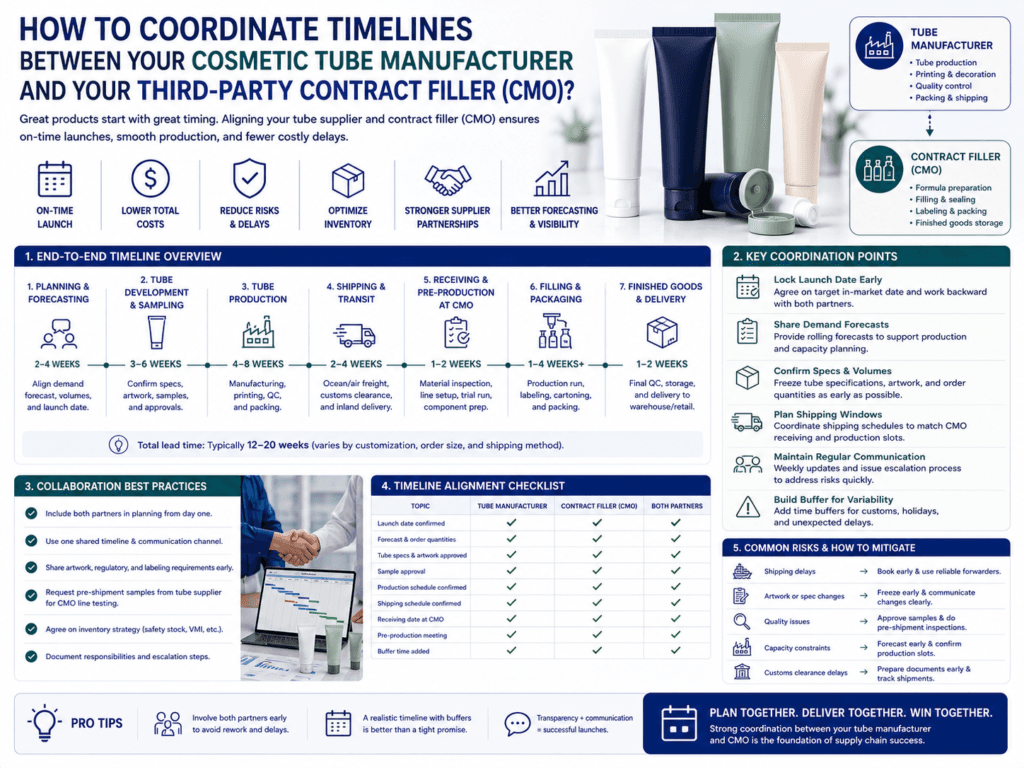
To coordinate timelines between a cosmetic tube manufacturer and a third-party contract filler, or CMO, brands should create one shared project schedule that links packaging approval, formula readiness, filling-line trials, tube production, freight, incoming inspection, filling, stability release, and final product delivery.
The tube manufacturer and CMO should not manage separate schedules without clear dependencies. A delay in artwork approval, tube compatibility testing, cap selection, formula scale-up, filling-line setup, or freight booking can stop the entire launch even when the other supplier is ready.
Quick Answer
The safest method is to plan backward from the required finished-product release date, identify every critical dependency, assign one owner to each milestone, include approval deadlines and buffer time, and require both suppliers to report progress against the same timeline.
| Milestone | Tube Manufacturer Responsibility | CMO Responsibility | Brand Responsibility |
|---|---|---|---|
| Packaging specification | Confirm tube structure, cap, orifice, dimensions, decoration, and feasibility | Confirm filling-machine, sealing, coding, and handling requirements | Approve final commercial and technical specification |
| Compatibility testing | Provide suitable samples and technical support | Fill, seal, store, and evaluate the actual formula | Approve test protocol and final package selection |
| Bulk tube production | Produce, inspect, pack, and ship approved tubes | Reserve filling capacity and prepare line tooling | Release purchase orders and approve changes quickly |
| Incoming inspection | Provide QC reports and traceability documents | Inspect received tubes before filling | Resolve deviations and release packaging for use |
| Filling and release | Support packaging-related troubleshooting | Fill, seal, code, inspect, pack, and release finished products | Approve finished goods and coordinate distribution |
Why Timeline Coordination Is Difficult
Custom cosmetic tubes and cosmetic formulas often develop at the same time. The formula may change viscosity, pH, color, filling temperature, or active ingredients after the tube design has already started. At the same time, the CMO may require final tube dimensions, tail length, cap orientation, and machine samples before reserving production capacity.
Packaging Dependency
The CMO cannot complete filling-line setup until the tube diameter, length, cap, orientation mark, and tail-seal area are confirmed.
Formula Dependency
The tube manufacturer cannot recommend the final material, barrier, orifice, or cap without knowing the formula’s viscosity and compatibility risks.
Artwork Dependency
The tube factory cannot start custom printing until the brand approves the dieline, legal text, barcode, Pantone colors, and decoration instructions.
Capacity Dependency
The CMO and tube factory may both require reserved production slots, so delays can push the project into the next available manufacturing window.
Start With the Finished-Product Delivery Date
Build the project plan backward from the date finished products must arrive at the warehouse, retailer, distributor, or launch market. Do not use the tube order date as the starting point.
| Backward-Planning Stage | Planning Question |
|---|---|
| Finished goods required | When must the saleable product arrive at the final warehouse? |
| Finished-goods transport | How long are freight, customs, warehouse receiving, and distribution? |
| CMO release | When must filling, QC, batch documentation, and release be completed? |
| CMO filling slot | When must tubes, caps, formula, labels, cartons, and batch instructions be available? |
| Packaging delivery | When must the tube manufacturer deliver approved tubes to the CMO? |
| Tube production | When must the PPS, artwork, deposit, and production release be completed? |
| Compatibility approval | When must formula-filled testing be complete to avoid changing the package later? |
Typical End-to-End Timeline
A standard custom tube project may use 7–10 working days for sample development and 25–35 days for mass production after approval. However, the total launch timeline is longer because formula testing, freight, incoming inspection, CMO scheduling, filling, and finished-goods release must also be included.
| Project Stage | Typical Planning Range | Main Dependency |
|---|---|---|
| Specification alignment | 3–7 working days | Formula details, tube size, cap, filling line, target market |
| Digital layout proof | 1–3 working days per approval round | Final artwork, dieline, Pantone, legal text, barcode |
| Custom sample or PPS | 7–10 working days for many standard projects | Material, color, cap, printing, and decoration availability |
| Compatibility and filling trial | Project-specific | Real formula, CMO equipment, test protocol, stability requirements |
| Bulk tube production | 25–35 days after final approval for many projects | Approved PPS, purchase order, deposit, raw materials, production slot |
| International transport | Depends on air, courier, rail, sea, customs, and local delivery | Carton data, freight booking, export documents, importer readiness |
| CMO incoming QC and filling | Depends on CMO schedule and batch size | Packaging release, bulk formula, line setup, components, batch documents |
Planning note: A 25–35-day tube production lead time does not mean the finished cosmetic product can launch within 25–35 days. The project must also include samples, formula compatibility, transport, receiving, filling, batch release, and finished-goods logistics.
1. Arrange a Three-Party Technical Kickoff
The brand, tube manufacturer, and CMO should hold a technical kickoff before approving the final packaging. The meeting should resolve both packaging-manufacturing and filling-line requirements.
- Formula: Viscosity, density, pH, oils, alcohol, fragrance, actives, particles, and filling temperature.
- Tube: Capacity, diameter, length, material structure, wall thickness, headspace, and tail-sealing allowance.
- Closure: Screw cap, flip-top cap, nozzle, orifice, pump, rollerball, applicator, liner, and torque.
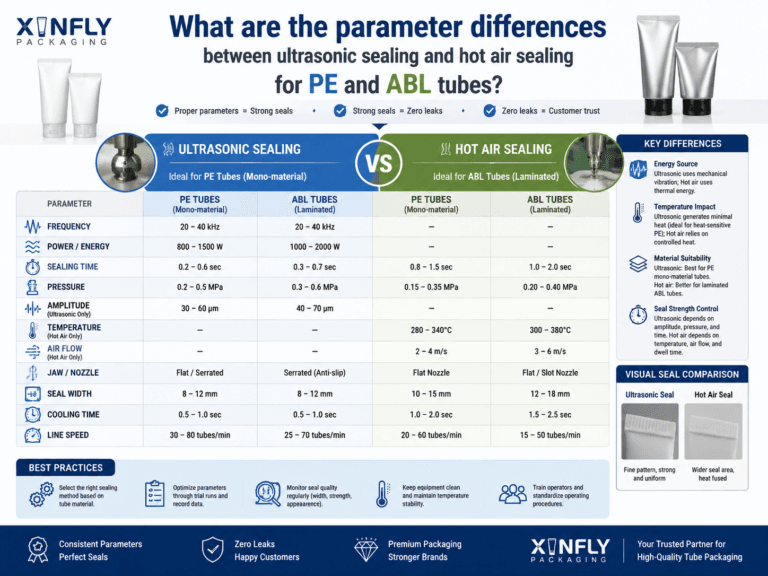
- Filling line: Tube loading, orientation, filling nozzle, sealing method, coding area, and production speed.
- Testing: Formula compatibility, leakage, drop, compression, dispensing, torque, and printing adhesion.
- Schedule: Approval deadlines, sample quantities, production slots, transport mode, and contingency buffers.
2. Create a Shared Responsibility Matrix
Every milestone should have one responsible owner and a clear approval authority. Avoid milestones assigned only to “all parties,” because no one may act when a problem occurs.
| Task | Responsible | Approver | Consulted |
|---|---|---|---|
| Tube technical drawing | Tube manufacturer | Brand | CMO engineering team |
| Filling-line compatibility | CMO | Brand | Tube manufacturer |
| Artwork and legal text | Brand | Brand regulatory/marketing team | Tube manufacturer and CMO |
| Formula compatibility study | Brand or CMO laboratory | Brand quality team | Tube manufacturer |
| Bulk tube release | Tube manufacturer | Brand quality/procurement | CMO |
| Incoming tube inspection | CMO | CMO quality or brand quality | Tube manufacturer |
3. Lock the Packaging Specification Before Bulk Production
The tube manufacturer should not start mass production while critical CMO requirements remain unresolved. Final specifications should be documented in one controlled technical file.
| Specification Item | Tube Manufacturer Confirms | CMO Confirms |
|---|---|---|
| Tube diameter and length | Manufacturing tolerance and capacity | Machine holders, guides, and filling-line compatibility |
| Open-tail length | Available length after tube production | Required sealing and trimming allowance |
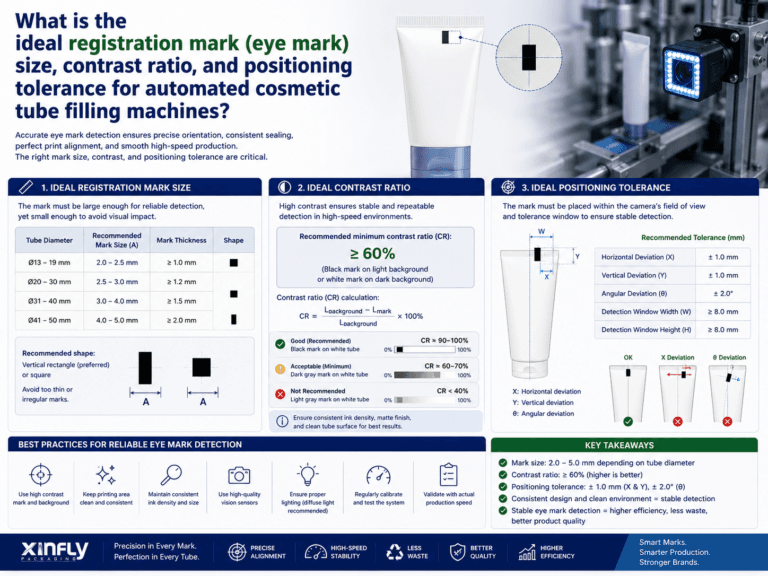
| Registration mark | Position, contrast, dimensions, and printing process | Sensor compatibility and orientation accuracy |
| Cap and neck | Thread, torque, plug, hinge, and leakage performance | Capping method, handling, and filling-line sequence |
| Orifice | Nominal diameter and tolerance | Formula flow, dosage, filling nozzle, and consumer use |
| Coding area | Printable or unprinted area | Batch code, date code, inkjet, laser, or embossing position |
4. Confirm the Formula Before Final Tube Selection
The brand should provide packaging-relevant formula information early. The full confidential formula may not be necessary, but the tube manufacturer and CMO need enough information to identify risks.
| Formula Information | Packaging Impact | CMO Impact |
|---|---|---|
| Viscosity | Tube softness, orifice size, cap design, and dispensing | Filling pump, nozzle, speed, and accuracy |
| Density | Tube volume required for a stated fill weight | Fill-weight setup and verification |
| Oil and fragrance content | Material migration, scalping, cap cracking, and barrier requirements | Cleaning, handling, and leakage risk |
| pH and active ingredients | Tube, cap, metal applicator, ink, and coating compatibility | Equipment-contact material and cleaning requirements |
| Filling temperature | Tube deformation, shoulder stability, and leakage risk | Filling process, cooling time, and line speed |
| Particles or shimmer | Orifice, nozzle, rollerball, and clogging risk | Filling nozzle diameter and product agitation |
5. Send Enough Samples for CMO Trials
A few presentation samples are not enough for filling-line validation. The CMO may need dozens or hundreds of tubes to set guides, feeders, orientation sensors, filling nozzles, sealing jaws, coding equipment, and inspection systems.
| Sample Purpose | Suggested Quantity Direction | Main Evaluation |
|---|---|---|
| Visual and dimensional review | 3–10 pcs | Size, artwork, cap, hand feel, and overall construction |
| Manual filling test | 10–30 pcs | Formula flow, headspace, leakage, dispensing, and sealing concept |
| Bench compatibility test | Quantity based on test conditions | Upright, inverted, hot, cold, and repeated-use testing |
| Pilot filling-line trial | 50–200 pcs or CMO-specific | Loading, orientation, filling, sealing, coding, and rejection rate |
| Commercial validation run | CMO-specific | Production speed, yield, quality, labor, and finished-goods performance |
6. Approve the Digital Proof Before PPS Production
The brand should complete legal, marketing, barcode, and artwork approval before the tube manufacturer prepares the PPS. Late artwork changes can require new screens, plates, hot-stamping dies, color trials, and samples.
- Confirm the correct tube dieline and print safe zone.
- Approve front and back artwork orientation.
- Confirm the registration mark required by the CMO.
- Keep coding and tail-sealing areas clear.
- Confirm Pantone colors and physical color references.
- Approve barcode size, quiet zone, and printing contrast.
- Freeze the artwork revision before sample production.
7. Do Not Release Bulk Tubes Before PPS and Line Approval
A PPS should confirm the physical tube, while the CMO trial confirms manufacturing usability. For higher-risk projects, both approvals should be complete before bulk tube production begins.
Recommended Production Release Gate
Artwork approved: Final digital layout, legal text, barcode, colors, and decoration are signed.
PPS approved: Tube material, dimensions, cap, printing, finish, and appearance are accepted.
Compatibility approved: The actual formula does not create leakage, swelling, cracking, odor, or dispensing problems.
CMO line approved: The tube can be loaded, oriented, filled, sealed, coded, and inspected using the intended equipment.
Commercial release approved: Purchase order, quantity, schedule, packing, freight, QC standard, and delivery location are confirmed.
8. Reserve the CMO Filling Slot Early
CMOs often schedule production weeks or months in advance. The brand should tentatively reserve the filling slot before bulk tubes are complete, then confirm it after the tube manufacturer provides a reliable factory-ready date.
| CMO Booking Stage | Recommended Action |
|---|---|
| Initial forecast | Share expected batch size, product type, tube format, and target filling month |
| Provisional slot | Reserve capacity based on the tube manufacturer’s production estimate |
| Confirmation point | Confirm after PPS approval, material readiness, and production start |
| Final readiness review | Verify tubes, formula, cartons, labels, batch records, and staff availability |
| Contingency slot | Where possible, identify the next available slot if tubes or formula arrive late |
9. Add Buffer Between Tube Delivery and Filling
Do not schedule filling for the same day the tubes are expected to arrive. The CMO needs time for warehouse receiving, quantity verification, incoming inspection, quarantine, sample testing, documentation review, and line staging.
- Allow time for customs clearance if the tubes are imported.
- Allow time for warehouse receiving and pallet checking.
- Allow time for incoming AQL or dimensional inspection.
- Allow time to resolve damaged cartons or quantity differences.
- Allow time for tube acclimatization if temperature or humidity differs significantly.
- Allow time to prepare the filling line, guides, jaws, coding, and change parts.
10. Separate Factory-Ready Date From CMO-Ready Date
The date the tube manufacturer finishes production is not the same as the date the CMO can use the tubes. The shared schedule should distinguish every handoff.
| Date | Meaning |
|---|---|
| Tube production completion | Manufacturing and decoration are complete |
| QC release date | Tubes have passed final inspection and functional tests |
| Factory-ready date | Tubes are packed and available for pickup |
| Shipment departure date | Cargo leaves the origin factory, airport, port, or forwarder warehouse |
| CMO delivery date | Cargo arrives at the contract filler |
| CMO packaging release date | Incoming QC and documentation review are complete |
| Filling start date | Tubes are issued to the production line |
11. Define Incoming Inspection at the CMO
The CMO should inspect tubes before they enter production. The brand, tube manufacturer, and CMO should agree on the inspection method to avoid inconsistent standards.
| Incoming Check | What to Verify |
|---|---|
| Quantity and identity | SKU, artwork, batch, carton count, and pieces received |
| Dimensions | Diameter, length, neck, orifice, open-tail length, and wall thickness where required |
| Appearance | Color, printing, hot stamping, coating, scratches, dents, and contamination |
| Cap function | Thread fit, torque, hinge, plug seal, snap closure, and cap orientation |
| Filling functionality | Tube feeding, orientation mark, tail sealing, coding position, and machine handling |
| Documents | COA, conformity statement, AQL report, material declaration, and approved specification |
12. Create a Deviation-Approval Process
Minor differences can stop a CMO from using the tubes if there is no authorized deviation process. The contract should define who can approve a temporary deviation and what technical evidence is required.
- Describe the deviation with measurable data and photographs.
- Identify the affected batch and quantity.
- Confirm whether filling, sealing, leakage, or saleability is affected.
- Obtain written approval from the brand and CMO quality teams.
- Define whether the deviation is one-time or changes the specification.
- Require corrective action before the next production lot.
- Keep deviated materials traceable through finished-product release.
13. Plan for Tube Production Overrun and Filling Loss
The ordered number of empty tubes should be higher than the exact number of finished products required because samples, setup, QC, filling loss, damaged components, and line rejects consume packaging.
| Loss Source | Examples |
|---|---|
| Tube manufacturer QC | Retention samples, dimensional checks, printing setup, and destructive tests |
| Freight and receiving | Damaged cartons, missing pieces, contamination, or handling damage |
| CMO line setup | Machine adjustment, fill-weight setup, seal testing, and coding setup |
| Production rejects | Underfill, overfill, poor seal, damaged cap, code rejection, and appearance failure |
| Quality retention | Finished-product stability, retention, laboratory, and customer samples |
14. Coordinate Tube Packing With CMO Handling
The most freight-efficient tube packing method may not be the most efficient for the filling line. Both parties should approve carton quantities, inner bags, tube orientation, cap assembly status, pallet height, and unpacking method.
| Packing Decision | Tube Manufacturer Concern | CMO Concern |
|---|---|---|
| Caps assembled or separate | Freight density, cap protection, and packing labor | Assembly equipment, labor, contamination, and line sequence |
| Tubes per carton | CBM, carton strength, and tube protection | Handling weight, count verification, and production usage |
| Inner bags | Cleanliness and abrasion protection | Controlled opening and transfer into the filling area |
| Tube orientation | Packing density and printing protection | Ease of loading and orientation on the line |
| Palletization | Container utilization and transport safety | Warehouse equipment, pallet size, and storage layout |
15. Monitor a Shared Critical Path
The critical path is the sequence of tasks that directly controls the final launch date. A delay in any critical-path milestone delays the full project unless recovery action is taken.
Typical Cosmetic Tube Project Critical Path
Formula specification → tube recommendation → digital proof → PPS → formula compatibility → CMO filling trial → bulk tube approval → tube production → final QC → freight → CMO incoming inspection → filling → finished-goods QC → release → distribution.
16. Use Weekly Status Reports
Both suppliers should report progress in the same format. A useful report focuses on milestones, decisions, risks, and recovery actions—not only a general statement that production is “on schedule.”
| Status Item | Required Update |
|---|---|
| Milestone status | Not started, in progress, completed, delayed, or blocked |
| Planned vs. actual date | Original date, latest forecast, and number of days changed |
| Blocking issue | Exact technical, commercial, material, or approval problem |
| Required decision | What approval is needed, from whom, and by what date |
| Recovery action | Overtime, alternate material, earlier freight, partial shipment, or backup slot |
| Critical-path impact | Whether the launch date is protected or at risk |
17. Add Schedule Buffers for High-Risk Projects
Projects with custom molds, metal applicators, PCR materials, EVOH structures, ABL or PBL tubes, premium decoration, multiple artworks, regulated formulas, or international sea freight need larger buffers.
| Project Risk | Recommended Buffer Direction |
|---|---|
| Standard PE tube with stock cap | Normal approval, production, freight, and receiving buffer |
| Custom body and cap colors | Add time for color trials and approval rounds |
| Five-layer EVOH tube | Add material scheduling and compatibility buffer |
| Metal applicator or rollerball | Add component supply, assembly, leakage, and compatibility buffer |
| Custom mold | Add tooling, mold trial, correction, and requalification buffer |
| Ocean freight | Add booking, port, customs, and local-delivery buffer |
18. Prepare Recovery Options Before Delays Occur
- Partial shipment: Send enough tubes for the first filling batch while the remaining quantity follows.
- Airfreight recovery: Air-ship a limited quantity to protect the filling slot or launch.
- Alternate CMO slot: Identify the next available production window.
- Standard-cap substitute: Prequalify a functionally compatible backup closure where branding allows.
- Alternative tube material: Validate a backup material before disruption, not during it.
- Backup tube supplier: Qualify a second source using the same drawings and CMO requirements.
- Launch split: Prioritize the most important SKU or market when components are limited.
19. Common Timeline Mistakes
- Booking the filler before approving the tube: The filling slot may be lost if packaging fails testing.
- Ordering tubes before final formula confirmation: A viscosity or ingredient change may require another orifice, material, or cap.
- Sending only a few samples to the CMO: The filler cannot complete a reliable line trial.
- Starting bulk production after digital proof only: Physical fit, compatibility, and filling performance remain unverified.
- Using factory completion as the delivery date: Freight, customs, receiving, and inspection are excluded.
- Scheduling filling immediately after expected arrival: No time remains for incoming inspection or customs delay.
- Not including packaging overrun: The CMO may run out of tubes before the target quantity is filled.
- Allowing separate schedules: The tube factory and CMO may each appear on time while the overall launch is late.
20. Procurement and Project Checklist
| Check Item | Question to Confirm |
|---|---|
| Final required date | When must finished goods arrive at the sale or distribution location? |
| Formula readiness | Is the formula stable enough for packaging compatibility testing? |
| CMO technical requirements | Are tube dimensions, registration marks, sealing allowance, and coding area confirmed? |
| Sample quantity | Has the CMO specified enough tubes for its filling trial? |
| Production approvals | Are the digital proof, PPS, compatibility, and filling-line trial approved? |
| Tube production slot | Has the manufacturer reserved materials, caps, printing, and machine capacity? |
| CMO filling slot | Is the slot provisional or confirmed, and what is the cancellation deadline? |
| Freight plan | Are the transport mode, forwarder, customs documents, and buffer confirmed? |
| Incoming QC | How many days does the CMO require to inspect and release the packaging? |
| Recovery plan | What happens if tubes, formula, artwork, or filling capacity are delayed? |
Best Practical Recommendation
Create one shared master schedule managed by the brand or designated project manager. The timeline should show every milestone, responsible party, approval owner, planned date, actual date, buffer, and dependency. Both the cosmetic tube manufacturer and CMO should receive the same updated schedule.
For standard custom printed tubes, plan approximately 7–10 working days for samples and 25–35 days for mass production after final approval, then add compatibility testing, freight, customs, incoming QC, filling, batch release, and finished-goods transport. More complex packages should receive additional schedule buffer.
Summary
Coordinating a cosmetic tube manufacturer and CMO requires backward planning from the finished-product delivery date. The brand should connect formula development, packaging approval, line testing, tube production, transportation, receiving, filling, and product release in one shared schedule.
The most important controls are a three-party kickoff, clearly assigned responsibilities, final technical specifications, sufficient CMO trial samples, PPS and compatibility approval before bulk production, early filling-slot reservation, realistic delivery buffers, incoming inspection time, weekly reporting, and a preapproved delay-recovery plan.
Learn more: Custom Printed Cosmetic Tube Lead Time, Tube Filling and Sealing Line Parameters, PPS vs. Digital Layout Proof, Request Samples for Compatibility Testing, Sample Development, Quality Assurance.
Need Tubes That Match Your CMO Filling Schedule?
Xinfly Packaging helps beauty brands coordinate tube specifications, samples, PPS approval, filling-line trials, cap compatibility, production lead times, quality inspection, export packing, and delivery schedules with third-party contract fillers.