

Quick Answer
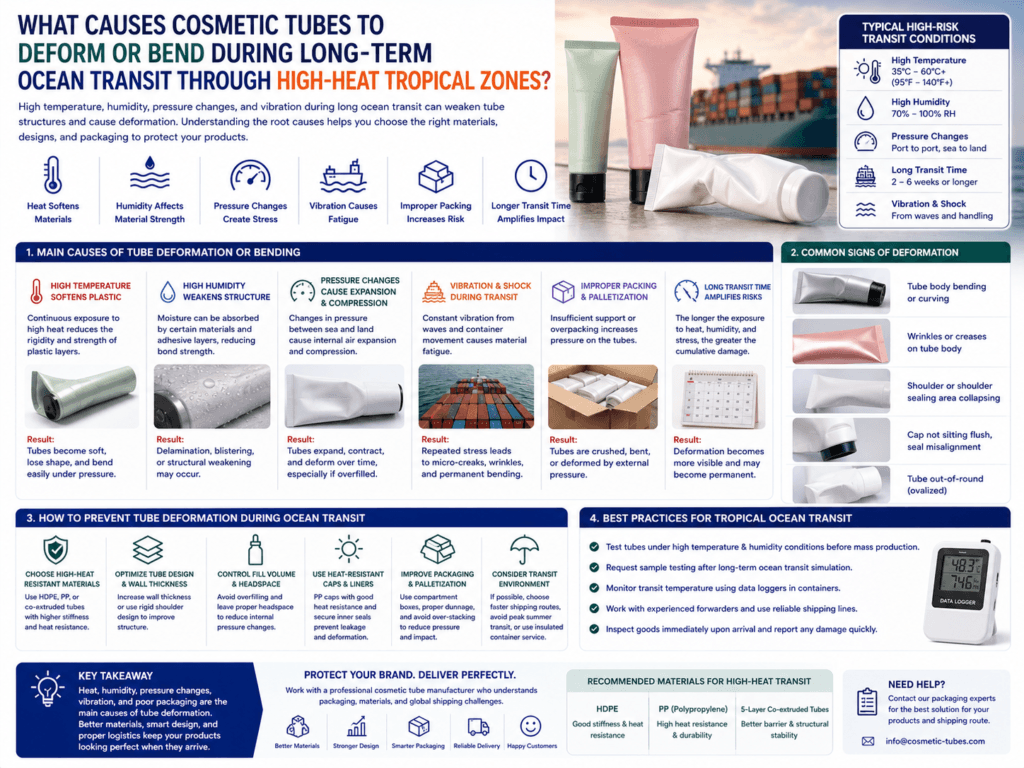
Cosmetic tubes usually deform or bend during long-term tropical ocean transit because elevated container temperatures soften the plastic while continuous carton and pallet pressure causes gradual polymer creep.
The risk becomes higher when tubes have thin or uneven walls, an excessively soft PE formulation, a long unsupported body, heavy caps or applicators, tight carton packing, weak corrugated cartons, poor pallet stacking or prolonged port delays.
Empty cosmetic tubes may appear straight and dimensionally stable when they leave the factory but arrive at the contract filler curved, flattened, dented or oval. This is more likely on ocean routes passing through hot tropical regions or when containers remain exposed to direct sunlight at ports and transshipment terminals.
Heat is usually not the only cause. Most deformation failures result from the combined influence of temperature, exposure time, mechanical load, tube construction, closure weight and export-packing design.
Why Do High-Heat Ocean Routes Increase Deformation Risk?
Cosmetic tubes are commonly produced from LDPE, LLDPE, HDPE, PCR polyethylene or multilayer PE structures. These materials do not need to reach their melting temperatures before becoming softer.
As the surrounding temperature increases, the tube body loses part of its short-term rigidity. If the softened tube remains compressed between neighboring tubes or beneath stacked cartons for several weeks, it may slowly change shape.
Factory Engineer Explanation
This gradual dimensional change is commonly described as polymer creep. A pressure level that causes almost no visible damage during a short room-temperature inspection may produce permanent bending after several weeks of elevated temperature.
The correct engineering question is therefore not only, “Can the tube tolerate heat?” It is, “Can the complete tube, closure, carton and pallet system tolerate heat and sustained mechanical load for the full shipping period?”
What Are the Main Causes?
High Container Heat
Elevated temperature reduces tube stiffness and makes PE more sensitive to continuous pressure.
Long Exposure Time
Small temporary dimensional changes can become permanent after several weeks under load.
Thin Tube Walls
Insufficient wall strength allows large body areas to flatten, lean or lose roundness.
Tight Carton Packing
Overpacked cartons continuously squeeze tubes and leave little space for shape recovery.
Weak Export Cartons
Humidity can reduce corrugated-board strength and transfer stacking pressure to the tubes.
Heavy Closures
Metal applicators, airless pumps and oversized caps can create uneven loading and localized bends.
1. The PE Resin Structure Is Too Soft
A cosmetic tube manufacturer normally combines different polyethylene grades to balance softness, squeeze recovery, sealing performance, impact resistance and body rigidity.
A structure optimized only for a luxurious soft squeeze may not provide enough stiffness for several weeks of hot ocean transportation.
| Material Factor | Possible Transit Effect | Recommended Adjustment |
|---|---|---|
| High LDPE content | Provides softness but may reduce structural rigidity | Rebalance the structure with a suitable stiffer PE grade |
| High LLDPE content | Improves flexibility but may make the body highly pliable | Optimize the complete layer composition rather than softness alone |
| Controlled HDPE content | Can improve stiffness and dimensional stability | Use a suitable percentage without making the tube difficult to squeeze |
| Variable PCR feedstock | May introduce changes in stiffness, shrinkage and recovery | Use controlled PCR sources and validate each final structure |
| Unapproved material substitution | Production tubes may perform differently from the approved sample | Require documented material change control |
2. The Tube Wall Is Too Thin or Uneven
Reducing tube-wall thickness can lower plastic consumption and unit cost, but it also reduces resistance to external compression. Large-diameter and high-capacity tubes are particularly vulnerable because they have larger unsupported body areas.
Wall thickness should be selected according to:
- Tube diameter and total body length.
- Nominal filling capacity and expected headspace.
- PE resin composition and multilayer structure.
- Cap, pump or applicator weight.
- Required consumer squeeze performance.
- Pieces packed into each export carton.
- Expected shipping route and transit duration.
Important: Average wall thickness alone is not sufficient. One side of the tube may be substantially thinner than the other, causing the weaker side to collapse first. The specification should include minimum wall thickness and measurements at several circumferential points.
3. The Tube Is Too Long for Its Diameter
Long, narrow tubes usually bend more easily than shorter tubes made from the same material. During horizontal transportation, a long unsupported body can act like a flexible column and gradually curve under diagonal carton pressure.
| Tube Geometry | Relative Risk | Main Engineering Concern |
|---|---|---|
| Short, small-diameter tube | Generally lower | Short unsupported body provides better stability |
| Long, narrow tube | Medium to high | Body may curve under diagonal or concentrated loading |
| Large-diameter tube | High when walls are too thin | Wide body panels are vulnerable to flattening and ovalization |
| Large-capacity tube | Medium to high | Requires balanced wall stiffness and stronger carton support |
In some projects, a shorter tube with a slightly larger diameter can provide the same filling capacity with better shipping stability. The final dimension must still allow sufficient formula headspace and tail-sealing area for the CMO.
4. Heavy Caps and Applicators Pull the Tube Sideways
Standard lightweight PP caps usually create limited stress. However, zinc-alloy massage heads, metal cooling applicators, airless pumps, rollerball heads and oversized decorative caps can substantially change the package’s center of gravity.
When packed horizontally, these components may pull the tube body to one side or press into adjacent tubes.
| Closure or Applicator | Possible Problem | Recommended Protection |
|---|---|---|
| Standard screw cap | Usually low risk when properly aligned | Maintain controlled spacing between closures |
| Large flip-top cap | Cap edges can press against neighboring tube bodies | Use aligned packing and suitable clearance |
| Zinc-alloy applicator | Heavy head may bend the neck or tube body | Use trays, partitions or dedicated head supports |
| Airless pump | Asymmetric weight creates localized loading | Test the fully assembled package in its production carton |
| Rollerball head | Housing can create concentrated contact points | Prevent direct applicator-to-tube pressure |
5. Too Many Tubes Are Packed Into Each Carton
Increasing carton quantity may reduce shipping volume, but excessive packing density can place the tubes under compression before the shipment leaves the factory.
When the tubes soften during tropical transportation, they have no room to move or recover. Cap corners, shoulders and neighboring tubes may create permanent pressure marks.
- Do not force the final rows into an undersized carton.
- Avoid inner bags that are tied or sealed too tightly.
- Prevent cap edges from pressing into printed tube bodies.
- Allow controlled clearance without permitting excessive movement.
- Test the exact commercial carton quantity used for mass production.
6. Tubes Are Packed Diagonally or Randomly
Randomly packed tubes can settle into uneven positions during truck and vessel vibration. A cap may rest against another tube’s sidewall, while an open tail may slide underneath an adjacent shoulder.
When heat and carton pressure are added, these uneven contact points can create permanent bending.
| Packing Method | Benefit | Potential Risk |
|---|---|---|
| Parallel aligned packing | Provides consistent support and easier counting | Cap spacing must be properly designed |
| Alternating head-to-tail packing | May improve carton utilization | Uneven cap and shoulder heights may create pressure points |
| Random loose packing | Fast and inexpensive | Higher risk of diagonal loading and surface abrasion |
| Layered tray packing | Provides stronger positional support | Increases packing cost and carton volume |
| Individual sleeve packing | Protects premium finishes and applicators | Adds labor, material and freight volume |
7. Humidity Weakens the Corrugated Carton
Ocean transportation exposes shipping cartons to changing temperature, humidity and possible condensation. Corrugated board that performs well in a dry factory may lose compression strength in a humid container.
When lower cartons begin to buckle, the weight of upper cartons can transfer directly to the plastic tubes.
- Use export-quality corrugated cartons.
- Define a suitable board grade and flute structure.
- Control maximum carton gross weight.
- Protect cartons from wet warehouse and container floors.
- Evaluate compression strength after humidity conditioning.
- Use pallet patterns that support carton edges and corners.
8. Pallet Stacking Pressure Is Too High
Lower cartons may remain under load during factory storage, inland transport, port waiting, ocean transit and destination warehousing. Poor pallet design can magnify this pressure.
| Stacking Problem | Possible Result | Preventive Action |
|---|---|---|
| Excessive pallet height | High compression on lower cartons | Set a validated maximum number of carton layers |
| Carton overhang | Loss of edge support and carton collapse | Match the carton pattern to the pallet dimensions |
| Misaligned carton columns | Load passes through weaker carton panels | Use a controlled pallet stacking pattern |
| Heavy cargo above tube cartons | Additional crushing during container transport | Control the container-loading sequence |
| Overtight stretch film | Carton corners are pulled inward | Control wrapping tension and use corner protectors |
9. Residual Manufacturing Stress Has Not Stabilized
Extrusion, heading, molding, rapid cooling, printing, coating and cap assembly can leave residual stress inside plastic components. Tropical heat may allow this internal stress to relax, causing twisting, shrinkage or dimensional change.
The factory should control:
- Extrusion temperature and cooling conditions.
- Die centering and wall-thickness distribution.
- Heading and shoulder-forming parameters.
- Cap molding and cooling time.
- Ink, varnish and coating curing conditions.
- Conditioning time before final packing.
10. Tubes Are Packed Before They Fully Cool
If tubes are packed immediately after extrusion, heading, printing, coating or hot stamping, residual heat may remain in the components.
Tightly packing warm tubes can lock them into curved, compressed or oval positions before ocean transportation even begins. The manufacturer should define an appropriate cooling and conditioning period before sealing the cartons.
11. Matte, Soft-Touch or Foil Decoration Changes Surface Friction
Surface decoration can affect how tubes move against each other. Soft-touch coating and some matte finishes may create more friction than an untreated glossy PE surface.
Instead of sliding slightly to release stress, decorated tubes may remain locked together under heat and pressure.
| Surface Treatment | Potential High-Heat Risk | Recommended Control |
|---|---|---|
| Glossy finish | Scratching and rubbing | Use clean inner bags and limit movement |
| Matte finish | Scuffing and visible pressure marks | Use layer sheets where necessary |
| Soft-touch coating | Blocking, sticking or gloss change | Conduct packed heat-aging tests |
| Hot-stamping foil | Scratching, cracking or foil transfer | Prevent direct foil-to-cap or foil-to-foil pressure |
| Full-body label | Bubbling, lifting or restricted tube recovery | Validate the adhesive and label under heat and compression |
12. PCR Tube Performance Has Not Been Validated
PCR cosmetic tubes can be suitable for international ocean transportation, but recycled polyethylene may introduce more variation in stiffness, shrinkage and recovery when the feedstock source is not tightly controlled.
A PCR structure that performs well in a short 30ml tube may not provide the same result in a long 200ml tube. The manufacturer should validate the complete package rather than approving the PCR percentage in isolation.
- PCR percentage and feedstock source.
- Combination of virgin and recycled resin.
- Tube diameter and total body length.
- Minimum wall thickness and distribution.
- Cap, pump or applicator weight.
- Printing and surface coating.
- Commercial carton and pallet configuration.
Do EVOH, ABL or PBL Tubes Resist Deformation Better?
Barrier performance and structural stiffness are separate requirements. Adding EVOH or changing to an ABL or PBL tube does not automatically eliminate transit bending.
| Tube Structure | Transit Consideration |
|---|---|
| Mono-layer PE | Shape retention depends heavily on resin selection, wall thickness and geometry |
| Two-layer PE | Allows separate inner and outer functions but still requires transit validation |
| Five-layer EVOH PE | Improves oxygen barrier, while stiffness depends on the complete layer design |
| PBL tube | Can provide good shape stability but may retain severe folds or creases |
| ABL tube | Offers strong barrier protection, but dents and sharp creases may remain visible |
How Should a Factory Test Tropical Transit Risk?
A room-temperature drop test alone cannot reproduce several weeks of tropical ocean transportation. Testing should evaluate the actual tube, closure, inner packaging, export carton and stacking load.
| Recommended Test | What It Evaluates |
|---|---|
| Elevated-temperature conditioning | Tube, cap and decoration behavior under prolonged heat |
| Loaded-carton aging | Polymer creep under the actual carton quantity and stacking pressure |
| Carton compression test | Resistance to pallet, warehouse and container stacking loads |
| Humidity conditioning | Reduction in corrugated-carton strength under moist conditions |
| Vibration test | Tube movement, settling, abrasion and diagonal loading |
| Carton drop test | Handling impacts affecting caps, shoulders and tube bodies |
| Recovery evaluation | Whether deformation disappears after unpacking or remains permanent |
Should Empty and Filled Tubes Be Tested Separately?
Yes. Empty and filled cosmetic tubes behave differently during transportation.
Empty tubes have almost no internal support and may collapse more easily under external pressure. Filled tubes may resist some flattening, but they create more carton weight and additional stress on the cap, shoulder, formula and tail seal.
- Test empty-tube export cartons for delivery from the tube factory to the CMO.
- Conduct a filling and sealing trial using the final production tube.
- Perform a separate finished-product distribution test after filling.
- Use the actual formula or a validated product simulant where appropriate.
Recommended Preventive Actions
What Should Buyers Include in the Purchase Specification?
| Specification Item | Recommended Requirement |
|---|---|
| Material structure | Approved resin grades, layer structure, PCR percentage and material change control |
| Tube dimensions | Diameter, length, neck, shoulder, orifice and dimensional tolerances |
| Wall thickness | Target and minimum values measured at defined body locations |
| Closure specification | Cap material, weight, thread fit, torque and applicator-support requirements |
| Carton configuration | Pieces per carton, tube orientation, inner bag, partitions and gross weight |
| Pallet configuration | Cartons per layer, maximum layers, pallet size and stretch-wrap controls |
| Transit validation | Heat, humidity, compression, vibration, drop and recovery-test requirements |
| Acceptance criteria | Maximum bow, ovality, dent depth, dimensional change and recovery period |
How Should Tube Deformation Be Inspected?
A quality agreement should use measurable acceptance criteria rather than stating only that tubes must be “straight” or “not deformed.”
- Measure maximum body bow against a straight reference line.
- Measure tube ovality at the upper, middle and lower body areas.
- Check whether the neck and closure remain properly centered.
- Confirm that tubes enter the CMO filling-machine puck or holder.
- Inspect permanent dents, sharp creases and localized pressure marks.
- Define whether a recovery period after unpacking is permitted.
- Confirm that recovered tubes remain suitable for decoration, filling and retail presentation.
Can Bent PE Tubes Recover After Unpacking?
Some PE tubes can partially recover when carton pressure is removed, particularly when the deformation remains within the elastic range of the material.
However, recovery depends on the resin structure, wall thickness, exposure temperature, compression time and severity of the bend. A tube that looks straighter after conditioning may still create problems during automatic feeding, orientation, filling or tail sealing.
Do not rely on visual recovery alone. The recovered tubes should also be checked for dimensional tolerances, machine compatibility, neck alignment and retail appearance.
Common Procurement Mistakes
- Testing loose tubes only: Loose samples do not reproduce real carton compression.
- Optimizing only for softness: A very soft tube may lack sufficient ocean-transit stiffness.
- Reducing wall thickness without testing: Small material savings can cause larger rejection costs.
- Testing a different tube size: Diameter and body length significantly affect deformation risk.
- Ignoring closure weight: Heavy applicators can bend an otherwise acceptable tube.
- Overpacking cartons to reduce CBM: Freight savings may be lost through damaged tubes.
- Using weak domestic cartons: Export cartons must tolerate humidity and prolonged stacking.
- Performing only room-temperature tests: Tropical heat changes both tube and carton behavior.
- Approving only the digital artwork: A production PPS should also confirm structure, dimensions and packing.
Factory Engineer Recommendation
Validate the Complete Shipping System
Do not evaluate the tube independently from the closure and export carton. The validation package should use the final tube material, exact diameter and length, production wall thickness, approved cap or applicator, final decoration, commercial carton quantity and pallet configuration.
Identify the Actual Root Cause
If deformation occurs, determine whether the main cause is insufficient tube stiffness, uneven wall thickness, excessive length, heavy closure loading, overpacked cartons, weak corrugated board or poor pallet stacking.
In many projects, the most reliable solution combines a moderate tube-structure adjustment with better carton support instead of making the tube excessively thick or difficult for consumers to squeeze.
Summary
Cosmetic tubes deform during long-term tropical ocean transit because high temperatures reduce plastic stiffness while continuous carton and pallet pressure causes gradual polymer creep.
The risk increases with thin or uneven walls, very soft PE blends, long tube bodies, wide unsupported panels, heavy applicators, tight packing, weak cartons, high pallet loads and extended port delays.
The most effective prevention strategy is to engineer the tube and its shipping packaging together. This means optimizing the resin structure, controlling minimum wall thickness, improving tube geometry, supporting heavy closures, using export-grade cartons and testing the commercial packing under combined heat, humidity, compression and vibration.
Learn more about PE Cosmetic Tubes, PCR Cosmetic Tubes, EVOH Barrier Tubes, ABL Cosmetic Tubes, PBL Cosmetic Tubes and Xinfly Packaging Quality Assurance.
Need Cosmetic Tubes Designed for Tropical Ocean Transit?
Xinfly Packaging helps cosmetic brands optimize tube materials, wall thickness, dimensions, closures, carton packing and quality-control standards for long-distance, high-temperature international shipping routes.
