
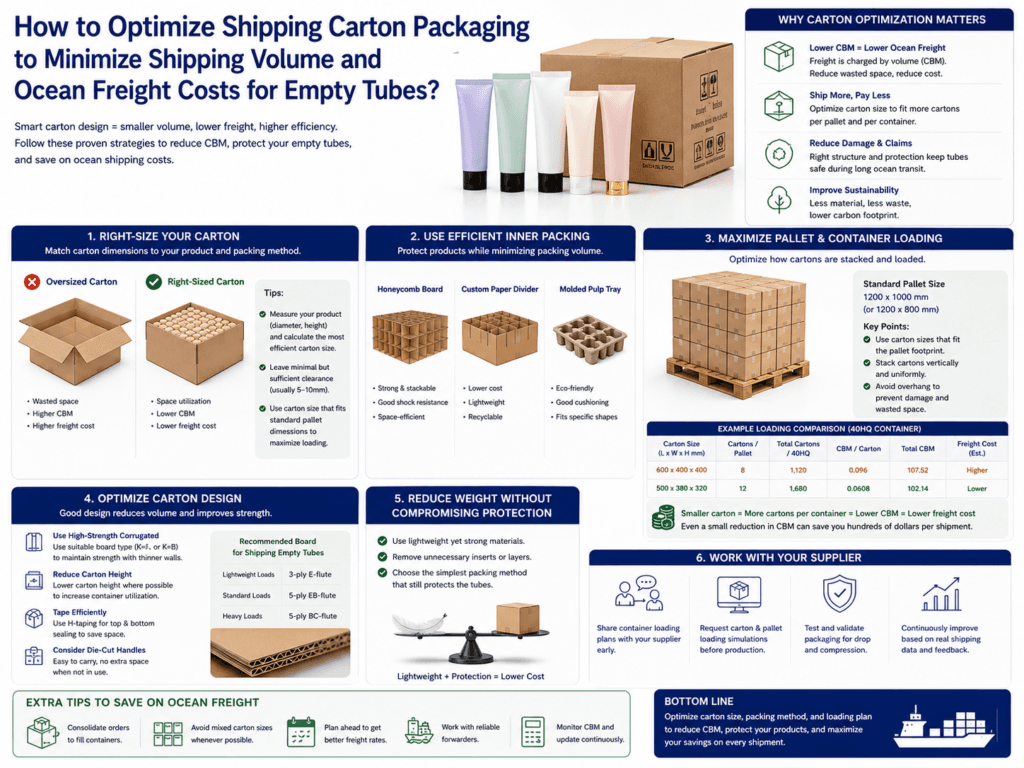
To minimize shipping volume and ocean freight costs for empty cosmetic tubes, manufacturers should optimize the tube dimensions, cap assembly method, carton size, tube orientation, packing density, inner protection, pallet pattern, and container loading plan as one complete system. Empty tubes are lightweight but occupy a large amount of space, so ocean freight is usually driven more by cubic volume than by gross weight.
The best carton is not simply the smallest possible box. It must increase the number of tubes per cubic meter while preventing tube deformation, scratched printing, damaged caps, crushed shoulders, contaminated openings, and excessive carton compression during international transport.
Quick Answer
The most effective methods are to use standard tube diameters, reduce unnecessary tube length, select compact caps, nest or alternate the tube orientation, pack caps separately when practical, minimize empty gaps, optimize carton dimensions for pallets and containers, and validate the final packing through compression and transport testing.
| Optimization Method | How It Reduces Volume | Risk to Control |
|---|---|---|
| Optimize tube length | Reduces the space occupied by each tube and carton | Must retain correct fill volume and sealing allowance |
| Use compact caps | Reduces total tube height and wasted space around closures | Cap must still provide reliable sealing and user comfort |
| Alternate tube orientation | Uses shoulder and tail spaces more efficiently | Printing and caps must not rub against each other |
| Separate tube and cap packing | Allows tube bodies and caps to be packed more densely | Adds cap assembly work at the filling factory |
| Optimize carton-to-pallet dimensions | Reduces unused pallet and container space | Cartons must remain strong enough for stacking |
Why Empty Tubes Are Charged Mainly by Volume
Empty PE, PCR, EVOH, ABL, and PBL tubes have a low weight compared with the amount of space they occupy. For ocean freight, the shipment is commonly limited by container volume before it reaches the maximum weight. This means the packing density and total cubic meters can have a major effect on landed cost.
| Shipping Characteristic | Empty Cosmetic Tubes | Cost Implication |
|---|---|---|
| Product weight | Relatively low | Weight is rarely the main container limitation |
| Product volume | Relatively high | Ocean freight cost is strongly affected by CBM |
| Shape | Cylindrical with shoulder, neck, cap, and open tail | Creates gaps if all tubes are packed in one direction |
| Surface sensitivity | Printed and coated tubes can scratch easily | Dense packing must not damage decoration |
| Compression resistance | Empty tube bodies can deform under excessive pressure | Carton strength and stacking height must be controlled |
Step 1: Optimize Tube Length Before Carton Design
Tube length is one of the most important shipping-volume factors. A tube should be long enough to hold the required formula volume, provide headspace, and leave enough open-tail length for filling and sealing. Any unnecessary extra length increases the volume of every carton and container.
| Tube-Length Factor | Why It Matters | Optimization Direction |
|---|---|---|
| Formula volume | Determines minimum usable internal capacity | Calculate capacity using formula density and fill weight |
| Headspace | Prevents overflow and pressure-driven leakage | Keep sufficient but not excessive headspace |
| Tail-sealing allowance | Required for the filling factory’s sealing equipment | Confirm minimum open-tail length with the filler |
| Artwork safe zone | Prevents text and logos from entering the tail seal | Coordinate final length with the artwork dieline |
| Retail proportions | Affects shelf appearance and consumer hand feel | Balance aesthetic preference with logistics efficiency |
Engineer’s note: Reducing only 5–10mm from a high-volume tube can create meaningful container-space savings when multiplied across tens of thousands of pieces, provided the fill capacity and sealing requirements remain safe.
Step 2: Select the Most Efficient Tube Diameter
Two tubes with the same capacity can use different combinations of diameter and length. A narrow tube may be longer, while a wider tube may be shorter. The best configuration depends on carton dimensions, pallet layout, cap diameter, shelf appearance, filling equipment, and consumer usability.
| Dimension Strategy | Advantage | Possible Disadvantage |
|---|---|---|
| Narrower and longer tube | Smaller footprint and elegant appearance | Longer cartons and potentially more deformation risk |
| Wider and shorter tube | Better standing stability and compact height | Larger cap and more carton width may be required |
| Standard industry diameter | Easier mold, cap, filling-line, and carton optimization | Less distinctive than a fully custom size |
| Custom non-standard diameter | Can create unique brand proportions | May increase tooling, MOQ, and packing complexity |
Step 3: Choose Compact Cap and Applicator Structures
Caps can significantly increase shipping volume. Tall flip-top caps, oversized luxury caps, metal jackets, pumps, rollerballs, and applicator heads create more empty space than compact screw caps. The cap should match the product function without adding unnecessary height or width.
| Closure Type | Packing Efficiency | Engineering Consideration |
|---|---|---|
| Compact screw cap | High | Good for small tubes and travel packaging |
| Standard flip-top cap | Medium to high | Cap base and hinge projection affect carton density |
| Wide stand-up flip-top cap | Medium | Improves shelf stability but increases carton width |
| Metal-jacketed luxury cap | Lower | Needs extra scratch and dent protection |
| Airless pump or applicator head | Lower | May require trays, protective caps, and more headspace |
Should Tubes Be Shipped with Caps Assembled?
Shipping tubes with caps assembled simplifies the filling process and protects the tube orifice. However, it may reduce carton density. Packing tube bodies and caps separately can reduce volume in some projects, but it transfers cap assembly work to the customer or contract filler.
| Packing Method | Advantages | Disadvantages |
|---|---|---|
| Caps assembled on tubes | Ready for filling, protects tube neck, reduces missing-cap risk | Lower packing density and larger carton volume |
| Caps packed separately | Tube bodies and caps can be nested or bulk-packed more efficiently | Requires cap assembly, counting, and contamination control at destination |
| Partial cap engagement | May protect the neck while reducing assembly stress | Must not allow caps to loosen or scratch during transport |
| Applicators packed separately | Protects metal tips, pumps, or rollerballs from damage | Adds assembly and inventory complexity |
Step 4: Use Alternating Tube Orientation
When all tubes face the same direction, shoulders and caps create repeated unused spaces. Alternating the tubes head-to-tail can improve packing density by placing the narrower tail section beside the wider shoulder or cap section of the next tube.
| Orientation Pattern | Packing Density | Risk to Control |
|---|---|---|
| All tubes in one direction | Simple but may waste space | Large gaps around shoulders and caps |
| Alternating head-to-tail | Usually more efficient | Caps must not scratch printed tube bodies |
| Layered cross-direction packing | Can improve carton stability | Requires controlled layer separators |
| Nested tube bodies without caps | Potentially highest density | May deform tubes or contaminate internal surfaces if poorly controlled |
Step 5: Minimize Unused Space Inside the Carton
A carton should closely match the packed product dimensions. Excessive gaps allow tubes to move, rub, and become disorganized. However, a carton that is too tight can compress tube bodies, damage printing, or deform caps.
- Control internal clearance: Leave enough room for loading without creating large empty gaps.
- Use thin protective liners: Select lightweight bags or sheets instead of bulky cushioning where possible.
- Avoid oversized dividers: Use partitions only when the decoration or component requires them.
- Match layer height: The carton height should correspond to a complete number of tube layers.
- Prevent random bulk movement: Use an inner bag, layer pad, or compact arrangement to stabilize tubes.
Step 6: Select the Right Inner Protection
Reducing packaging material too aggressively can create higher losses through scratches, dents, contamination, and customer claims. The goal is to use the minimum effective protective material rather than eliminating protection completely.
| Protection Method | Best Use | Volume Impact |
|---|---|---|
| Large PE inner bag | Standard blank or simply printed tubes | Low |
| Layer separator sheets | Printed, hot-stamped, or soft-touch tubes | Low to moderate |
| Individual sleeves | Luxury finishes, metal caps, or sensitive applicators | High |
| Molded trays | Airless pumps, rollerballs, zinc-alloy applicators | High but offers strong protection |
| Honeycomb or partition inserts | Heavy caps or components with impact risk | Moderate to high |
Step 7: Optimize Carton Dimensions for Pallets
Carton optimization should continue beyond the number of tubes per carton. The carton dimensions must fit efficiently on the selected pallet without creating unused edges, excessive overhang, weak stacking, or irregular loading patterns.
| Pallet Factor | Optimization Goal | Problem If Ignored |
|---|---|---|
| Cartons per pallet layer | Use most of the pallet surface | Unused edge space increases freight per tube |
| Carton overhang | Avoid overhang beyond pallet edges | Cartons become crushed or unstable |
| Layer interlocking | Create stable stacking pattern | Pallet may shift during ocean transport |
| Total pallet height | Use available container height safely | Low pallets waste vertical space |
| Pallet weight | Remain within handling limits | Overweight pallets are difficult to move or unload |
Should Empty Tubes Be Palletized?
Pallets improve handling, warehouse efficiency, and carton protection, but they also consume container volume. For some full-container shipments, floor loading can fit more cartons. For less-than-container-load shipments, palletizing may reduce handling damage and consolidation risk.
| Loading Method | Advantages | Disadvantages |
|---|---|---|
| Floor-loaded cartons | Maximum container-volume utilization | More manual unloading and higher carton handling risk |
| Palletized cartons | Faster handling, better protection, easier warehouse receiving | Pallet base and gaps reduce usable container volume |
| Slip-sheet loading | Uses less space than wooden pallets | Requires compatible push-pull handling equipment |
| Mixed loading | Can balance protection and volume | Needs a detailed loading plan and clear unloading instructions |
Step 8: Optimize Carton Strength Without Overpacking
Heavy cartons increase material cost and shipping weight, while weak cartons collapse during stacking. The corrugated board grade should be selected based on carton dimensions, gross weight, stacking height, humidity, pallet pattern, and shipping duration.
| Carton Design Factor | Too Weak | Too Heavy | Correct Direction |
|---|---|---|---|
| Corrugated board strength | Carton collapse and tube compression | Unnecessary cost and weight | Match board grade to stacking and shipment conditions |
| Carton height | Tall cartons may bulge or crush | Short cartons increase carton count | Balance tube quantity and compression strength |
| Carton gross weight | Very light cartons increase handling units | Heavy cartons are difficult to move and may tear | Keep within practical manual or mechanical handling limits |
| Sealing method | Carton may open during transport | Excess tape or strapping adds cost | Use suitable tape, glue, or strapping based on load |
Step 9: Calculate Tubes per Cubic Meter
Procurement managers should compare packing options using tubes per carton, carton cubic volume, cartons per cubic meter, and tubes per cubic meter. A carton containing more tubes is not automatically more efficient if its dimensions create poor pallet or container utilization.
| Calculation Item | Formula | Use |
|---|---|---|
| Carton volume | Length × width × height | Calculates the CBM of each carton |
| Cartons per cubic meter | 1 ÷ carton CBM | Estimates theoretical carton density |
| Tubes per cubic meter | Tubes per carton ÷ carton CBM | Compares different packing methods |
| Freight cost per tube | Total freight ÷ total tube quantity | Shows the logistics cost added to each tube |
Procurement note: Always compare the complete pallet or container layout. A carton with excellent internal density may still waste space if its external dimensions do not fit the pallet or container efficiently.
Step 10: Develop a Container Loading Plan
A loading plan should confirm carton orientation, container type, pallet usage, stacking height, aisle or door clearance, and total quantities. This allows the supplier and forwarder to estimate whether the order should use LCL, a 20-foot container, a 40-foot container, or a high-cube container.
| Loading-Plan Item | What to Confirm | Why It Matters |
|---|---|---|
| Container type | Standard or high-cube container | Changes available internal height and total CBM |
| Carton orientation | Best direction for maximum loading | Reduces unused space between carton rows |
| Stacking height | Safe number of cartons or pallets vertically | Prevents lower-carton crushing |
| Mixed SKU arrangement | Placement of different sizes and carton dimensions | Avoids unstable gaps and simplifies unloading |
| Door clearance | Final cartons or pallets can pass through container doors | Prevents loading and unloading problems |
How Different Tube Types Affect Carton Efficiency
| Tube Type | Packing Challenge | Recommended Direction |
|---|---|---|
| Standard round PE tube | Gaps around shoulder and cap | Alternate tube orientation and use compact layers |
| Oval tube | Orientation must remain consistent to avoid pressure points | Use aligned rows or protective layer sheets |
| ABL or PBL tube | Body can crease if compressed incorrectly | Avoid excessive nesting and carton pressure |
| Soft-touch printed tube | Surface can rub, stain, or scratch | Use clean separators or protective bags |
| Tube with metal applicator | Applicator can scratch tubes or become dented | Use trays, individual sleeves, or separate packing |
| Airless pump tube | Pump increases height and is sensitive to impact | Use structured trays and optimize pump orientation |
How Printing and Surface Finish Affect Packing
Highly decorated tubes often need more protective packing than blank tubes. The cost savings from tighter cartons should be balanced against the risk of scratched logos, foil transfer, ink abrasion, soft-touch marks, or coating damage.
| Surface Type | Packing Sensitivity | Recommended Protection |
|---|---|---|
| Blank PE tube | Low | Bulk inner bag and compact packing |
| Standard silk-screen tube | Medium | Control rubbing and verify ink adhesion |
| Hot-stamped tube | Medium to high | Layer separators and foil abrasion testing |
| Glossy varnished tube | Medium | Prevent hard cap edges from rubbing the surface |
| Soft-touch tube | High | Clean separators, individual protection, or lower packing pressure |
| Metallic or luxury tube | High | Protective sleeves or trays may be required |
Recommended Packaging Tests
| Test | Purpose | What to Inspect |
|---|---|---|
| Carton compression test | Checks stacking resistance | Carton collapse, tube deformation, cap damage |
| Drop test | Simulates manual handling and warehouse impacts | Broken caps, dented shoulders, torn cartons |
| Vibration test | Simulates truck and ocean movement | Tube rubbing, print abrasion, cap loosening |
| Humidity exposure | Checks corrugated strength during sea transport | Carton softening, bulging, stacking loss |
| Pallet stability test | Checks stretch-wrap and stacking pattern | Load shifting, leaning, carton-edge damage |
| Packing trial | Confirms real tube count and loading efficiency | Carton clearance, tube scratches, labor efficiency |
Common Packaging Mistakes
- Using oversized cartons: Increases CBM and allows tubes to move during shipping.
- Reducing carton size without testing: Excess pressure may deform tubes or scratch printing.
- Ignoring cap dimensions: A larger cap may control the entire carton layout.
- Optimizing the carton but not the pallet: Poor carton dimensions can waste pallet and container space.
- Using heavy individual packaging for standard tubes: Adds unnecessary volume, labor, and material cost.
- Floor loading fragile cartons: Repeated manual handling may create more damage than the freight savings justify.
- Not checking destination handling: A low-volume packing method may be difficult for the filling factory to unpack and use.
Procurement Checklist Before Approving Carton Packaging
| Check Item | Question to Confirm |
|---|---|
| Tube dimensions | Is the tube length fully optimized for fill capacity and tail sealing? |
| Cap assembly | Should caps be assembled or packed separately? |
| Carton quantity | How many tubes can be packed safely per carton? |
| Carton dimensions | What is the exact external length, width, height, and CBM? |
| Protective packing | Are separators, trays, sleeves, or bags necessary? |
| Pallet plan | How many cartons fit per layer and per pallet? |
| Container load | How many cartons and tubes fit in the selected container? |
| Transport validation | Has the packing passed compression, drop, and vibration tests? |
Best Practical Recommendation
For standard empty PE cosmetic tubes, the best cost-saving approach is usually to optimize the tube length, use an existing standard diameter, select a compact closure, arrange tubes head-to-tail, use a tightly sized export carton, and design carton dimensions around the final pallet or container layout.
For premium printed tubes, soft-touch tubes, metal applicators, or airless pump tubes, do not remove protective materials only to reduce CBM. First identify where protection is genuinely required, then use the thinnest effective separators, sleeves, or trays that pass transport testing.
Summary
Shipping carton packaging for empty cosmetic tubes can be optimized by reducing unnecessary tube length, selecting logistics-efficient diameters and caps, alternating tube orientation, minimizing internal carton gaps, choosing appropriate protective materials, and matching carton dimensions to pallet and container sizes.
The most useful measurement is not only tubes per carton, but tubes per cubic meter and freight cost per tube. The final packing design should achieve high density without causing tube deformation, printing abrasion, cap damage, carton collapse, contamination, or inefficient unpacking at the filling factory.
Learn more: Optimize Tube Length and Diameter for Shipping Cartons, Cosmetic Squeeze Tubes, PE Tubes, Hidden Costs of Buying PE Tubes from China, Quality Assurance, Customization.
Need Lower-Volume Export Packaging for Empty Cosmetic Tubes?
Xinfly Packaging helps procurement teams optimize tube dimensions, cap selection, carton quantities, packing orientation, protective materials, pallet layouts, and container loading plans to reduce CBM and ocean freight cost without compromising tube quality.