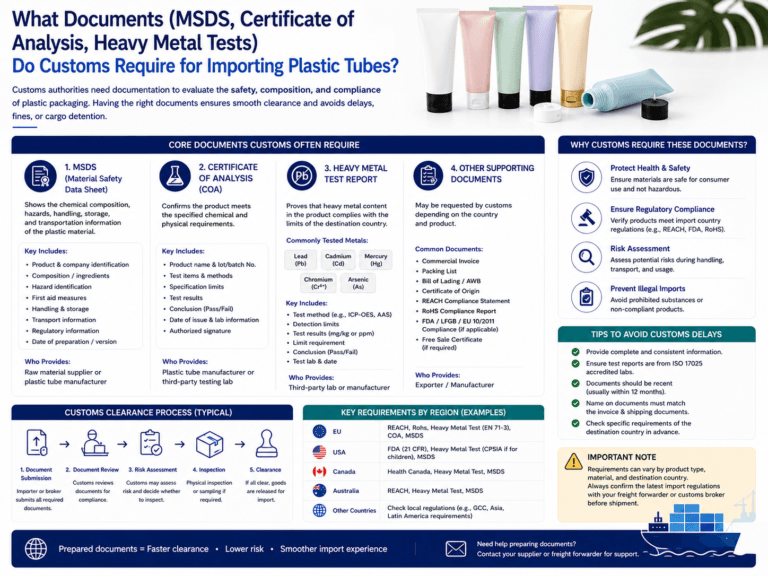

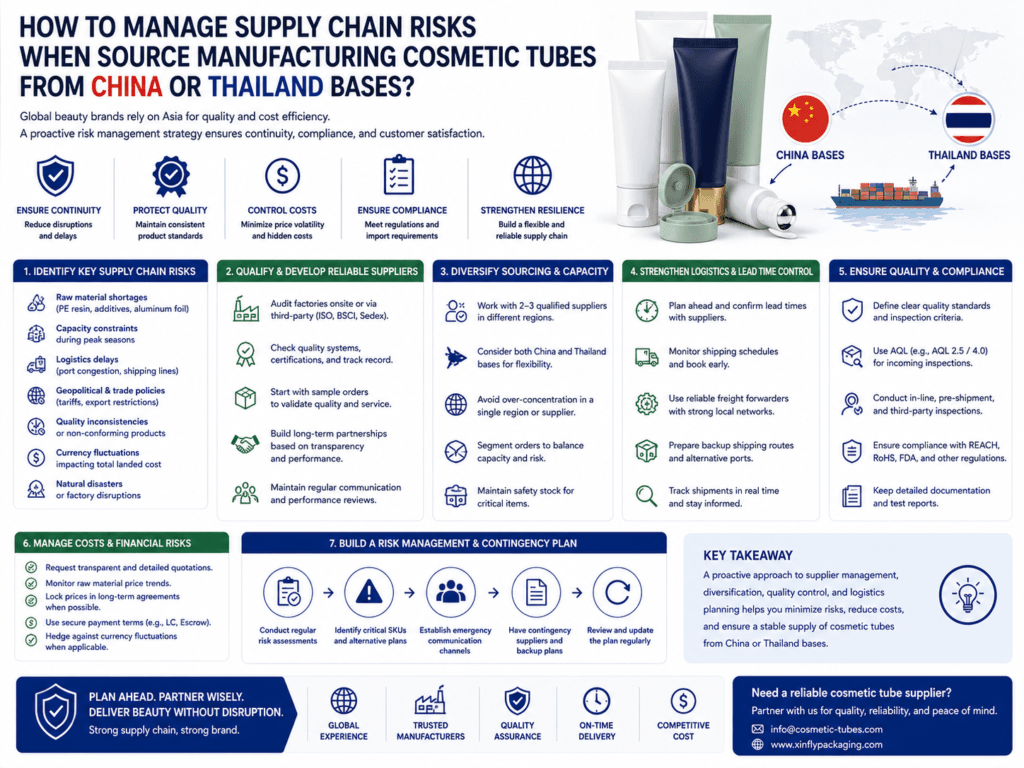
To manage supply chain risks when sourcing cosmetic tubes from manufacturing bases in China or Thailand, buyers should evaluate the entire supplier network—not only the final tube factory. A reliable strategy should cover factory qualification, raw-material traceability, tooling ownership, component sourcing, sample approval, formula compatibility, production capacity, quality inspection, safety stock, logistics alternatives, and contractual remedies.
China and Thailand can both support cosmetic packaging production, but choosing a second country does not automatically eliminate supply risk. A Thailand-based tube factory may still source resin, caps, molds, pumps, applicators, foil, inks, or printing equipment parts from China. Procurement managers should therefore identify all upstream dependencies before treating the two manufacturing bases as independent supply sources.
Quick Answer
The most effective approach is to use a primary supplier plus a technically qualified backup supplier, standardize critical tube and cap specifications, control all material or process changes, reserve long-lead components, maintain safety stock, inspect every production lot, and prepare alternative ports, forwarders, and transportation methods before a disruption occurs.
| Supply Chain Risk | Typical Problem | Recommended Control |
|---|---|---|
| Single factory dependency | Production stops after equipment failure, labor shortage, fire, flood, or capacity overload | Qualify a second manufacturing source before placing critical orders |
| Component dependency | Tube bodies are ready, but caps, pumps, applicators, or foil are delayed | Map component suppliers and hold buffer stock for long-lead parts |
| Material substitution | Supplier changes resin, PCR source, ink, coating, or adhesive without approval | Require written change-control approval and new validation samples |
| Quality failure | Leakage, cap mismatch, color variation, poor printing, or tube deformation | Use PPS approval, compatibility testing, in-process QC, and AQL inspection |
| Logistics disruption | Port congestion, container shortage, customs delay, or route interruption | Approve alternative ports, forwarders, routes, and emergency airfreight plans |
China vs. Thailand: Which Is Lower Risk?
Neither country is automatically lower risk for every cosmetic tube project. The better option depends on the actual supplier’s technical capability, component network, export experience, quality history, logistics routes, and ability to recover from disruption.
| Evaluation Area | China Manufacturing Base | Thailand Manufacturing Base |
|---|---|---|
| Supplier ecosystem | Often offers a broad network of tube, cap, mold, applicator, printing, and material suppliers | Capability may be more concentrated and should be verified for each component |
| Customization | Often strong for custom molds, multiple materials, decoration methods, and closure options | Can support custom projects, but mold and component availability must be checked |
| Supply diversification | Suitable as a primary source for established China supply chains | Can support a China-plus-one or ASEAN sourcing strategy |
| Upstream dependency | Many components may be sourced domestically | Some factories may import molds, resin, caps, or applicators from China |
| Best decision method | Audit the specific factory and its upstream suppliers | Audit the specific factory and confirm genuine supply independence |
Procurement warning: A purchase order placed with a Thailand factory does not create true geographic diversification if its caps, molds, applicators, or raw materials still come from a single Chinese supplier.
1. Map Every Critical Supplier and Component
Buyers should ask the cosmetic tube manufacturer to disclose which processes are performed internally and which are outsourced. The supply chain map should include all components that could stop final packaging production.
| Component or Process | Questions to Ask | Potential Risk |
|---|---|---|
| Tube extrusion | Is extrusion performed in-house? How many production lines are available? | Insufficient capacity, wall-thickness variation, or equipment shutdown |
| Tube head and shoulder | Who owns the heading mold? Is a backup mold available? | Loss of neck, thread, shoulder, or orifice production |
| Caps and closures | Are caps molded internally or purchased from another company? | Cap color, thread, hinge, torque, and delivery inconsistency |
| Printing and finishing | Are silk screen, offset, hot stamping, coating, and labels produced in-house? | Longer lead times and unclear responsibility for defects |
| Applicators and pumps | Where are rollerballs, airless pumps, silicone tips, and zinc-alloy heads produced? | Single-source dependency and long component lead time |
| Raw materials | Which companies supply PE, PP, EVOH, laminate, PCR, pigments, ink, adhesive, and foil? | Unapproved substitutions, certification gaps, and batch variation |
2. Audit the Actual Manufacturing Facility
Certifications and website photographs are not sufficient by themselves. A technical audit should confirm equipment, process controls, quality systems, maintenance, capacity, traceability, contamination control, and subcontractor management.
Production Capability
Verify extrusion lines, heading machines, cap molding, printing, coating, assembly, inspection equipment, and available backup capacity.
Quality Laboratory
Confirm the ability to test dimensions, wall thickness, torque, leakage, printing adhesion, hinge life, drop resistance, and compression.
Traceability
Review how resin batches, cap batches, machines, molds, artwork versions, operators, and production dates are recorded.
Business Continuity
Evaluate backup power, fire prevention, flood exposure, equipment recovery, emergency communication, and alternative production arrangements.
3. Standardize the Complete Tube Specification
Supply can be transferred between China and Thailand more easily when both factories work from the same controlled drawings, material standards, inspection methods, and approved samples.
| Specification Area | Details to Standardize |
|---|---|
| Tube body | Material, layer structure, diameter, length, wall thickness, softness, color, opacity, and capacity |
| Tube neck | Thread profile, neck diameter, sealing land, orifice, shoulder, and dimensional tolerances |
| Cap | Material, thread, torque, plug seal, hinge, snap force, color, liner, and tamper-evident feature |
| Decoration | Artwork revision, Pantone colors, print registration, hot stamping, varnish, and surface finish |
| Quality | Defect manual, AQL, test methods, golden sample, and inspection conditions |
| Packing | Quantity per carton, tube orientation, protection, carton dimensions, labels, palletization, and loading plan |
4. Prohibit Unapproved Material or Process Changes
The contract should require advance written approval before the supplier changes any resin, cap supplier, mold, production site, printing process, pigment, coating, adhesive, foil, recycled-content source, or packaging method.
| Proposed Change | Possible Effect | Required Validation |
|---|---|---|
| PE or PP resin grade | Changes stiffness, shrinkage, squeeze force, hinge performance, or chemical resistance | Material data, trial production, dimensions, and compatibility approval |
| PCR supplier or percentage | Changes odor, color, mechanical strength, and certification | Traceability documents, sensory test, mechanical test, and PPS |
| Cap manufacturer | Changes thread fit, torque, sealing, color, and hinge durability | Cap-neck fit, leakage, torque, and repeated-use testing |
| Ink, coating, or foil | Changes color, adhesion, abrasion resistance, and formula resistance | Decoration trial, adhesion test, aging test, and visual approval |
| Production location | Changes machinery, processes, staff, environment, and traceability | Factory audit, PPS, filling trial, and quality requalification |
5. Approve Digital Proof, PPS, and Filled Compatibility Tests
Different approval steps control different supply risks. A digital proof alone cannot validate a physical tube, and an empty PPS cannot confirm long-term interaction with the actual cosmetic formula.
| Approval Stage | What It Confirms | Risk Prevented |
|---|---|---|
| Digital layout proof | Artwork position, text, barcode, colors, print areas, and decoration instructions | Artwork and layout errors |
| Pre-production sample | Physical material, dimensions, cap fit, printing, finish, and assembly | Manufacturing and appearance errors |
| Formula compatibility test | Leakage, swelling, odor, migration, discoloration, cracking, and dispensing | Long-term formula-packaging failure |
| Filling-line trial | Tube feeding, orientation, filling, sealing, coding, and production speed | Operational downtime at the filling factory |
6. Protect Custom Mold Ownership
Custom tooling can become one of the most serious supply chain constraints. Buyers should define ownership, storage, maintenance, access, transfer rights, confidentiality, and duplicate-tool requirements before paying the tooling charge.
- Assign a unique identification number to every buyer-funded mold.
- State that the supplier cannot use the mold for another customer.
- Require preventive maintenance and tool-condition reports.
- Define whether the tool can be transferred internationally.
- Keep current CAD drawings and component specifications.
- Consider duplicate molds for custom caps, shoulders, or applicators with long replacement times.
- Specify what happens to the tooling when the commercial relationship ends.
7. Qualify a Second Source Before It Is Needed
A backup supplier is useful only when it has already produced acceptable samples, passed compatibility testing, demonstrated production capacity, and been approved by the brand and filling factory.
| Backup Qualification Step | Required Evidence |
|---|---|
| Factory audit | Equipment, capacity, quality system, traceability, and business-continuity review |
| Material matching | Equivalent approved resin, laminate, cap, ink, coating, and color references |
| PPS approval | Physical sample matching the approved primary-source specification |
| Compatibility testing | Filled aging, leakage, drop, compression, and dispensing results |
| Filling-line approval | Confirmation that dimensions and orientation work on existing machinery |
| Pilot order | Small commercial production lot inspected before emergency use |
8. Standardize Critical Interfaces Across Both Countries
The easiest products to transfer between manufacturing bases use common tube diameters, threads, necks, caps, orifices, artwork standards, and inspection methods. Highly proprietary components increase switching time and cost.
- Common thread profile: Allows alternative caps to fit both suppliers’ tube necks.
- Standard diameter: Reduces tooling and filling-line adjustment.
- Approved material grades: Minimizes differences in softness, color, and compatibility.
- Shared color standard: Use signed physical samples and controlled measurement conditions.
- Shared QC manual: Both suppliers should classify defects using the same criteria.
- Common carton dimensions: Simplifies freight planning, warehousing, and filling operations.
9. Reserve Long-Lead Components
Tube extrusion may be relatively fast, but a missing closure, applicator, pump, foil, or certified material can delay the entire finished order. These components should be identified during planning and reserved against the rolling forecast.
| Long-Lead Item | Supply Risk | Recommended Action |
|---|---|---|
| Custom-colored caps | Separate molding MOQ and production schedule | Reserve resin and cap capacity before tube production |
| Metal applicators | Multiple processing, coating, polishing, and assembly stages | Hold additional component inventory |
| Airless pumps | Complex parts and specialized suppliers | Approve a backup pump and keep safety stock |
| PCR or certified resin | Feedstock and certification availability may vary | Reserve approved batches and alternative certified sources |
| Printed laminate | Requires artwork setup and larger production runs | Plan purchases using a longer forecast horizon |
10. Maintain Safety Stock Based on Recovery Time
Safety stock should cover more than normal production lead time. It should also consider how long it would take to replace a damaged mold, qualify a new cap supplier, repeat compatibility testing, clear customs, and ship goods from the alternative country.
| Packaging Type | Risk Level | Inventory Direction |
|---|---|---|
| Standard PE tube with stock cap | Lower | Moderate finished-goods safety stock |
| Custom-color flip-top tube | Medium | Finished-tube and custom-cap buffer stock |
| EVOH or PCR tube | Medium to high | Reserve approved material and finished packaging |
| Metal-applicator eye cream tube | High | Additional applicator and assembled-tube inventory |
| Custom laminate tube | High | Longer planning horizon and printed-laminate safety stock |
11. Use a Rolling Forecast and Capacity Plan
Annual factory capacity figures do not guarantee that machines will be available during the month when the buyer needs production. Brands should provide rolling forecasts and confirm the supplier’s monthly normal and emergency capacity.
- Provide a three-, six-, or twelve-month rolling demand forecast.
- Identify which portion is informational and which portion is a firm commitment.
- Reserve production slots before seasonal peaks and long holidays.
- Confirm planned equipment maintenance and shutdown periods.
- Ask how quickly the factory can add overtime or move production to another line.
- Reserve caps, applicators, and special materials earlier than standard PE resin.
12. Include AQL and Functional Tests in the Contract
Pre-shipment quality control should combine visual and dimensional AQL inspection with product-specific functional tests. AQL alone does not confirm long-term formula compatibility or every functional characteristic.
| Quality Control | Recommended Requirement |
|---|---|
| Critical defects | Ac=0/Re=1 for contamination, sharp edges, unapproved materials, and severe safety defects |
| Major defects | AQL 2.5 for leakage, wrong dimensions, cap failure, unreadable artwork, and severe printing defects |
| Minor defects | AQL 4.0 for limited cosmetic imperfections that do not affect function or normal saleability |
| Functional tests | Leakage, torque, hinge cycle, drop, compression, dispensing, and printing adhesion |
| Compatibility tests | Separate filled-formula testing for swelling, odor, migration, cracking, and stability |
13. Define Responsibilities for Failed or Delayed Orders
A B2B contract should explain what happens when a shipment fails inspection, misses the approved delivery date, or forces the buyer to arrange emergency freight.
| Failure Event | Contract Requirement |
|---|---|
| Failed pre-shipment inspection | Containment, root-cause analysis, sorting or remake plan, and reinspection |
| Supplier-caused delay | Recovery schedule and responsibility for additional transport costs where agreed |
| Unapproved substitution | Buyer rejection rights, replacement, and corrective action |
| Latent defect after filling | Warranty, investigation, replacement, and claim process |
| Tooling failure | Repair responsibility, backup production plan, and replacement timing |
| Shipment damage | Packaging responsibility, insurance documents, and claim support |
14. Prepare Multiple Logistics Routes
Do not wait until finished goods are packed to begin comparing transportation options. Accurate carton quantities, dimensions, gross weights, pallet data, and readiness dates should be available early.
- Approve a primary and backup freight forwarder.
- Identify alternative origin ports where practical.
- Prepare both palletized and floor-loaded container options.
- Use sea freight for planned demand and reserve air freight for recovery shipments.
- Consider splitting urgent volume across more than one vessel or route.
- Prepare customs documents and product descriptions before cargo completion.
- Use cargo insurance appropriate to the value and risk of the shipment.
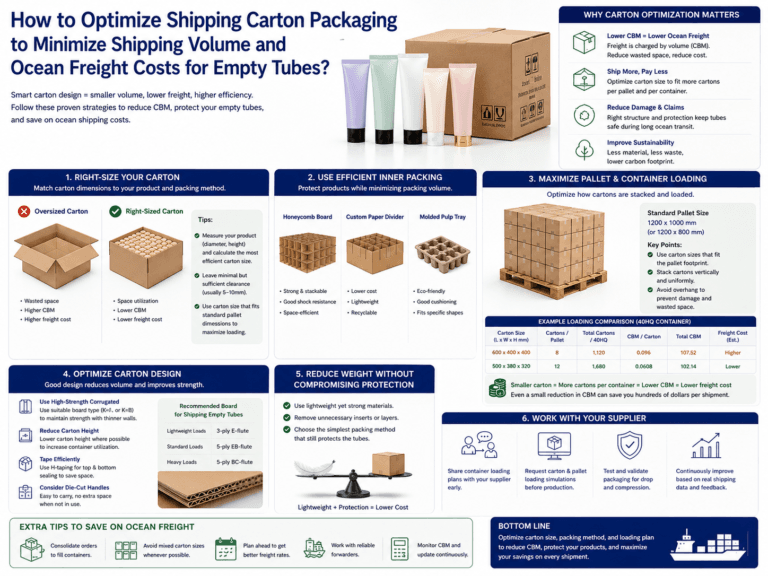
15. Optimize Carton Packaging and Container Utilization
Empty cosmetic tubes are lightweight but bulky. Poor carton design increases ocean freight cost, while excessive compression can damage tubes, caps, printing, or applicators.
| Packing Control | Supply Chain Benefit |
|---|---|
| Optimized tube length | Reduces carton and container volume |
| Head-to-tail packing | Improves the number of tubes per cubic meter |
| Compact caps | Reduces overall shipping volume |
| Tested carton strength | Prevents crushing during ocean transport and stacking |
| Protective layer sheets | Prevents scratches on hot-stamped or soft-touch tubes |
| Container loading plan | Reduces unused space and unstable carton stacks |
16. Monitor the Order by Production Milestone
Waiting for a final “goods are ready” notice makes it difficult to recover from delays. Buyers should track material readiness, PPS approval, production start, printing completion, QC status, packing, and freight booking.
| Milestone | Evidence to Request |
|---|---|
| Artwork approval | Signed digital proof and revision number |
| Material reservation | Confirmation of resin, caps, applicators, inks, foil, and cartons |
| PPS approval | Approved sample, measurements, photographs, and test results |
| Production start | First-article report and production schedule |
| Decoration completion | Printing, hot stamping, coating, and adhesion records |
| Final inspection | AQL report, functional tests, quantity, and packing inspection |
| Freight booking | Forwarder, port, vessel or flight, cutoff date, and estimated departure |
17. Use Supplier Performance Scorecards
Price should be only one part of supplier evaluation. Buyers should track delivery, quality, communication, documentation, corrective action, and change-control performance.
| KPI | What It Measures |
|---|---|
| On-time delivery | Percentage of orders meeting the contractual completion or shipment date |
| First-pass acceptance | Percentage of lots passing inspection without sorting or rework |
| Complaint rate | Problems detected during filling, distribution, retail, or consumer use |
| Corrective-action performance | Speed and effectiveness of root-cause and prevention activities |
| Lead-time consistency | Difference between promised and actual production time |
| Change-control compliance | Whether material, process, tooling, and supplier changes are reported in advance |
| Documentation accuracy | Quality of inspection, certification, packing, and shipping records |
18. Create a Product Risk Classification
| Risk Level | Example Project | Recommended Controls |
|---|---|---|
| Low | Standard white PE tube with stock screw cap and simple printing | Normal supplier audit, AQL inspection, and moderate safety stock |
| Medium | Custom-color tube with flip-top cap and multi-color artwork | PPS, cap testing, reserved capacity, and backup closure plan |
| High | EVOH tube with special applicator, premium finish, and oil-rich formula | Dual source, filled compatibility testing, stricter QC, and larger inventory buffer |
| Critical | Single-source packaging for a regulated product with proprietary tooling | Duplicate tooling, fully approved alternative factory, emergency stock, and documented continuity plan |
Recommended China-and-Thailand Sourcing Model
Primary Supplier
Select the factory with the strongest combination of technical capability, quality history, component availability, capacity, cost, and delivery performance.
Qualified Backup Supplier
Approve a second factory through audit, PPS, compatibility testing, filling-line trials, and at least one pilot production order.
Common Packaging Platform
Use shared tube diameters, neck drawings, thread profiles, materials, cap functions, artwork standards, QC methods, and carton specifications wherever possible.
Protected Tooling
Document ownership and transfer rights, and consider duplicate tooling for custom caps, applicators, or tube heads that would take a long time to replace.
Inventory Buffer
Hold additional safety stock for long-lead caps, certified PCR resin, printed laminate, pumps, rollerballs, and metal applicators.
Logistics Redundancy
Approve multiple forwarders, ports, routes, container options, and emergency airfreight procedures before a disruption occurs.
Common Supply Chain Mistakes
- Choosing a factory only by price: Low quotations may hide subcontracting, weak QC, tooling, testing, and logistics risks.
- Assuming two countries equal two independent supply chains: Both factories may depend on the same upstream supplier.
- Waiting for a crisis before qualifying a backup: Audits, samples, compatibility tests, and tooling can take months.
- Allowing different specifications at each base: Emergency production transfer becomes slower and less reliable.
- Ignoring cap and applicator supply: A complete tube cannot ship when one small closure component is missing.
- Not protecting molds: Production cannot move if the buyer cannot access custom tooling.
- Skipping filled compatibility testing: Similar-looking tubes may behave differently with the formula.
- Holding no safety stock: A short interruption can stop a cosmetic filling line and product launch.
Procurement Checklist
| Check Item | Question to Ask |
|---|---|
| Factory identity | Where will tube extrusion, molding, printing, decoration, and assembly actually occur? |
| Component origin | Where are the caps, pumps, applicators, resin, laminate, ink, foil, and cartons produced? |
| Backup capability | Which approved factory or machine can take over after a disruption? |
| Tooling control | Who owns the molds, and can they be transferred or duplicated? |
| Quality controls | Are PPS, compatibility, AQL, leakage, torque, adhesion, and transport tests documented? |
| Safety stock | How many weeks of finished tubes and long-lead components are available? |
| Logistics alternatives | Which ports, forwarders, routes, and emergency shipping methods have been approved? |
| Contract remedies | Who is responsible for failed lots, reinspection, replacement, and supplier-caused urgent freight? |
Best Practical Recommendation
For standard PE cosmetic tubes, use existing molds, common neck and cap systems, documented material grades, a qualified backup factory, and sufficient safety stock. These choices make it easier to transfer production between China and Thailand if necessary.
For five-layer EVOH tubes, PCR packaging, ABL or PBL tubes, airless pump tubes, rollerball tubes, metal-applicator eye cream tubes, and premium decorated packaging, use a stronger continuity plan. These projects normally have longer component lead times, more specialized tooling, stricter formula compatibility requirements, and greater difficulty matching appearance between factories.
Summary
Managing cosmetic tube supply chain risks requires visibility from raw materials to final container loading. Buyers should map upstream suppliers, audit production sites, standardize product specifications, control substitutions, protect tooling, approve backup factories, reserve capacity, maintain safety stock, inspect production lots, and prepare alternative logistics routes.
The strongest China-and-Thailand sourcing strategy uses one capable primary manufacturer and one fully qualified backup, while ensuring that both sources follow the same drawings, materials, testing methods, approved samples, quality standards, and packaging requirements.
Learn more: Factory Direct vs. Trading Company, China Tube Manufacturer vs. Local Supplier, Hidden Costs of Buying PE Tubes from China, AQL QC Standards for Cosmetic Packaging Contracts, Optimize Cartons and Ocean Freight Costs, Quality Assurance.
Need a Reliable Cosmetic Tube Supply Plan?
Xinfly Packaging helps B2B buyers manage tube materials, caps, applicators, custom tooling, sample approval, compatibility testing, AQL inspection, production schedules, export cartons, ocean freight planning, and supply continuity for custom cosmetic tube projects.