Published: .
A supplier sends a material document for the conditioner tube body. Your formulation team asks a reasonable follow-up: what about the shoulder, outlet and closure? The tube may look like one object on the shelf, but the purchasing file needs enough component information to describe the assembly actually being proposed.
A conditioner tube contact material list connects each relevant surface to its component identity, material information and supporting document. It helps your technical team ask the right questions before approving a packaging combination. This guide offers a request framework, not a declaration that a particular material is compatible, a completed safety assessment or a universal list of parts found in every tube.
Start with the Proposed Assembly
Name the Body, Shoulder and Closure
When considering hair conditioner squeeze tubes, ask the supplier to identify how the proposed assembly is constructed. Record the body, shoulder or neck and closure references, together with revisions where available. Some features may be integrated. Other constructions may contain additional parts. Let the actual design determine the component list instead of creating a fictional bill of materials from a photograph.
The description “PE tube with flip cap” is a starting point for an enquiry. It does not establish that every part is the same polymer, nor does it identify every constituent relevant to the proposed construction. Ask the supplier which material information belongs to each component. Where information is confidential, discuss an appropriate way for the responsible technical parties to receive what they need.
Keep the Formula Reference Attached
Identify whether the project is a rinse-out conditioner, leave-in product or another defined formulation. Provide the formula information requested by the responsible reviewers through the appropriate channel. A product category helps frame the application; it cannot establish compatibility with every formula bearing that name. Keep the formulation reference and revision connected to the proposed packaging assembly.
Describe the Contact Question Before Requesting Documents
Separate Storage Contact from Use Contact
Ask the technical team which surfaces need consideration during filling, storage, dispensing and reclosure. These stages can raise different questions. Do not assume that every external surface is normally in contact with the bulk formula, or that a closure is irrelevant merely because it sits outside the filled body. Have the reviewer define the relevant conditions for the actual design and use.
Include the Specimen’s Position and State
Record whether the discussion concerns an empty assembly, a filled sealed pack or a used and reclosed pack. State the relevant storage orientation and handling conditions. A contact-material request becomes more useful when it names the situation under review. Purchasing should preserve that description without turning it into a test method or deciding which exposure is sufficient for a technical conclusion.
Ask About Optional Parts Only When Present
A liner, insert, membrane or other additional component should appear in the request if the proposed assembly actually includes it. Ask the supplier to confirm its presence and identity. Do not add an imaginary liner to the specification because another cap used one. Likewise, do not omit a real insert because it is hidden when the closure is fitted.
| Area to identify | Supplier information to request | Technical question to connect |
|---|---|---|
| Tube body | Structure reference and relevant material information | Which surface faces the formula in this construction? |
| Shoulder or neck | Component identity and proposed material | Which surfaces are relevant to the stated contact conditions? |
| Outlet features | Integrated geometry or separate part references | What does the formula pass through during use? |
| Closure | Exact closure reference and relevant material information | Which closure surfaces need consideration? |
| Additional parts, if present | Identity, material and role | Are these parts included in the review scope? |
| Decorative construction | Relevant coating, print or other construction information | Does the reviewer need additional information for this design? |
| Complete specimen | Assembly, formula and preparation references | Does the specimen represent the documented combination? |
Match Each Document to the Correct Part
Read the Document’s Sample Description
A document title may sound broad while its contents refer to a specific resin, colour, sample or component. Record the issuing organisation, document identity, date and described item. Ask the supplier to explain the relationship between that item and the quoted component. A body-material document should not silently acquire the scope of a declaration covering the complete decorated assembly.
Record What the Document Actually Establishes
A material description, a declaration and a laboratory report can have different purposes. Ask the responsible reviewer which information is needed and what each supplied document can support. Preserve any limitations, test items and sample descriptions. Do not turn a narrow reported result into a general statement about formula compatibility, all markets or every component in a product family.

Treat Polymer Names as Part of the Description
Request the Proposed Construction Rather Than a Generic Substitute
The PE tube options can help start a material discussion, but the project still needs its proposed structure and component references. If the body changes from one construction to another, ask the supplier to update the affected information. A familiar material abbreviation does not tell the technical team whether the actual quoted assembly is unchanged.
Keep Colour and Other Relevant Variants Identifiable
Ask whether the available information covers the proposed component colour and other relevant variants. Let the supplier and responsible reviewer determine what additional constituent or construction details are necessary. Do not assume that an undecorated natural-colour sample represents every coloured and finished version. Record which differences exist so the reviewer can decide whether they affect the planned assessment.
Request a Representative Assembly for Evaluation
Label the Sample’s Purpose and Limitations
Through material and pre-production samples, request the combination relevant to your question. An appearance sample may use a display tail or an alternative closure. A material sample may intentionally omit decoration. Those specimens can serve useful purposes when their differences are identified, but they should not be presented as identical to the proposed production pack without confirmation.
Agree Who Prepares the Filled Specimens
Identify the party responsible for filling, sealing and recording preparation conditions. Keep formula identity, packaging references and preparation records linked. A result from a pack filled under one set of conditions may not answer a question about another preparation route. The technical team should establish which conditions its evaluation needs to represent and what information the filler must record.
Keep Appearance Approval Separate from Technical Disposition
A buyer may approve the printed colour while a technical question remains open. Record both decisions with their scopes. A photograph showing an attractive pack should not close an unresolved material question. Equally, a completed material-information request does not by itself approve the design, dispensing experience or production appearance. Each responsible party should state the decision it actually made.
Use an Evidence Map for Supplier Communication
| Record field | Entry to preserve | Follow-up when missing |
|---|---|---|
| Assembly reference | Proposed pack identity and revision | Ask which quoted configuration is covered |
| Component reference | Body, shoulder, closure or actual additional part | Connect the document to a named item |
| Material description | Supplier’s proposed material information | Request the detail needed by the technical reviewer |
| Document identity | Issuer, number or reference, date and version | Obtain an identifiable source document |
| Scope and conditions | Described sample, relevant items and limitations | Clarify what the document establishes |
| Reviewer disposition | Actual interpretation and decision scope | Keep the question open pending review |
| Change connection | Old and new references when applicable | Assess which prior decisions need reconsideration |
Make Missing Information a Named Question
Instead of recording “documents incomplete,” identify the gap: closure reference not connected, shoulder material not described or sample version unclear. Send that specific question to the supplier. A precise request is easier to answer and easier to close. Preserve the supplier’s answer with the affected row rather than leaving it buried in a separate email chain.
Preserve the Actual Reviewer’s Interpretation
Ask the responsible technical reviewer to record what the supplied information supports and any remaining actions. Name a reviewer only when that person actually participates. A purchasing checklist can organise evidence, but checking its boxes does not manufacture a technical endorsement. This article does not report a physical evaluation or an independently completed review of the illustrated packaging.
Revisit the Map When a Component Changes
Compare References Before Carrying Approval Forward
For custom conditioner tube packaging, a visually similar replacement cap may have a different component reference. Ask what changed and which material information applies. A revised shoulder or body construction also needs a clear relationship to the existing file. Have the responsible team determine the effect on earlier decisions. Do not assume that the same nominal capacity makes two assemblies equivalent.
Confirm the Scope at Reorder
On a reorder, compare the proposed assembly, formula and relevant documents with the approved reference set. Ask the supplier to identify differences. Retain the authorised disposition for any affected technical questions. This creates a usable history of the selected configuration without implying that an old document automatically remains sufficient for every future formulation, component or destination market.
Give the Images Their Proper Role
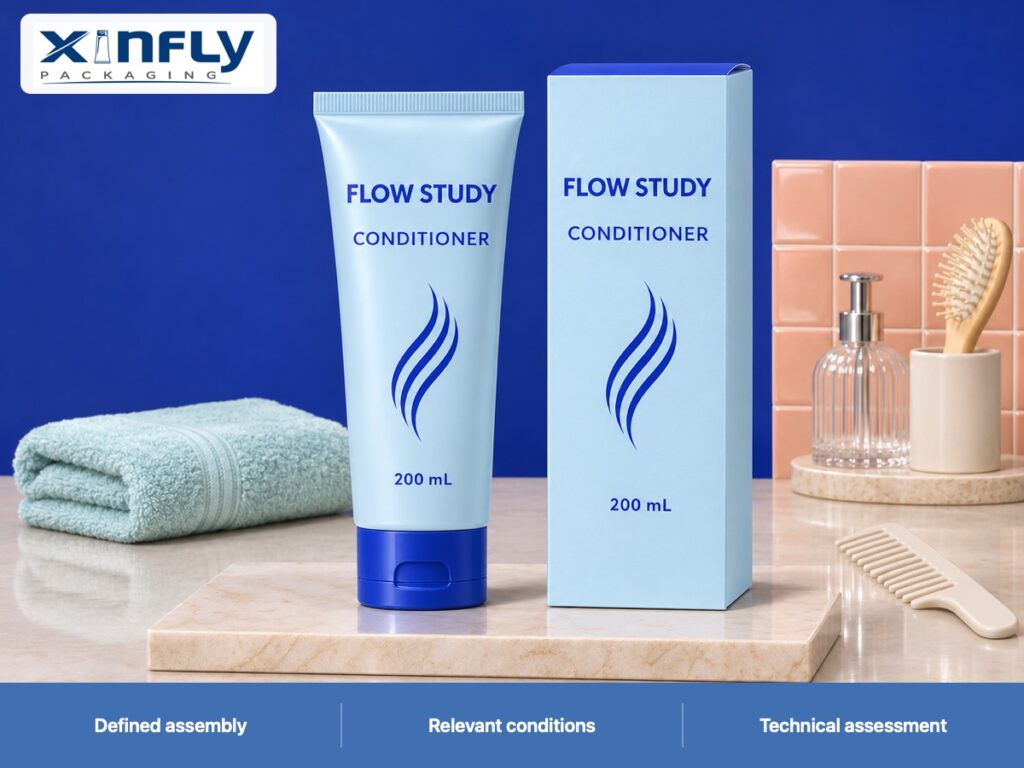
The illustrations show a fictional FLOW STUDY conditioner design: a pale blue PE-style body, moulded shoulder, straight crimped display tail and cobalt round flip cap. Cobalt single-colour screen-print-style lettering and a flowing ribbon motif coordinate with the printed carton. The cap remains closed. The images cannot reveal the actual resin grade, hidden parts or formula-contact pattern of a supplied assembly.
Use them as an appearance reference while the supplier identifies the actual construction. Conditioner tube packaging can be discussed through the product page, drawings, component records and representative samples. Each source serves a different purpose. The purchasing file should make those relationships clear enough that a reviewer can distinguish a decorative concept from information describing the proposed materials.
Prepare a Focused Xinfly Packaging Enquiry
Send your intended product type, formula reference through the appropriate channel, capacity, closure preference, decoration, quantity and target market. Explain which component or contact question needs an answer. Ask Xinfly Packaging which material records and representative samples can be provided for the proposed combination. Discuss open questions through the quality assurance team contact and confirm responsibilities for the project-specific assessment.
Frequently Asked Questions
Does PE Tube Mean the Closure Is Also PE?
Do not infer the closure material from the body description. Ask the supplier to identify the actual proposed body, shoulder and closure, including material information needed by the responsible technical reviewer. The construction should follow the specific component references.
Should Every Tube Request Include a Liner Specification?
Only request details for a liner as an actual component when the proposed assembly uses one. Ask the supplier to confirm its presence, identity and role. Avoid adding an unsupported part requirement based on another cap design.
Can a Body-Material Report Cover the Whole Assembly?
Read its scope and sample description. Ask the supplier and reviewer to establish which item it describes and what it supports. Do not automatically extend a body-only document to the shoulder, closure, decoration or additional components.
Does a Complete Material List Prove Formula Compatibility?
A material list supplies information for the technical assessment. It does not itself establish compatibility with a particular formula throughout intended use. The responsible team should define the evaluation and interpret the applicable evidence for the actual combination.
What If the Replacement Cap Looks Identical?
Compare its component identity and relevant material information with the approved reference. Ask what changed and have the technical team determine the effect on prior decisions. Appearance alone cannot establish that the proposed material configuration is unchanged.
Conclusion
A useful contact-material request follows the real assembly from body to outlet and closure. Link each relevant component to identifiable information, then let the responsible technical team assess the proposed formula and conditions. Xinfly Packaging can review a focused packaging enquiry and clarify the construction and available documents before you release the selected conditioner tube combination.