Published: .
Your hand cream tube fits on the designer’s screen. The printed carton arrives, the packing team inserts the finished tube, and the top flap will not close comfortably. What went wrong? Often, the drawing and the physical pack were describing different dimensions.
A hand cream tube retail carton fit review begins with the finished tube and the carton’s usable internal space. Flat artwork size, external carton size and internal fit are different pieces of information. This guide helps buyers connect them before approving production. It provides a measurement brief and review worksheet, not standard clearances or a universal carton construction.
Begin with the Finished Tube Envelope
Include the Cap and Final Tail
When planning hand cream tube packaging, ask which physical configuration the carton will contain. Record the selected body, cap and finished tail references. Overall height should describe the assembled pack in the condition being reviewed. A tube body length from another drawing may leave out a component or use a different reference convention. Confirm the endpoints rather than assuming they match.
If the filler completes the tail operation, ask for a representative finished specimen or a mutually accepted reference for the resulting pack. An empty, open-tail tube may be useful at another stage of development, but it may not answer the final retail-carton fit question. Keep the specimen’s role and its limitations explicit in the review record.
Find the Widest Relevant Section
Do not size a carton from nominal tube diameter alone. Ask the reviewer to identify the maximum relevant width and depth of the finished configuration in its intended orientation. The closure, shoulder, body, tail or an added component may affect the required envelope. Measure the actual reference selected for the exercise rather than assuming which feature will govern fit.
For 30ml hand cream tubes, a compact pack can make small drawing ambiguities inconvenient during packing. That is a reason to define the measurement references, not a reason to adopt a generic clearance. Ask the packaging engineer which dimensions and variation need consideration for the selected structure. The appropriate fit allowance must be agreed for the project.
Ask What the Carton Dimensions Mean
Internal and External Size Are Different References
Request cosmetic packaging boxes with dimensions clearly identified as internal, external or another stated convention. Ask the carton supplier to name the axes and show the reference points. An external height cannot simply be treated as usable internal height. The selected board, folds, closure structure and any insert belong in the structural discussion.
A Flat Dieline Is Not a Ready-Made Fit Result
The dieline describes a flat construction with panels, folds and closure features. It needs the supplier’s structural interpretation to connect it to the assembled carton. Do not calculate the usable cavity from the total flat sheet size or assume every labelled panel is an internal dimension. Ask the supplier to identify the assembled dimensions relevant to your tube.
Confirm the Usable Cavity
An insert, internal divider or closure feature can occupy space within the carton. Record which components are included in the fit sample. If the structural sample has no insert but the production pack will have one, that difference must remain visible. Approving the outer box alone does not establish the fit of the complete retail pack.
Build a Dimension Brief Before Releasing Artwork
| Item | Reference to identify | Information to confirm |
|---|---|---|
| Finished tube | Body, cap and tail revisions | Overall envelope in the reviewed state |
| Tube orientation | Front, back, cap and tail position | Intended insertion and display orientation |
| Maximum section | Location and measurement direction | Width and depth relevant to the cavity |
| Carton dimensions | Internal or external convention | Named axes and reference points |
| Closure structure | Top and bottom construction | Effect on usable internal space |
| Insert or divider | Component drawing and revision | Space occupied in the assembled pack |
| Fit allowance | Project-specific design basis | Responsible packaging reviewer’s approval |
| Structural sample | Material and assembly reference | Whether it represents the proposed construction |
The table keeps two suppliers and the packing team focused on the same physical arrangement. It does not specify board thickness, flap style or a clearance value. Ask the carton supplier to propose the construction and the responsible technical reviewer to accept its suitability. Purchasing should keep that acknowledged reference with the approved tube and carton documents.
Use Arithmetic to Expose Questions, Not Approve Fit
A Simple Illustrative Height Comparison
Imagine a fictional finished tube reference with an overall height of 130 mm and a proposed usable internal carton height of 136 mm. The arithmetic difference is 6 mm. That number describes the stated one-axis difference only. It is not a recommended clearance, a tolerance, a production specification or evidence that the carton will close and protect the tube.
Check the Other Directions and the Structure
A separate fictional comparison of a 31 mm pack envelope with a 34 mm internal span gives a 3 mm difference along that direction. Do not call it 3 mm on each side: the stated total difference is 3 mm. The tube’s orientation, other dimensions, structural features and actual sample behaviour still require review. These examples explain the worksheet; they do not describe a Xinfly stock item.
Review Insertion, Closure and Removal
Observe the Packing Operation
Ask the team that will pack the retail cartons to review the representative tube and structure. Record the insertion orientation, any contact points and the observations relevant to its process. Do not push a tube into place and treat a single successful insertion as a general production approval. The parties should define an appropriate review and its acceptance basis.
Close the Carton as Intended
Check the proposed closure arrangement with the tube and any insert in place. Record what happens at the cap, tail and closure features. If the reviewer sees interference or an undesired presentation, identify the location and specimen reference. The carton supplier and packaging reviewer can then assess whether to revise the structure, orientation or another defined part of the design.
Consider How the Customer Removes the Tube
A retail pack has an unpacking step as well as a packing step. Ask the responsible reviewer to assess access and removal for the intended product presentation. Record observations without making an unsupported usability claim about every customer. The objective is a documented review of the selected arrangement, not a promise based on a display rendering.
Keep Decoration and Structural Approval Connected
Use the Actual Printed-Pack References
For custom hand cream tubes, the approved decoration and physical construction should refer to the same intended pack. A render can communicate appearance but cannot demonstrate physical clearance. Likewise, a structural carton sample may answer fit questions while leaving colour and print approval open. Label those decisions separately and connect them through the item and revision references.
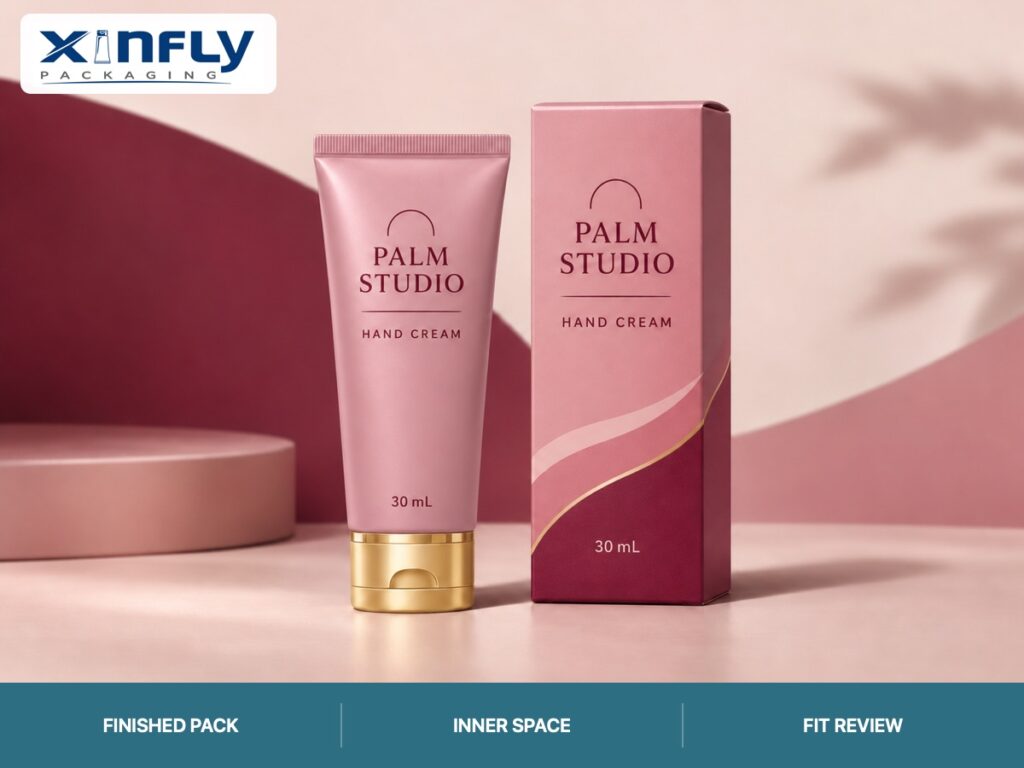
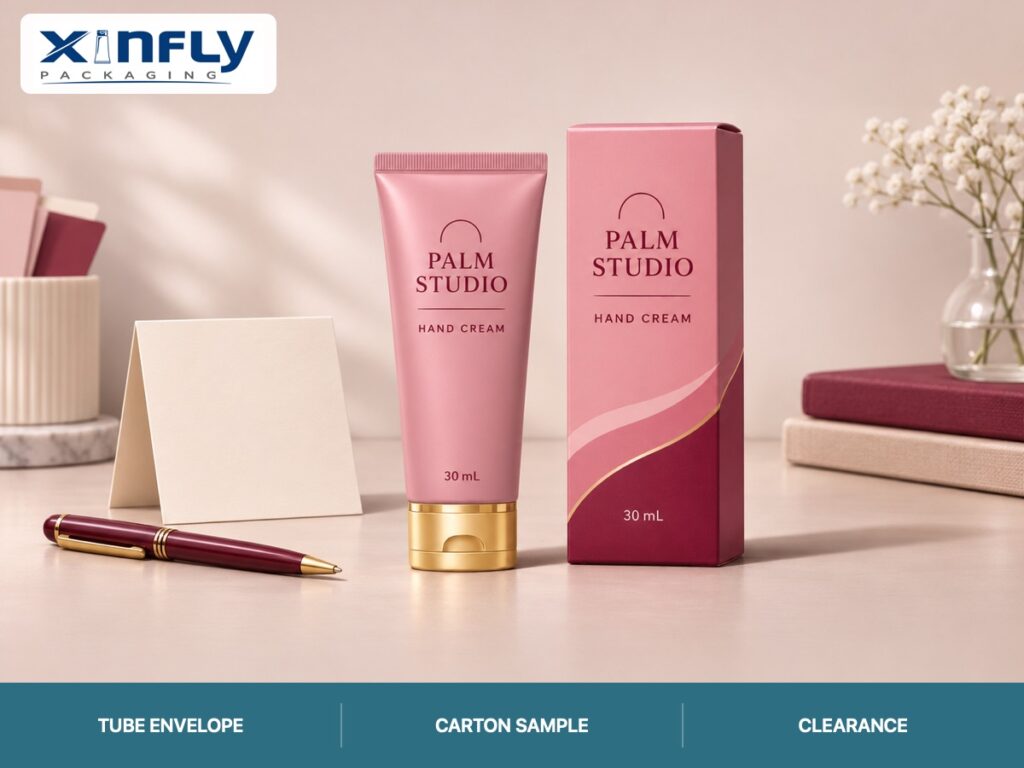
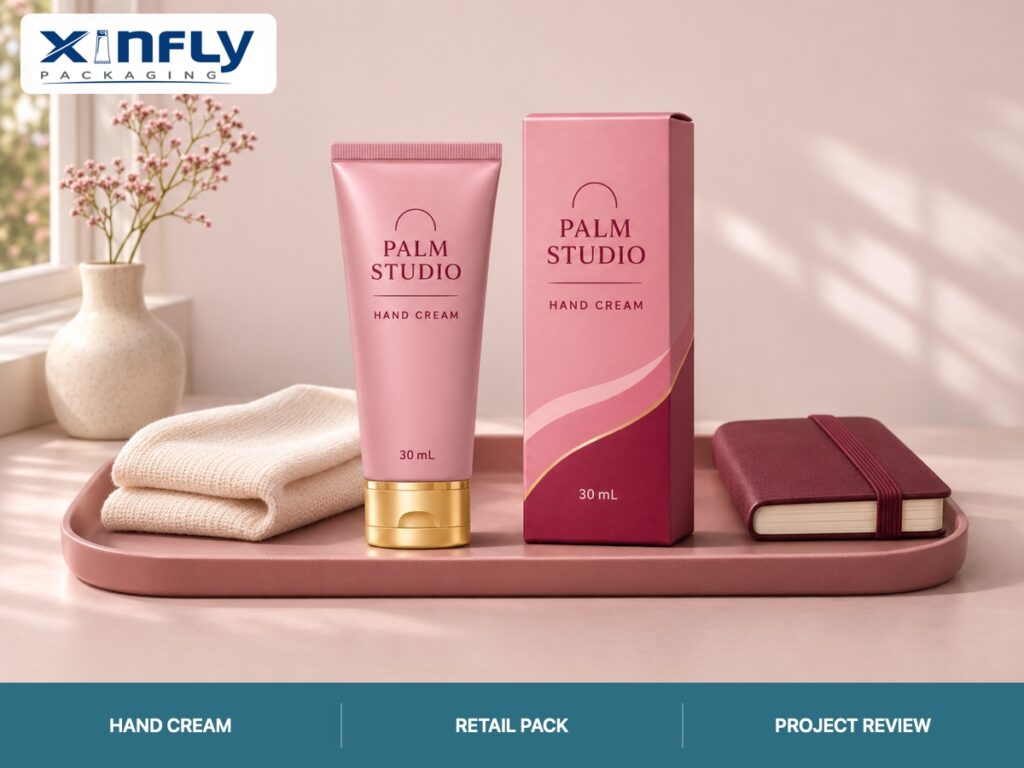
The illustrations show a fictional PALM STUDIO design: a dusty rose PE-style tube with moulded shoulder, straight crimped display tail and gold-coloured round flip-top cap. Burgundy single-colour screen-print-style text and an arch appear on the tube. Its coordinating printed carton uses rose, burgundy, cream and a gold-coloured line. No drawing dimension or successful physical fit is represented by these illustrations.
Release Artwork Against the Agreed Structure
Once the structural reference is accepted for the applicable stage, the printing and artwork discussion should use the associated dieline revision. Ask the carton supplier which structural lines, safe areas and artwork conventions apply. If the construction changes, determine which artwork reviews need repeating. Do not rely on a filename containing “final” as the only link between artwork and structure.
Record Fit Observations Without Guessing the Cause
| Observation | Record with the observation | Question to resolve |
|---|---|---|
| Top closure interferes | Tube state, carton revision and contact location | Which structural reference needs review? |
| Tube moves more than intended | Orientation and complete pack components | Is the proposed restraint arrangement suitable? |
| Insertion is difficult | Entry direction and observed contact points | Does the sample represent the intended construction? |
| Insert changes the fit | Insert revision and assembly arrangement | Was it included in the previous fit review? |
| Display face is misoriented | Front artwork and insertion reference | Which orientation should the packing instruction specify? |
| Carton artwork changes | Structural and artwork revisions | Does the approved dieline still apply? |
| Tube cap changes | Old and new component references | Which fit checks need reassessment? |
These fields support a decision; they do not set inspection quantities or defect limits. Agree the applicable conditions and acceptance authority through the project’s quality assurance review. Where a concern remains, preserve the sample and its identity. A clear contact-point description is usually more useful to the engineer than an unsupported statement that the whole carton is too small.
Confirm What the Sample Represents
Distinguish an Appearance Mock-up from a Structural Sample
Ask sample development to identify the purpose and limitations of each specimen. A visually convincing carton may use different board or assembly details from the proposed production construction. A structural sample may have no final decoration. Neither is automatically wrong; the important question is which decision the specimen can support at its current stage.
Name the Remaining Approvals
The review may confirm the concept while leaving production material, print or a finished filled-tube reference pending. Write that status plainly. Before release, connect the relevant tube, closure, carton, insert and artwork references to the acknowledged decision. Ask the actual participants to record what they reviewed. Do not invent a completed packing trial or an unnamed technical sign-off.
Send a Fit-Focused Request to the Suppliers
A useful request can read: “Please propose a retail folding carton for the attached finished hand cream tube reference. Identify the assembled internal dimensions and their convention, closure construction, any insert, and the structural sample proposed for review. Please state what finished tube specimen is required and which details remain subject to physical fit confirmation.” Add the intended display orientation and packing-party contact.
Keep commercial scope explicit too. Ask whether the proposed quote includes the carton alone, an insert, printing, finishing or other agreed components. The matching carton in a product illustration does not prove those items are included in a tube quotation. Confirm quantities, component references and the scope of each supplier’s offer before comparing totals or issuing the purchase order.
Frequently Asked Questions
Can I choose a carton using only the tube’s nominal capacity?
Capacity does not define the finished external envelope. Identify the body, cap, finished tail and intended orientation, then supply the relevant dimensions or representative specimen. Ask the carton supplier and packaging reviewer to confirm the structure against the actual pack.
Is the printed dieline size the internal carton size?
Not necessarily. Ask the supplier to identify its dimension convention and the assembled usable cavity. The complete flat layout includes structural features that should not be treated as a simple internal length, width and height without the supplier’s interpretation.
What clearance should every 30 mL hand cream tube use?
This guide gives no universal value. The appropriate allowance depends on the selected tube, carton, components and packing requirements. Have the responsible packaging reviewer agree the design basis and confirm the relevant physical sample rather than borrowing an arbitrary number.
Does a photorealistic carton render prove fit?
No. A render can support visual discussion, but it does not establish the dimensions, material or behaviour of a physical pack. Request a representative structural sample and identify the tube condition and components used in the review.
What information should Xinfly Packaging receive first?
Send the intended tube and cap references, finished-pack dimensions or sample, display orientation, artwork and quantity. Identify whether the carton needs an insert and who will perform packing. Ask for the proposed structure and sample scope, with unresolved fields clearly marked.
Conclusion: Approve the Space the Tube Will Actually Use
Retail carton fit starts with a finished tube envelope and a clearly defined internal cavity. Connect those references to the closure, insert and structural sample, then record what the responsible reviewers confirm. Contact Xinfly Packaging with your hand cream tube and retail-pack requirements to discuss a coordinated quotation and fit-review plan.