Published: .
Your PBL tube sample is approved, the artwork is signed off, and the order is moving. Then a supplier proposes another laminate. It has the same broad material name and looks similar. Should purchasing accept the substitution to keep the project moving? You need a clearer basis than a reassuring email.
This PBL tube laminate substitution approval guide gives buyers a practical change record: what changed, which checks may be affected, who reviews the evidence and which lots the decision covers. Start with Xinfly Packaging’s PBL tubes for the commercial packaging category. Use the steps below when a particular laminate proposal needs to be compared with your approved construction.
First Define What Counts as a Substitution
A Material Category Is Not an Approved Specification
“Plastic barrier laminate” identifies a broad packaging family. It does not tell you that two suppliers’ webs have identical structures, thicknesses, sealing surfaces or supporting evidence. The same category name is therefore an incomplete reason to transfer an existing approval. Ask for the proposed construction’s identifier and revision, alongside the approved baseline it is meant to replace.
The change might concern the web supplier, a grade, a declared layer structure or another construction detail. Alternatively, the original construction may remain unchanged while its commercial distributor changes. Identify the actual difference before deciding the review scope. A concise, accurate change description saves more work than collecting a large folder of unrelated certificates.
Separate the Proposal from Permission to Use It
A request for technical review is not the same as authorization to ship changed goods. Give the proposal a change number and status. Record whether it is awaiting documents, awaiting samples, approved within stated limits or declined. The supplier and buyer should share the same understanding of that status before the proposed material reaches an order intended for the original specification.
Establish the Approved Baseline Before Comparing Alternatives
Gather the Records Behind the Signed Sample
Connect the original sample to its drawing, tube size, web specification, decoration revision and relevant component references. Include the intended formula and filling route where those formed part of the approval. If you cannot identify what the approved sample used, record that gap. Calling a new material “equivalent” to an undocumented baseline leaves the purchasing decision unresolved.
Do not rely solely on the appearance of an empty tube. An attractive sample can be valuable for artwork review without identifying every material feature needed for technical qualification. Ask which records are available, which details can be reviewed under confidentiality arrangements and what remains unverified. The evidence should answer your project’s question, not merely decorate the supplier file.
Give Every Comparison a Revision and a Date
Write “approved baseline revision A compared with proposed revision B,” using the actual identifiers. Save the supplier’s change description and the date it was received. If the proposal evolves during review, update the comparison. Otherwise, a test on the first proposal could be mistakenly cited as support for a later construction with a different identifier.
| Comparison field | Approved baseline | Proposed replacement | Buyer action |
|---|---|---|---|
| Construction identity | Supplier or construction reference and revision | Proposed reference and revision | Confirm exactly what is changing |
| Declared structure | Available layer and thickness information | Proposed structure and thickness information | Assign packaging review for relevant differences |
| Contact and sealing surfaces | Approved specification or reference | Proposed specification or reference | Ask formula and filling owners which checks are affected |
| Decoration route | Approved printing and finishing references | Confirmed route for the proposal | Review relevant artwork and appearance changes |
| Evidence scope | Reports tied to identified samples and conditions | Documents tied to the proposed construction | Check applicability rather than count certificates |
| Affected supply | Orders and lots using the baseline | Proposed first lot and effective point | Agree segregation and written release conditions |
Identify Which Checks the Change Could Affect
Let the Difference Drive the Review Plan
Ask the packaging, filling, formula and quality owners to assess the documented difference. A change in one part of a laminate may raise different questions from a change elsewhere. Do not decide that every substitution requires the same test list, or that an unchanged total thickness makes every other difference irrelevant. The review should explain why each selected check is needed.
For background on the supplied material format, Xinfly’s laminate web options provide a separate commercial reference. An option shown on a webpage is a starting point for a technical discussion. It is not confirmation that a specific web is interchangeable with the material in your approved order.
Ask the Filler About the Actual Changed Construction
Send the proposed construction information to the filling partner before arranging a trial. Ask which line settings, sealing checks and inspection records need review. The filler should define suitable conditions and acceptance criteria for the actual pack and process. This article does not supply universal sealing temperatures, dwell times or test limits; those would be unreliable without the relevant equipment and material information.
Keep Formula and Shelf-Life Decisions with the Right Owner
An empty-tube inspection cannot establish formula compatibility or the intended shelf life. Where the assessed change could affect those matters, involve the team responsible for the product’s qualification plan. Ask what existing evidence remains applicable and what additional work is required. Keep any conditional approval explicit about what has been reviewed and what still awaits a decision.
Read Supplier Evidence for Applicability
Match Documents to the Proposed Material
A report is useful when its sample identity, test scope and conditions relate to the decision in front of you. Compare the construction reference in the proposal with the sample description in the evidence. If the match is unclear, request clarification. A report for another tube body, cap or historical material is not automatically evidence for the replacement laminate.
Record who assessed the documents and the conclusion they actually reached. Do not translate “document received” into “construction qualified.” Likewise, a test result for a particular substance or property does not establish every regulatory, performance or environmental claim a finished package might carry. Keep the release wording inside the scope of the reviewed evidence and intended market requirements.
Explain Any Remaining Evidence Gap
If a supplier can provide only limited information, describe what that prevents your team from concluding. You might need a technical discussion, a better sample reference or a revised proposal. Purchasing can then assess the commercial implications with the technical uncertainty visible. Hiding the gap behind a general material label makes the next decision harder, not faster.
Review Decoration on the Changed Tube
Keep the Same Artwork Reference During Comparison
Use the same approved design when comparing relevant appearance features. A new layout or color scheme can conceal differences the team is trying to evaluate. If the change assessment calls for print trials, agree the decoration route and the observations to record. Xinfly’s printing and design services are relevant when a material proposal also needs a controlled artwork review.
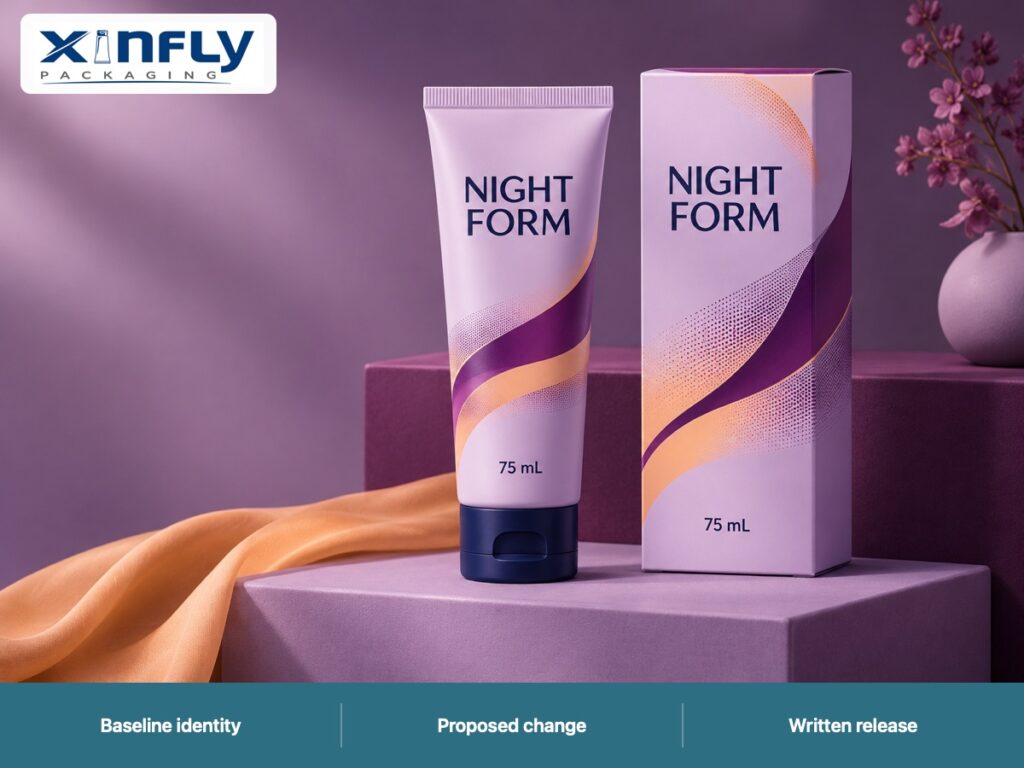
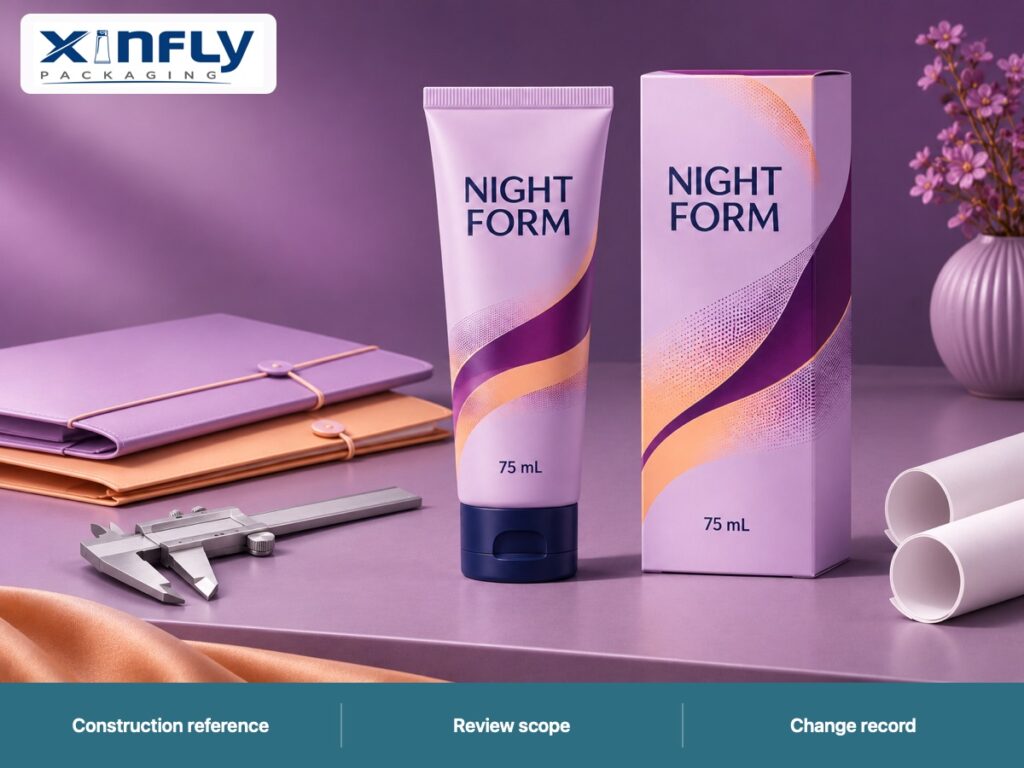
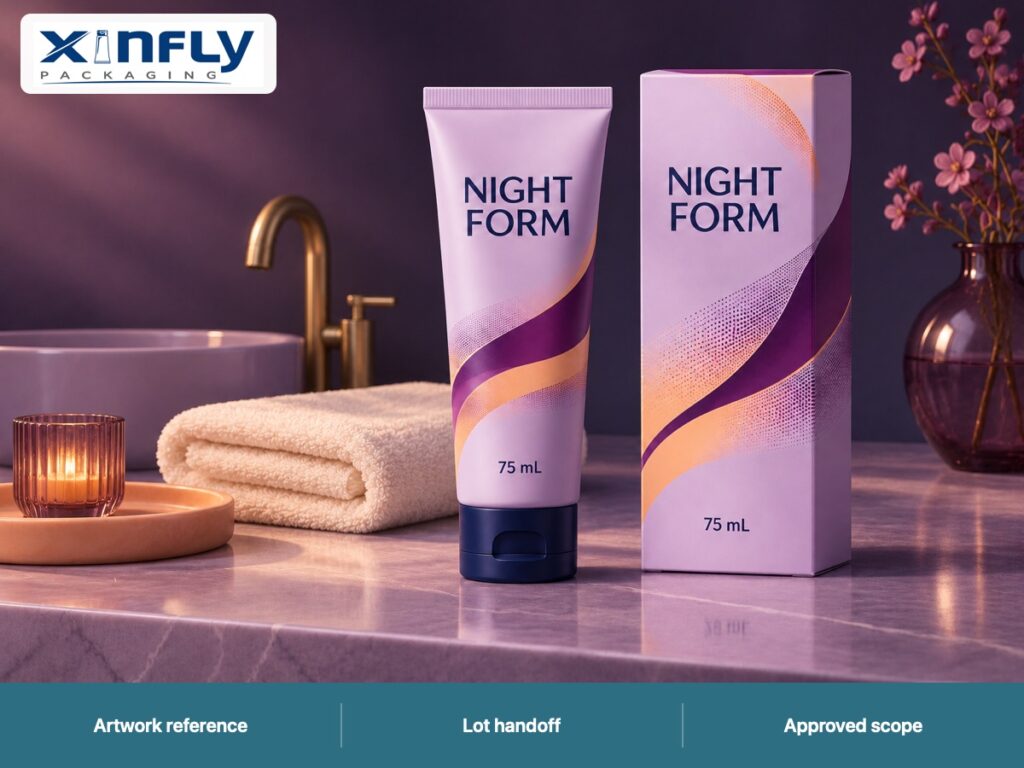
The NIGHT FORM illustrations in this article show a nominal 75 mL PBL body, molded shoulder, straight sealed tail and navy flip-top. The lavender, plum and apricot artwork represents an offset-print concept with a matching printed carton. The pictures explain the design context; they do not depict two tested laminates or prove that an alternative web will reproduce the same result.
Avoid Expanding an Appearance Approval
An accepted print sample resolves the appearance items listed in its approval. It does not silently approve sealing, compatibility, barrier performance or market documentation. Make the scope easy to read. The buyer should be able to tell whether a sample is accepted for color review, accepted for an identified trial or released for the specified order.
Control the First Order Using the Replacement
Define the Effective Point and Affected Stock
Ask the supplier to identify the first order or lot proposed for the replacement, plus any original-material stock or work in progress relevant to the transition. Agree how those supplies will be identified. If mixed deliveries are proposed, ask for a clear packing and lot record so receiving can distinguish them. Do not assume a material change starts neatly at the next calendar month.
| Gate | Question to resolve | Record needed before proceeding |
|---|---|---|
| Proposal intake | What exactly differs from the approved baseline? | Change number, side-by-side specification references and supplier explanation |
| Impact review | Which product, process and presentation decisions could be affected? | Review scope agreed by responsible packaging, formula, filling and quality owners |
| Sample planning | What samples and conditions address those questions? | Identified construction, trial plan and project acceptance criteria |
| Evidence review | Do documents and observations support the requested approval scope? | Traceable findings, gaps and the responsible reviewers’ decisions |
| Commercial release | Which order and material version may be supplied? | Written release with effective point, conditions and stock treatment |
| Receiving handoff | Can the delivered goods be matched to that release? | Order, lot and packing identification connected to the change record |
Plan the Trial Before Asking for Samples
Use sample development to discuss the required sample state and purpose. Do you need empty decorated components, packs for a filling trial or another agreed preparation? Identify who supplies the formula, performs the trial and retains the reference. Confirm sample availability and timing for the project rather than assuming they follow the original quotation.
Put the Release Decision into the Purchasing Record
State What the Approval Covers
The final release should identify the baseline, replacement, evidence reviewed, approved use and effective order or lot. Add any conditions and unresolved items. Connect that record to the purchase order and relevant supplier documents. A named project owner should be able to retrieve the decision without reconstructing it from scattered messages.
If the review does not support release, record that outcome just as clearly. “Still under review” should not drift into approval because an order is urgent. Discuss the available commercial options using the actual material status, including whether the original specification remains available. Costs, quantities and timing require a supplier response; this guide does not assume any particular outcome.
Send Xinfly Packaging a Reviewable Change Brief
For a new or repeat PBL tube project, share the approved specification reference, proposed change, affected order and intended formula and filling route. Identify the decisions your team needs to make. Contact Xinfly Packaging with that comparison so the discussion can focus on missing information, sample scope and a documented approval path.
Frequently Asked Questions
Are two plastic barrier laminate tubes interchangeable if both are called PBL?
The category name alone does not establish interchangeability. Compare identified constructions and ask the responsible teams to assess relevant differences. Transfer an existing approval only where the reviewed evidence supports that decision for the intended pack and use.
Does the same total laminate thickness mean no further review is needed?
No. Equal total thickness does not describe every construction detail. Establish what changed, then let the impact assessment determine the review scope. Avoid inventing a universal test requirement or exemption based only on that single dimension.
Can I approve a substitution from a supplier certificate alone?
A certificate or report may support a particular question, but its usefulness depends on its scope and sample identity. The release decision should address the actual proposed change, relevant project requirements and any remaining evidence gaps. Document receipt by itself is not approval.
Who should approve the replacement laminate?
Assign owners according to your project’s responsibilities. Purchasing coordinates the commercial release, while packaging, filling, formula and quality teams review the issues within their roles. Record actual participants and decisions instead of adding reviewers who did not take part.
What happens to the approved sample after a change?
Retain its identification as the original baseline and identify any newly approved reference separately. Record which orders each version covers. Keeping both records makes later receiving questions and repeat-order discussions easier to resolve without confusing the original and replacement constructions.
Conclusion
A manageable laminate substitution begins with an identified difference and ends with a traceable release. Compare the approved baseline, assign the relevant checks, review evidence for its actual scope and define the affected supply. That gives Xinfly Packaging, your filler and your buying team a shared decision record for the particular PBL tube project, instead of relying on a broad material name.