Published: .
A supplier offers a “30% PCR tube.” Your buyer compares it with another quotation and assumes the percentages describe the same thing. They might not. One could refer to a defined body component, another to a layer or resin blend, and another to a wider packaging assembly. Before comparing the numbers, you need to know what each number divides by.
A PCR cosmetic tube recycled content calculation starts with that weight basis. This guide gives purchasing teams a component worksheet and a document request list. For commercial material options, begin with Xinfly Packaging’s PCR cosmetic tubes. The calculations below illustrate scope differences; they do not state the PCR content of an available Xinfly product or authorize a packaging claim.
Put the Percentage Boundary in Writing
Ask What the Supplier’s Number Describes
Request a definition alongside the percentage. Does it describe a purchased material, a particular layer, the extruded wall, the body-and-shoulder assembly or the complete tube with its cap? Those are different boundaries. If the quotation only says “PCR 30%,” ask the supplier to identify the numerator, denominator and supporting reference before treating it as a comparable specification.
Keep the same boundary in the sample request and order. An accurate material statement can become misleading when somebody copies it into a field labeled “whole pack.” Purchasing can prevent that problem by preserving the original scope instead of shortening every description to one percentage. The specification should remain understandable to design, quality and marketing colleagues too.
Distinguish Post-Consumer Content from Other Material Descriptions
Ask the supplier to identify what it means by PCR and which records support the post-consumer portion. Do not silently combine an unspecified recycled-content figure with a confirmed post-consumer figure. Similarly, a resin trade name or certificate title does not supply the missing percentage or the weight of the component in your proposed pack.
This is a data-definition step before the calculation. If information is unavailable, mark it as unknown and describe what remains unresolved. A blank source field should not become a zero, and a general recycled-content statement should not become a verified PCR fraction simply because a spreadsheet needs a number.
Build the Calculation from Identified Components
List Every Item Inside the Chosen Boundary
For a tube-and-cap boundary, identify the body, shoulder, closure and any other relevant parts. If your source record combines some items, state that combination clearly. For a wider tube-plus-carton boundary, add the carton and other included packaging items. Record excluded items as well so somebody reviewing the worksheet can reproduce the same calculation.
Use weights that belong to the actual identified specification and state. A nominal 100 mL capacity is a volume description, not the empty packaging weight. An untrimmed sample, a finished empty assembly and a filled product are also different weighing states. The responsible team should define the measurement basis and the precision appropriate to the project.
Use the Same Units Throughout
Calculate PCR mass for each included component as its mass multiplied by its supported PCR fraction. Add those PCR masses, divide by the total mass inside the defined boundary and multiply by 100. Keep grams and fractions consistent. Do not average component percentages without their weights; a light cap and a heavier body do not contribute equal mass by default.
Work Through a Controlled Arithmetic Example
Label the Inputs as Hypothetical
Assume, only for this calculation, that an entire defined body-and-shoulder component weighs 9 g and has a supported PCR fraction of 30% across that component. Assume a 3 g cap and a 10 g carton each have 0% PCR. These are invented arithmetic inputs, not measured component weights, available specifications, certificate results or recommended content levels.
| Included item | Assumed mass | Assumed PCR fraction | Calculated PCR mass |
|---|---|---|---|
| Defined body-and-shoulder component | 9 g | 30% | 2.7 g |
| Cap | 3 g | 0% | 0 g |
| Carton | 10 g | 0% | 0 g |
Within the assumed body-and-shoulder boundary, the result is 2.7 divided by 9, or 30%. Within the tube-and-cap boundary, it is 2.7 divided by 12, or 22.5%. If the chosen boundary includes that assumed carton too, it becomes 2.7 divided by 22, or approximately 12.27%. The PCR mass has not changed. The set of included packaging items has.
Keep the Zero Assumption Separate from Missing Evidence
The example deliberately assigns zero PCR to the cap and carton. In a live project, an unknown fraction is not the same input. Keep unknown values visible and request the missing information, or define a clearly limited calculation that excludes the unresolved scope. Do not present an incomplete worksheet as a verified whole-pack result.
Check Whether the Percentage Applies Only to a Layer
Consider a different hypothetical construction: a 6 g wall has 30% PCR, while a separate 3 g shoulder and 3 g cap are assumed to have none. The PCR mass would be 1.8 g, giving 15% within the 12 g tube-and-cap boundary. This example explains why a wall-specific or layer-specific fraction cannot simply be copied onto the entire assembly.
Request Evidence for the Inputs Before Comparing Quotes
Match the Material Record to the Offered Construction
Ask how the supplied PCR fraction is connected to the proposed component, layer or construction reference. Where the supplier provides a declaration, certificate or other supporting document, review its scope and identity. The existence of a document does not, by itself, establish every number in your worksheet or confirm the PCR content of a different ordered assembly.
For custom PCR cosmetic tubes, preserve the proposed material reference, component specification, decoration and cap choice in one quotation record. If two bidders define the body differently, ask for clarification before comparing their percentages. A precise comparison may require a component-level response rather than another general statement that the tube uses recycled plastic.
Record How Component Weights Were Established
Identify whether a weight came from a measured sample, an engineering estimate or another stated basis. Keep its revision and date. Ask the responsible team which basis is suitable for the current decision and what must be confirmed before release. An early planning estimate can be useful without pretending to be the final production measurement.
When the supplier changes a cap, shoulder or wall specification, review the affected weight entries. Even with the same PCR mass in one component, a heavier component elsewhere can change the result within a wider boundary. Your calculation record should make those dependencies clear enough that a repeat-order buyer knows when to revisit it.
| Input or record | Question for the supplier | What purchasing should retain |
|---|---|---|
| Percentage definition | Which material, layer or component does this fraction cover? | Exact scope and reference |
| Post-consumer basis | What supports the identified PCR portion? | Applicable source or declaration and its limits |
| Construction identity | Which proposed specification uses that material? | Drawing, material reference and revision |
| Component masses | How were the included weights established? | State, units, basis and relevant sample identity |
| Assembly boundary | Are shoulder, cap, liner, label and carton included? | Explicit inclusion and exclusion list |
| Unresolved inputs | Which values still need confirmation? | Visible gaps and responsible follow-up owner |
| Change control | Which changes require the worksheet to be updated? | Effective specification and release reference |
Keep Arithmetic Separate from Public Claims
Use the Worksheet as an Input to Claims Review
For U.S. marketing review, the FTC’s recycled-content guidance in 16 CFR 260.13 discusses substantiation for post-consumer distinctions and qualification of partial recycled-content claims by weight. Its multi-component examples show why scope matters. Have the responsible reviewer assess the intended wording and complete evidence for the actual product and market; this procurement worksheet does not approve label language.
Avoid turning a supported percentage into unrelated promises about recyclability, biodegradability, compostability or lower emissions. Those are separate questions with their own evidence needs. Xinfly’s sustainable packaging material options can help organize the material discussion, but a category page does not establish every claim for an assembled pack.
Do Not Read Content from a Photograph
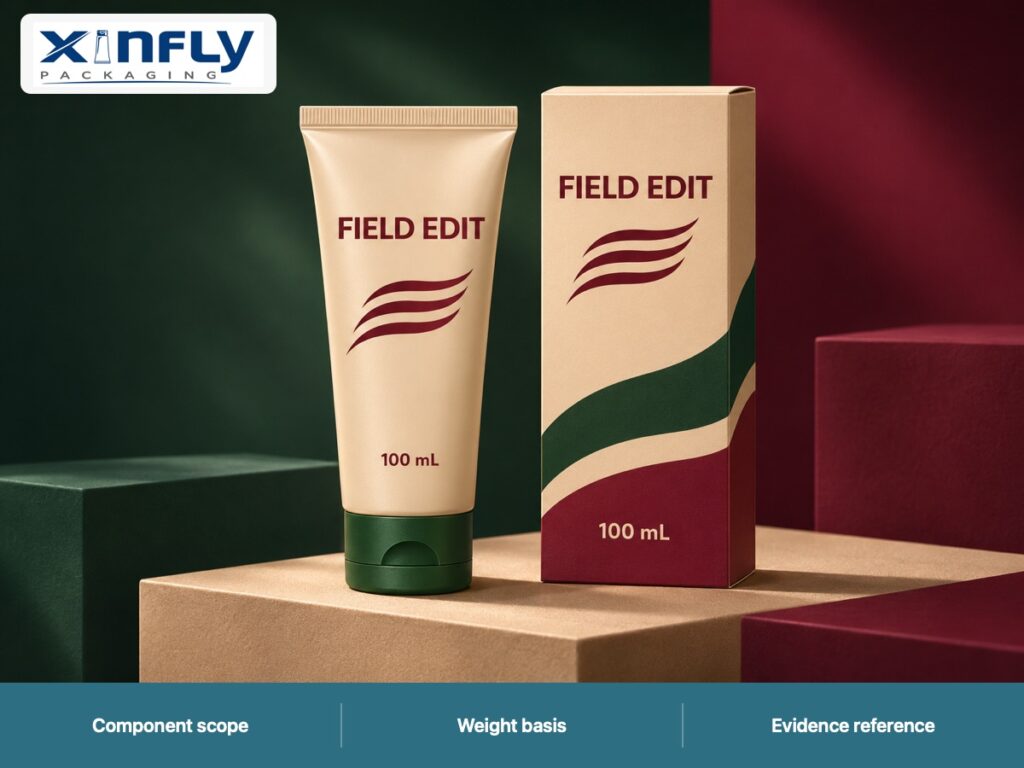
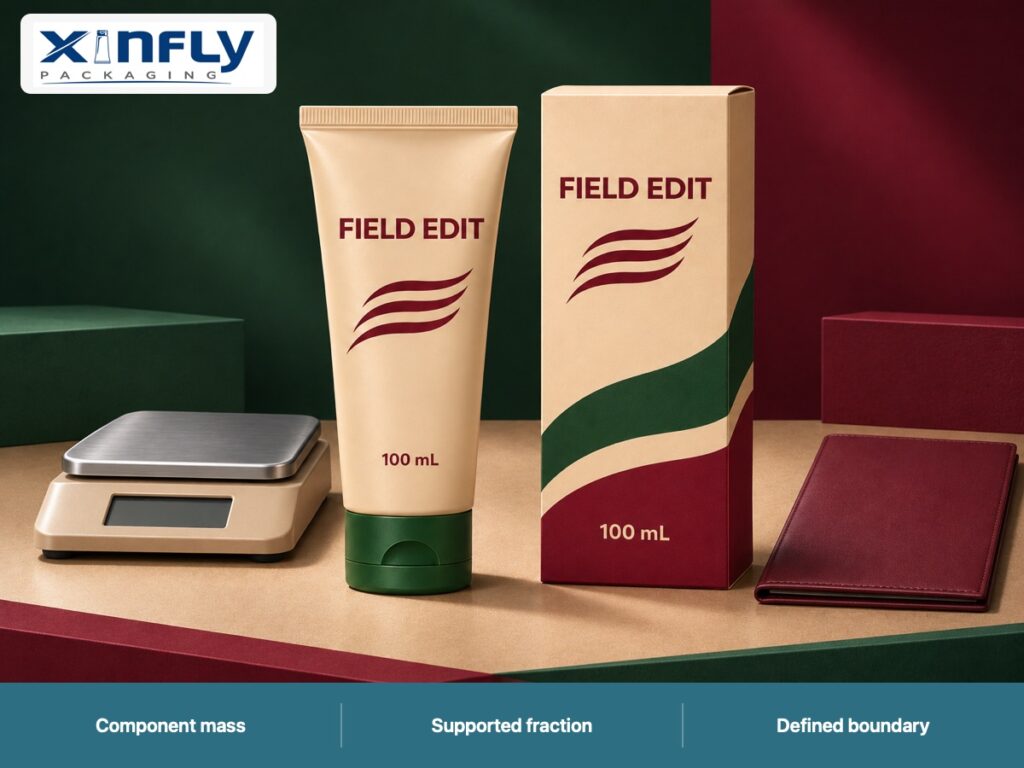
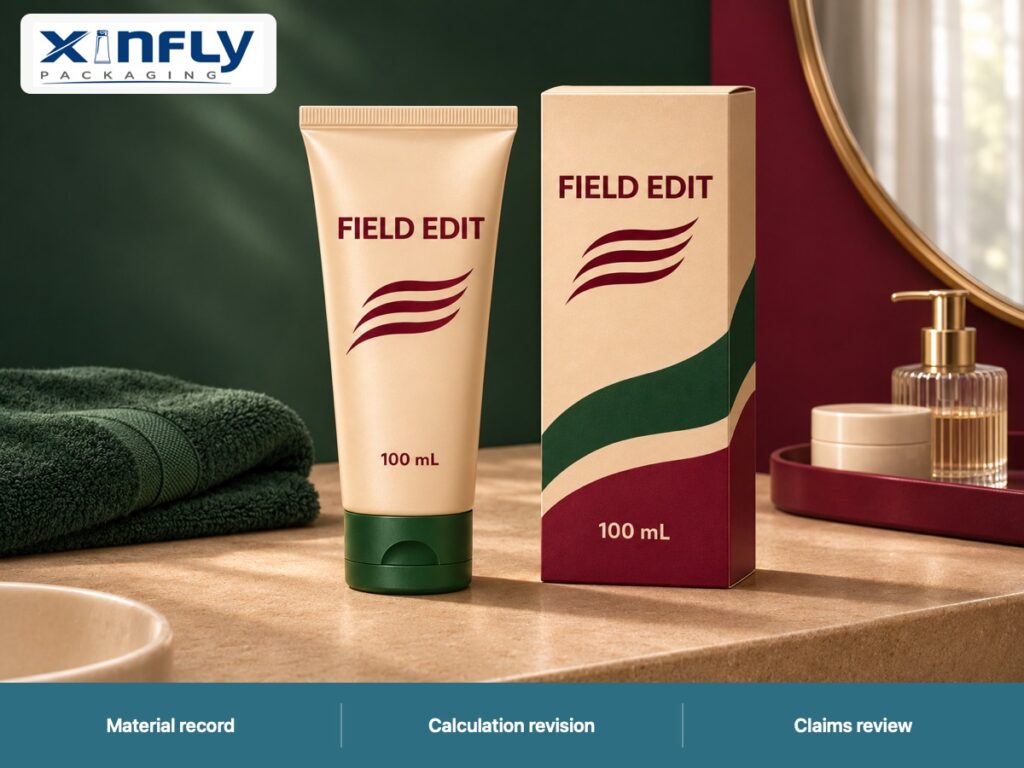
The FIELD EDIT illustrations show a sand-colored nominal 100 mL PE tube, molded shoulder, straight sealed display tail and forest-green flip-top, with burgundy one-color screen printing and a matching printed carton. No PCR percentage is printed on the concept. Appearance alone cannot establish recycled content, and these pictures do not depict a certified construction or a measured component-weight exercise.
Preserve the Basis Through Sampling and Ordering
Connect the Sample to the Data Sheet
When arranging sample development, identify which sample corresponds to the proposed construction and what the sample is intended to resolve. Keep appearance, fit, formula qualification and content documentation as distinct approval items. One attractive decorated sample should not silently close missing material records or establish a whole-pack percentage.
For PCR cosmetic packaging inquiries, send the intended component boundary alongside capacity, closure, artwork, quantity and destination. Ask the quotation to identify any assumptions or values still awaiting confirmation. Discuss project-specific availability, quantities, costs and timing rather than assuming a stated material percentage fixes the commercial terms.
Freeze the Approved Calculation with the Specification
Save the component list, supported fractions, weight basis, arithmetic, evidence references and actual review decisions together. Give the worksheet a revision that can be linked to the released order. Keep the proposed marketing wording separate and identify its review status. That makes later changes easier to assess without rewriting the original basis from memory.
If you want Xinfly Packaging to review a PCR tube brief, send your component scope and material requirements. Identify whether your priority is a body-specific specification, a wider assembly comparison or data needed for a separate claims review. A defined question helps the supplier provide the information purchasing actually needs.
Frequently Asked Questions
Is 30% PCR in the tube body automatically 30% in the tube and cap?
No. The wider result depends on the mass and supported PCR fraction of every component included in that boundary. Use the body figure only within its documented scope, then calculate the wider value from the identified component data.
Can I average the body and cap percentages?
Use a mass-weighted calculation. Multiply each included component’s mass by its supported PCR fraction, add the PCR masses and divide by the total included mass. A simple average of percentages is not generally equivalent when component weights differ.
Should the formula inside the tube be included in this worksheet?
The examples here concern empty packaging components, not the cosmetic formula. State the boundary explicitly and use weights corresponding to that defined state. A different reporting or claims question needs its own agreed scope rather than a silent change to this worksheet.
Can a certificate replace component-weight information?
A document can support the matters within its scope. It does not automatically provide the mass of your cap, shoulder or carton, or resolve an undefined assembly boundary. Review what each input needs and request the missing records specifically.
When should the calculation be updated?
Review it when relevant construction, component weight, PCR fraction or included packaging scope changes. Retain the original record and connect the revised calculation to the affected specification and order. Ask the responsible claims reviewer whether any public wording also needs reassessment.
Conclusion
The useful question is not just “What percentage?” It is “What percentage of which identified packaging mass, supported by which records?” Define that boundary, calculate from components and keep unknown inputs visible. This gives Xinfly Packaging and your buying team a clearer comparison while preserving the separate evidence and review needed for any public material claim.