Published: .
You order enough tubes for a hotel launch, yet the packing team cannot finish the expected number of amenity sets. Shampoo is available. Body wash is available. Conditioner runs out first. The total number of tubes looked comfortable, but the mix was wrong for the set you planned to build.
Hotel amenity tube kit quantity planning starts with the contents of one finished set, then works backward to each component. This guide gives buyers a simple calculation and a supplier handoff sheet. For the underlying pack options, see Xinfly Packaging’s hotel amenities tubes. Use the worksheet to distinguish tube quantities, usable components and complete sets before issuing the purchase order.
Define One Finished Kit Before Counting Tubes
Write the Contents as a Bill of Materials
List each product and the quantity needed per kit. A three-product set might require one shampoo, one conditioner and one body wash, plus one printed outer carton. If another hotel uses two shampoos or omits the outer carton, it needs a different kit definition. Keep those versions separate even when some tubes share the same design.
Give every component a purchasing reference. Include the product name, capacity, artwork revision and relevant packaging specification. Color can help people recognize a variant, but it should not be its only identifier. A receiving team needs to distinguish the correct conditioner tube from a visually similar item approved for another property or language version.
Distinguish Empty Components from Ready-to-Kit Products
An empty decorated tube is not a filled amenity ready to place in a guest set. Identify the stage covered by your quotation and planning worksheet. If filling, finished-product release and kitting sit with separate companies, create a handoff for each. Otherwise, a tube delivery may be mistaken for stock that can already enter finished-kit assembly.
For hotel shampoo and conditioner tubes, keep packaging supply and formula responsibilities visible. Ask who supplies or fills the products, who approves finished goods and who assembles the kit. This article’s arithmetic can organize quantities at a defined stage, but the record must name that stage before the numbers become useful.
Calculate Complete Kits from the Limiting Component
Divide Each Usable Quantity by Its Per-Kit Requirement
For each component, divide the usable quantity by the quantity required in one kit. Round down to a whole number of kits. The smallest result is the number of complete kits those components can support together. This is why adding all tubes into a single total can hide a shortage in one product.
Include the printed outer carton or other required component in the same calculation. A missing box can limit finished sets even when all tubes are available. If a tray, sleeve or insert is part of the approved kit, add it as its own line instead of assuming it is included in the carton count.
Use a Clearly Labeled Planning Example
The figures below are hypothetical arithmetic inputs. They are not a Xinfly order, production allowance, defect rate, MOQ or inventory statement. Assume each kit needs one of each listed item and that the units shown as usable have already reached the defined, accepted ready-to-kit stage. Quantities withheld are deliberate example reservations, not recommended percentages.
| Component | Quantity at the defined stage | Reserved or unavailable | Usable quantity | Complete kits supported |
|---|---|---|---|---|
| Shampoo tube | 1,040 | 20 | 1,020 | 1,020 |
| Conditioner tube | 1,030 | 30 | 1,000 | 1,000 |
| Body wash tube | 1,060 | 10 | 1,050 | 1,050 |
| Printed outer carton | 1,015 | 15 | 1,000 | 1,000 |
The limiting result is 1,000 complete kits. After those kits are assembled, the example leaves 20 usable shampoo tubes and 50 usable body wash tubes, with no usable conditioner tubes or cartons left over. The extra tubes are not another 70 finished sets. They are separate remaining components that need their own stock record.
Give Reservations Their Own Reason and Owner
Separate Samples, Held Stock and Deliberate Spares
Use different descriptions for units retained for sampling, units awaiting a quality decision and units intentionally reserved as service spares. They affect available quantities, but they do not mean the same thing. Ask the relevant owner which units may enter kitting and update the worksheet when their status changes.
Avoid automatically adding a fixed percentage to every component. An allowance needs a reason and agreement on its commercial treatment. Ask whether the supplier is quoting an exact quantity, a stated quantity range or another agreed basis. Confirm what you will be charged for and how delivered quantities will be reported for each SKU.
State Whether Spares Are Individual Products or Complete Sets
A request for “extra amenities” can mean individual replacement tubes, spare complete kits or both. Describe the intended stock clearly. If the hotel wants complete spare sets, reserve the corresponding carton and every required product. If housekeeping wants only replacement shampoo, record that as an individual-SKU requirement rather than increasing the kit target without explanation.
The distinction also helps when purchasing negotiates a top-up order. Ask which component is actually short and how it will be used. A balanced replenishment set may be unnecessary when one SKU alone limits assembly. Equally, buying only tubes will not resolve a shortage in the printed box or another required component.
Keep the Kit Artwork Connected to the Correct Mix
Match the Printed Carton to Its Contents
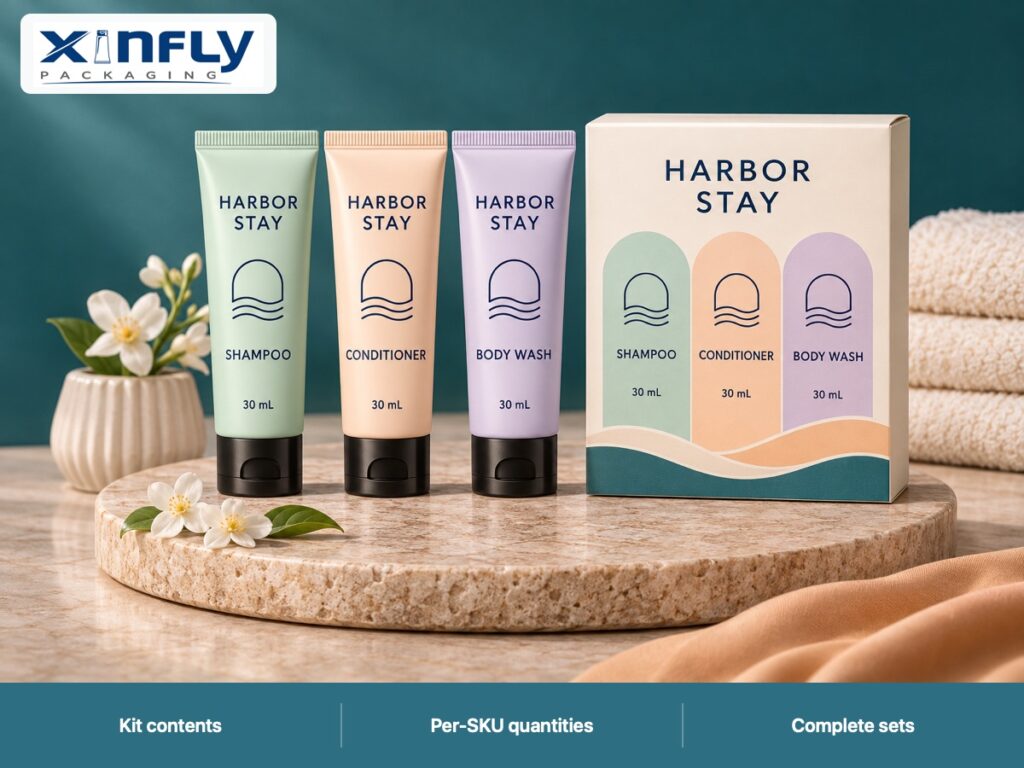
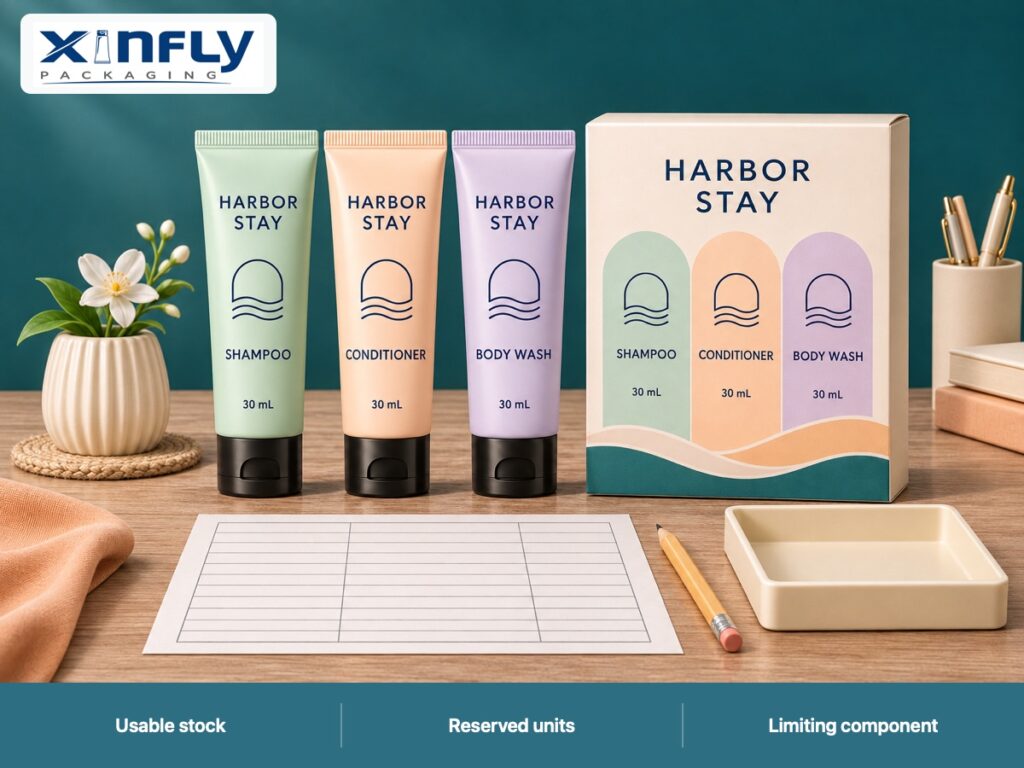
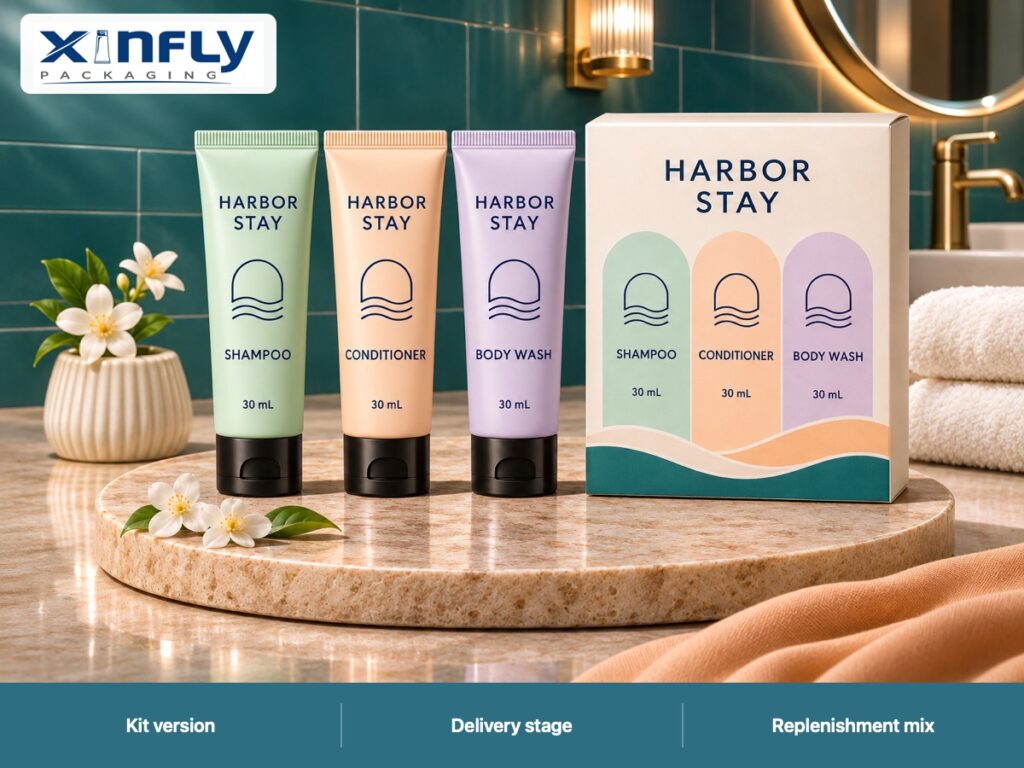
The HARBOR STAY illustrations show three nominal 30 mL PE tubes: seafoam shampoo, apricot conditioner and lavender body wash. Each has a molded shoulder, straight sealed display tail, black flip-top and navy one-color screen-printed arch-and-wave artwork. The matching carton shows those same three products. It is a packaging illustration, not a delivered hotel order or a filled-product supply commitment.
When discussing custom cosmetic packaging boxes, send the actual finished tube dimensions and kit contents. A printed carton should be reviewed against the set it is intended to contain. If one product is removed or substituted, check whether the pack artwork, fit and component list need revision before old and new supplies are mixed.
Preserve Identity When Several Properties Share Components
Hotels in one group may share a common tube assembly while using different artwork or kit contents. Assign each finished-kit version its own reference and identify which components it uses. A common cap or capacity does not make the filled and printed products interchangeable. This is a quantity-control question as well as a design question.
Plan Partial Deliveries Around Complete Sets
Check the Mix Available at Each Handoff
A supplier may deliver some components earlier than others. Ask what the first shipment enables the receiving team to do. As another hypothetical example, 600 shampoos, 500 conditioners, 700 body washes and 650 cartons support only 500 complete three-tube kits when each set uses one of each. The remaining components can be tracked, but they cannot complete the missing sets by themselves.
Do not describe that example as a recommended shipment or a promised lead time. Use it to ask a practical question: which quantities must reach the same handoff before the planned kitting activity can proceed? Agree the answer with the parties responsible for packaging, filling, assembly and delivery, based on their actual capacities and commitments.
Put the Delivery Stage Beside the Date
Clarify whether a date refers to empty tubes ready for dispatch, arrival at the filler, accepted filled products or completed kits. Each is a different milestone. A launch schedule built around the wrong stage can look on track until the last handoff. Ask for project-specific timing and identify the conditions on which that timing depends.
| Planning item | Question to resolve | Record to retain |
|---|---|---|
| Tube supply | Which SKUs, artwork revisions and quantities are included? | Per-SKU order and delivered quantity record |
| Filling scope | Who supplies formula, fills and releases finished products? | Responsibility split and defined stock stage |
| Outer packaging | Are boxes, sleeves or inserts included, and in what state? | Component references and quantities |
| Assembly | Who builds the kit and verifies its contents? | Agreed kit bill of materials and assembly record |
| Reservations | Which units are samples, held stock or planned spares? | Reason, quantity and decision owner |
| Partial deliveries | How many complete kits can each handoff support? | Component balance by shipment or milestone |
| Replenishment | Which remaining components and finished kits are available? | Separate component and complete-kit stock balances |
Compare Quotations on the Same Unit Basis
Label Per-Tube and Per-Kit Prices Clearly
A price per tube is not a price for a three-tube kit. The kit may also require outer packaging, filling, assembly or other separately quoted activities. Ask each supplier to identify what the unit represents and what is included. Compare the same contents and stage before deciding which offer is more suitable.
For 30ml squeeze tubes for hotel amenities, request the body, cap, decoration and carton scope explicitly. Confirm the actual assembly dimensions and project requirements through sample development. A capacity description helps organize the inquiry, but it does not establish the complete dimensions, fit or work included in the quote.
Use One Reconciliation Record at Receiving
Reconcile Expected, Received and Released Quantities
Keep the expected order quantities separate from what arrived and what has been accepted for the defined next stage. Record differences by component. The person coordinating the kit should see the resulting complete-set count without having to infer it from several packing lists. Keep individual leftovers visible after assembly as well.
Connect quantity checks to the agreed receiving process and quality assurance requirements. Counting units and accepting their quality are related handoffs, but one does not automatically settle the other. Units awaiting a disposition should have a visible status so the kitting plan does not count them as available by accident.
Send Xinfly Packaging the Whole Kit Brief
Share the kit contents, per-kit quantities, SKU specifications, artwork versions, desired stock stage, outer packaging and delivery destination. Identify any planned individual spares or complete spare sets separately. Contact Xinfly Packaging with your amenity kit brief to discuss the packaging proposal and its confirmed commercial scope.
Frequently Asked Questions
Can I divide the total tube quantity by three to calculate kits?
Only when the required three SKUs are available in the necessary balance and every other required component is available too. Calculate the supported kit count for each component and use the smallest result. A combined tube total can conceal a shortage in one product.
Should samples and held units count as available for assembly?
Use the status agreed by the responsible owner. Identify samples, held stock and usable stock separately, then calculate kits from units actually released for that stage. Update the balance when a reservation or disposition changes.
Does a quotation for hotel tubes include filling and kit assembly?
Confirm the actual scope. Empty packaging, filling, finished-product release and kit assembly can be separate activities. State the delivered stage and responsibility split in the inquiry and order rather than assuming they are bundled.
How should I plan an early partial shipment?
List the usable quantity of every required component available at that handoff. Calculate the complete kits it can support and track the remaining components separately. Then confirm whether that result meets the intended milestone with the relevant suppliers and assembly team.
What should I send for a replenishment quotation?
Send the kit version, required complete-set quantity, remaining component balances and any individual-SKU demand. Include artwork and specification references. That lets the supplier discuss the actual top-up need instead of repeating an order mix that may no longer fit the stock position.
Conclusion
Reliable kit planning begins with one clear set definition. Count usable quantities by component, include the outer packaging and let the limiting component determine the complete-set total. With reservations, delivery stages and leftovers visible, Xinfly Packaging and your assembly partners can discuss a hotel amenity order that matches the sets you intend to deliver.