
A stand-up cap can look like a minor choice on a toothpaste tube quote. Then the first filled packs arrive at your contract packer. The cap clears the carton opening, but the seal catches a dust flap. Someone slows the line to turn the pack by hand. The tube reaches the shelf with a crease in the carton and a cap that rocks on the counter. Each symptom points to a different dimension. The time to find out which is before committing to either the tube tool or the carton dieline.
This toothpaste stand-up cap carton fit checklist is for brands pairing a filled tube with a folding carton. The example uses a 75 mL white aluminum barrier laminate tube, molded shoulder, dark blue stand-up screw cap, straight sealed tail, and blue and mint offset artwork. The matching paperboard carton carries its own print. Use the dimensions and checks below on the actual configuration you plan to order. Start with the options for custom toothpaste tubes.
Identify the Dimensions the Two Suppliers Share
Start With the Finished Tube
Ask the tube maker and filler to agree on the finished assembly before the carton supplier finalizes the dieline. A drawing for an empty open-ended tube can show the neck and barrel accurately while leaving finished tail length and seal width unresolved. Record the capped length, maximum barrel width, cap width across the widest point, and the tail width and thickness after trimming. Ask for the tolerance on each dimension and identify which are measured before or after filling.
Read the Cap Drawing at Its Widest Point
A stand-up screw cap has to do two jobs in this brief. It needs to seat correctly on the neck and support the finished tube on a flat shelf. The nominal diameter may describe a thread or another portion of the component. Ask for the widest actual exterior dimension, including ribs, corners, or the step between cap and shoulder. Measure the actual sample and compare it with the drawing. For a nonround cap, state the insertion orientation and check both axes.
Check the Base With a Real Fill
Set a filled tube on a clean, flat reference surface and look for rocking. Try it again after normal opening and closing. If the base becomes unstable only after the cap is refitted, check whether the cap sits fully home. If an upright tube leans after the tail is sealed, compare the shoulder, seal, and body orientation. These observations can help identify the cause. The agreed acceptance condition belongs in the project record so the factory and packer evaluate the same thing.
| Feature | Measure on | Why it matters |
|---|---|---|
| Finished capped length | Filled and sealed tube | Controls end clearance and closing flap pressure |
| Largest cap width | Production closure in its loaded orientation | Controls clearance at the entry and inside the carton |
| Barrel width and shoulder | Filled tube where its profile is widest | Controls wall rubbing and fit through guides |
| Seal width and thickness | Actual trimmed tail | Controls flap catch points and tail-first loading |
| Usable carton opening | Assembled carton with dust flaps in place | May be smaller than the outside dimensions suggest |
Set the Carton Opening From the Filled Sample
Measure the Inside, Including the Flaps
Ask the carton supplier for usable internal dimensions and the actual opening once the carton is formed. Paperboard thickness, fold position, dust flaps, and the glue seam can all affect the path into the carton. A generous outside width can hide a narrow entry. Have the packer mark where the cap, shoulder, and tail travel during insertion. Send those locations back to the carton designer before approving the printed carton proof.
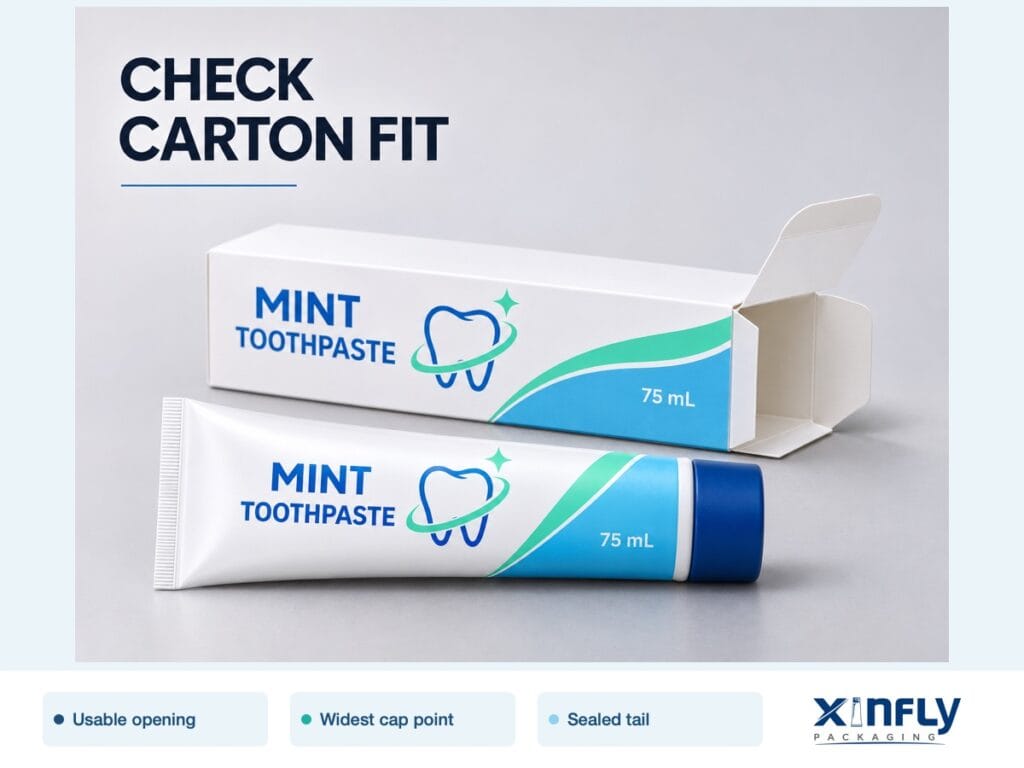
Choose Cap-First or Tail-First on the Actual Line
A rounded cap may feed smoothly into some cartons, while a tall tail can snag as it enters another carton. In a cap-first approach, check whether the closure flange contacts a flap or guide. In a tail-first approach, watch the crimp corners and batch code as they pass the opening. If the packer can run both directions, record jams and cosmetic damage separately and ask the team which presentation meets retailer and labeling requirements. Run the comparison using the same sealed tubes and the same folded paperboard lot.
Work With the Real Range of Dimensions
Compare samples near the large end of the tube tolerance with cartons near the small end of their internal tolerance. Then check the reverse combination so you can spot a package that rattles, turns, or slides into a flap. If you do not have limit samples, ask both suppliers how they can represent the dimensional extremes before production. Record exactly which parts were measured. A calculation is a good screening step, and a pilot on production-representative packs shows what happens during loading and closing.
Check the Printed Carton and Tube Together
The carton and tube use different substrates. An offset design on a laminate and ink on paperboard can look different under the same light. Compare both printed proofs next to each other, and decide which colors should match and which should contrast. Check that the carton variant, product name, and fill identify the tube correctly. Ask for blank space or a dedicated area for coding where required. Approve the folding carton design against the current tube and cap revision.

Run a Pilot Before You Approve the Purchase
Record Fit, Handling, and the Finished Appearance
Have the contract packer use the proposed cartons, filled tubes, and equipment settings during a small controlled run. Inspect the packages immediately after loading and after the agreed handling or shipment trial. Look for a crushed flap, the corner of a seal wearing into the carton, abrasion around the cap, or the tube twisting in a loose carton. Document the first failure at each station and ask the packer to show it again with another unit. Photos and sample codes help the supplier reproduce the issue.
| Check | Record before release | Follow-up when it fails |
|---|---|---|
| Insertion | Direction, jam point, package orientation, and affected lot | Compare the largest tube and smallest carton at the interference |
| Carton closure | Flap engagement, bowing, pressure marks | Check internal length and the location of the seal |
| Shelf use | Cap seating, base contact, and rocking | Check actual cap fit and finished tube alignment |
| Handling | Scuffs, carton deformation, and movement after the agreed trial | Adjust the contact points or the packout |
| Identification | Tube and carton revision, coding position, and visible product name | Align the approved tube artwork and carton artwork versions |
Decide Which Changes Need a New Trial
State which dimensions or components require a fresh carton fit check. A new cap, new laminate construction, different seal trim, or carton stock may affect the result even if the nominal fill stays at 75 mL. A revised line guide or carton opening direction can change it as well. Use the toothpaste tube packaging guide for related material and closure decisions, then document what actually changed in your approved assembly.
Ask for a Small Trial Across More Than One Carton Stack
A clean demonstration with a handful of cartons can miss variation in the folded blanks. For the production-style trial, ask the packer to pull cartons from more than one stack if available. Have them track the incoming stack and tube lot rather than mixing everything together. If the same defect appears in both, investigate a common dimension or a line setting. If it appears only in one, compare how the affected cartons open and where their flaps sit. This is a buyer's troubleshooting plan, so agree with the packer on how many samples they need to represent their process.
Turn the Trial Into a Release Record
Add three columns to the packing sheet for the number checked, the number affected, and the location of the failure. Record the instruction for holding a lot when a dimension is out of tolerance. Include a photo of a correctly closed end and a photo of each defect you expect inspectors to identify. Sign off the approved configuration with the tube maker, filler and carton supplier. If a closure is supplied separately, identify which party checks it at receiving and which party verifies its fit after filling.
Confirm Print Orientation at the Packing Station
Ask the operator to load a few finished tubes without explaining where the front is. Check whether the pack is consistently oriented when opened at the retail end. If orientation matters, show the reference on the packing instruction and test whether a guide or mark makes the setup repeatable. A beautiful carton proof does not show whether the production line puts the product inside the right way.
Agree on Which Teams Own the Measuring Tools
Tell the filler which dimensions to check at the line and tell the carton supplier which internal dimensions it should report on the formed blank. Agree on the measuring tools and where they contact the part. A flexible shoulder can distort under a tight instrument grip, while an outside carton measurement can conceal a tight internal flap. Record how to handle a dispute over which part is out of tolerance. The documentation should name the approved reference and revision for both pieces. This avoids repeating the pilot whenever an incoming inspector and a supplier measure from different surfaces.
Compare Quotes at the Packed Unit Level
Request the same tube, cap, finished dimensions, printing, carton board, quantity per variant, and packing requirements from each supplier. Clarify which company supplies the samples and runs the line trial. Ask which setup costs recur when a carton graphic changes or an alternate cap is needed. Include the likely cost of handling or sorting affected units if either party suggests a dimensional change. Bring Xinfly Packaging a finished sample or drawing and request a coordinated packaging quote.
Frequently Asked Questions
Does a 75 mL toothpaste tube have a standard carton size?
Ask for the completed tube dimensions. A different diameter, closure or seal can change the envelope even when the fill is the same. Match the carton to the exact assembly.
Which end should go into the carton first?
Test both directions where your equipment supports them. Choose based on how the actual cap and tail pass the flaps and guides, and on the final display orientation you need.
Can I approve the carton using an empty tube sample?
Use the empty sample for preliminary dimensions. Approve the carton with a filled, capped, sealed, and trimmed sample from the intended configuration so the size and stiffness represent the pack.
What should I do if the pack fits but the carton bulges?
Check the internal length, the seal position, and the pressure of the dust flaps. Use witness marks or photos to identify the first contact before increasing all dimensions.
Does a different color cap require a new carton trial?
Confirm whether only the colorant changed. If the resin, tool, closure supplier, or measured dimensions change, assess which fit and standing checks should be repeated on the new production sample.
Conclusion
Specify a stand-up toothpaste cap as part of the filled tube and the carton system. Measure the cap, barrel and tail on finished units, and have the packer run the actual printed carton through the intended loading process. Save the dimension record and reference samples with the purchase order so the next lot can be compared against the same decision.