

Toothpaste Tube Packaging Guide: Materials, Sizes & Closure Options
Toothpaste tube packaging is more technical than many beauty brands first expect. The right tube must protect the formula, support smooth dispensing, match filling equipment, hold high-quality printing and create a reliable user experience from the first squeeze to the last use.
This guide explains how to choose toothpaste tube packaging for fluoride toothpaste, whitening toothpaste, kids toothpaste, natural toothpaste, hotel toothpaste, sensitive toothpaste and private label oral care products.
- PE, ABL, PBL, Aluminum & PCR Options
- 10ml, 30g, 50g, 75g, 100g & 150g Sizes
- Screw Cap, Flip Top & Standing Cap Choices
- OEM / ODM Custom Printing Support
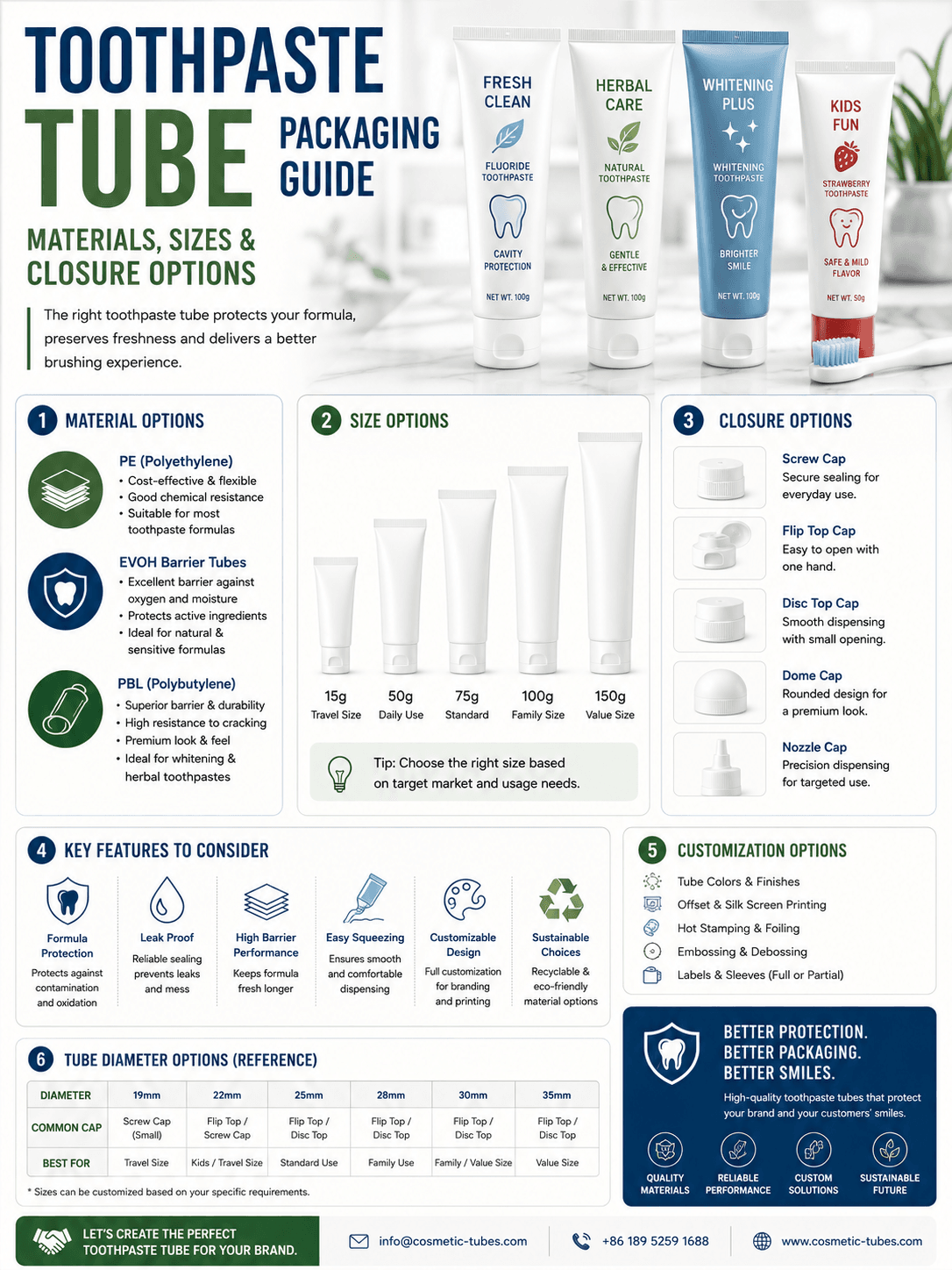
What This Toothpaste Tube Packaging Guide Covers
Why Toothpaste Products Require Specialized Tube Packaging
Toothpaste packaging must handle a dense paste formula, repeated squeezing, high-viscosity dispensing, long bathroom storage conditions and strict consumer expectations for hygiene and convenience.
Formula Compatibility
Toothpaste may contain fluoride, whitening agents, abrasives, herbal extracts, essential oils, flavor systems and sensitive active ingredients. The tube structure should be selected according to formula stability, ingredient sensitivity and shelf-life requirements.
Paste Dispensing Control
Toothpaste is thicker than most skincare lotions. Tube softness, shoulder design, outlet diameter and cap structure must support controlled dispensing without leakage, cracking or poor recovery after squeezing.
Brand & Retail Trust
Oral care packaging needs to communicate cleanliness, safety and professional credibility. Material choice, white base color, metallic details, matte finishing and precise printing can all influence buyer perception.
Toothpaste Tube Materials: PE, ABL, PBL, Aluminum, PCR and Multi-Layer Options
Material selection is the foundation of toothpaste tube development. Different formulas and market positions require different tube structures. For a broader explanation of cosmetic tube materials, you can also review how to choose cosmetic tube materials, 2-layer vs 5-layer plastic tubes and PE tubes vs laminated tubes.
PE Toothpaste Tubes
PE toothpaste tubes are flexible, lightweight and suitable for many daily oral care products. They are commonly used for standard toothpaste, natural toothpaste, kids toothpaste, hotel toothpaste and private label oral care launches. PE tubes can support offset printing, silkscreen printing, hot stamping, labeling and different surface finishes.
PE is a practical choice when the formula has moderate barrier requirements and the brand wants a flexible, cost-effective and recyclable-friendly packaging direction. For many entry-level and mid-range toothpaste projects, PE provides a strong balance between performance, appearance and production efficiency.
ABL Toothpaste Tubes
ABL tubes use an aluminum barrier layer and are widely used in toothpaste packaging because they provide strong barrier protection and good product stability. They are suitable for fluoride toothpaste, whitening toothpaste, herbal toothpaste, sensitive toothpaste and formulations that require better protection from oxygen, moisture or fragrance loss.
ABL is often selected when the brand wants a more protective, pharmacy-style or high-performance oral care package. If your team is comparing laminated tube structures, read ABL tubes vs PBL tubes.
PBL Toothpaste Tubes
PBL tubes are plastic barrier laminate tubes. They can offer a cleaner plastic appearance while supporting better barrier performance than basic single-layer structures. PBL toothpaste tubes are suitable for premium oral care, whitening toothpaste, natural toothpaste and brands that want a modern retail look with improved protection.
PBL can be a strong choice when the brand wants excellent decoration quality, a smooth tube surface and a more cosmetic-style appearance. Related options include PBL tubes manufacturer and laminate tubes.
Aluminum Toothpaste Tubes
Aluminum toothpaste tubes provide a classic collapsible packaging style and strong barrier performance. They are often used for specialty oral care, medical-style toothpaste, sensitive formulations, pharmacy packaging or brands that prefer a traditional metallic tube feel.
However, aluminum tubes have a different squeezing experience compared with PE or laminated tubes. They collapse during use and do not recover their shape like plastic tubes. For comparison, visit aluminum vs laminated squeeze tubes and aluminum cosmetic tubes.
PCR Toothpaste Tubes
PCR toothpaste tubes are suitable for oral care brands that want to reduce virgin plastic usage and communicate sustainability. They can be used for natural toothpaste, eco-friendly toothpaste, kids toothpaste and clean oral care product lines.
When selecting PCR for toothpaste packaging, buyers should confirm PCR percentage, tube color, decoration quality, cap matching and formula compatibility. For more sustainable material options, review PCR cosmetic tubes manufacturer, PE tubes vs PCR tubes and how to choose sustainable cosmetic tubes.
| Material | Best For | Key Advantages | Buyer Notes |
|---|---|---|---|
| PE Tubes | Daily toothpaste, kids toothpaste, hotel toothpaste | Flexible, lightweight, cost-effective, good printing support | Suitable for formulas with moderate barrier requirements |
| ABL Tubes | Fluoride toothpaste, whitening toothpaste, sensitive toothpaste | Strong barrier, good formula protection, trusted oral care structure | Often selected for high-performance toothpaste packaging |
| PBL Tubes | Premium toothpaste, natural toothpaste, cosmetic-style oral care | Smooth appearance, improved barrier, clean decoration quality | Good when both shelf appeal and protection matter |
| Aluminum Tubes | Specialty toothpaste, medical-style oral care | Excellent barrier, classic collapsible tube feel | Different user experience from plastic squeeze tubes |
| PCR Tubes | Eco-friendly toothpaste, natural toothpaste, sustainable oral care | Reduced virgin plastic, sustainability positioning | PCR percentage and appearance should be confirmed by sampling |
Barrier Options for Fluoride, Whitening and Sensitive Toothpaste
Barrier performance is especially important for toothpaste because many oral care formulas include active ingredients, flavor systems, abrasives and moisture-sensitive components.
The barrier requirement depends on the toothpaste formula. A hotel toothpaste or basic daily toothpaste may use PE, while whitening toothpaste, fluoride toothpaste, sensitive toothpaste or premium oral care formulas may benefit from ABL, PBL or other multi-layer structures.
Choose PE When
The toothpaste formula is stable, the launch requires flexible MOQ, cost control is important and the buyer wants a lightweight tube for daily oral care, kids toothpaste or hotel toothpaste programs.
Choose ABL When
The formula needs stronger protection from oxygen, moisture or flavor loss. ABL is suitable for fluoride, whitening, herbal, sensitive and export retail toothpaste packaging.
Choose PBL When
The brand wants a premium plastic laminate appearance with improved barrier performance and strong decoration quality for modern oral care packaging.
Recommended Toothpaste Tube Sizes by Capacity and Application
Toothpaste tube size affects filling volume, shelf presentation, shipping cost, dispensing experience and consumer usage frequency. For oral care buyers, the right capacity should match the product type, target market and retail channel.
If your team is still comparing tube diameter, length, capacity and artwork area, you can also review our tube capacity, diameter, length and thickness guide and design area dimensions guide.
| Capacity | Common Diameter | Best Application | Buyer Recommendation |
|---|---|---|---|
| 5g - 15g | 16mm - 19mm | Hotel toothpaste, amenity kits, travel sets, trial samples | Best for hotel amenities, airline kits and promotional oral care programs |
| 20g - 30g | 19mm - 25mm | Travel toothpaste, kids toothpaste, sample packs | Suitable for small retail formats and starter oral care kits |
| 50g | 25mm - 30mm | Kids toothpaste, whitening toothpaste, natural toothpaste | Good for compact retail products and premium oral care SKUs |
| 75g | 30mm - 35mm | Daily toothpaste, fluoride toothpaste, sensitive toothpaste | One of the most common sizes for standard toothpaste products |
| 100g | 35mm - 40mm | Family toothpaste, whitening toothpaste, herbal toothpaste | Suitable for mainstream retail oral care products |
| 120g - 150g | 40mm - 50mm | Family toothpaste, value packs, pharmacy oral care | Best for high-consumption markets and family-use positioning |
Hotel Toothpaste Tubes
Hotel toothpaste tubes usually use 5g, 8g, 10g or 15g capacity. The key purchasing logic is different from retail toothpaste: buyers care more about stable supply, clean design, low unit cost, packaging consistency and fast delivery. For this application, link to hotel toothpaste tubes and hotel amenities tubes.
Kids Toothpaste Tubes
Kids toothpaste tubes often use 30g, 50g or 75g capacity. Packaging should feel safe, friendly and easy to squeeze. Colorful printing, rounded caps, soft tube body and clear dosage control are important for parents and children. Related page: kids toothpaste tubes manufacturer.
Family Toothpaste Tubes
Family toothpaste commonly uses 100g, 120g or 150g tubes. These sizes provide larger front-panel branding area and higher filling volume, making them suitable for supermarkets, pharmacies and mass retail oral care products.
Toothpaste Tube Closure Options: Screw Cap, Flip Top and Standing Cap
The cap is a small component, but it has a large impact on leakage control, bathroom usability, hygiene perception, shelf display and consumer repurchase experience.
Most toothpaste tubes use screw caps or flip-top caps. Premium oral care and modern toothpaste brands may also use larger standing caps for better shelf stability. For a broader cap comparison, review screw cap vs flip cap vs airless pump, caps and closures, screw cap tubes and flip cap tubes.
Screw Cap Toothpaste Tubes
Screw caps are classic, secure and cost-effective. They are suitable for hotel toothpaste, travel toothpaste, fluoride toothpaste and standard retail oral care products. Screw caps also support simple color matching and reliable leakage control.
Flip Top Toothpaste Tubes
Flip-top caps improve convenience and one-hand operation. They are suitable for family toothpaste, kids toothpaste and premium oral care products where daily-use convenience matters. Related page: flip top cap tubes manufacturer.
Standing Cap Tubes
Standing caps help toothpaste tubes stand upright on shelves and bathroom counters. They are useful for premium retail toothpaste, whitening toothpaste and private label oral care brands that want stronger shelf presence.
Small Outlet Caps
Small outlet caps support controlled dispensing for kids toothpaste, sensitive toothpaste and sample-size products. They help reduce waste and improve dosage control.
Large Outlet Caps
Some high-viscosity toothpaste formulas need a slightly larger outlet for smoother dispensing. This should be tested during sampling to avoid difficult squeezing or over-dispensing.
Custom Color Caps
Cap color can support product range segmentation, such as blue for whitening, green for herbal, pink for kids toothpaste and white for professional oral care products.
Toothpaste Tube Packaging by Application Scenario
This guide can work as the hub page for your Toothpaste Cluster. From here, buyers can continue to specific pages based on formula type, user group, retail channel and packaging requirement.
Fluoride Toothpaste Tubes
Fluoride toothpaste packaging should consider formula stability, moisture protection, cap sealing and long-term retail storage. ABL, PBL or multi-layer tubes are often evaluated for this application. View: fluoride toothpaste tubes.
Whitening Toothpaste Tubes
Whitening toothpaste may contain peroxide alternatives, abrasives, enzymes or optical brightening claims. Tube barrier, decoration quality and premium appearance are important. View: whitening toothpaste tubes manufacturer.
Kids Toothpaste Tubes
Kids toothpaste tubes should be easy to squeeze, safe-looking, colorful and parent-friendly. Soft PE tubes, small outlets and playful printing can improve the usage experience. View: kids toothpaste tubes manufacturer.
Hotel Toothpaste Tubes
Hotel toothpaste tubes focus on small capacity, clean design, stable supply and cost control. They are commonly used in hotel amenity sets, airline kits and travel hygiene packs. View: hotel toothpaste tubes.
Natural Toothpaste Tubes
Natural toothpaste brands often care about PCR plastic, recyclable structures, matte finishing and clean visual identity. Related reading: how to choose sustainable cosmetic tubes.
Private Label Toothpaste Tubes
Private label toothpaste projects need flexible MOQ, custom printing, stable quality and fast sampling. Related page: private label tubes manufacturer.
Custom Toothpaste Tube Packaging
For brands that need custom diameter, tube color, cap color, printing and barrier structure, visit: custom toothpaste tube packaging.
Oral Care Tubes
Toothpaste is part of a wider oral care packaging system, including gum gel, mouth gel, dental cream and care products. View: oral care tubes manufacturer.
Toothpaste Tubes Manufacturer
When buyers are ready to source, they can move from this guide to the commercial manufacturer page: toothpaste tube manufacturer.
Printing and Decoration Options for Toothpaste Tube Packaging
In oral care packaging, decoration is not only about aesthetics. It influences consumer trust, shelf visibility, perceived product quality and purchasing decisions. Toothpaste packaging often needs to communicate cleanliness, efficacy, safety and brand credibility within seconds.
Modern toothpaste tubes can support a wide range of decoration methods including offset printing, silkscreen printing, hot stamping, labeling, matte finishing and soft-touch coating. The most suitable solution depends on your budget, MOQ, artwork complexity and target market.
Offset Printing
Offset printing is ideal for toothpaste tubes that require multiple colors, gradients, detailed illustrations and photographic graphics. It is widely used for retail oral care products and family toothpaste brands.
Learn more: offset printing tubes.
Silkscreen Printing
Silkscreen printing delivers excellent opacity and sharp text quality. It is commonly used for whitening toothpaste, sensitive toothpaste and professional oral care brands that prefer a clean, premium appearance.
Related page: silkscreen printing tubes.
Hot Stamping
Metallic accents can help premium toothpaste products stand out on crowded retail shelves. Gold, silver and holographic foil are commonly used for whitening and luxury oral care products.
Related page: hot stamping tubes.
Matte Finish
Matte finishes create a modern and professional appearance. Many natural toothpaste and sustainable oral care brands prefer matte surfaces because they communicate simplicity and trust.
Related page: matte vs glossy vs soft-touch tubes.
Soft-Touch Coating
Soft-touch coatings provide a premium tactile experience and are increasingly used by premium oral care brands, luxury whitening toothpaste products and specialty dental care packaging.
Labeling
Labeling is suitable for market testing, pilot runs and lower-volume product launches. It provides flexibility without requiring full custom printing.
Related page: labeling tubes.
How Procurement Teams Should Evaluate Toothpaste Tube Suppliers
Selecting a toothpaste tube supplier involves more than comparing quotations. Professional oral care buyers evaluate material expertise, manufacturing capability, quality control, packaging knowledge and long-term supply stability.
| Evaluation Area | Why It Matters | What Buyers Should Confirm |
|---|---|---|
| Material Knowledge | Different formulas require different barrier levels | PE, PCR, ABL, PBL, aluminum and multi-layer capabilities |
| Tube Manufacturing | Directly affects consistency and quality | Tube extrusion, shoulder molding, decoration and assembly |
| Printing Quality | Packaging appearance influences retail success | Offset, silkscreen, hot stamping, matte and specialty finishes |
| MOQ Flexibility | Important for startups and emerging oral care brands | Stock tubes, custom printing MOQ and development costs |
| Sampling Process | Reduces project risk before production | Stock samples, custom samples and lead times |
| Quality Systems | Important for international markets | ISO, SGS, RoHS, GRS and quality control procedures |
Additional resources that can help procurement teams:
Real Toothpaste Tube Packaging Projects
Reviewing actual projects helps buyers understand how material structures, printing methods, closures and dimensions are applied in commercial toothpaste packaging development.
Custom Toothpaste Tube Packaging Project
A private label oral care packaging project featuring custom printing, laminated tube structure and retail-ready branding.
Hotel Toothpaste Packaging Solutions
Small-capacity toothpaste tube solutions developed for hotel amenity suppliers and hospitality brands.
Kids Toothpaste Tube Development
Child-friendly toothpaste packaging focused on safe dispensing, colorful graphics and consumer convenience.
Why Oral Care Brands Choose Xinfly Packaging
15+ Years Experience
Extensive experience supporting toothpaste, oral care, skincare and personal care brands worldwide.
60 Million Tubes Annually
Scalable production capacity for both emerging brands and large-volume oral care projects.
OEM & ODM Services
Complete packaging support from concept development to production.
Advanced Decoration
Offset printing, silkscreen printing, hot stamping, matte finishing and specialty surface treatments.
Quality Assurance
ISO systems, SGS testing and multiple quality control checkpoints throughout production.
Global Export Support
Serving oral care brands across North America, Europe, Australia and emerging markets.
Learn more about our OEM & ODM services, certifications, factory, quality assurance system and manufacturing capabilities.
Frequently Asked Questions About Toothpaste Tube Packaging
What material is best for toothpaste tubes?
PE, ABL and PBL are the most common toothpaste tube materials. The best choice depends on formula sensitivity, barrier requirements, budget and sustainability goals.
Why are ABL tubes widely used for toothpaste?
ABL tubes provide strong barrier protection and help maintain formula stability, flavor retention and shelf life.
Can toothpaste tubes be made with PCR plastic?
Yes. PCR toothpaste tubes are increasingly used by sustainable oral care brands looking to reduce virgin plastic usage.
What is the most common toothpaste tube size?
75g and 100g are among the most common retail toothpaste tube sizes, while hotel toothpaste products often use 5g to 15g tubes.
Which cap is best for toothpaste tubes?
Flip-top caps are popular for convenience, while screw caps remain a cost-effective and reliable solution.
Can toothpaste tubes be customized?
Yes. Tube diameter, length, material, cap color, printing, surface finish and barrier structure can all be customized.
What is the MOQ for custom toothpaste tubes?
MOQ depends on tube diameter, material, decoration method and cap type. Stock solutions generally support lower MOQs.
Can samples be provided before mass production?
Yes. Stock samples and custom development samples are available to verify compatibility and artwork before production.
Looking for Custom Toothpaste Tube Packaging?
Whether you need ABL toothpaste tubes, PBL laminate tubes, PCR toothpaste packaging, hotel toothpaste tubes, whitening toothpaste tubes or complete OEM solutions, Xinfly Packaging can help turn your concept into a market-ready oral care product.