
Quick Answer
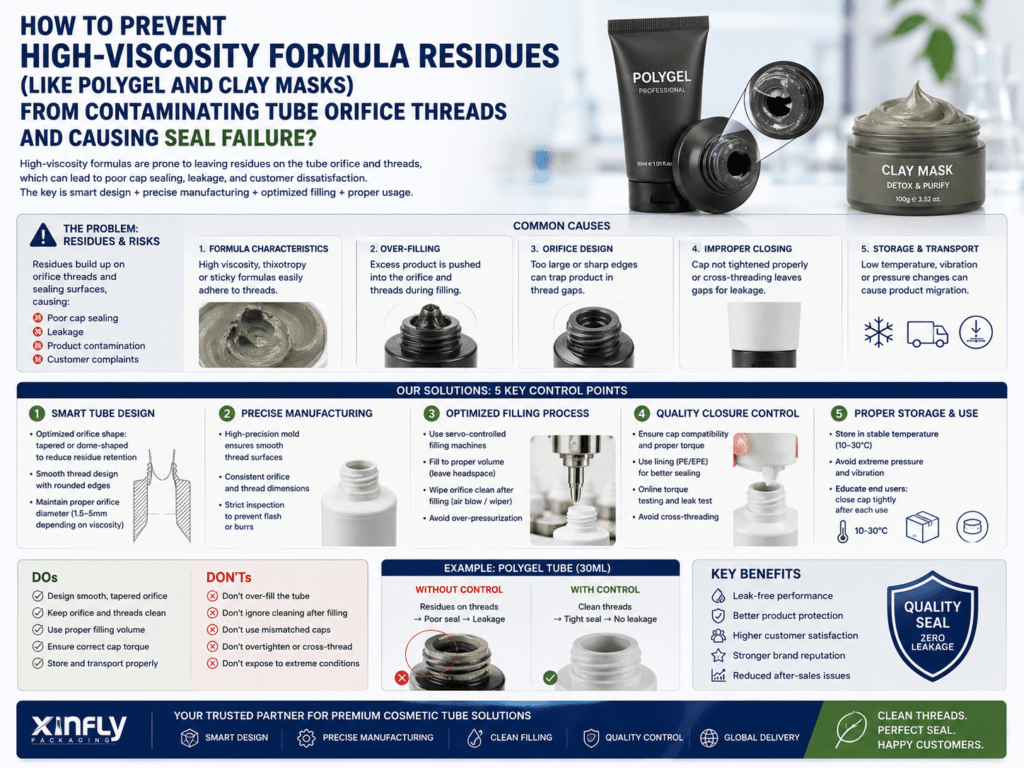
High-viscosity formulas such as polygel, clay masks, thick creams and concentrated pastes can contaminate cosmetic tube orifice threads when the filling nozzle withdraws with product attached, when the fill level is too high, or when product slowly strings or creeps toward the neck after filling.
The most effective prevention strategy is to optimize filling nozzle geometry, suck-back settings, nozzle withdrawal speed, fill level, headspace, orifice diameter, cap assembly timing and thread design so that the sealing surfaces remain completely clean before the closure is applied.
Thread contamination is a frequent packaging issue with high-viscosity skincare formulas because these products do not break cleanly away from the filling nozzle. Instead, they may form strings, peaks or residual deposits that touch the neck, orifice or screw threads.
Once product reaches the closure sealing surfaces, the cap may not seat fully. This can cause inconsistent torque, leakage, dried product around the neck, contaminated retail appearance and reduced sealing performance during transportation.
Why Do High-Viscosity Formulas Contaminate Tube Threads?
Stringing
Sticky formulas remain connected between the filling nozzle and product surface as the nozzle withdraws.
Product Peak
Thick formulas may form a raised peak after filling that contacts the neck or cap during assembly.
Nozzle Drip
Residual formula left inside the nozzle can drop onto the tube opening after filling stops.
Overfilling
Insufficient headspace pushes product too close to the orifice and threads.
Pressure Relaxation
Compressed high-viscosity formula may slowly expand upward after dispensing stops.
Incorrect Nozzle Size
A small nozzle can require high filling pressure, increasing stringing and product rebound.
What Packaging Failures Can Thread Contamination Cause?
| Contamination Problem | What Happens | Commercial Risk |
|---|---|---|
| Product on Screw Threads | Cap encounters abnormal resistance before reaching the designed closing position. | Under-torque, cap misalignment or leakage. |
| Product on Plug Seal | Formula prevents the cap plug from fully contacting the orifice. | Reduced airtightness and possible leakage. |
| Formula Around Neck | Residual product dries after filling. | Poor appearance and customer complaints. |
| Product Between Cap and Shoulder | Closure may appear raised or tilted. | Inconsistent finished-product appearance. |
| Oil or Paste on Sealing Surface | Material creates a physical barrier between sealing components. | Leakage during storage or transport. |
Why Are Polygel and Clay Masks Especially Difficult to Fill?
Polygel, clay masks and dense cosmetic pastes typically have high viscosity and strong cohesive behavior. Unlike thin lotions that break away cleanly from the filling nozzle, these products can stretch as the nozzle moves upward.
Typical High-Viscosity Filling Characteristics
- Long product strings after nozzle withdrawal.
- Slow leveling after filling.
- High pressure required to push product through small nozzles.
- Product rebound after pump pressure is released.
- Air pockets trapped inside the tube.
- Material accumulation around the filling nozzle tip.
1. Optimize the Filling Nozzle Diameter
The filling nozzle should be large enough to dispense the formula without excessive pressure but small enough to enter the tube opening safely.
| Formula Type | Typical Filling Behavior | Nozzle Strategy |
|---|---|---|
| Low-viscosity lotion | Flows easily with low pressure. | Smaller nozzle may be acceptable. |
| Medium-viscosity cream | Moderate resistance and limited stringing. | Use balanced nozzle diameter and suck-back. |
| Clay mask | Dense and slow flowing. | Use larger flow path to reduce dispensing pressure. |
| Polygel | Extremely thick and highly cohesive. | Use a larger nozzle and precise cutoff system. |
Important: There is no universal filling-nozzle diameter for every high-viscosity formula. The correct size depends on rheology, particles, tube neck diameter, pump characteristics and target filling speed.
2. Use Suck-Back or Reverse Draw at the End of Filling
Suck-back briefly reverses the filling pump at the end of each dosage cycle. This pulls residual product back into the nozzle and helps prevent drips or strings from reaching the tube neck.
Too Little Suck-Back
Formula continues to drip or string after filling stops.
Too Much Suck-Back
Air may be pulled into the product path or filling accuracy may become unstable.
Optimized Suck-Back
Produces a clean product cutoff with minimal residue at the nozzle tip.
3. Control Nozzle Withdrawal Speed
If the nozzle leaves the tube too quickly, a cohesive product can stretch into a long string. If the nozzle moves too slowly, the tip may drag through the product surface and carry residue upward toward the neck.
For difficult formulas, filling factories should synchronize nozzle withdrawal with the product-dosing profile instead of using one fixed withdrawal speed for all formulas.
4. Use Bottom-Up Filling for Thick Products
Bottom-up filling means the nozzle begins deeper inside the tube and gradually rises as the product level increases.
This approach can reduce trapped air, splashing and uncontrolled product deposits near the neck.
Bottom-Up Filling Benefits
- Reduces air entrapment.
- Controls product placement inside the tube.
- Reduces contact with the upper tube wall.
- Improves fill-level consistency.
- Helps prevent product from reaching threads.
5. Maintain Enough Headspace Below the Orifice
Overfilling is one of the simplest causes of thread contamination. A tube should contain enough headspace between the formula and closure system to accommodate product leveling, air movement and temperature expansion.
| Headspace Condition | Result |
|---|---|
| Too Little | Formula contacts orifice, plug seal or threads during capping. |
| Correct | Product remains safely below closure sealing area. |
| Excessive | Package may appear underfilled or require unnecessary tube length. |
6. Match the Tube Orifice to Formula Viscosity
The consumer dispensing orifice and factory filling nozzle perform different functions, but both should be considered during packaging development.
A very small retail orifice may be unsuitable for extremely thick products because it requires higher consumer squeeze force and can trap residue around the opening.
| Orifice Diameter Example | General Application Direction |
|---|---|
| Approx. 1.5mm | Serums, eye creams and controlled low-volume dispensing. |
| Approx. 3mm | Many creams, lotions and medium-viscosity skincare formulas. |
| Approx. 5mm | Thicker creams, masks and higher-viscosity products where larger flow is needed. |
These dimensions are design references rather than fixed rules. Final orifice selection should be confirmed through dispensing and formula compatibility testing.
7. Keep the Plug-Seal and Thread Area Outside the Product Path
The tube neck and closure should be designed so the formula does not naturally collect in the critical sealing region.
- Keep the internal plug-seal contact area smooth and unobstructed.
- Avoid unnecessarily deep cavities around the orifice.
- Use thread geometry that is easy to clean during production.
- Confirm that the closure reaches its designed sealing position without product interference.
- Evaluate whether nozzle-style or applicator closures are better for very thick formulas.
8. Delay Capping Until Product Movement Has Stabilized
Some highly viscous products continue moving after the filling pump stops. If the cap is applied immediately, the closure may press against a product peak and push formula onto the threads.
A short settling period between filling and capping can improve cleanliness for certain formulations, although this must be balanced against production speed and contamination control requirements.
9. Control Capping Torque
Contaminated threads can produce false torque readings. The capping machine may reach its torque limit before the closure actually reaches the correct sealing position.
| Torque Condition | Possible Problem |
|---|---|
| Too Low | Cap may loosen or leak. |
| Too High | Threads may strip, closure may crack or plug seal may deform. |
| False Torque Caused by Product | Machine detects resistance from contaminated threads rather than full closure engagement. |
10. Inspect and Clean Filling Nozzles Frequently
High-viscosity products may gradually build up on the outside of filling nozzles. Even a well-adjusted machine can begin contaminating tube necks after several production cycles if residue accumulates.
How Does Production Speed Affect Thread Contamination?
Increasing filling speed shortens the time available for product cutoff, nozzle withdrawal, settling and capping. A process that runs cleanly at low speed may begin contaminating threads after line speed is increased.
| When Line Speed Increases | Potential Effect |
|---|---|
| Shorter dosing cycle | Higher instantaneous filling pressure. |
| Faster nozzle movement | More stringing or product drag. |
| Reduced settling time | Formula may still be moving during capping. |
| Faster capping | Less time to detect contaminated necks. |
| Higher vibration | May disturb product peaks or tube positioning. |
What Should a Filling Factory Check When Thread Contamination Starts?
Step-by-Step Troubleshooting Sequence
- Step 1: Confirm whether the formula viscosity or production batch has changed.
- Step 2: Inspect filling nozzle diameter and nozzle-tip condition.
- Step 3: Check suck-back settings and product cutoff.
- Step 4: Observe whether strings form during nozzle withdrawal.
- Step 5: Measure actual fill weight and available headspace.
- Step 6: Check nozzle centering relative to the tube neck.
- Step 7: Inspect thread cleanliness before capping.
- Step 8: Verify capping torque and final cap position.
- Step 9: Run leakage tests on finished samples.
- Step 10: Record the validated filling parameters.
What Quality Checks Should Be Used After Filling?
| QC Test | Purpose |
|---|---|
| Visual Neck Inspection | Detect visible formula residue around threads and orifice. |
| Cap Position Check | Confirm closure reaches the correct final position. |
| Torque Test | Verify closure tightening performance. |
| Leakage Test | Confirm contamination has not compromised the seal. |
| Inverted Storage Test | Evaluate leakage under continuous product contact. |
| Transportation Simulation | Check whether vibration or pressure causes leakage. |
| Consumer Dispensing Test | Ensure thick formula can dispense without excessive residue buildup. |
Can the Tube Neck Design Be Modified for Polygel or Clay Masks?
Yes. If the formula consistently contaminates a standard screw-neck design, packaging engineers can evaluate alternative neck and closure systems.
Larger Orifice
Reduces dispensing resistance for very thick products.
Shorter Product Path
Reduces cavities where sticky formula can accumulate.
Alternative Nozzle
May improve controlled dispensing for gels and concentrated pastes.
Flip-Top Closure
Can eliminate repeated consumer handling of separate screw caps.
Plug-Seal Optimization
Improves contact between closure and tube orifice.
Custom Applicator
May better suit highly specialized formulas.
Factory Engineer Recommendation
Validate the Entire Filling System, Not Only the Tube
For polygel, clay masks and other high-viscosity products, thread contamination is usually a system-level problem involving formula rheology, nozzle design, filling pressure, cutoff behavior, tube neck geometry and closure assembly.
Before mass production, validate the actual formula using the final tube and the intended filling line.
- Use the actual commercial formula.
- Confirm nozzle diameter and fill pressure.
- Optimize suck-back and cutoff parameters.
- Validate fill weight and headspace.
- Check cap torque after filling.
- Run leakage and inverted-storage tests.
- Revalidate parameters whenever line speed changes significantly.
Common Mistakes
- Using a nozzle that is too small: High pressure increases stringing and rebound.
- Increasing filling speed without revalidation: Product cutoff may become unstable.
- Overfilling the tube: Product reaches the neck during capping.
- Ignoring suck-back: Residual formula drips after filling stops.
- Using the same parameters for every viscosity: Different formulas require different filling profiles.
- Checking torque only: Contaminated threads can create false torque readings.
- Skipping inverted leakage testing: Seal failures may appear only after extended product contact.
Summary
High-viscosity formulas such as polygel, clay masks and thick cosmetic creams contaminate tube orifice threads primarily because they string, rebound or remain attached to the filling nozzle after dosing.
The most effective controls are selecting the correct filling nozzle diameter, using optimized suck-back, controlling nozzle withdrawal, maintaining adequate headspace, matching the orifice to formula viscosity and verifying capping torque.
For difficult formulas, brands should test the complete system—formula, tube, neck, cap and filling machine—before commercial production rather than treating leakage as a closure-only problem.
Need a Tube Designed for High-Viscosity Formulas?
Xinfly Packaging supports polygel, clay mask, thick cream and high-viscosity cosmetic projects with tube-size selection, orifice design, cap matching, filling compatibility and sample testing support.
Request a Packaging Solution Contact Packaging Engineer