
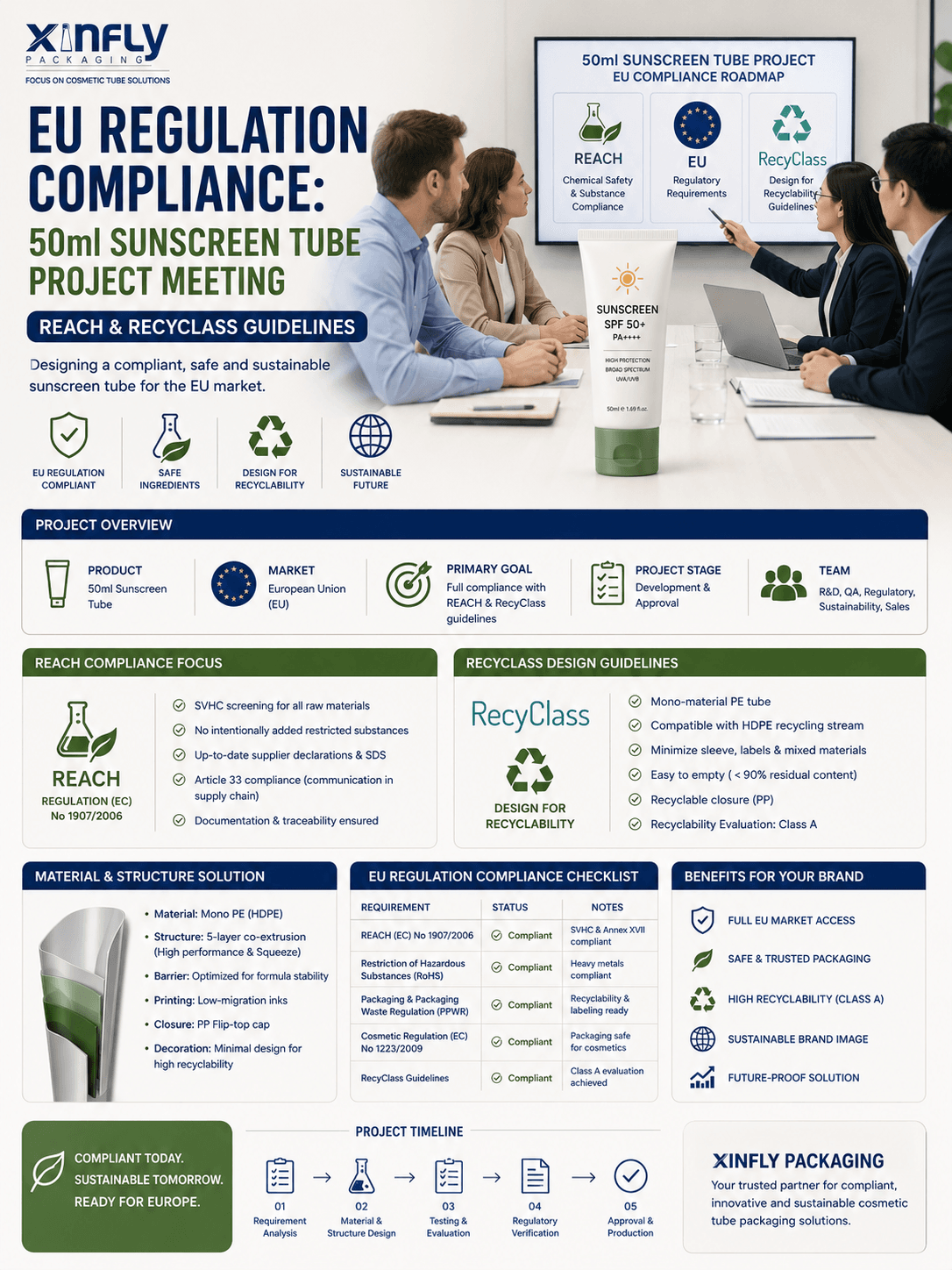
EU Regulation Compliance: 50ml Sunscreen Tube Project Meeting REACH & RecyClass Guidelines
A European sunscreen brand approached Xinfly Packaging to develop a 50ml cosmetic squeeze tube that could support both high-performance SPF formula protection and increasingly demanding European packaging requirements.
The project was not limited to choosing a recyclable-looking tube. The purchasing team needed documentation for material review, REACH-related chemical compliance, a structure designed with European recycling compatibility in mind, reliable sunscreen formula protection, and decoration that would not unnecessarily complicate the packaging recycling stream.
Our engineering team therefore treated compliance, material structure, formula compatibility, decoration, closure selection, and recyclability as one integrated packaging-development project.
Project Background: Building a Sunscreen Tube for the European Market
The customer was preparing a 50ml facial sunscreen for European retail and e-commerce channels. The SPF formula required dependable packaging protection, but the purchasing team also wanted to reduce future regulatory and sustainability risks associated with the tube structure.
Instead of selecting the package only from appearance samples, the customer requested a more structured technical review covering polymer selection, pigments and additives, printing decoration, closure compatibility, material documentation, formula protection, and end-of-life recyclability considerations.
For this project, Xinfly Packaging combined experience from SPF sunscreen tubes, EVOH sunscreen tubes, recyclable cosmetic tubes, and high-barrier cosmetic tubes to develop a structure that balanced protection with European market requirements.
Customer Pain Points Before Development
REACH Documentation Risk
- The European buyer required material and chemical compliance information.
- Plastic packaging components, colorants, inks, coatings, and closures needed controlled supplier documentation.
- The customer wanted to reduce uncertainty around substances of concern before commercial production.
Recyclability vs Formula Protection
- The SPF formulation still required dependable packaging performance.
- Adding unnecessary incompatible layers or components could complicate recycling.
- The team needed to balance barrier performance with Design for Recycling considerations.
Decoration Could Affect Recycling Design
- Heavy decoration can introduce additional materials into the packaging system.
- Metallic effects, labels, coatings, and incompatible components required review.
- The brand still wanted premium shelf appearance for European sunscreen retail.
Factory Engineer’s Recommendation: Start with the Complete Packaging System, Not the Tube Body Alone
For European sunscreen packaging, evaluating only the tube body resin is not sufficient. The finished package includes the tube body, shoulder, closure, masterbatch, printing ink, coatings, decorative elements, and any barrier layers. These components should be reviewed together.
Our engineering team first analyzed the sunscreen formula and determined the level of oxygen, light, moisture, and migration protection actually required. Where a simpler PE-oriented structure could meet product-protection requirements, unnecessary material complexity could be avoided.
Where higher barrier performance was necessary, the barrier system needed to be evaluated against the customer's recycling objectives rather than being added automatically. This is particularly important for sunscreen because formulation stability should not be sacrificed merely to make a packaging claim.
We also recommended reviewing EVOH and ABL sunscreen packaging, EVOH vs ABL vs PBL structures, and sustainable cosmetic tube selection before locking the commercial specification.
Our EU Compliance & Design-for-Recycling Strategy
1. REACH-Oriented Material Review
Material declarations and upstream supplier information were reviewed as part of the packaging compliance file, with particular attention to substances that could trigger European regulatory obligations.
2. Recycling-Stream Compatibility
Tube material, closure, decoration, barrier layers, and other components were evaluated from a Design for Recycling perspective rather than relying only on a generic “recyclable” claim.
3. Sunscreen Formula Protection
Packaging simplification was considered only where the selected structure could still provide the mechanical, dispensing, and protective performance required by the SPF formulation.
Why the Brand Selected a 50ml Sunscreen Tube
Premium Facial SPF Format
A 50ml tube provides a compact premium format well suited to facial sunscreen, daily SPF moisturizers, mineral sunscreen, and skincare-sunscreen hybrid formulas.
Efficient Material-to-Product Ratio
The tube dimensions can be optimized around the actual fill volume so the package avoids unnecessary length or wall weight while maintaining adequate squeeze and transport performance.
Suitable for EU Retail & E-Commerce
The compact format supports shelf merchandising, travel-friendly consumer use, beauty subscription programs, and e-commerce distribution.
REACH Review: What the Buyer Needed from the Packaging Supply Chain
For this project, the customer's regulatory team did not want a generic statement saying that the tube was “EU compliant.” They wanted traceable information covering the major packaging components and materials used in the finished sunscreen tube.
Because plastic packaging is treated as an article under REACH, the purchasing review considered whether Candidate List substances could be present in the finished packaging and whether any applicable information obligations needed to be addressed by the responsible economic operators.
Polymer & Masterbatch Review
- Tube body resin specification
- Shoulder resin specification
- Color masterbatch documentation
- Relevant upstream supplier declarations
Closure & Component Review
- Cap polymer identification
- Colorant and additive information
- Compatibility with the selected tube recycling stream
- Component documentation retained for the project file
Decoration Material Review
- Printing inks and coating information
- Hot stamping or metallic decoration evaluation
- Avoidance of unnecessary decorative complexity
- Artwork adjusted where needed to support DfR goals
RecyClass Design-for-Recycling Review for the 50ml Sunscreen Tube
For recyclability, our objective was not to make an unsupported “100% recyclable” marketing statement. Instead, the packaging structure was reviewed against relevant Design for Recycling principles for the intended plastic recycling stream.
RecyClass evaluates plastic packaging based on compatibility with existing collection, sorting, and recycling infrastructure. Its 2026 guidance includes updated Design for Recycling criteria for HDPE and PP containers and tubes.
Tube Body
Where sunscreen formula protection permitted, we prioritized a PE-oriented tube structure with reduced material complexity. If a barrier layer was necessary, its function and recycling impact needed separate evaluation.
Closure
The closure was considered as part of the complete packaging system rather than as an unrelated accessory. Material selection, density, color, dimensions, and separation behavior can all influence recyclability assessment.
Printing & Decoration
Printing coverage, inks, coatings, metallic decoration, labels, and adhesives were reviewed because decoration can affect sorting and recycling performance.
Product Residue
For creams and pasty products such as sunscreen, package emptying behavior also matters. The tube should allow consumers to evacuate the product effectively without excessive residue remaining inside.
Engineer’s Advice: Do Not Ignore the Easy-to-Empty Performance of Sunscreen Tubes
Recyclability engineering is not limited to polymer identification. Tubes containing creams, gels, and pasty products should also be considered from an emptying-efficiency perspective because excessive residual formula reduces recycling yield and increases contamination.
For the 50ml sunscreen project, our engineers therefore reviewed tube flexibility, shoulder geometry, closure opening, squeeze recovery, and consumer evacuation behavior together.
A tube that uses less material but leaves excessive sunscreen inside is not necessarily a better packaging solution. The goal is to optimize material use, formula protection, dispensing, emptying efficiency, and end-of-life compatibility as one system.
Buyers can also review our tube capacity, diameter, length and thickness guide and cosmetic tube material selection guide.
Mono-PE, EVOH or ABL: How We Evaluated the Structure
One of the most important engineering decisions was whether the sunscreen formula genuinely required a high-barrier structure. The packaging team avoided specifying a complex laminate merely because it sounded more protective.
PE-Oriented Structure
Preferred when formula compatibility and stability testing show that a simpler polyethylene-focused structure can provide adequate protection and dispensing performance.
EVOH Barrier Structure
Evaluated where additional oxygen-barrier performance is required. The amount and configuration of barrier material should be considered together with recyclability objectives and actual formula-protection needs.
ABL Structure
Considered for formulations requiring very strong barrier performance, but its aluminum-containing laminate construction represents a different recycling pathway and should not be presented as equivalent to a PE-oriented recyclable tube.
For detailed comparisons, see EVOH vs ABL Tubes, EVOH vs PBL Tubes, and Mono-Material vs Multi-Layer Tubes.
Decoration Strategy: Premium Appearance Without Unnecessary Recycling Complexity
The customer wanted the 50ml facial sunscreen to retain a premium retail appearance, so the engineering challenge was not to remove decoration entirely. Instead, the artwork and finishing plan were reviewed to avoid adding unnecessary materials where a simpler decoration method could achieve the same visual objective.
Direct Printing
Direct offset or silk screen printing can reduce the need for separate label constructions when suitable for the artwork and tube surface.
Controlled Ink Coverage
Artwork coverage and ink systems should be reviewed in the context of the intended recycling stream rather than assuming every decoration choice has the same recycling impact.
Metallic Decoration Review
Hot stamping and metallic effects should be used deliberately. Where premium differentiation can be achieved with simpler decoration, the brand can reduce packaging complexity.
Related technical resources: Labeling vs Direct Tube Printing, Hot Stamping vs Silk Screen Printing, and Cosmetic Tube Printing Options.
Final 50ml Sunscreen Tube Project Specifications
The final commercial specification was built around European-market documentation, efficient material selection, practical sunscreen protection, consumer usability, and Design for Recycling considerations.
| Item | Project Specification |
|---|---|
| Project | 50ml EU-Market Sunscreen Tube Development |
| Application | Facial Sunscreen / Daily SPF / Skincare-SPF Hybrid |
| Nominal Capacity | 50ml |
| Primary Material Direction | PE-Oriented Cosmetic Tube Structure |
| Barrier Option | EVOH-Containing Structure Subject to Formula & Recycling Evaluation |
| Closure | PE / PP Closure Selected According to Functional & DfR Requirements |
| Decoration | Direct Offset / Silk Screen Printing; Reduced-Complexity Decoration Preferred |
| Surface Finish | Glossy / Matte Depending on Artwork & Recycling Evaluation |
| REACH Support | Material & Supplier Documentation Review for Relevant Packaging Components |
| Recyclability Strategy | Design Reviewed Against Applicable RecyClass DfR Principles |
| Formula Testing | Compatibility, Dispensing, Leakage & Stability Testing Recommended Before Commercial Approval |
| Target Market | European Sunscreen, Skincare & Clean Beauty Brands |
Quality Control Required Before Commercial Approval
Formula Compatibility
- Tube / sunscreen contact evaluation
- Appearance change monitoring
- Odor and migration-risk review where applicable
- Long-term stability testing by the formula owner
Packaging Performance
- Cap fitting inspection
- Leakage testing
- Squeeze and dispensing evaluation
- Transport-condition simulation
Decoration & Documentation
- Artwork confirmation
- Printing adhesion inspection
- Color consistency review
- Applicable supplier documents retained
Xinfly Packaging Quality & Documentation Support
For European projects, packaging documentation is increasingly important alongside physical product quality. Xinfly Packaging supports customers with relevant factory and material records available for the specific project and supplied packaging configuration.
ISO Quality Management
Structured production procedures support consistency from sample approval through repeat mass-production orders.
SGS Testing Support
Relevant third-party test documentation can be supplied according to the material and project scope.
RoHS Documentation
Applicable restricted-substance documentation is available for supported packaging projects.
GRS PCR Materials
GRS-certified PCR options can be evaluated separately when the customer's sustainability strategy includes recycled content.
Review available documentation on our Certifications & Compliance page or contact our team for documentation relevant to your specific tube construction.
Related EU Sunscreen Packaging Resources
SPF Sunscreen Tubes
Explore custom packaging structures developed for SPF skincare products.
Explore SPF Tubes →EVOH Sunscreen Tubes
Learn where EVOH barrier structures can support sensitive sunscreen formulas.
Explore EVOH Tubes →Recyclable Cosmetic Tubes
Review packaging options designed around improved recycling compatibility.
Explore Recyclable Tubes →Sustainable Packaging
Compare PCR, sugarcane, mono-material and other sustainability strategies.
Explore Sustainable Packaging →Development Process: From EU Requirement Review to Commercial Tube Approval
The project followed a compliance-aware development process in which regulatory documentation, sunscreen formula protection, tube functionality, decoration, and recycling design considerations were reviewed before mass production.
Project Results: A More EU-Ready 50ml Sunscreen Packaging System
The final 50ml sunscreen tube project gave the customer a clearer packaging specification for European commercialization. Instead of relying on a generic recyclable-packaging claim, the project created a documented decision path covering material selection, sunscreen formula compatibility, closure design, printing, recyclability considerations, and supplier information.
The brand was also able to reduce unnecessary packaging complexity while retaining the protection and consumer usability required for a daily facial SPF product. Where additional barrier performance was required, the technical justification could be evaluated before locking the tube structure.
This approach gives procurement, sustainability, regulatory, artwork, and formulation teams a shared technical basis for packaging approval—particularly valuable when preparing repeat sunscreen SKUs for European distribution.
Client Feedback
“We needed more than a recyclable-looking sunscreen tube. Our team required material documentation, a clear explanation of the barrier structure, and a packaging design that could support our European sustainability objectives. Xinfly Packaging helped us evaluate the complete tube system instead of looking only at the tube body.”
— Packaging & Sustainability Manager, European Skincare Brand
Engineer’s Advice for Buyers Sourcing Sunscreen Tubes for the EU Market
Do not request only a “REACH certificate”
Ask the supplier what documentation applies to the actual tube body, cap, colorants, inks, coatings, and other components used in your commercial packaging specification.
Do not assume “mono-material” automatically means recyclable
The complete package should still be evaluated for sorting, separation, decoration, closures, barrier layers, product residue, and compatibility with the intended recycling stream.
Do not remove necessary barrier protection only for a sustainability claim
A tube structure should first protect the sunscreen formula adequately. Barrier simplification should be based on formula compatibility and stability evidence rather than marketing pressure alone.
Keep a packaging technical file by SKU
Record the approved resin, cap, masterbatch, printing, coating, barrier configuration, artwork version, supplier documents, and test results so repeat orders remain consistent.
Frequently Asked Questions About EU Sunscreen Tube Compliance & Recyclability
1. Does REACH apply to plastic cosmetic packaging?
Plastic packaging is generally treated as an article under REACH. Applicable obligations depend on the substances present, concentration, supply-chain role, and other regulatory conditions.
2. What REACH information should a sunscreen tube buyer request?
Buyers should request relevant material and supplier documentation for the commercial tube configuration, including information covering the tube body, closure, masterbatch, decoration, and other applicable components.
3. Is RecyClass an EU regulation?
No. RecyClass provides Design for Recycling methodologies, guidelines, testing protocols, tools, and certification schemes for plastic packaging. It is different from EU legislation such as REACH or the Packaging and Packaging Waste Regulation.
4. Can a tube be described as RecyClass certified without assessment?
No. A packaging design should not be described as RecyClass certified unless it has completed the applicable certification process. Design guidance and certification should be clearly distinguished.
5. Is a PE sunscreen tube always recyclable?
Not automatically. Recycling compatibility depends on the complete package, including barrier layers, closure, pigments, decoration, labels, adhesives, product residue, and local collection and recycling infrastructure.
6. Can sunscreen tubes use EVOH and still pursue recyclability goals?
Potentially, depending on the complete structure and applicable Design for Recycling criteria. The barrier configuration should be evaluated rather than assumed to be compatible.
7. Why is easy-to-empty performance important?
Residual sunscreen remaining inside a tube can reduce material recovery efficiency. Tube flexibility, dispensing opening, shoulder geometry, and consumer evacuation behavior should therefore be considered during packaging development.
8. Does direct printing improve recyclability?
Direct printing can avoid a separate label construction in some projects, but inks and printing coverage still need to be evaluated as part of the complete packaging design.
9. Can hot stamping be used on an EU-oriented recyclable sunscreen tube?
Metallic decoration should be evaluated against the applicable recycling-design criteria. Where possible, brands may choose to minimize decorative complexity while retaining essential premium branding.
10. What tests should be completed before commercial production?
Recommended evaluations include formula compatibility, leakage, dispensing, tube recovery, closure fitting, printing adhesion, transportation performance, appearance stability, and any additional testing required by the brand or target market.
11. Can Xinfly Packaging supply PCR sunscreen tubes for the EU market?
Yes. PCR tube structures can be evaluated separately according to formula compatibility, recycled-content objectives, appearance requirements, decoration, and project-specific compliance documentation.
12. Can Xinfly Packaging guarantee legal compliance for my finished sunscreen product?
Xinfly Packaging can support packaging engineering, supplier documentation, material information, and relevant testing for the supplied packaging. Final legal compliance of the finished marketed product remains subject to the applicable responsibilities of the brand owner, importer, or other economic operator.
Continue Your EU Sunscreen Packaging Research
For procurement teams comparing structures, explore why EVOH barriers matter for SPF sunscreen tubes, EVOH and ABL sunscreen packaging, eco-friendly sunscreen tubes, PCR sunscreen tubes, and our sunscreen tube packaging guide.
EU Compliance Note: This case study describes packaging-development and documentation-support practices and should not be interpreted as legal advice, an EU authority approval, or a claim that every Xinfly Packaging tube is automatically REACH-compliant or RecyClass-certified. Compliance and recyclability depend on the final commercial packaging configuration, substances and materials used, applicable legislation, target market, available recycling infrastructure, test evidence, and the obligations of the relevant economic operators.
Developing Sunscreen Packaging for the European Market?
Send us your SPF formula type, target capacity, preferred tube material, closure, artwork, sustainability objectives, and EU-market requirements. Our engineering team can help you compare PE, EVOH, ABL, PBL, PCR, and other structures before you lock the commercial specification.
We can also help organize the packaging information needed for formula compatibility review, material documentation, sample development, and Design for Recycling evaluation.