

Sunscreen Tube Packaging Guide: Materials, Sizes & Closure Options
Choosing the right sunscreen tube packaging is not only about appearance. For SPF skincare brands, the tube material, barrier structure, capacity, closure type, decoration method and filling compatibility all influence product stability, user experience and purchasing decisions.
This guide explains how beauty brands, sunscreen startups and purchasing teams can select suitable tube packaging for SPF30, SPF50, mineral sunscreen, kids sunscreen, reef-safe sunscreen, travel-size sunscreen and high-barrier sunscreen products.
- PE, PCR, ABL, PBL & EVOH Options
- 30ml, 50ml, 75ml, 100ml & 150ml Sizes
- Flip Top, Screw Cap, Nozzle & Airless Pump
- OEM / ODM Custom Printing Support
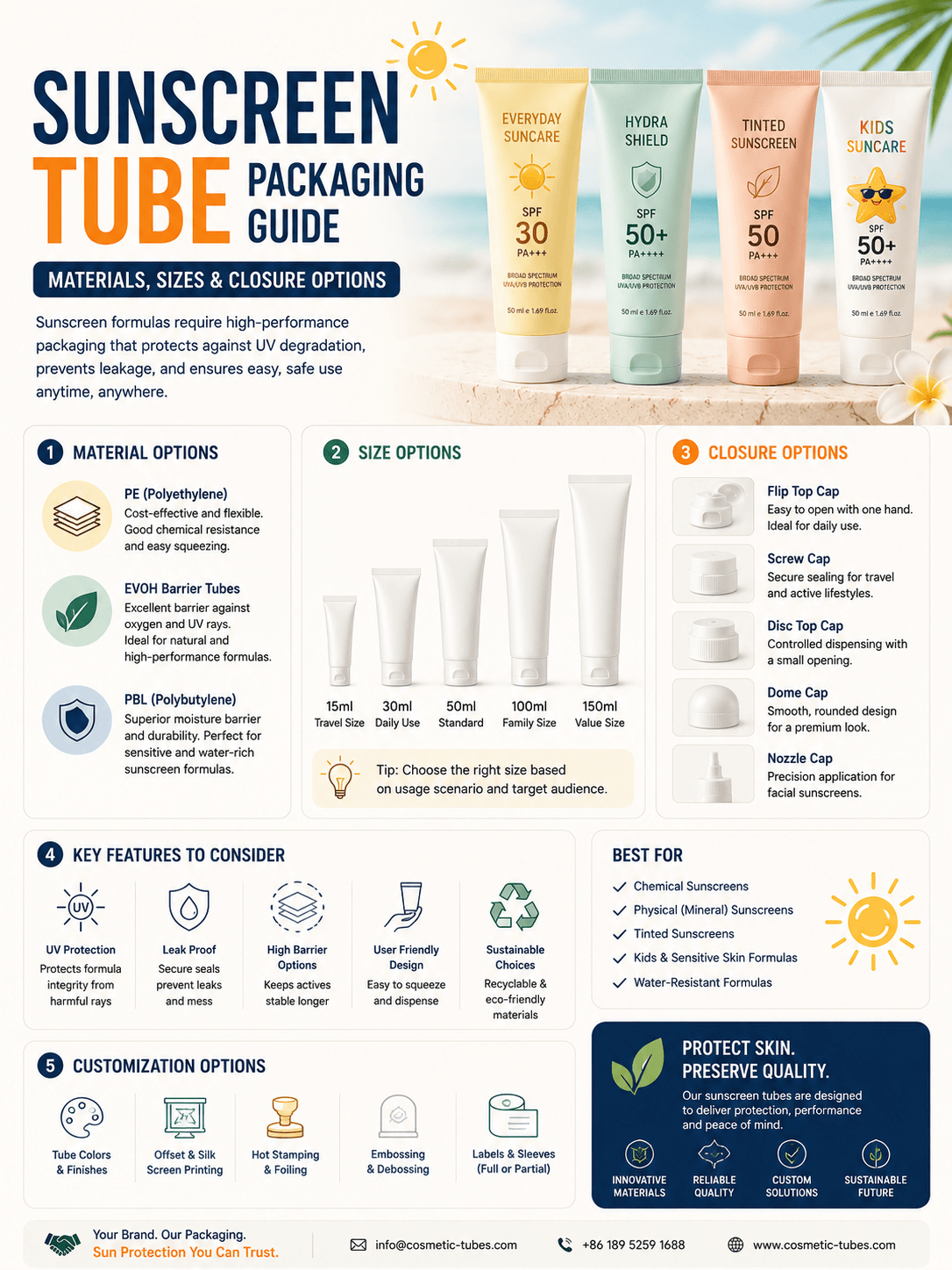
What This Sunscreen Tube Packaging Guide Covers
Why Sunscreen Products Require Specialized Tube Packaging
Sunscreen formulas are more demanding than many standard skincare products. A simple PE squeeze tube may work for some daily SPF lotions, but mineral sunscreen, high-SPF formulas, reef-safe sunscreen and active skincare sunscreen products often require more careful packaging evaluation.
Formula Stability
Sunscreen formulas may contain UV filters, mineral powders, oils, emulsifiers, fragrance systems and active skincare ingredients. The packaging must help reduce oxygen exposure, avoid unnecessary formula interaction and support stable shelf life.
Barrier Protection
For SPF50, high-active formulas or premium sunscreen products, barrier performance becomes important. Multi-layer tubes, EVOH sunscreen tubes, ABL and PBL structures can offer stronger protection than basic single-material tubes.
User Experience
Sunscreen is often used outdoors, on the beach, during travel or for children. Tube softness, squeeze control, cap security, outlet diameter and one-hand operation can directly affect customer satisfaction.
Sunscreen Tube Materials: PE, PCR, ABL, PBL and EVOH Options
Material selection is the first major decision when developing sunscreen tube packaging. Different sunscreen formulas require different levels of flexibility, barrier performance, recyclability and visual positioning. For brands that are still comparing options, our broader guide on how to choose cosmetic tube materials can also help explain the difference between PE, PCR, ABL, PBL and aluminum structures.
PE Sunscreen Tubes
PE tubes are widely used for daily sunscreen lotions, body sunscreen, facial sunscreen and affordable SPF products. They are flexible, easy to squeeze and suitable for many common formulations. PE tubes can support offset printing, silk screen printing, hot stamping, matte coating, glossy finishing and soft-touch effects.
PE is often selected when the formula does not require strong oxygen barrier protection or when the brand prioritizes a recyclable mono-material direction. For general skincare brands, PE sunscreen tubes provide a good balance between cost, production efficiency and decoration flexibility.
PCR Sunscreen Tubes
PCR sunscreen tubes are designed for brands that want to reduce virgin plastic usage and communicate a more sustainable packaging story. PCR PE can be used for many sunscreen products, especially eco-friendly sunscreen, reef-safe sunscreen and clean beauty SPF brands.
However, PCR content, tube color, printing performance and formula compatibility should be confirmed during sampling. For premium sunscreen projects, PCR can also be combined with additional design choices such as matte finishing, soft-touch coating, minimalist printing and recyclable cap options.
ABL Sunscreen Tubes
ABL tubes use an aluminum barrier layer and are often selected when stronger barrier performance is required. They are suitable for formulas that are more sensitive to oxygen, fragrance loss or external exposure. ABL tubes can also create a premium feel for pharmaceutical-style sunscreen, dermocosmetic SPF products and high-protection skincare lines.
If your purchasing team is comparing ABL and PBL structures, you can review our detailed comparison: ABL vs PBL Tubes.
PBL Sunscreen Tubes
PBL tubes are laminated plastic barrier tubes that can provide improved barrier performance while keeping a plastic-based tube appearance. They are commonly used for premium skincare, sunscreen, personal care and cosmetic products where clean printing quality and better barrier protection are required.
For sunscreen brands comparing high-barrier packaging options, our guide on EVOH vs PBL Tubes can help clarify when to choose EVOH structures and when PBL tubes may be more suitable.
EVOH Barrier Sunscreen Tubes
EVOH barrier tubes are especially important for sunscreen packaging because they help improve oxygen barrier performance while supporting modern cosmetic tube structures. For SPF50, mineral sunscreen, reef-safe sunscreen or active skincare sunscreen products, EVOH can be considered when formula stability and shelf-life protection are priorities.
For more technical reading, visit: Why EVOH Barriers Matter for SPF Sunscreen Tubes and EVOH and ABL Tubes for Sunscreen Packaging.
| Material | Best For | Key Advantages | Buyer Notes |
|---|---|---|---|
| PE Tubes | Daily sunscreen, body SPF, facial SPF | Flexible, cost-effective, good printing compatibility | Best for formulas with moderate barrier requirements |
| PCR Tubes | Eco-friendly sunscreen, reef-safe sunscreen | Reduced virgin plastic, sustainability story | PCR percentage, color and printing should be confirmed |
| ABL Tubes | High-barrier sunscreen, dermocosmetic SPF | Strong barrier protection, premium positioning | Good for formulas needing stronger protection |
| PBL Tubes | Premium sunscreen, skincare SPF | Plastic laminate structure, clean appearance | Useful when both barrier and appearance matter |
| EVOH Tubes | SPF50, mineral sunscreen, active SPF formulas | Improved oxygen barrier, modern multi-layer structure | Recommended for technical sunscreen packaging evaluation |
How to Decide Whether Your Sunscreen Formula Needs Barrier Tubes
Not every sunscreen product needs the same barrier level. A simple daily SPF moisturizer may use a PE tube, while a high-SPF sunscreen with sensitive actives may require EVOH, ABL or PBL packaging. The right choice depends on formula type, target market, shelf-life requirement, distribution channel and brand positioning.
Choose PE When
The formula is stable, the product is positioned as daily-use sunscreen, cost control is important and the brand wants a flexible, recyclable-friendly tube structure.
Choose EVOH When
The formula contains sensitive actives, targets SPF50 or premium skincare positioning, or requires better oxygen barrier performance without moving into aluminum laminate packaging.
Choose ABL/PBL When
The product requires stronger barrier protection, a more premium shelf impression or a laminated tube structure for dermocosmetic, pharmacy or export retail channels.
If you are still at the development stage, Xinfly Packaging recommends confirming the formula type, filling process, expected shelf life, target market and decoration requirements before finalizing material. For brands comparing multiple technical structures, the article Comparing EVOH, ABL and PBL Tubes can be used as a supporting reference.
Recommended Sunscreen Tube Sizes by Capacity and Application
Tube size is one of the most important decisions for sunscreen packaging. It affects retail positioning, hand feel, shipping weight, filling efficiency, label design area and consumer usage scenario.
For sunscreen products, capacity is usually selected based on where the product will be used: daily facial SPF, family body sunscreen, kids sunscreen, sports sunscreen, travel-size sunscreen, beach sunscreen or premium skincare sunscreen. If your team is still comparing diameter, length and fill volume, you can also review our tube capacity, diameter, length and thickness guide.
| Capacity | Common Diameter | Best Application | Buyer Recommendation |
|---|---|---|---|
| 10ml - 20ml | 19mm - 22mm | Samples, hotel sunscreen, trial packs, travel kits | Good for promotional SPF sets and low-volume sampling programs |
| 30ml | 25mm - 30mm | Facial sunscreen, daily SPF cream, travel-size sunscreen | Ideal for skincare brands targeting daily-use facial SPF |
| 50ml | 30mm - 35mm | Facial SPF, mineral sunscreen, premium sunscreen | One of the most common sunscreen tube sizes for beauty brands |
| 75ml | 35mm - 40mm | Body sunscreen, kids sunscreen, sport sunscreen | Good balance between portability and usage volume |
| 100ml | 40mm - 50mm | Family sunscreen, beach sunscreen, body SPF | Suitable for retail sunscreen products with higher consumption |
| 150ml+ | 50mm - 60mm | Body sunscreen, family sunscreen, outdoor sunscreen | Best for large-volume sunscreen products and value packs |
Travel Size Sunscreen Tubes
Travel-size sunscreen tubes are usually produced in 10ml, 15ml, 20ml, 30ml or 50ml capacity. They are popular for beach kits, hotel amenities, airline travel, outdoor sports and trial-size beauty products. For this topic, you can build stronger internal relevance by linking to travel size sunscreen tubes.
50ml Sunscreen Tubes
50ml is one of the most common sunscreen tube capacities for skincare and SPF brands. It is large enough for regular use but still compact enough for handbags, travel kits and premium facial sunscreen products. For SPF50, mineral sunscreen and clean beauty sunscreen, 50ml tubes can provide a strong balance between shelf presence and consumer convenience.
100ml Sunscreen Tubes
100ml sunscreen tubes are often selected for body sunscreen, sport sunscreen, family sunscreen and beach sunscreen. Compared with smaller sizes, they offer more front-panel branding area and are more suitable for retail channels where customers expect higher usage volume.
Sunscreen Tube Closure Options: Flip Top, Screw Cap, Nozzle and Airless Pump
The closure is not only a functional component. It affects leakage control, formula dispensing, user convenience, premium perception and filling compatibility.
For sunscreen packaging, the most common closure choices include flip-top caps, screw caps, nozzle caps and airless pump tube systems. If you want to compare closure structures in more detail, visit our guide: Screw Cap vs Flip Cap vs Airless Pump.
Flip Top Cap Tubes
Flip-top caps are widely used for sunscreen tubes because they are convenient, easy to open and suitable for one-hand use. They are ideal for body sunscreen, kids sunscreen, beach sunscreen and daily SPF products. For sourcing options, view flip top cap tubes.
Screw Cap Tubes
Screw caps provide a simple, secure and classic closure option. They are often used for premium skincare SPF, facial sunscreen and products that require a clean minimalist look. Screw caps can also support metallic, matte or color-matched finishing.
Nozzle Tubes
Nozzle tubes are useful when the sunscreen formula requires controlled application, smaller dispensing area or targeted use. They can be suitable for face sunscreen, spot sunscreen, eye-area SPF or treatment-style sunscreen products. Learn more about nozzle tubes.
Airless Pump Tubes
Airless pump tubes are suitable for premium sunscreen, active skincare SPF and formulas that require better dispensing control. They can improve the user experience and reduce direct product exposure during use. View related options: airless pump tubes.
Large Outlet Caps
Mineral sunscreen formulas containing zinc oxide or titanium dioxide are often thicker than standard lotions. A larger outlet can improve dispensing performance and reduce consumer frustration during application.
Custom Color Caps
Cap color can be matched with tube artwork, brand identity and product range design. White, matte black, pastel blue, sand beige and orange accent colors are common for sunscreen brands.
Sunscreen Tube Packaging by Application Scenario
A strong sunscreen packaging hub page should not only explain materials and sizes. It should also guide buyers to the most relevant application pages based on formula type, target user and market positioning.
This is where the page becomes the center of the Sunscreen Cluster. From this guide, buyers can continue to more specific pages such as travel-size sunscreen tubes, mineral sunscreen tubes, kids sunscreen tubes, reef-safe sunscreen tubes, SPF sunscreen tubes, PCR sunscreen tubes and EVOH sunscreen tubes.
SPF Sunscreen Tubes
For SPF30, SPF50 and high-protection sunscreen products, packaging should consider barrier level, tube opacity, cap security and printing durability. Visit SPF sunscreen tube manufacturer for dedicated sourcing information.
Mineral Sunscreen Tubes
Mineral sunscreen formulas often contain zinc oxide or titanium dioxide and may have thicker texture. Tube softness, outlet size and barrier option should be carefully reviewed. Learn more: mineral sunscreen tubes manufacturer.
Kids Sunscreen Tubes
Kids sunscreen tubes require safe, convenient and friendly packaging. Soft squeeze feel, rounded cap design, easy dispensing and colorful printing can improve parent and child usage experience. View: kids sunscreen tubes manufacturer.
Reef Safe Sunscreen Tubes
Reef-safe sunscreen brands often care about sustainable materials, PCR plastic, recyclable structures and clean brand presentation. Build internal relevance with: reef safe sunscreen tubes.
Eco-Friendly Sunscreen Tubes
Eco-friendly sunscreen packaging can use PCR PE, sugarcane-based plastic, recyclable mono-material structures or reduced-plastic design. Related page: eco-friendly sunscreen tubes.
PCR Sunscreen Tubes
PCR sunscreen tubes are suitable for beauty brands that want to reduce virgin plastic usage while maintaining custom printing and retail-ready appearance. View: PCR sunscreen tubes manufacturer.
EVOH Sunscreen Tubes
EVOH sunscreen tubes are recommended when buyers need improved oxygen barrier performance for SPF50, mineral sunscreen or premium active sunscreen formulas. View: EVOH sunscreen tubes manufacturer.
Travel Size Sunscreen Tubes
Travel-size sunscreen tubes are ideal for trial sets, outdoor kits, hotel amenities and compact retail formats. Link to: travel size sunscreen tubes.
Low MOQ Sunscreen Tubes
Emerging sunscreen brands often need lower MOQ, fast sampling and flexible custom printing support. View: low MOQ sunscreen tubes.
Decoration and Branding Options for Sunscreen Tube Packaging
Sunscreen packaging must communicate trust, protection and outdoor lifestyle value. For beauty brands, tube decoration is as important as the material structure. A sunscreen tube should look clean, stable and professional while also matching the formula story, such as mineral sunscreen, reef-safe sunscreen, kids sunscreen or premium facial SPF.
Offset Printing
Offset printing is suitable for colorful sunscreen tube designs, gradient backgrounds, lifestyle illustrations and multi-color brand artwork. Learn more about offset printing tubes.
Silkscreen Printing
Silkscreen printing is commonly used for clean text, high-opacity logos and premium minimalist packaging. It works well for facial sunscreen, dermocosmetic SPF and luxury skincare sunscreen tubes. View: silkscreen printing tubes.
Hot Stamping
Hot stamping can add metallic details to sunscreen tubes, especially for premium SPF products. Gold, silver, champagne and rose-gold accents can improve shelf appeal. Related: hot stamping tubes.
Matte Finish
Matte sunscreen tubes are popular for clean beauty, mineral sunscreen and reef-safe sunscreen brands. For more comparison, visit: matte finish vs glossy vs soft-touch tubes.
Soft Touch Coating
Soft-touch coating can create a premium hand feel for high-end facial sunscreen and skincare SPF products. It is suitable when the brand wants a luxury cosmetic feel instead of a mass-market sunscreen appearance.
Labeling
Labeling can be used for smaller batches, test launches or flexible SKUs. It is also useful when brands want to validate markets before investing in full custom printing. Related: labeling tubes.
How Procurement Teams Should Evaluate Sunscreen Tube Suppliers
A professional sunscreen tube supplier should not only quote a price. They should help buyers confirm material, diameter, capacity, cap matching, artwork feasibility, sampling plan, MOQ, testing and production timeline.
| Evaluation Point | Why It Matters | What to Confirm |
|---|---|---|
| Material Structure | Directly affects compatibility, barrier and sustainability | PE, PCR, EVOH, ABL, PBL, mono-material options |
| Formula Compatibility | Sunscreen formulas may be thick, oily or active-rich | Viscosity, filling temperature, outlet diameter, stability test |
| MOQ | Startups and new brands need flexible launch quantities | Stock tube MOQ, custom printing MOQ, cap color MOQ |
| Printing Capability | Packaging appearance affects retail performance | Offset, silkscreen, hot stamping, matte, soft touch, labeling |
| Sampling | Samples reduce risk before mass production | Stock samples, custom samples, lead time, artwork proofing |
| Certifications | Important for export buyers and beauty brands | ISO, SGS, RoHS, GRS PCR and third-party testing support |
For lower-volume brand launches, also read MOQ for custom printed cosmetic tubes and what MOQ means in cosmetic packaging.
Real Sunscreen Tube Packaging Projects
Reviewing actual packaging projects can help purchasing teams understand how sunscreen tube specifications, materials, decoration methods and closure selections are applied in real production environments.
At Xinfly Packaging, we have supported sunscreen packaging development for SPF skincare brands, mineral sunscreen brands, kids sunscreen brands and PCR packaging projects across North America, Europe, Australia and emerging beauty markets.
SPF50 Sunscreen Tube Packaging Project
A custom SPF50 sunscreen tube developed with enhanced barrier protection, premium matte finishing and high-impact retail printing.
Mineral Sunscreen Tube Packaging Project
Designed for zinc oxide sunscreen formulations requiring improved dispensing, larger outlet diameter and premium branding presentation.
Kids Sunscreen Tube Packaging Project
Child-friendly sunscreen tube packaging featuring soft squeeze performance, safe closure options and colorful custom decoration.
PCR Sunscreen Tube Solutions
Sustainable sunscreen packaging developed with PCR materials, eco-conscious design strategy and custom decoration support.
Why Beauty Brands Choose Xinfly Packaging
Choosing a sunscreen tube supplier is not simply about finding a factory. The right partner should understand SPF formulations, material compatibility, packaging sustainability, printing technologies and international brand requirements.
15+ Years of Packaging Experience
Extensive experience serving global beauty, skincare, personal care and sunscreen brands.
60 Million Tubes Annually
Stable production capacity supporting both growing brands and large-volume international projects.
OEM & ODM Support
Complete support from packaging concept development to production and delivery.
PCR & Sustainable Solutions
PCR, sugarcane-based, recyclable and environmentally conscious packaging options available.
Advanced Decoration Capabilities
Offset printing, silkscreen printing, hot stamping, matte finishing and soft-touch coating.
Global Export Experience
Export support for brands across North America, Europe, Australia, Southeast Asia and the Middle East.
Learn more about our cosmetic tube manufacturing capabilities , certifications , factory and OEM / ODM services .
Frequently Asked Questions About Sunscreen Tube Packaging
What material is best for sunscreen tube packaging?
The answer depends on the formula. PE tubes work well for many standard sunscreen products, while EVOH, PBL and ABL structures may be preferred for higher barrier requirements, SPF50 products or sensitive formulations.
Do sunscreen products need EVOH barrier tubes?
Not always. However, EVOH barrier tubes can provide improved oxygen barrier performance, making them suitable for many premium sunscreen and active skincare formulations.
Are PCR tubes suitable for sunscreen packaging?
Yes. PCR tubes are commonly used for sunscreen packaging when sustainability goals are important. Formula compatibility testing is recommended before final approval.
What is the most common sunscreen tube size?
50ml and 100ml are among the most common sunscreen tube capacities. Travel-size formats often use 15ml, 20ml or 30ml tubes.
Which closure is best for sunscreen tubes?
Flip-top caps are the most popular choice. Premium sunscreen products may use airless pump tubes, while thicker mineral sunscreen formulations sometimes benefit from larger outlet caps.
Can sunscreen tubes be recycled?
Many sunscreen tubes can be designed with recyclable materials, PCR content or sustainable packaging structures depending on project requirements.
What is the MOQ for custom sunscreen tubes?
MOQ depends on tube diameter, decoration method, cap type and material structure. Stock tube solutions generally support lower MOQs than fully customized projects.
Can you provide samples before production?
Yes. Stock samples and custom development samples can be arranged before mass production to help evaluate compatibility, artwork and functionality.
Looking for Custom Sunscreen Tube Packaging?
Whether you need PCR sunscreen tubes, EVOH barrier packaging, mineral sunscreen tubes, travel-size sunscreen packaging, kids sunscreen tubes or fully customized OEM solutions, Xinfly Packaging can help transform your concept into a retail-ready product.