Quick Answer
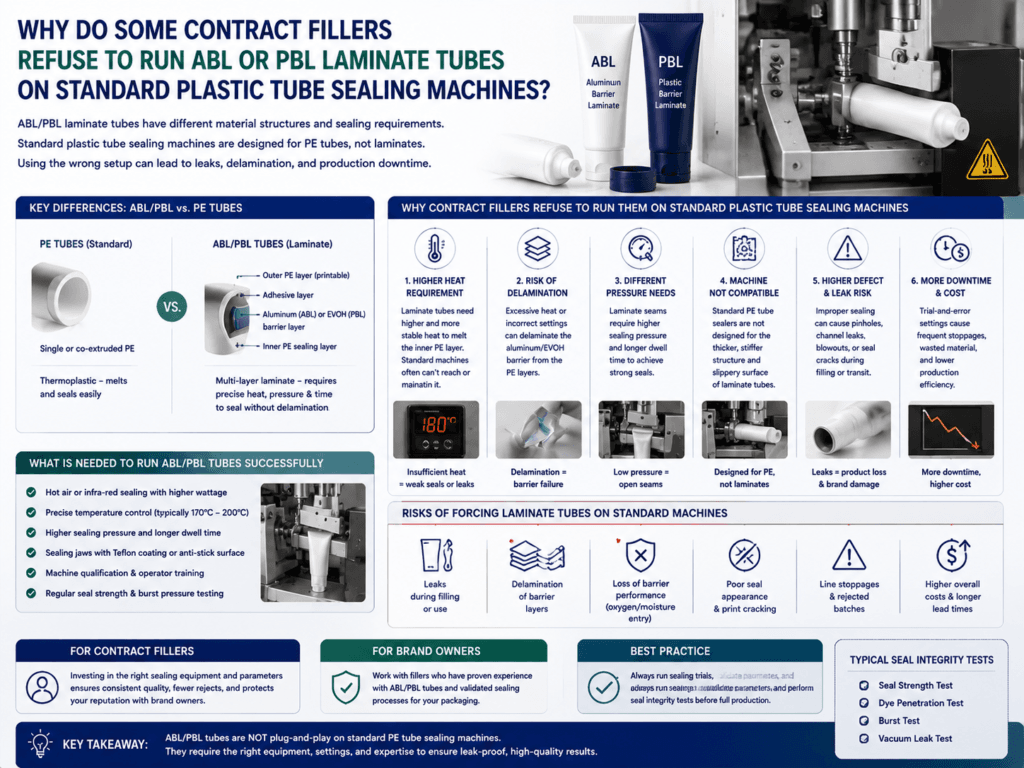
Some contract fillers refuse to run ABL or PBL laminate tubes on standard plastic tube sealing machines because laminate tubes require different sealing temperatures, pressure settings, tooling designs and machine parameters compared with traditional PE extruded tubes.
If a CMO uses unsuitable sealing equipment or incorrect settings, problems such as incomplete seals, tube leakage, tail wrinkles, delamination, aluminum layer damage or production downtime may occur.
When cosmetic brands switch from standard PE tubes to ABL (Aluminum Barrier Laminate) or PBL (Plastic Barrier Laminate) tubes, they sometimes discover that their chosen filling partner cannot process them on existing equipment.
This is not necessarily a supplier limitation. It is often related to differences in tube construction, sealing technology, machine capability and previous production experience.
Why Are ABL and PBL Tubes Different From Standard PE Tubes?
Although all cosmetic tubes appear similar externally, their internal structures are very different.
| Tube Type | Structure | Sealing Consideration |
|---|---|---|
| Mono-layer / Co-extruded PE Tube | Polyethylene body without laminate layers | Generally easier to heat seal with standard parameters |
| ABL Tube | PE / Adhesive / Aluminum Barrier / Adhesive / PE layers | Requires controlled heat sealing to protect aluminum barrier structure |
| PBL Tube | Plastic Barrier Laminate with EVOH or polymer barrier layer | Requires optimized sealing temperature and pressure |
Main Reasons Contract Fillers Reject ABL or PBL Tubes
1. Machine Not Designed for Laminate Tubes
Some filling machines are optimized only for PE extrusion tubes and cannot accurately control laminate sealing conditions.
2. Incorrect Heat Parameters
Laminate structures require different temperature windows compared with mono-material PE tubes.
3. Lack of Technical Experience
Some fillers avoid unfamiliar tube structures because trial runs may increase production risk.
4. Wrong Sealing Tooling
Tube diameter, shoulder shape and tail-sealing jaws must match the tube specification.
5. High-Speed Line Limitations
Older filling lines may struggle with precise laminate tube positioning and sealing.
6. Formula Compatibility Concerns
Certain aggressive formulas require additional testing before commercial production.
What Problems Occur When ABL or PBL Tubes Are Sealed Incorrectly?
| Problem | Possible Cause | Production Impact |
|---|---|---|
| Incomplete Tail Seal | Insufficient temperature, pressure or sealing time | Product leakage during transportation |
| Overheated Seal Area | Excessive sealing temperature | Tube deformation or laminate damage |
| Aluminum Layer Cracking | Incorrect folding or excessive mechanical stress | Reduced barrier performance |
| Wrinkled Tail Seal | Poor tooling alignment or unstable tube positioning | Poor shelf appearance |
| Layer Separation | Improper sealing conditions or incompatible materials | Possible leakage or package failure |
Why Can Standard Plastic Tube Sealing Machines Fail With ABL and PBL Tubes?
The biggest misunderstanding is assuming that all cosmetic tubes can use identical sealing parameters. The sealing process depends heavily on the tube material structure, thickness, barrier layer position and machine design.
| Parameter | Standard PE Tube | ABL / PBL Laminate Tube |
|---|---|---|
| Heat Transfer Behavior | PE material absorbs and transfers heat relatively predictably. | Multiple layers have different melting points and thermal behavior. |
| Sealing Temperature Window | Generally wider tolerance range. | Requires more precise temperature control. |
| Sealing Pressure | Usually easier to compress and seal. | Excessive pressure may damage laminate layers. |
| Tube Positioning | Standard tube handling is often sufficient. | Accurate positioning is required to avoid uneven seals. |
| Cooling Requirement | Normal cooling after sealing is usually adequate. | Controlled cooling helps prevent deformation and delamination. |
What Technical Parameters Should a CMO Confirm Before Running ABL or PBL Tubes?
Before accepting laminate tubes, a contract filler should review the complete compatibility between the tube supplier and filling equipment.
| Technical Item | Why It Matters |
|---|---|
| Tube Diameter | Determines filling nozzle size, machine holder and sealing jaw compatibility. |
| Tube Length | Affects tube positioning accuracy during filling and sealing. |
| Tube Shoulder Design | Different shoulder shapes may require different machine settings. |
| Laminate Structure | ABL, PBL, EVOH and barrier layers react differently to heat. |
| Tube Wall Thickness | Changes heat transfer speed and sealing behavior. |
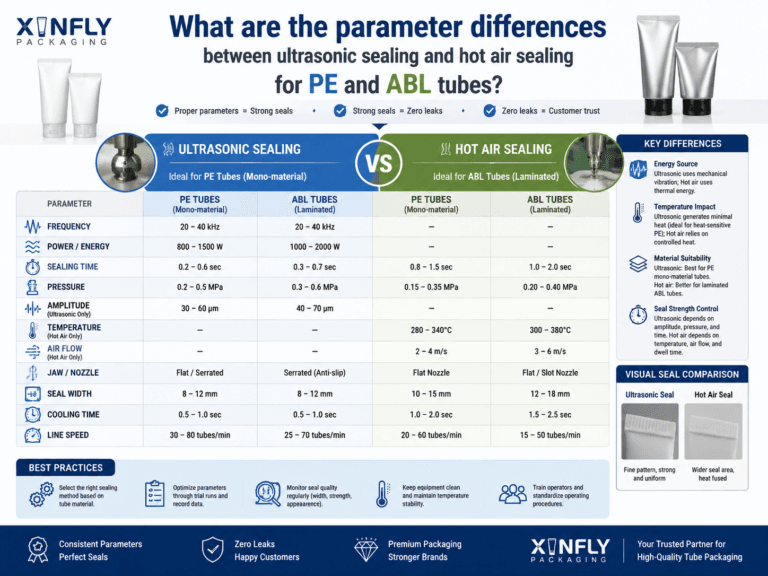
| Tail Sealing Method | Hot air, ultrasonic or other methods require different conditions. |
| Formula Viscosity | High-viscosity creams require different filling and sealing timing. |
| Filling Temperature | Hot filling can affect laminate layers and sealing performance. |
| Orifice Size | Impacts filling speed and potential product contamination near seal area. |
| Required Production Speed | High-speed lines require stable tube feeding and sealing control. |
How Should a CMO Test Laminate Tube Compatibility Before Mass Production?
The best practice is to conduct a tube compatibility trial before commercial filling. The test should use the actual production tube, filling machine and formula whenever possible.
Step 1: Tube Inspection
Confirm diameter, length, wall thickness, neck design and laminate structure.
Step 2: Machine Setup
Adjust sealing temperature, pressure, timing and tooling according to tube specifications.
Step 3: Trial Filling
Run production samples using the actual formula and filling speed.
Step 4: Seal Evaluation
Check seal strength, appearance, leakage resistance and laminate integrity.
Step 5: Aging Test
Evaluate filled tubes after storage under normal and accelerated conditions.
Step 6: Production Approval
Approve machine parameters before commercial manufacturing begins.
What Tests Should Be Performed After Sealing ABL or PBL Tubes?
| Test | Purpose |
|---|---|
| Seal Appearance Inspection | Check wrinkles, incomplete seals, deformation or contamination. |
| Leakage Test | Confirm the sealed tube prevents formula leakage. |
| Seal Strength Test | Verify mechanical strength of the tail seal. |
| Burst Pressure Test | Evaluate resistance to internal product pressure. |
| Heat Aging Test | Check whether the seal remains stable over time. |
| Transportation Simulation | Verify performance after vibration and temperature changes. |
| Delamination Inspection | Confirm laminate layers remain bonded. |
Why Do Some CMOs Prefer PE Tubes Instead of Laminate Tubes?
Some filling companies prefer standard PE tubes because their existing equipment, operators and quality systems are already optimized for extruded tubes.
Factory Engineer Explanation
ABL and PBL tubes are not necessarily more difficult products. They simply require different process knowledge.
A CMO experienced with laminate toothpaste tubes, pharmaceutical tubes or premium skincare packaging usually understands the required adjustments. The challenge occurs when a filling line has only been validated for one tube structure.
Can a Standard PE Tube Filling Line Be Modified for ABL or PBL Tubes?
In many cases, yes. A filling line may be adjusted or upgraded depending on the machine model and tube requirements.
| Possible Modification | Purpose |
|---|---|
| New Sealing Jaws | Match tube diameter and laminate sealing area. |
| Temperature Controller Upgrade | Provide more accurate heat management. |
| Tube Holder Adjustment | Improve tube positioning accuracy. |
| Software Parameter Update | Control sealing time, pressure and production speed. |
| Operator Training | Reduce setup errors during production. |
What Should Brands Do If Their CMO Refuses ABL or PBL Tubes?
A refusal does not always mean the laminate tube is unsuitable. The buyer should investigate the actual reason.
- Ask whether the machine has previously processed laminate tubes.
- Confirm the exact reason for rejection: machine limitation, lack of experience or quality risk.
- Request a technical trial before changing packaging materials.
- Ask the tube manufacturer to provide sealing recommendations.
- Evaluate whether another qualified filler is required.
Procurement Tip: Do not select a cosmetic tube only based on appearance and material performance. Always confirm filling-line compatibility before finalizing packaging specifications.
Procurement Checklist Before Selecting ABL or PBL Laminate Tubes
Before approving laminate tubes for a cosmetic product, procurement managers should coordinate between the brand, tube manufacturer and contract filler.
Recommended Communication Process Between Brand, Tube Supplier and CMO
Successful laminate tube projects require cooperation between three parties: the cosmetic brand, the tube manufacturer and the contract filler.
| Project Stage | Brand Responsibility | Tube Supplier Responsibility | CMO Responsibility |
|---|---|---|---|
| Packaging Selection | Define formula requirements and product positioning. | Recommend suitable ABL, PBL or PE structure. | Confirm filling equipment compatibility. |
| Sample Development | Approve appearance and packaging function. | Provide production samples and technical data. | Conduct sealing and filling trials. |
| Production Preparation | Confirm final packaging specifications. | Provide sealing recommendations. | Set machine parameters and validate process. |
| Mass Production | Monitor quality approval. | Maintain tube consistency. | Control filling and sealing quality. |
What Information Should a Tube Manufacturer Provide to a CMO?
A professional laminate tube supplier should provide technical information that allows the filling partner to correctly adjust the equipment.
- Tube material structure (ABL, PBL, EVOH or other barrier layer).
- Tube diameter and dimensional tolerance.
- Recommended sealing temperature range.
- Recommended sealing pressure and timing.
- Tube wall thickness information.
- Tail sealing recommendations.
- Compatibility notes for special formulas.
- Sample tubes for machine testing.
Why Is a Sealing Trial More Important Than Just Sending Tube Samples?
A common mistake is sending cosmetic tube samples to a CMO and assuming compatibility is confirmed after visual inspection.
A tube may look perfect but fail when it runs through an automated filling and sealing machine.
Factory Engineer Advice
The correct validation process is not only checking the tube. It is testing the interaction between:
- Tube structure.
- Machine sealing system.
- Filling speed.
- Formula viscosity.
- Filling temperature.
- Production operator settings.
- Final packaging requirements.
A successful sealing trial reduces the risk of expensive production interruptions after thousands of tubes have been purchased.
Common Mistakes When Switching From PE Tubes to ABL or PBL Tubes
| Mistake | Why It Happens | Better Approach |
|---|---|---|
| Assuming all tubes seal the same way | External appearance is similar. | Evaluate the internal material structure. |
| Testing only empty tubes | Formula and filling conditions are ignored. | Perform filled-product sealing trials. |
| Ignoring machine age | Older equipment may have limited adjustment capability. | Review machine specifications early. |
| Changing suppliers without CMO approval | New tube structures may behave differently. | Validate every new tube design. |
| Choosing packaging only by appearance | Premium design may create technical challenges. | Balance aesthetics, protection and manufacturability. |
Can ABL and PBL Tubes Improve Product Protection Compared With PE Tubes?
Yes. ABL and PBL tubes are often selected because they provide stronger barrier performance for sensitive formulas.
| Requirement | Recommended Tube Structure |
|---|---|
| Oxygen-sensitive skincare formulas | EVOH barrier PBL or ABL structures. |
| Oil-based formulas and essential oils | Barrier laminate tubes with improved protection against migration. |
| Toothpaste and oral care products | ABL or PBL laminate tubes are widely used. |
| Premium skincare positioning | ABL/PBL with high-quality printing and decoration options. |
| Standard lotions and creams | PE tubes may be sufficient depending on formula requirements. |
Factory Engineer Final Recommendation
Choose the Tube Together With the Filling Process
The best cosmetic packaging decision is not simply choosing the most advanced tube material. The correct choice must consider the formula, barrier requirement, production equipment and consumer experience.
ABL and PBL tubes provide excellent protection for many skincare, toothpaste and functional cosmetic applications, but they must be validated with the filling line before mass production.
A successful project requires:
- Correct tube structure selection.
- CMO machine compatibility confirmation.
- Sealing parameter optimization.
- Production trial approval.
- Quality monitoring during mass production.
Summary
Some contract fillers refuse to run ABL or PBL laminate tubes on standard plastic tube sealing machines because laminate tubes have different thermal behavior, sealing requirements and processing characteristics compared with traditional PE tubes.
The issue is usually not that laminate tubes cannot be sealed. The real challenge is whether the filling equipment, tooling and operators are properly prepared for the specific tube structure.
Brands should confirm CMO compatibility before finalizing packaging, perform sealing trials, define technical parameters and ensure communication between the tube supplier and filling partner.
Related resources:
- EVOH vs ABL Tubes: Barrier Performance Comparison
- Comparing EVOH, ABL and PBL Laminate Tubes
- What Is EVOH Barrier Material?
- Choosing ABL Tubes for Sensitive Formulas
- Custom Cosmetic Tube Manufacturer
Need ABL or PBL Tubes Compatible With Your Filling Line?
Xinfly Packaging provides ABL, PBL, EVOH barrier and PE cosmetic tubes with technical support for tube selection, sealing compatibility and global OEM production.
Discuss Your Laminate Tube Project Explore ABL Tubes