
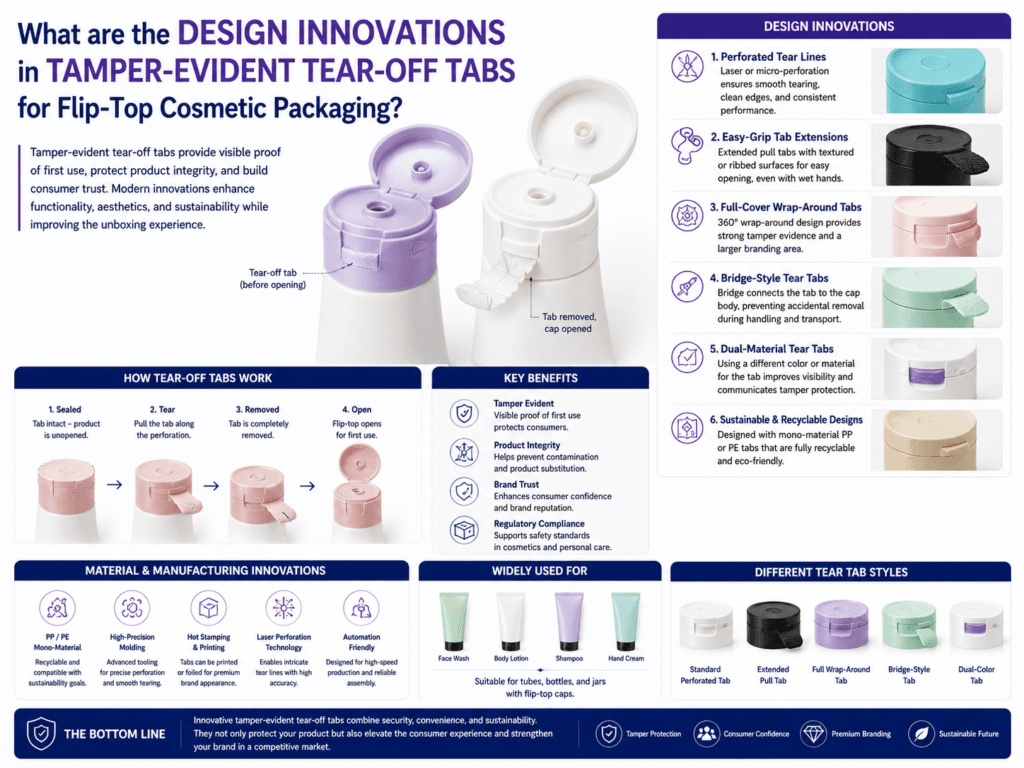
Tamper-evident tear-off tabs for flip-top cosmetic packaging are evolving from simple breakable strips into more user-friendly, brand-integrated, and production-efficient security features. Modern designs focus on visible first-opening evidence, easy consumer removal, stable flip-top function, clean appearance, recyclable material direction, and compatibility with automated filling and capping lines.
For cosmetic tubes, tear-off tabs are especially useful for facial cleanser, sunscreen, hand cream, body lotion, shampoo, conditioner, hotel amenities, skincare, and travel-size products where brands want a clear “unopened” signal without using a full shrink band or secondary outer box.
Quick Answer
The main design innovations include integrated break bridges, pull-ring tabs, easy-grip tear strips, hidden tamper bands, directional tear paths, one-piece molded PP structures, color-contrast safety tabs, reduced-plastic designs, smoother post-tear edges, and compatibility with flip-top hinge and plug-seal systems. These innovations help improve security, user experience, premium appearance, and mass production stability.
| Innovation | How It Works | Packaging Benefit |
|---|---|---|
| Integrated tear-off bridge | Small molded bridges connect the lid to the cap base before first use | Shows clear evidence when the cap has been opened |
| Pull-ring tab | User pulls a ring or tab to break the safety feature | Easier first opening and stronger consumer confidence |
| Color-contrast tab | Tamper tab uses a different color from the cap body | Makes the security feature more visible on shelf |
| Directional tear path | Designed weak points guide the tear in a controlled direction | Prevents messy tearing and sharp broken edges |
| One-piece molded design | TE feature is molded directly into the flip-top cap | Reduces extra parts, assembly steps, and material waste |
What Is a Tamper-Evident Tear-Off Tab?
A tamper-evident tear-off tab is a small breakable or removable molded feature that prevents the flip-top lid from opening until the consumer removes or breaks it. Once removed, the tab cannot be restored to its original condition, giving a visible indication that the product has been opened.
| Component | Function | Design Requirement |
|---|---|---|
| Tear tab | Consumer pulls or breaks it before first use | Must be easy to grip but not easy to break accidentally |
| Break bridge | Connects the tab to the lid or cap base | Must break cleanly at the designed force |
| Flip-top lid | Opens after tamper feature is removed | Must still close securely after first opening |
| Inner plug seal | Controls leakage after the cap is closed | Must not be damaged by the tear-off function |
| Cap base | Holds cap onto tube neck | Must maintain thread fit, torque, and sealing stability |
Why Cosmetic Brands Use Tear-Off Tabs
Cosmetic products are often opened, tested, or handled before purchase in retail environments. For e-commerce and wholesale distribution, products may also experience shipping vibration, carton compression, and multiple handling steps. A tear-off tab gives a simple visible sign that the flip-top cap has not been opened before the consumer receives it.
- Visible first-opening security: Consumers can quickly see if the product is unopened.
- Reduced need for shrink bands: Some designs can reduce secondary packaging steps.
- Better hygiene perception: Useful for skincare, cleanser, sunscreen, and hotel amenities.
- Retail confidence: Helps discourage casual opening or sampling on shelf.
- Brand trust: Makes the product feel safer, cleaner, and more professional.
Innovation 1: Integrated One-Piece Molded Tear Tabs
One of the most practical innovations is molding the tamper-evident feature directly into the flip-top cap. Instead of adding a separate band, label, or shrink sleeve, the cap itself includes a tear-off bridge or tab. This reduces assembly steps and improves production efficiency.
| Design Benefit | Why It Matters |
|---|---|
| Fewer components | Reduces secondary packaging, labor, and supply complexity |
| Better recyclability direction | Mono-material PP cap designs are easier to manage than mixed-material safety bands |
| Cleaner appearance | TE function looks integrated instead of added later |
| Stable mass production | Fewer loose parts means fewer assembly defects |
Innovation 2: Controlled Break Bridges
Break bridges are thin molded connections that hold the cap closed before first use. The challenge is balancing strength and removability. If the bridge is too weak, it may break during shipping. If it is too strong, consumers may struggle to open the product or tear the cap unevenly.
| Bridge Design | Function | Risk If Poorly Designed |
|---|---|---|
| Thin bridge | Easy to break at first use | May break during shipping or filling |
| Thick bridge | More secure during transport | Hard to remove; may damage cap or hurt user experience |
| Multiple micro-bridges | Creates controlled break force | Needs precise molding control |
| Directional bridge pattern | Guides tear path cleanly | Poor direction may leave sharp or ugly tear marks |
Innovation 3: Easy-Grip Pull Tabs
Older tamper tabs can be difficult to grip, especially with wet hands, long nails, or small travel-size caps. Newer designs use raised tabs, textured tabs, small pull-rings, or finger-friendly shapes to improve first-opening comfort.
- Raised grip area: Helps consumers find the tab quickly.
- Textured surface: Improves grip when hands are wet or oily.
- Pull-ring shape: Gives a clear opening gesture.
- Rounded edges: Reduces scratching or discomfort during opening.
- Clear instruction icons: “Pull” or arrow marks reduce confusion.
Innovation 4: Hidden or Low-Profile Tamper Bands
For premium cosmetic packaging, brands may not want a large visible security feature that disrupts the design. Hidden or low-profile tear-off tabs keep the cap looking clean while still providing visible evidence after opening.
| Design Style | Appearance | Best Application |
|---|---|---|
| Hidden underside tab | Mostly invisible from front view | Luxury skincare, premium facial cleanser, eye cream tubes |
| Low-profile side bridge | Small visible connection at side | Minimalist cosmetic tube designs |
| Decorative tear strip | Security feature becomes part of cap design | Color-coded product lines and retail packaging |
| Cap-base security band | Band breaks when cap is first opened | Products requiring stronger first-opening evidence |
Innovation 5: Color-Contrast Tamper Tabs
Color-contrast tabs use a different color for the tear-off area to make the tamper-evident function more visible. This is useful for retail, hotel amenities, travel kits, and personal care products where consumers should immediately understand that the package is sealed.
| Color Strategy | Brand Effect | Engineering Note |
|---|---|---|
| White cap + blue tab | Clean, hygienic, clinical look | Good for cleanser, sunscreen, and skincare |
| Black cap + gold tab | Premium and giftable appearance | Needs color-matching and molding control |
| Natural cap + green tab | Eco-friendly and botanical image | Useful for sustainable packaging lines |
| Same-color subtle tab | Minimalist luxury appearance | Less visible but cleaner design |
Innovation 6: User-Safe Tear Path Design
A common weakness of tear-off tabs is rough broken edges after removal. Modern designs control the tear path so the broken area is smoother, safer, and less visually distracting. This is important for cosmetic products because consumers repeatedly touch the cap during daily use.
| Tear Path Feature | Purpose | Quality Benefit |
|---|---|---|
| Pre-weakened score line | Guides the break along a planned line | Cleaner first opening |
| Rounded bridge base | Reduces sharp broken points | Better hand feel after opening |
| Controlled tear thickness | Balances security and removability | Reduces accidental breakage and consumer complaints |
| Hidden break area | Places the broken edge away from finger contact | Improves long-term user comfort |
Innovation 7: Sustainable Tamper-Evident Design
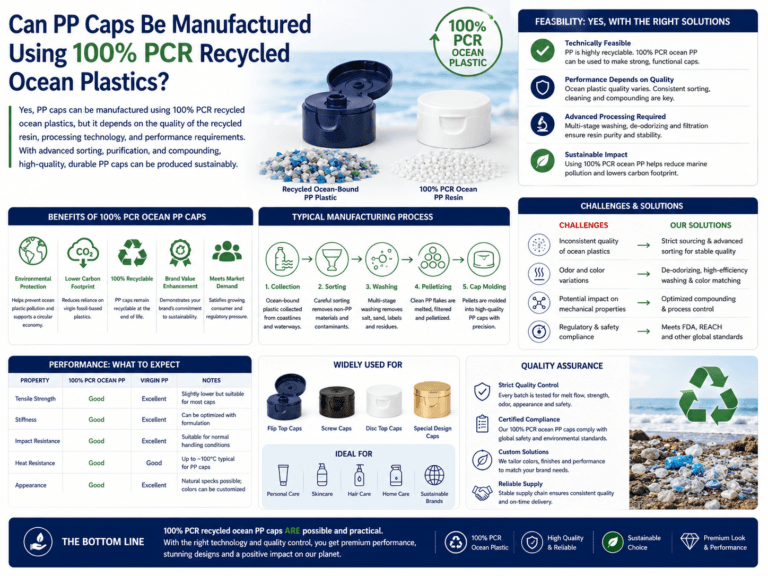
Many brands want tamper evidence without adding extra shrink film, labels, or mixed-material components. One-piece molded tear-off tabs can support a simpler material structure, especially when the cap is made from PP and the tear tab is also PP.
| Sustainable Design Direction | Benefit | Consideration |
|---|---|---|
| Mono-material PP cap | Simpler recycling direction than multi-material safety parts | Must still pass hinge and break-force testing |
| No shrink band | Reduces secondary plastic use | Tear tab must provide enough tamper evidence by itself |
| Lightweight tab geometry | Uses less resin | Must not break during shipping |
| PCR PP option | Supports recycled-content positioning | Needs durability, odor, and color consistency testing |
How Tear-Off Tabs Affect Flip-Top Cap Function
The tamper feature should not weaken the flip-top cap’s main functions. After the tab is removed, the cap must still open smoothly, close securely, seal the orifice, resist leakage, and maintain hinge strength. Poor tear-tab design can damage the lid, distort the snap lock, or interfere with the inner plug seal.
| Cap Function | Risk From Poor Tear-Tab Design | Control Point |
|---|---|---|
| Hinge durability | Tear force may overstress the hinge | Place tear tab away from hinge stress zone |
| Snap closure | Lid may become loose after tab removal | Separate TE bridge from snap-lock geometry |
| Plug seal | Opening force may distort the plug area | Validate seal after first opening |
| Cap appearance | Broken tab area may look rough or cheap | Use controlled tear path and hidden break location |
| User comfort | Sharp tear remains may scratch fingers | Use rounded geometry and safe break points |
Best Product Applications
| Product Category | Why Tear-Off Tabs Help | Design Recommendation |
|---|---|---|
| Facial cleanser tubes | Prevents retail opening and improves hygiene perception | Easy-grip flip-top tab with strong plug seal |
| Sunscreen tubes | Useful for travel, e-commerce, and outdoor retail channels | Durable tab with leakage and compression testing |
| Hand cream tubes | Supports gift sets and retail shelf confidence | Low-profile tab to preserve premium appearance |
| Hotel amenity tubes | Shows guests the product has not been opened | Clear visible tab or color-contrast security design |
| Baby care or sensitive skincare | Builds trust for hygiene-sensitive buyers | Soft-opening tab with clear first-use indication |
| Travel-size tubes | Protects product during bags, flights, and kits | Compact tab that does not snag or break accidentally |
Manufacturing Challenges
Tamper-evident tear-off tabs require precise injection molding. The bridge must be thin enough to tear, but strong enough to survive molding, ejection, packing, transport, and cap assembly. Material choice, mold flow, cooling, gate position, and dimensional tolerance directly affect performance.
| Manufacturing Factor | Risk | Solution Direction |
|---|---|---|
| Bridge thickness variation | Some tabs break too easily, others are too hard to remove | Control mold precision and process stability |
| Material brittleness | Tab may snap during shipping or cap assembly | Use suitable PP grade and test color masterbatch |
| Gate position | Poor flow may weaken tab or hinge area | Optimize mold flow and avoid weak weld lines |
| Cap ejection stress | Tabs may crack during demolding | Improve ejection design and cooling time |
| PCR material variation | Recycled PP may affect break force and hinge fatigue | Run PCR batch consistency and cycle tests |
Quality Tests Before Mass Production
| Test | Purpose | What to Check |
|---|---|---|
| Tear force test | Measures how much force is needed to remove the tab | Too easy to break, too hard to open, batch variation |
| First-opening inspection | Checks whether tamper evidence is clearly visible | Broken bridge, missing tab, visible opening indication |
| Post-tear safety check | Ensures no sharp or rough edge remains | Finger comfort, cap appearance, broken residue |
| Repeated open-close test | Confirms flip-top function after tab removal | Hinge strength, snap closure, plug seal durability |
| Leakage test | Checks whether cap still seals after first opening | Plug seal, cap snap, orifice leakage |
| Drop and compression test | Simulates shipping and e-commerce handling | Accidental tab breakage, lid popping, cap cracking |
| Temperature cycling test | Checks hot and cold performance | Brittleness, warpage, tear-force change, snap looseness |
Common Problems and Solutions
| Problem | Likely Cause | Adjustment Direction |
|---|---|---|
| Tab breaks during shipping | Bridge too thin, brittle material, carton compression | Increase bridge strength and run compression/drop tests |
| Consumer cannot remove tab easily | Bridge too thick or grip area too small | Add grip texture, pull ring, or thinner tear path |
| Rough edge remains after tearing | Poor tear path or sharp bridge geometry | Add rounded break points and controlled score line |
| Flip-top lid becomes loose after tab removal | TE feature interferes with snap-lock structure | Separate tamper bridge from functional snap area |
| Cap leaks after first opening | Plug seal or lid geometry damaged during tearing | Validate cap sealing after tab removal |
| Tab appearance looks cheap | Oversized tab or poor color integration | Use hidden, low-profile, or brand-colored tab design |
Design Checklist for Brands
- Define the security level: Decide whether the tab only needs visual first-opening evidence or stronger retail anti-opening protection.
- Confirm cap structure: Tear-off design must not weaken hinge, snap closure, plug seal, or thread fit.
- Choose user-friendly geometry: Pull area should be easy to grip, especially for wet hands or small caps.
- Set tear-force standard: Avoid tabs that break too easily or require excessive force.
- Control post-tear appearance: Broken area should be clean, safe, and not damage the premium look.
- Test filled tubes: Leakage, compression, travel, and repeated-use tests should be done with real formula.
Common Mistakes to Avoid
- Adding a tear tab too late in design: It should be considered during cap mold development.
- Making the tab too small: Consumers may struggle to grip it, especially on mini tubes.
- Making the bridge too weak: It may break during shipping and lose tamper-evident value.
- Ignoring the hinge: Tear-off force can damage the flip-top hinge if the design is poorly placed.
- Skipping post-opening leakage tests: The cap must still seal after the tamper feature is removed.
- Using mixed materials unnecessarily: Extra bands or films may complicate sustainability positioning.
Best Practical Recommendation
For flip-top cosmetic packaging, the best tamper-evident tear-off tab should be visible before first use, easy to remove, difficult to restore, safe after tearing, compatible with the hinge and plug seal, and stable during shipping. For premium skincare or minimalist designs, low-profile or hidden tabs are better. For hotel amenities, travel kits, and hygiene-focused products, color-contrast or highly visible tabs may be more effective.
The final design should be validated with real cap material, real tube neck, real formula, real filling process, and real transport conditions. Testing should include tear force, accidental breakage, post-tear safety, leakage, repeated open-close durability, drop, compression, and temperature cycling.
Summary
Design innovations in tamper-evident tear-off tabs for flip-top cosmetic packaging include integrated one-piece molded tabs, controlled break bridges, easy-grip pull rings, color-contrast security tabs, hidden low-profile bands, user-safe tear paths, and sustainable mono-material PP designs. These features help brands improve first-opening security, consumer confidence, hygiene perception, and retail presentation without relying only on shrink bands or outer cartons.
To succeed, the tear-off tab must not interfere with the flip-top hinge, snap closure, plug seal, cap torque, or leakage performance. The best design balances security, appearance, user comfort, manufacturability, and sustainability.
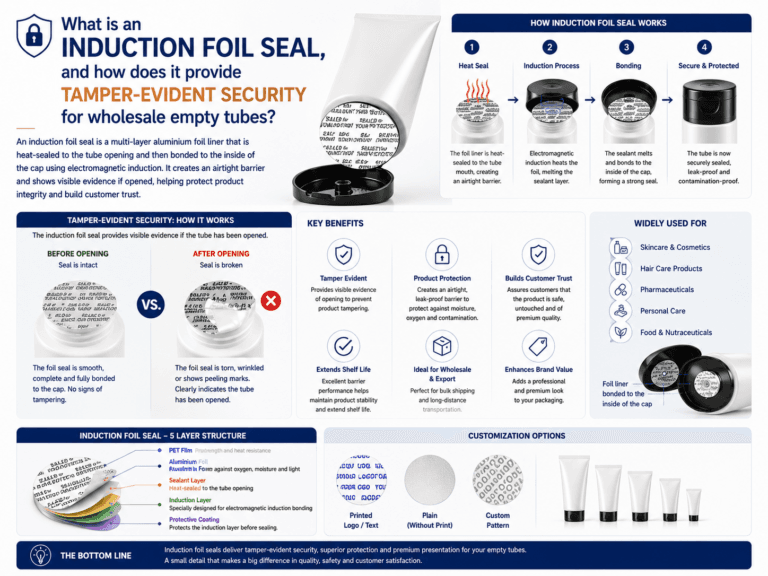
Learn more: Flip Cap Tubes, Caps & Closures, Induction Foil Seal for Tamper-Evident Security, Flip-Top Cap Hinge Durability, PE Tube Neck and PP Flip-Top Cap Compatibility, Quality Assurance.
Need Tamper-Evident Flip-Top Caps for Cosmetic Tubes?
Xinfly Packaging helps beauty brands develop flip-top cosmetic caps with tear-off tabs, tamper-evident bridges, secure plug seals, hinge durability, cap fit testing, leakage control, PCR PP options, and premium cosmetic tube packaging solutions.