
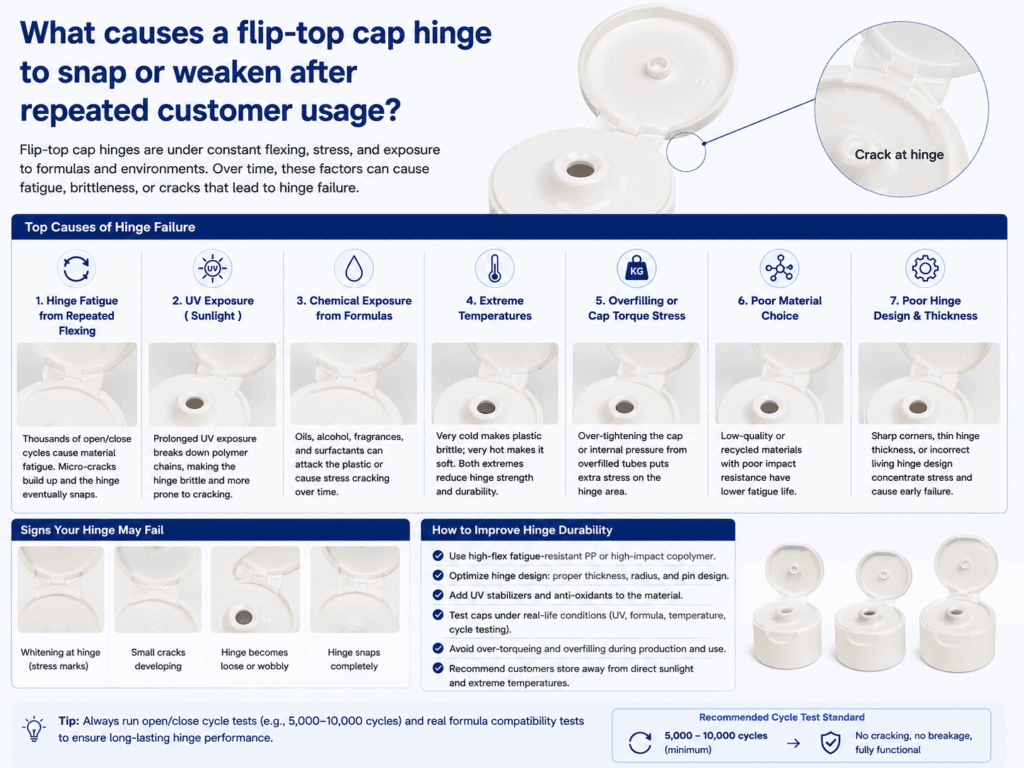
A flip-top cap hinge may snap, crack, or weaken after repeated customer usage because of poor hinge geometry, brittle PP material, excessive opening angle, weak living-hinge thickness, high snap force, chemical stress from the formula, or insufficient cycle testing before mass production. The failure usually appears as a white stress mark, loose lid, cracked hinge bridge, broken hinge pin area, or cap that no longer closes securely.
For cosmetic tube packaging, the flip-top hinge is a small but critical functional part. It must survive repeated opening and closing in bathrooms, showers, handbags, travel bags, and e-commerce shipping. A cap that looks good at sample approval may still fail later if the hinge design, material toughness, molding conditions, and formula compatibility are not validated together.
Quick Answer
The most common causes are thin hinge design, poor PP toughness, excessive opening force, sharp hinge corners, weak snap-lock balance, cold-temperature brittleness, formula attack, over-tight assembly, and lack of repeated open-close testing. To prevent failure, factories should optimize the hinge thickness, radius, material grade, mold flow, snap force, cap wall thickness, and test the cap through thousands of open-close cycles with real filled tubes.
| Failure Mode | Main Cause | Visible Symptom |
|---|---|---|
| Hinge snaps suddenly | Brittle material, thin hinge, sharp stress point | Complete break at hinge bridge |
| Hinge becomes loose | Fatigue after repeated bending | Lid does not close tightly or wobbles |
| White stress marks | Plastic overstretching or repeated flexing | White line near hinge or lid root |
| Cap no longer snaps closed | Snap lock wear or plug deformation | Lid pops open after closing |
| Cracking after storage | Chemical stress cracking or high internal stress | Hairline cracks around hinge or cap skirt |
Why Flip-Top Hinges Are Vulnerable
Most flip-top caps use a living hinge structure, usually molded from PP. A living hinge works by repeatedly bending a thin plastic section. This requires good material flexibility, correct hinge thickness, smooth mold flow, rounded corners, and controlled opening angle. If any of these are wrong, the hinge may weaken long before the product is finished by the customer.
- Repeated flexing: The hinge bends every time the consumer opens and closes the cap.
- Thin section: Living hinges are intentionally thin, so small design errors matter.
- Stress concentration: Sharp corners or uneven thickness can create crack starting points.
- High snap force: If the lid is hard to open, the consumer applies more force to the hinge.
- Formula residue: Oils, surfactants, sunscreen, or cleanser residue can affect cap material over time.
Main Design Causes of Hinge Failure
| Design Cause | Why It Weakens the Hinge | Improvement Direction |
|---|---|---|
| Hinge too thin | Cannot withstand repeated bending and fatigue | Optimize hinge thickness and PP flow orientation |
| Hinge too thick | Requires too much bending force and may crack | Reduce stiffness and improve flexing geometry |
| Sharp hinge corners | Creates stress concentration during opening | Add smooth radii and avoid sharp transitions |
| Opening angle too wide | Overstretches the living hinge | Add controlled stop angle or redesign lid travel |
| Snap lock too tight | Consumer pulls harder, increasing hinge stress | Balance snap force with sealing performance |
| Plug seal too tight | Closing force becomes excessive | Adjust plug interference and orifice fit |
Material Factors: Why PP Grade Matters
PP is commonly used for flip-top caps because it is suitable for living hinges. However, not all PP grades perform the same. A cap that uses brittle PP, excessive filler, poor recycled-content control, or unsuitable color masterbatch may crack more easily after repeated use.
| Material Factor | Effect on Hinge | Quality Control Point |
|---|---|---|
| PP toughness | Higher toughness improves repeated bending durability | Select hinge-grade PP for flip-top caps |
| Recycled content | May create batch variation and lower hinge consistency | Test PCR/ recycled PP carefully if used |
| Color masterbatch | Some pigments or additives may affect brittleness | Approve color with mechanical testing, not only visual matching |
| Filler content | Can increase stiffness but reduce hinge fatigue resistance | Avoid excessive filler in living-hinge areas |
| Cold-temperature behavior | Plastic may become more brittle in cold shipping or storage | Run low-temperature open-close and drop tests |
Engineer’s note: A flip-top cap should not be approved only by checking whether it opens and closes 10 times. For daily-use skincare, cleanser, sunscreen, and lotion tubes, repeated hinge-cycle testing is essential.
Molding Process Problems That Damage Hinge Strength
Even with a good design and good PP resin, poor injection molding conditions can weaken the hinge. Mold temperature, injection speed, gate position, cooling time, weld lines, and residual stress all affect cap durability. A hinge may pass initial visual inspection but fail after repeated customer use.
| Molding Issue | How It Affects the Hinge | Possible Failure |
|---|---|---|
| Poor gate position | Material flow does not align well through hinge area | Weak hinge, uneven flexing, early cracking |
| Weld line near hinge | Creates a weak bonding line in the plastic | Crack starts at weld line |
| Excessive residual stress | Cap is already stressed before use | Stress whitening, cracking, brittle break |
| Insufficient cooling control | Creates uneven shrinkage and warpage | Lid misalignment or weak snap closure |
| Flash or burrs | Interferes with hinge movement or cap closing | Hard opening, hinge stress, poor closing feel |
Formula Contact and Chemical Stress Cracking
Flip-top caps are often used for facial cleanser, sunscreen, hand cream, body lotion, hair mask, and shower gel tubes. These formulas may contain surfactants, oils, fragrance, essential oils, UV filters, acids, or botanical extracts. If formula residue remains near the hinge or cap edge, it can weaken the plastic or accelerate stress cracking.
| Formula Type | Risk to Hinge | Packaging Recommendation |
|---|---|---|
| Facial cleanser / shower gel | Surfactants may leave residue around cap and hinge | Test repeated wet-use and residue exposure |
| Sunscreen | UV filters and oils may stress some plastics | Run formula compatibility and aging tests |
| Essential-oil cream | Volatile oils can migrate into plastic | Use compatible PP and verify chemical resistance |
| Hair mask / conditioner | Thick formula can require higher cap opening and closing force | Optimize orifice and plug seal to reduce stress |
| Acid or active skincare | Some formulas may affect cap material over time | Validate with filled aging and torque tests |
Snap Force and Plug Seal Balance
A flip-top cap must be easy enough for consumers to open but secure enough to prevent leakage. If the snap lock is too tight, the consumer may pull forcefully and bend the hinge sharply. If the plug seal is too tight, closing the lid requires excessive force. If both are too loose, the cap may leak or pop open.
| Cap Function | Too Tight | Too Loose | Correct Direction |
|---|---|---|---|
| Snap lock | Hard opening, hinge stress, broken lid | Lid pops open, poor leakage control | Stable click with comfortable opening force |
| Inner plug | Hard closing, plug stress, cap deformation | Formula leakage and messy cap | Secure plug seal without excessive interference |
| Hinge stiffness | High bending force and fatigue | Loose lid and poor control | Smooth flex with stable lid return |
Customer Usage Conditions That Accelerate Hinge Failure
- Opening the lid beyond its designed angle: Overextension can stretch or tear the living hinge.
- Wet bathroom use: Water, cleanser residue, and slippery hands can create uneven pulling force.
- Travel and handbag storage: Caps may be compressed or hit repeatedly.
- Cold weather use: PP can feel stiffer and more brittle in low temperatures.
- Product buildup: Dried formula around the plug or lid increases closing resistance.
- One-side pulling: Consumers may open from one corner, twisting the hinge unevenly.
Recommended Factory Tests for Flip-Top Hinges
| Test | Purpose | What to Check |
|---|---|---|
| Repeated open-close cycle test | Simulates daily customer use | Hinge cracks, stress whitening, loose lid, snap failure |
| Opening force test | Measures how much force is needed to open the lid | Too tight, too loose, consumer comfort |
| Closing force test | Checks plug seal and snap-lock balance | Hard closing, cap deformation, plug wear |
| Formula contact test | Checks chemical compatibility | Cracking, swelling, discoloration, brittleness |
| High-temperature aging test | Accelerates chemical and mechanical stress | Hinge weakening, cap warpage, snap looseness |
| Low-temperature test | Checks cold-weather brittleness | Hinge snap, cap cracking, hard opening |
| Drop and compression test | Simulates shipping, travel, and e-commerce handling | Hinge breakage, lid popping, cap leakage |
Testing Standards for Different Product Types
| Product Type | Hinge Durability Focus | Special Test Recommendation |
|---|---|---|
| Facial cleanser tube | Frequent bathroom use and wet-hand opening | Open-close cycles with wet residue and leakage test |
| Sunscreen tube | Outdoor use, heat exposure, oil-rich formula | Heat aging, formula contact, and drop test |
| Hand cream tube | Repeated daily opening in bags or pockets | Cycle test, compression test, travel leakage test |
| Body lotion tube | Large cap base and higher filled weight | Standing stability, drop, and hinge fatigue test |
| Hotel amenity tube | Short-term use but high-volume production consistency | Batch QC and cap snap consistency inspection |
How to Prevent Flip-Top Hinge Failure
| Prevention Method | How It Helps |
|---|---|
| Use hinge-grade PP material | Improves bending fatigue resistance and reduces brittle failure |
| Optimize hinge thickness and radius | Reduces stress concentration during repeated opening |
| Control snap force | Prevents consumers from pulling too hard and damaging the hinge |
| Match plug seal to orifice | Prevents excessive closing force and cap deformation |
| Improve injection molding conditions | Reduces weld lines, residual stress, warpage, and weak hinge zones |
| Run repeated-use testing | Confirms real consumer durability before mass production |
Common Mistakes to Avoid
- Approving cap samples only by appearance: A glossy, beautiful cap can still have a weak hinge.
- Ignoring opening force: A cap that is too hard to open puts extra stress on the hinge.
- Using brittle PP or excessive filler: This can reduce living-hinge durability.
- Skipping formula compatibility tests: Oils, surfactants, and fragrance may weaken caps over time.
- Testing only at room temperature: Caps may fail in hot warehouses or cold shipping conditions.
- Not testing after filling: Filled tubes create different pressure, residue, and handling conditions than empty caps.
Best Practical Recommendation
For cosmetic tubes with flip-top caps, the hinge should be designed as a functional engineering part, not just a decoration detail. Use a suitable PP grade, smooth living-hinge geometry, controlled snap force, accurate plug seal, and stable injection molding conditions. Then validate the cap with real filled tubes under repeated opening, leakage, drop, compression, high-temperature, low-temperature, and formula-contact conditions.
For high-frequency products such as facial cleanser, sunscreen, hand cream, body lotion, shampoo, conditioner, and shower gel, it is safer to run extended open-close cycle testing before final cap approval.
Summary
A flip-top cap hinge snaps or weakens after repeated customer use because of hinge fatigue, poor living-hinge geometry, brittle PP material, excessive opening angle, high snap force, plug-seal interference, injection molding stress, formula attack, or insufficient durability testing. The problem may appear as stress whitening, hinge cracking, loose lid, snap failure, or complete breakage.
To prevent hinge failure, factories should optimize the cap material, hinge thickness, hinge radius, opening angle, snap force, plug seal, mold flow, and cap tolerance. Final approval should include repeated open-close cycle testing, formula compatibility, leakage, drop, compression, hot/cold aging, and real filled-tube validation.
Learn more: Flip Cap Tubes, Caps & Closures, PE Tube Neck and PP Flip-Top Cap Compatibility, Choose the Right Orifice Size, Screw Caps vs Flip-Top Caps, Quality Assurance.
Need Durable Flip-Top Caps for Cosmetic Tubes?
Xinfly Packaging helps brands match flip-top cap material, hinge design, snap force, plug seal, tube neck fit, orifice size, formula compatibility, and repeated-use testing for reliable skincare, sunscreen, cleanser, lotion, and personal care tube packaging.