
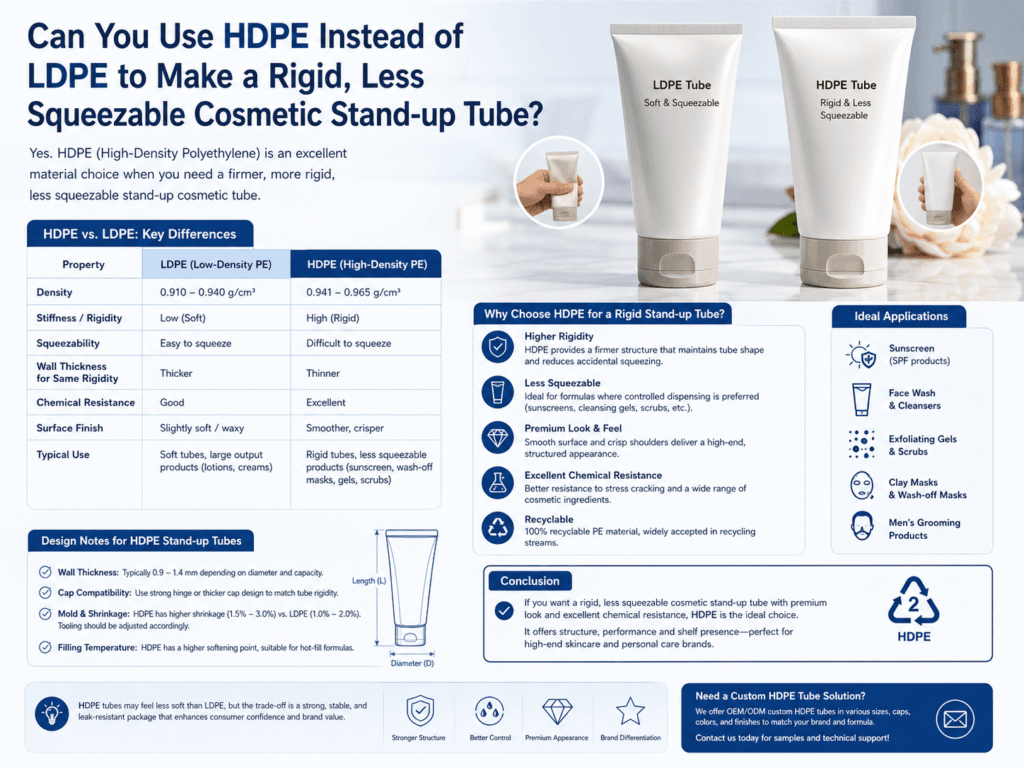
Yes, HDPE can be used instead of LDPE to make a more rigid, less squeezable cosmetic stand-up tube, but it must be carefully balanced with tube wall thickness, diameter, shoulder design, cap type, and formula viscosity. HDPE is stiffer than LDPE, so it can improve stand-up performance and body strength, but it may also make the tube harder to squeeze and less comfortable for daily-use cosmetics.
For cosmetic squeeze tubes, LDPE is commonly used when softness, flexibility, and easy dispensing are important. HDPE is more suitable when the brand wants a firmer tube body, stronger shape retention, better upright display, or a more structured premium feel. However, using too much HDPE can create a tube that feels rigid, difficult to dispense, or prone to stress whitening under repeated squeezing.
HDPE vs. LDPE in Cosmetic Tubes
| Material | Main Character | Effect on Tube Feel | Best Use |
|---|---|---|---|
| LDPE | Softer, more flexible, easier to squeeze | Soft hand feel and better dispensing comfort | Hand cream, lotion, cleanser, sunscreen, daily skincare |
| HDPE | Stiffer, stronger, better shape retention | More rigid and less squeezable | Stand-up tubes, structured cosmetic tubes, products needing firmer body |
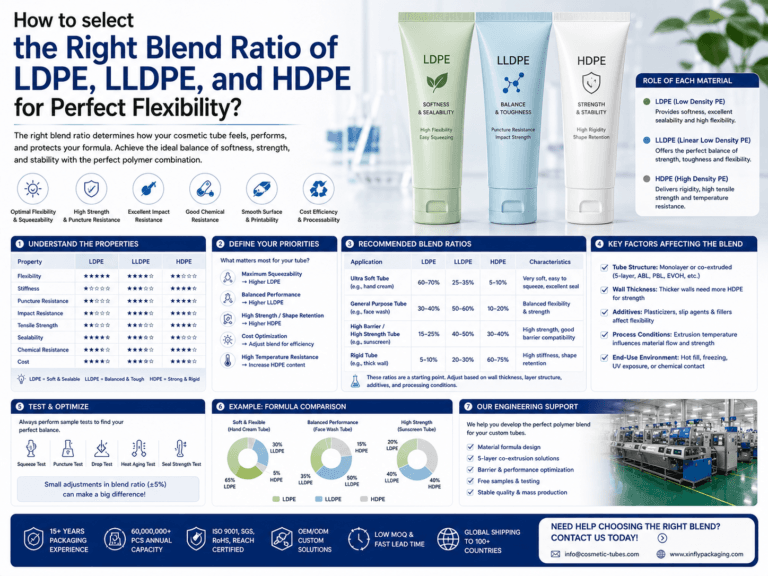
| LDPE + HDPE blend | Balanced softness and stiffness | Controlled squeeze feel with better body support | Most practical option for semi-rigid cosmetic tubes |
Why Use HDPE for a Stand-Up Cosmetic Tube?
HDPE can help the tube stand more firmly on the shelf because it increases body stiffness and reduces excessive collapsing. This is useful for larger tubes, retail display packaging, men’s grooming products, functional skincare, and products where the tube should look neat and upright after repeated use.
- Better upright stability: A stiffer body helps the tube stand more confidently.
- Less deformation: HDPE reduces soft body collapse and paneling risk.
- Stronger shelf presence: The tube can look more structured and premium.
- Improved shape retention: HDPE helps the tube keep its designed form.
- Useful for larger tubes: Body lotion, sunscreen, and hair care tubes may need more structural support.
What Are the Risks of Using Too Much HDPE?
| Risk | What Happens | Impact on Consumer Use |
|---|---|---|
| Harder squeeze | The tube requires more compression force | Users may struggle to dispense thick creams or lotions |
| Poor dispensing control | Rigid walls may not deform smoothly | Product may come out unevenly or require two-hand squeezing |
| Stress whitening | Repeated bending can create white marks on the tube body | Tube may look damaged after use |
| Reduced premium softness | The tube may feel less smooth and less cosmetic-friendly | Not ideal for luxury skincare or elderly-friendly products |
| Tail seal stress | Rigid material may need more precise sealing control | Potential leakage or cracking if sealing is not optimized |
When HDPE Is a Good Choice
HDPE is a good option when the product needs a firmer structure more than a very soft squeeze feel. It can be useful for products displayed upright, products with larger capacity, or brands that want a more rigid tube body to support shelf appearance.
| Product Type | HDPE Suitability | Reason |
|---|---|---|
| Stand-up body lotion tube | Good, if squeeze force is tested | Improves upright stability and body support |
| Men’s grooming tube | Good | Firmer tube body can match a structured brand image |
| Thick cream or balm | Use carefully | Too much HDPE can make dispensing difficult |
| Elderly-friendly hand cream | Usually not ideal as main material | Soft squeeze is more important than rigid body |
| Luxury soft-touch skincare | Use blended structure | Needs balance between firmness and premium hand feel |
Better Option: Blend HDPE With LDPE
Instead of using 100% HDPE, many cosmetic tube projects use a controlled blend or multi-layer structure. This allows the tube to keep enough stiffness for stand-up performance while still remaining squeezable for consumers. The factory can adjust the material ratio, layer thickness, and resin grade to achieve the desired hand feel.
- More HDPE: Firmer body, better standing stability, higher squeeze force.
- More LDPE: Softer body, easier squeezing, less rigid appearance.
- Balanced blend: Best for semi-rigid stand-up cosmetic tubes.
- Multi-layer design: Different layers can provide stiffness, softness, barrier, and printability.
How Wall Thickness Affects Rigidity
Material selection is only one part of tube stiffness. Wall thickness also has a major effect. A thicker LDPE tube may feel firmer than a thin HDPE-rich tube, while an overly thick HDPE tube may become too hard to squeeze. For a stand-up tube, the wall should be strong enough to hold shape but not so rigid that dispensing becomes uncomfortable.
| Design Choice | Effect | Recommendation |
|---|---|---|
| Thin wall + LDPE | Very soft and easy to squeeze | Good for small skincare tubes, but may not stand firmly |
| Moderate wall + LDPE/HDPE blend | Balanced squeeze and structure | Best starting point for rigid stand-up cosmetic tubes |
| Thick wall + high HDPE | Very rigid and less squeezable | Use only if the formula is easy to dispense and rigidity is required |
Tube Diameter and Cap Design Also Matter
A rigid stand-up tube needs the right diameter and cap base. If the tube is too narrow or the cap base is too small, it may still fall over even if the body uses HDPE. If the tube is too wide and rigid, it may become uncomfortable to hold and squeeze. The cap should provide a stable standing platform while matching the tube’s dispensing needs.
| Component | Impact on Stand-Up Performance | Design Direction |
|---|---|---|
| Tube diameter | Affects grip comfort and standing proportion | Choose a diameter that supports both hand feel and shelf stability |
| Cap base | Directly affects upright stability | Use a flat, stable flip-top or wide screw cap |
| Shoulder shape | Affects weight distribution and visual balance | Match shoulder profile with tube diameter and cap style |
| Fill weight | Changes the center of gravity | Test stability with real filled samples |
How Formula Viscosity Changes the Decision
If the formula is light lotion, a more rigid HDPE-rich tube may still dispense well. If the formula is thick cream, clay mask, balm, sunscreen paste, or high-density treatment product, too much HDPE can make the product difficult to squeeze out. In that case, a softer PE blend or larger dispensing orifice may be needed.
| Formula Type | HDPE Direction | Packaging Advice |
|---|---|---|
| Light lotion | HDPE blend can work well | Good for stand-up tubes with stable cap base |
| Medium cream | Use balanced LDPE/HDPE structure | Test squeeze force and dispensing control |
| Thick paste or balm | Use HDPE carefully | Prioritize squeeze comfort and outlet size |
| Elderly-friendly formula | Limit HDPE content | Soft squeeze and easy opening are more important |
Testing Before Mass Production
| Test | Purpose | What to Check |
|---|---|---|
| Squeeze force test | Measures how hard the tube is to squeeze | Initial dispensing force and continuous dispensing force |
| Stand-up stability test | Checks whether the filled tube stands reliably | Tilting, falling, cap base stability, center of gravity |
| Repeated squeeze test | Checks long-term appearance and usability | Stress whitening, creasing, shape recovery, wall cracking |
| Tail seal strength test | Confirms sealing performance with stiffer material | Tail cracking, leakage, seal peeling |
| Filled drop test | Checks transport durability | Shoulder breakage, cap damage, body cracking, leakage |
Common Mistakes to Avoid
- Using 100% HDPE without testing: The tube may become too hard to squeeze.
- Ignoring formula viscosity: Thick products need easier-squeeze tube structures.
- Making the wall too thick: This increases rigidity but may hurt usability.
- Only focusing on tube body: Stand-up performance also depends on cap base and center of gravity.
- Skipping filled samples: Empty tubes do not show real squeeze force or standing stability.
Best Practical Recommendation
If the goal is to make a rigid, less squeezable cosmetic stand-up tube, do not simply replace LDPE with 100% HDPE. A better approach is to use a controlled LDPE/HDPE blend or a multi-layer PE structure that provides enough stiffness for standing while keeping the tube usable for consumers.
For light lotions and products where rigid appearance is important, a higher HDPE ratio may work. For thick creams, sunscreen, body butter, or elderly-friendly products, keep the structure softer and optimize the orifice size instead of relying only on HDPE stiffness.
Summary
HDPE can be used instead of LDPE to make a cosmetic stand-up tube more rigid and less squeezable, but it must be engineered carefully. HDPE improves stiffness, shape retention, and upright stability, while LDPE provides softness, flexibility, and easier dispensing. For most cosmetic tubes, a balanced LDPE/HDPE blend or multi-layer PE structure is safer than using HDPE alone.
The final design should be confirmed through squeeze force testing, stand-up stability testing, repeated squeeze testing, tail-seal strength testing, and filled drop testing before mass production.
Learn more: PE Tubes, 2-Layer Plastic Tubes, 5-Layer Plastic Tubes, Cosmetic Tube Squeeze Force Design, Industry-Standard Tube Diameters, Quality Assurance.
Need a More Rigid Stand-Up Cosmetic Tube?
Xinfly Packaging helps brands adjust LDPE/HDPE ratio, wall thickness, tube diameter, cap base, shoulder structure, and squeeze force to create cosmetic stand-up tubes with the right balance of rigidity, usability, and shelf appearance.