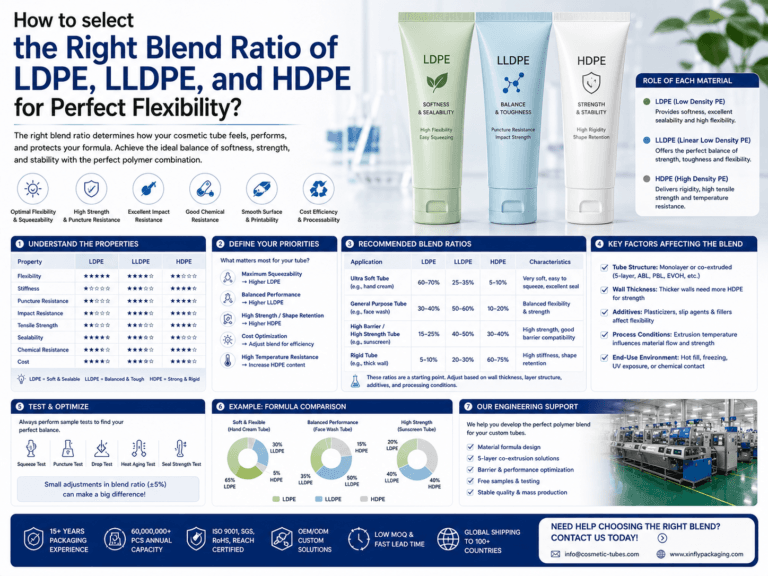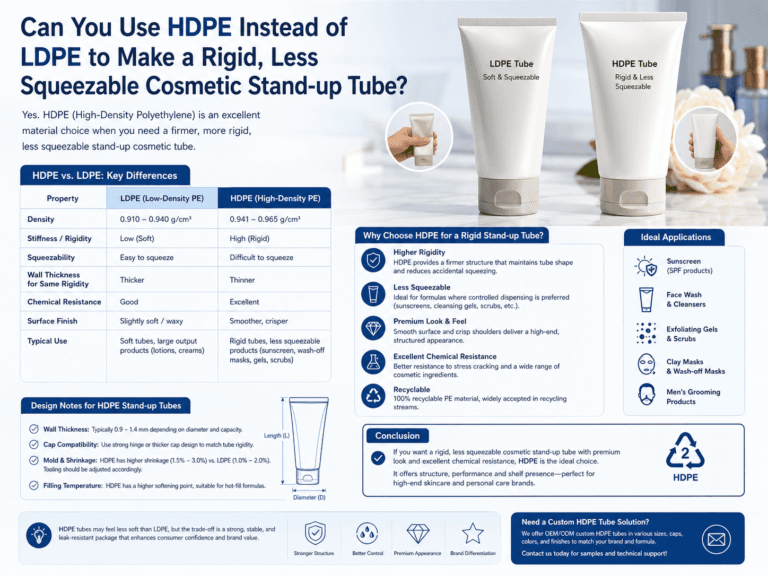

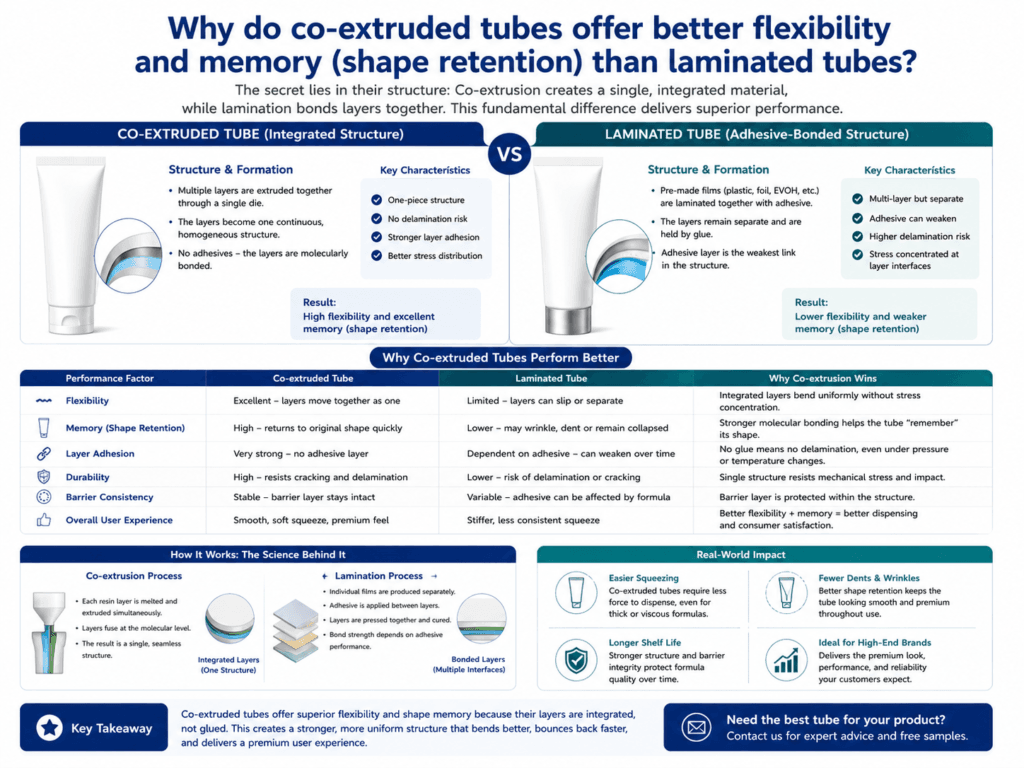
Co-extruded tubes often offer better flexibility and memory, or shape retention, because their tube body is made from continuous extruded plastic layers rather than a flat laminate sheet that is rolled and side-welded. This gives co-extruded tubes a more integrated plastic structure, allowing the tube to squeeze smoothly and recover closer to its original shape after use.
By contrast, laminated tubes are made from laminated sheet materials such as ABL or PBL. The sheet is formed into a tube and welded along the side seam. This construction can provide excellent barrier protection, but the tube body may behave differently under squeezing, especially when the laminate includes a stiffer barrier layer such as aluminum foil.
Quick Answer: Why Co-Extruded Tubes Recover Better
| Reason | Co-Extruded Tube Advantage | Effect on User Experience |
|---|---|---|
| Continuous plastic structure | Layers are formed together through extrusion | Smoother squeezing and better shape recovery |
| No side seam on the body | The tube wall behaves more evenly around the circumference | Less local stiffness or stress around the seam area |
| Plastic memory | PE-based materials tend to rebound after deformation | Tube looks cleaner after repeated use |
| Adjustable layer design | Material softness, stiffness, and barrier can be engineered together | Better balance between protection and squeeze feel |
What Does “Memory” Mean in Tube Packaging?
In cosmetic tube packaging, memory means the tube’s ability to return toward its original shape after being squeezed. A tube with good memory does not stay heavily dented, creased, or collapsed after use. This is important for premium skincare, sunscreen, hand cream, cleanser, and lotion products because the package still needs to look attractive on the bathroom shelf or retail display after repeated squeezing.
Co-Extruded Tube Structure and Shape Retention
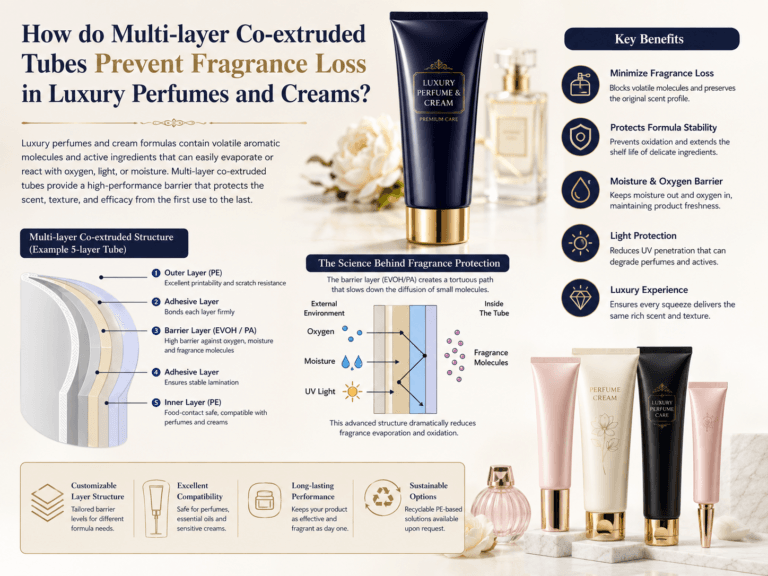
Co-extruded tubes are produced by extruding multiple plastic layers together into a tube body. The structure may include PE layers, tie layers, and a barrier layer such as EVOH. Because the layers are integrated during extrusion, the tube body behaves more like one continuous plastic structure. This usually supports better flexibility and a cleaner rebound after squeezing.
- More uniform tube wall: The body has no longitudinal side seam that changes stiffness locally.
- Better elastic recovery: PE-based structures naturally provide better bounce-back than foil-based laminate structures.
- Customizable softness: Factories can adjust materials and layer ratios to fine-tune hand feel.
- Premium appearance after use: The tube is less likely to show hard creases after normal squeezing.
Laminated Tube Structure and Shape Behavior
Laminated tubes are made from flat laminate sheets. These sheets are cut, rolled into tube shape, and sealed along the side. Depending on the laminate type, the tube may include aluminum foil, plastic barrier layers, adhesives, and printed films. This structure can be very good for barrier performance, but it may not always recover as smoothly as a co-extruded tube.
| Laminated Tube Type | Shape Behavior | Typical Application |
|---|---|---|
| ABL tube | More collapsible; may keep squeezed shape or crease | Toothpaste, ointment, functional paste, high-barrier formulas |
| PBL tube | Better recovery than ABL, but still formed from laminate sheet | Skincare, toothpaste, personal care, barrier cosmetic products |
| Co-extruded tube | Usually better seamless flexibility and memory | Premium cosmetic, skincare, sunscreen, cleanser, lotion |
Why Side Seams Matter for Flexibility
A laminated tube normally has a side seam because the tube body is made by welding the edges of a flat laminate sheet. This seam area can have slightly different stiffness, thickness, and visual behavior compared with the rest of the tube body. A co-extruded tube body is generally seamless, so the wall responds more evenly when squeezed.
- Seamless body: More even deformation around the tube.
- Side-welded body: The seam area may create local stiffness or visual interruption.
- Premium design benefit: Seamless tubes often look smoother and more refined after use.
Flexibility and Memory Comparison
| Feature | Co-Extruded Tubes | Laminated Tubes |
|---|---|---|
| Flexibility | Usually very good and adjustable through material design | Depends on laminate structure and barrier layer |
| Shape memory | Usually better bounce-back after squeezing | ABL may crease; PBL recovers better but still depends on laminate design |
| Side seam | Usually seamless body | Usually has a longitudinal side seam |
| Premium shelf appearance after use | Strong | Good to moderate depending on structure |
| Barrier protection | Good to high with EVOH or multi-layer design | Very high with ABL; good to high with PBL |
Why Co-Extruded Tubes Are Popular for Premium Cosmetics
For premium cosmetics, the package needs to protect the formula and also look attractive after repeated use. Co-extruded tubes are popular because they combine a seamless appearance, smooth hand feel, flexible squeezing, and good recovery. This makes them suitable for products where consumer experience and shelf appearance are important.
- Skincare cream tubes
- Sunscreen tubes
- Facial cleanser tubes
- Hand cream tubes
- Lotion tubes
- Hair care and body care tubes
When Laminated Tubes May Still Be Better
Better flexibility does not mean co-extruded tubes are always the best choice. Laminated tubes are still excellent when the formula needs strong barrier protection, when the brand wants toothpaste-style packaging, or when ABL/PBL laminate performance is required. ABL tubes, for example, are often chosen because they collapse and hold the squeezed shape, which can be useful for controlled dispensing and high-barrier paste products.
| Project Priority | Better Tube Direction | Reason |
|---|---|---|
| Best squeeze-back memory | Co-extruded tube | Seamless PE-based structure usually recovers better |
| Maximum aluminum barrier | ABL laminated tube | Aluminum foil provides very strong barrier protection |
| Premium skincare appearance | Co-extruded tube | Smoother body and cleaner look after use |
| Traditional toothpaste feel | ABL or PBL laminated tube | Laminated structures are common in oral care |
| Plastic barrier with better recovery than ABL | PBL laminated tube or co-extruded EVOH tube | Both can support better recovery than foil-based ABL |
Common Misunderstandings
| Misunderstanding | Correct Explanation |
|---|---|
| “All laminated tubes have poor memory.” | Not always. PBL tubes can have better recovery than ABL, but the exact result depends on the laminate structure. |
| “Co-extruded tubes always have lower barrier.” | Not necessarily. Co-extruded tubes can include EVOH barrier layers for stronger oxygen protection. |
| “A tube that holds its squeezed shape is defective.” | No. ABL tubes are often designed to be more collapsible and may naturally hold creases after squeezing. |
| “Shape recovery is only about material softness.” | Shape recovery also depends on layer structure, wall thickness, seam design, barrier layer, and tube diameter. |
Best Practical Recommendation
If your product needs a premium cosmetic look and should keep a clean shape after repeated squeezing, a co-extruded tube is usually a strong choice. If your product needs maximum barrier protection or a traditional toothpaste-style collapsible feel, a laminated tube may be better. For functional skincare, sunscreen, and premium personal care, a co-extruded EVOH tube can often provide a strong balance between barrier protection, flexibility, and shape retention.
Summary
Co-extruded tubes usually offer better flexibility and memory than laminated tubes because their body is formed from continuous extruded plastic layers, creating a seamless and more uniform structure. This allows the tube to squeeze smoothly and recover closer to its original shape after use.
Laminated tubes are made from flat laminate sheets that are rolled and side-welded, so their flexibility and shape retention depend strongly on the laminate material, side seam, and barrier layer. ABL tubes may hold creases, while PBL tubes recover better than ABL. Co-extruded tubes are often preferred for premium cosmetics where smooth appearance and shape retention matter most.
Learn more: Co-Extruded Cosmetic Tubes Guide, PE Tubes vs Laminated Tubes, ABL vs PBL Tubes, 5-Layer Plastic Tubes, EVOH Barrier Tubes Manufacturer, Skincare Tubes Manufacturer.
Need Better Flexibility and Shape Retention for Cosmetic Tubes?
Xinfly Packaging helps brands compare co-extruded, ABL, and PBL tubes based on formula sensitivity, barrier performance, squeeze feel, memory, side-seam appearance, and premium shelf presentation.