
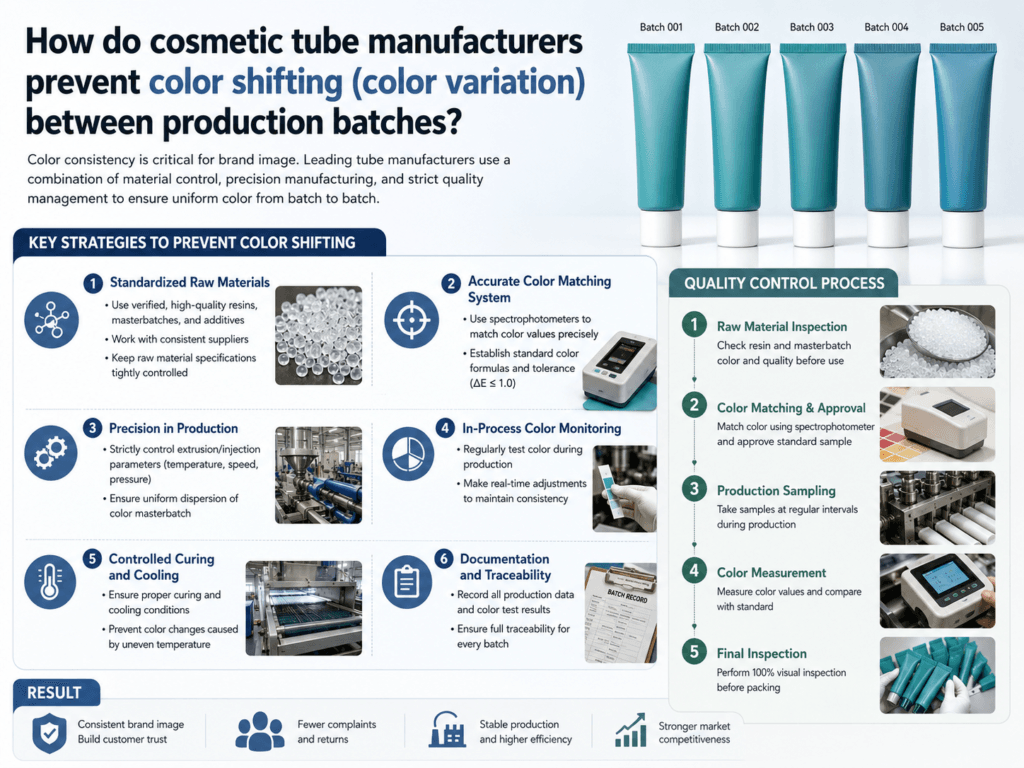
Cosmetic tube manufacturers prevent color shifting between production batches by controlling the full color system, not just the pigment itself. In practice, this means using a stable color masterbatch, keeping the same carrier resin and let-down ratio, measuring color with instruments such as a spectrophotometer, and approving every batch against a predefined color tolerance such as ΔE. Color consistency in plastics is commonly measured by ΔE, and masterbatch is widely used because it gives more repeatable dispersion than loose pigments.
For cosmetic tubes, batch color variation usually comes from a mix of factors: resin lot differences, masterbatch quality, machine temperature fluctuation, screw-speed changes, wall-thickness variation, recycled-content inconsistency, or even changes in lighting during inspection. That is why professional factories manage color as a process-control issue, not just a purchasing issue.
How Manufacturers Control Color Consistency
| Control Point | What the Factory Does | Why It Helps |
|---|---|---|
| Color masterbatch control | Uses the same approved masterbatch formula and compatible carrier resin | Improves pigment dispersion and reduces random shade variation |
| Let-down ratio control | Keeps masterbatch dosage consistent batch to batch | Prevents shade drift caused by over- or under-dosing |
| Spectrophotometer testing | Measures batch color numerically against a standard | Detects small differences before they become visible in production |
| Standardized lighting checks | Compares tubes under controlled visual-inspection light | Reduces approval mistakes caused by different viewing conditions |
| Stable processing parameters | Locks temperature, pressure, screw speed, and cooling conditions | Keeps color development and surface appearance more uniform |
Why Masterbatch Matters So Much
- Masterbatch is pre-dispersed: This makes it more repeatable than raw pigment powder in normal plastic processing.
- It improves dosing accuracy: Factories can meter pellets more consistently than loose pigments.
- It supports batch approval: Good masterbatch suppliers typically verify target shade before release using spectrophotometric control.
- It reduces contamination and handling variation: Encapsulated color pellets are more stable in daily production environments.
Common Causes of Batch-to-Batch Color Shifting
| Cause | Typical Result |
|---|---|
| Different resin lots | Base whiteness or transparency changes the final shade |
| Masterbatch inconsistency | Hue, saturation, or brightness shifts between runs |
| Temperature variation during extrusion | Color tone may warm or darken slightly |
| Recycled material fluctuation | PCR or OBP content may introduce undertone variation |
| Wall-thickness change | The tube looks lighter or darker depending on opacity and color density |
How Premium Cosmetic Tube Factories Reduce Color Risk
- Approve a golden sample before production starts.
- Set a clear numeric tolerance such as a target ΔE window for approval. ΔE is a standard way to quantify visible color difference in plastic manufacturing. [oai_citation:6‡Delta Tecnic](https://deltatecnic.com/color-consistency-in-plastics/?utm_source=chatgpt.com)
- Use the same resin family, same masterbatch supplier, and same approved process parameters for repeat orders.
- Control PCR ratio carefully when producing sustainable cosmetic tubes, because recycled content can increase shade variability.
- Inspect both instrumentally and visually under standard lighting before shipment.
Best Practice for Beauty Brands
If your brand cares about premium visual consistency, the most effective approach is to approve color using both a physical sample and a measurable tolerance. This is especially important for white, nude, pastel, black, or pearlescent cosmetic tubes, where even a small batch shift becomes easy to notice on shelf or in ecommerce photography. Factories that rely only on visual judgment usually have a higher risk of repeat-order variation than those that combine masterbatch control with spectrophotometer testing.
Summary
Cosmetic tube manufacturers prevent color shifting between production batches by standardizing the color masterbatch, controlling dosage, locking process parameters, and checking every run against a defined visual and instrumental color standard. In real production, masterbatch consistency + spectrophotometer control + stable resin/process settings are the three most important tools for reducing batch color variation.
Learn more: Printing & Design, Printing Options, Customize Cosmetic Tubes, PCR Cosmetic Tubes, White Cosmetic Tubes.
Need More Stable Tube Color Across Repeat Orders?
Xinfly Packaging helps brands control cosmetic tube color consistency through approved masterbatch systems, standardized process control, and repeat-order color verification.