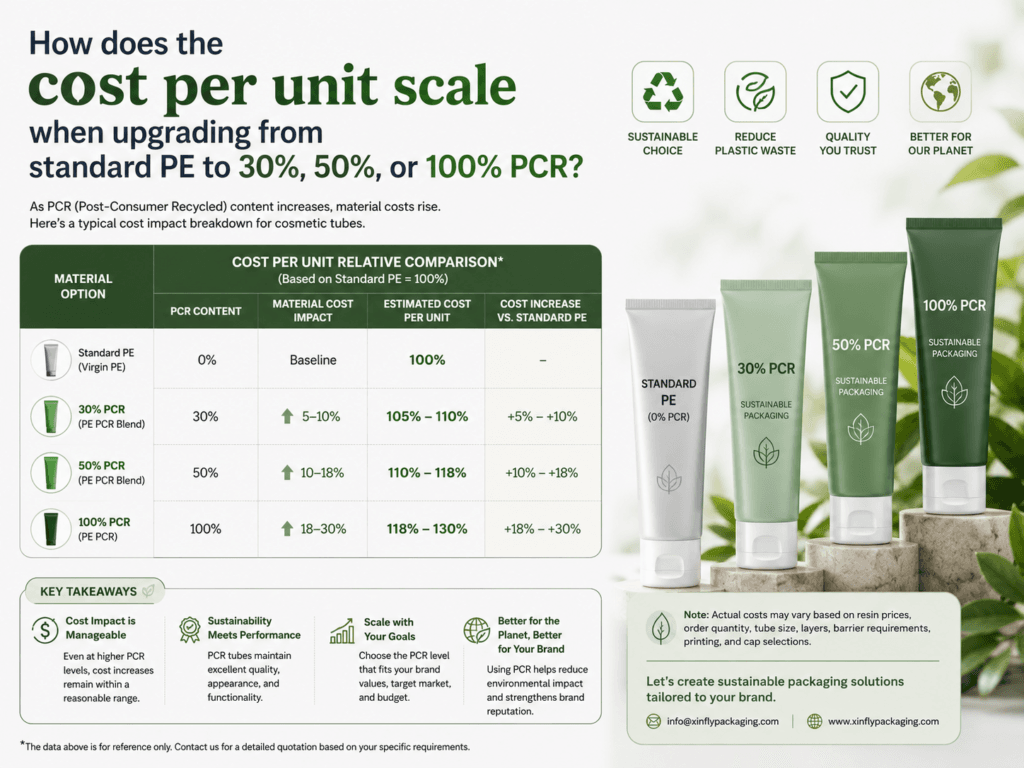
The cost per unit usually increases gradually when upgrading from standard PE to 30%, 50%, and 100% PCR tubes, but the increase is not linear in every project. In most cosmetic tube programs, the final unit price depends on much more than resin cost alone, including tube diameter, wall structure, decoration method, color control, order quantity, and supply stability.
As a practical market estimate, many brands see a small premium at 30% PCR, a moderate premium at 50% PCR, and the highest premium at 100% PCR. The cost gap tends to widen as PCR content rises because appearance control, mechanical consistency, odor control, and production stability become more demanding.
Typical Unit Cost Scaling from Standard PE to PCR
| Tube Material Option | Typical Unit Cost Change vs Standard PE | Commercial Meaning |
|---|---|---|
| Standard PE | Baseline | Lowest and most stable cost structure |
| 30% PCR | Typically +3% to +8% | Entry-level sustainable upgrade with limited cost pressure |
| 50% PCR | Typically +6% to +15% | Balanced option for sustainability and manageable commercial impact |
| 100% PCR | Typically +12% to +30% or more | Highest sustainability claim, but also highest material and process challenge |
Why the Cost Does Not Scale Perfectly in a Straight Line
- Raw material premium: PCR resin often costs more than virgin resin because collection, sorting, cleaning, and reprocessing add cost.
- Color and appearance control: Higher PCR content usually requires more effort to keep white, glossy, or premium finishes consistent.
- Production efficiency: Very high PCR ratios may reduce extrusion stability or require tighter processing control.
- Waste and QC rate: More recycled content can increase quality-control sensitivity, especially in high-end cosmetic tubes.
- Supply chain volatility: PCR pricing can move with feedstock supply and certification requirements, not just oil price.
What Usually Drives the Biggest Cost Increase?
| Cost Driver | Effect on PCR Tube Pricing |
|---|---|
| Higher PCR percentage | Raises resin-control and appearance-management difficulty |
| Custom white or pearlescent colors | Increases color matching cost more than standard natural or darker shades |
| Premium decoration | Matte, hot stamping, and complex printing add more cost than PCR alone |
| Low MOQ orders | Make PCR premiums more visible on a per-unit basis |
| Certified recycled-content supply | Traceability documents and approved sourcing can add commercial cost |
Best Cost Strategy by PCR Level
- 30% PCR: Best for brands that want a sustainability claim with minimal price impact.
- 50% PCR: Often the best balance between ESG positioning, tube performance, and commercial practicality.
- 100% PCR: Best for strong environmental storytelling, but should be planned with realistic expectations for price, appearance, and production control.
How to Reduce the Cost Premium of PCR Tubes
- Use standard diameters and existing cap molds
- Reduce unnecessary custom color complexity
- Choose simpler printing and finishing methods
- Increase order quantity to dilute setup and sourcing costs
- Use 30% or 50% PCR instead of jumping directly to 100%
Practical Buying Insight
For many beauty brands, the smartest commercial upgrade is not 100% PCR on day one. A 30% or 50% PCR structure often delivers a better cost-to-sustainability ratio, especially when the project also needs premium appearance, soft squeeze feel, and stable printing quality.
That is why 50% PCR is often treated as a strong middle point: it gives a meaningful recycled-content claim without the full cost and consistency pressure of a 100% PCR structure.
Summary
When upgrading from standard PE to PCR tubes, unit cost usually rises step by step, but not in a perfectly fixed ratio. In most cosmetic tube projects, 30% PCR adds a small premium, 50% PCR adds a moderate premium, and 100% PCR adds the highest premium. The final difference depends on resin market conditions, decoration level, color requirements, quality expectations, and MOQ.
For brands that want both sustainability and price control, 50% PCR is often the most practical balance point.
Learn more: PCR Cosmetic Tubes, PE vs PCR Tubes, Maximum PCR Percentage Guide, MOQ in Cosmetic Packaging, Hidden Costs in Cosmetic Packaging.
Need PCR Tube Cost Advice?
Xinfly Packaging helps brands compare standard PE, 30% PCR, 50% PCR, and 100% PCR tube options based on real project budgets, appearance goals, MOQ, and sustainability targets.