
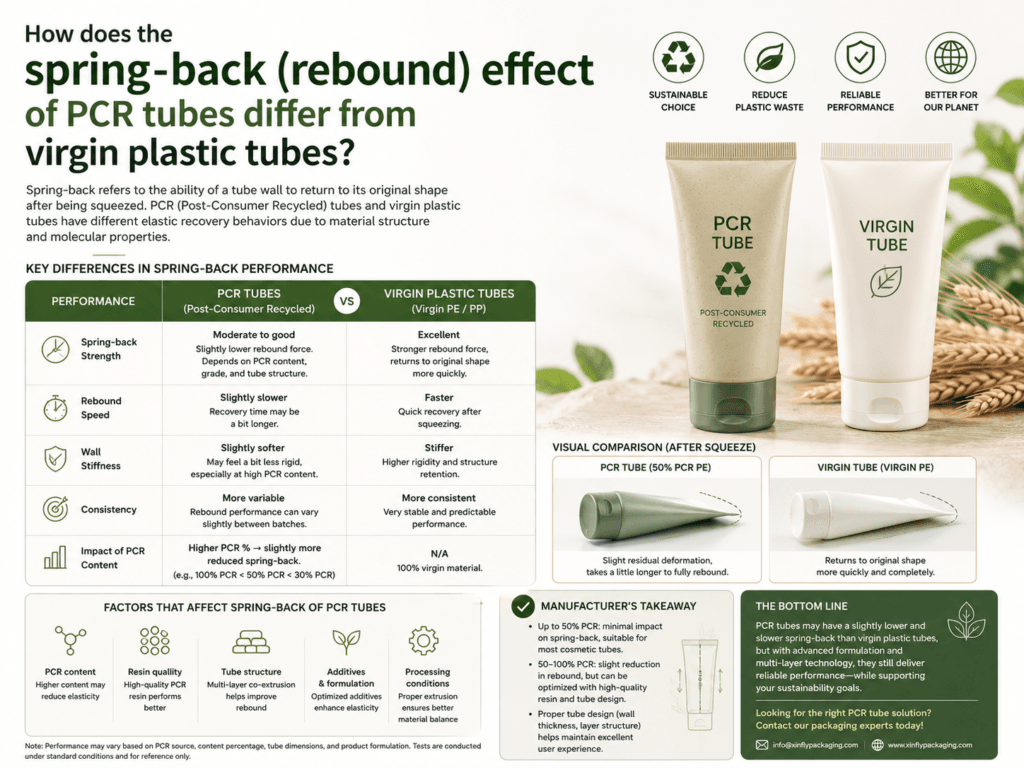
The spring-back effect of PCR cosmetic tubes is usually a little less stable than virgin plastic tubes, but the difference depends heavily on resin quality, PCR ratio, tube structure, and processing control. In daily use, “spring-back” means how well the tube body recovers its shape after being squeezed. Virgin PE tubes generally offer more predictable rebound because the resin is more uniform, while PCR tubes may show slightly softer recovery, slower rebound, or more visible paneling if the recycled material quality is inconsistent.
That said, a well-engineered PCR tube can still provide very good squeeze performance. For many cosmetic packaging projects, especially hand cream, lotion, and cleanser tubes, the real difference is not whether the tube contains PCR, but whether the PCR material has been properly selected, blended, and tested.
What “Spring-Back” Means in Cosmetic Tubes
| Performance Factor | Why It Matters |
|---|---|
| Shape recovery | Determines whether the tube returns close to its original form after squeezing |
| Consumer feel | Affects whether the tube feels soft, premium, and easy to use |
| Paneling resistance | Helps prevent visible dents or flat spots after repeated use |
| Long-term durability | Supports stable performance during shipping, filling, and repeated dispensing |
PCR Tubes vs Virgin Plastic Tubes in Rebound Performance
| Tube Type | Typical Spring-Back Behavior | Commercial Meaning |
|---|---|---|
| Virgin PE tube | More consistent and predictable rebound | Best for maximum shape recovery and uniform squeeze feel |
| 30% PCR tube | Usually close to virgin performance | Good balance of sustainability and rebound stability |
| 50% PCR tube | Slightly softer or less uniform rebound in some projects | Often the best practical midpoint for sustainable tubes |
| High PCR or 100% PCR tube | Higher risk of slower rebound or visible paneling | Requires tighter engineering and quality control |
Why PCR Tubes May Rebound Differently
- Material variability: Recycled resin can vary more than virgin resin in molecular structure and melt behavior.
- Lower modulus consistency: PCR blends may show more variation in stiffness and recovery response from batch to batch.
- Contamination or degradation history: Previous processing cycles can influence mechanical behavior.
- Higher PCR ratios: As PCR content increases, rebound performance usually becomes more sensitive to resin quality.
When the Difference Is Most Noticeable
- Large-diameter soft squeeze tubes
- Thin-wall hand cream and lotion tubes
- High-gloss or premium appearance projects where dents are easy to see
- Repeated daily-use products that require strong shape recovery
How Manufacturers Improve PCR Tube Rebound
| Optimization Method | Result |
|---|---|
| Use high-quality PCR resin | Improves consistency of squeeze feel and rebound |
| Blend PCR with controlled virgin PE | Helps recover softness and shape memory |
| Optimize wall thickness distribution | Reduces visible dents and improves panel recovery |
| Reinforce shoulder and body design | Improves overall structural stability during repeated use |
| Run squeeze-cycle testing | Confirms actual spring-back before production approval |
Practical Recommendation
For most skincare and personal care brands, 30% to 50% PCR is the most practical range if you want a strong sustainability message without sacrificing too much rebound performance. Very high PCR ratios can still work, but they usually need better resin sourcing, stricter process control, and more product-specific testing.
Summary
PCR tubes usually show slightly less predictable spring-back than virgin plastic tubes, especially at higher recycled-content levels. Virgin PE remains the benchmark for uniform rebound, while PCR tubes may have slower recovery or more visible paneling if the resin and structure are not optimized.
However, with proper material selection, blending, and tube engineering, PCR cosmetic tubes can still achieve excellent squeeze feel and commercially strong rebound performance.
Learn more: PCR Cosmetic Tubes, PE vs PCR Tubes, How to Balance Softness and Durability in a 50% PCR Hand Cream Tube, Why Do Some PCR Squeeze Tubes Have a Slight Odor?, PCR Cosmetic Tubes Manufacturer.
Need PCR Tubes with Better Rebound Performance?
Xinfly Packaging helps brands optimize PCR tube structure, wall design, and resin ratio to achieve a better balance between sustainability, squeeze feel, and shape recovery.