

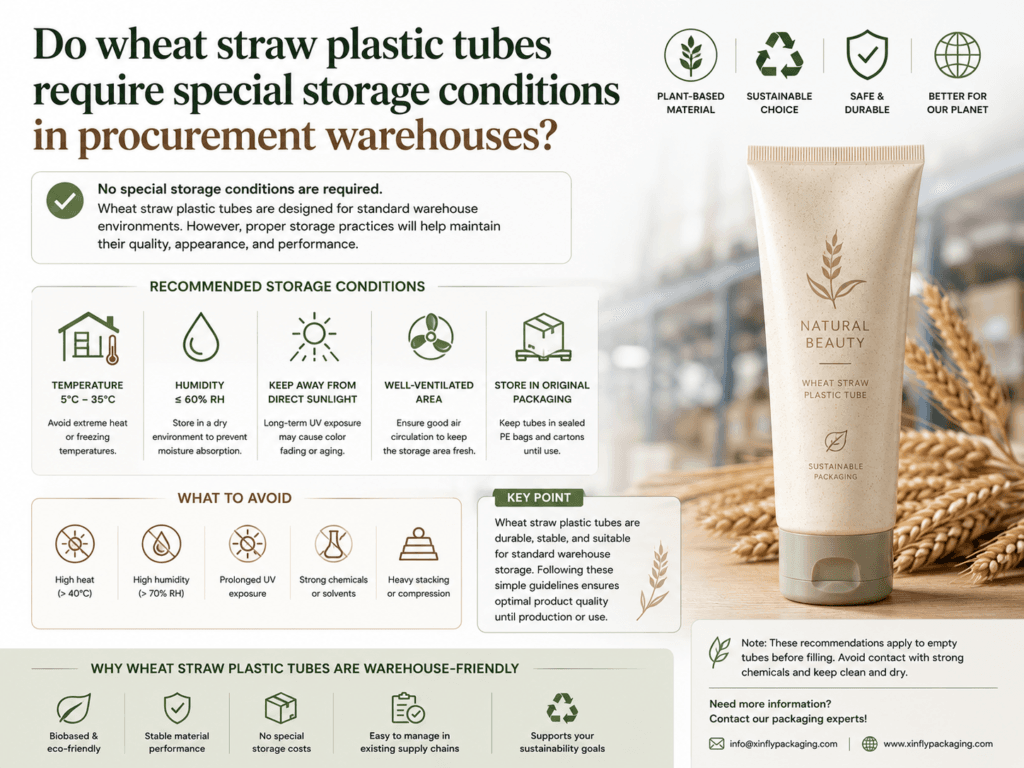
Wheat straw plastic tubes usually do not require highly specialized storage conditions such as cold-chain warehousing, but they do require better control of humidity, sunlight, and temperature fluctuation than standard plastic packaging in many cases.
Because wheat straw tubes are typically made from a natural-fiber and plastic composite, they are more sensitive to moisture absorption, UV exposure, and condensation than pure virgin PE tubes. For procurement warehouses, the safest approach is to treat them as dry, indoor packaging components that should be protected from damp air, direct sunlight, and long-term heat buildup.
Do Wheat Straw Tubes Need “Special” Storage?
| Storage Condition | Is It Needed? | Recommendation |
|---|---|---|
| Cold-chain storage | No | Not normally required |
| Climate-controlled dry warehouse | Recommended | Best for maintaining shape, appearance, and print quality |
| Direct sunlight protection | Yes | Avoid UV exposure during long-term storage |
| Humidity control | Yes | Keep warehouse dry and avoid condensation |
Recommended Warehouse Conditions
- Store in a cool, dry indoor warehouse with stable ventilation.
- Avoid high humidity, especially damp corners, wet floors, or long exposure to rainy-season air.
- Keep away from direct sunlight or strong UV exposure, which may affect color and surface stability over time.
- Avoid extreme temperature swings that can create condensation on packaging surfaces.
- Keep cartons sealed until use to reduce dust, moisture, and odor contamination.
Why Storage Matters More for Wheat Straw Tubes
| Risk Factor | Possible Impact |
|---|---|
| High humidity | May affect surface feel, carton condition, and long-term dimensional stability |
| UV exposure | Can accelerate surface aging, fading, or color shift |
| Condensation | May affect printing appearance and outer packaging cleanliness |
| High stacking pressure | May deform tubes or caps during long-term storage |
Best Practices for Procurement Warehouses
- Store pallets off the ground to reduce moisture transfer from warehouse floors.
- Use first-in, first-out inventory control for better appearance consistency.
- Avoid placing wheat straw tubes near heaters, windows, or loading doors with strong temperature fluctuation.
- Do not mix with strong-smelling chemicals, inks, or solvents in the same open storage zone.
- Inspect cartons periodically if storage exceeds several months.
Compared with Standard PE Tubes
| Tube Type | Storage Sensitivity | Warehouse Priority |
|---|---|---|
| Standard PE tubes | Lower | General dry indoor storage |
| Wheat straw plastic tubes | Moderate | Dry, shaded, humidity-controlled storage preferred |
Summary
Wheat straw plastic tubes do not normally require highly specialized storage conditions, but they do require better warehouse discipline than ordinary PE tubes. Procurement warehouses should keep them dry, shaded, clean, and protected from humidity, UV exposure, condensation, and excessive compression.
For most projects, the right storage strategy is simple: cool indoor storage, moderate humidity, sealed cartons, and no direct sunlight.
Learn more: Wheat Straw Plastic Cosmetic Tubes, Wheat Straw Plastic Tubes, What Are Wheat Straw Tubes?, Does the Texture of Wheat Straw Tubes Affect Printing?, Sustainable Materials.
Need Wheat Straw Tube Packaging Advice?
Xinfly Packaging helps brands evaluate wheat straw cosmetic tubes for storage, printing, durability, and real-world supply chain performance before mass production.