
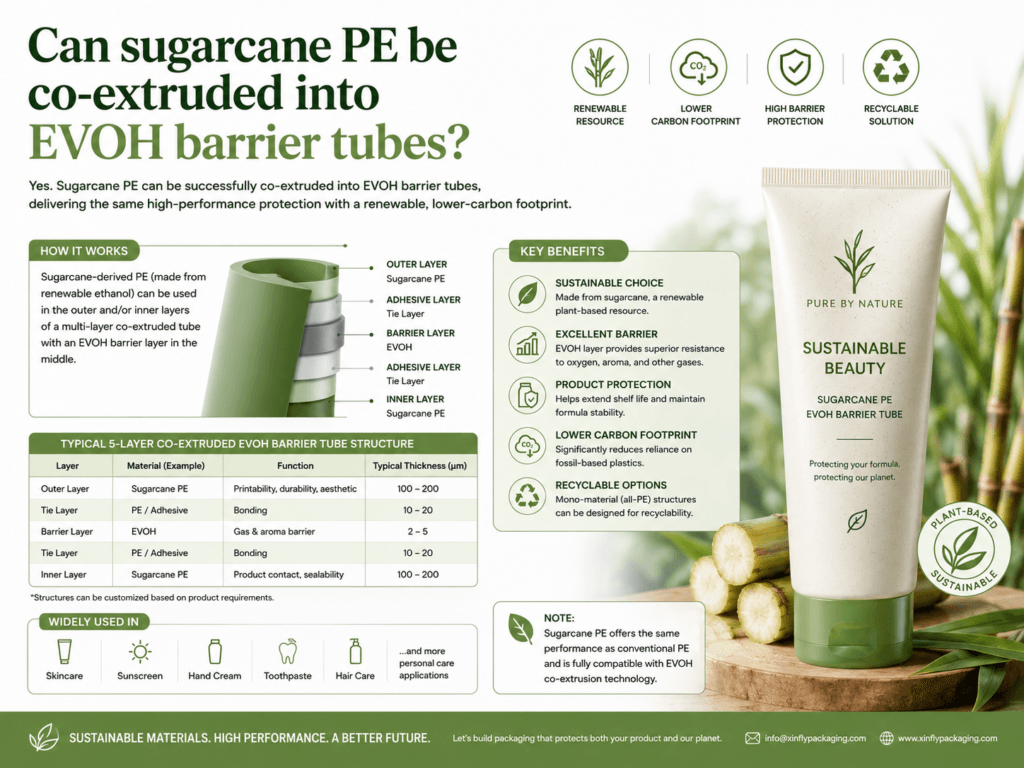
Yes, sugarcane PE can be co-extruded into EVOH barrier tubes. Because sugarcane-based PE is chemically identical to conventional polyethylene, it can be used in many of the same extrusion and tube-converting processes as fossil-based PE. This makes it a practical sustainable option for co-extruded cosmetic tubes that require both renewable material content and high barrier performance.
In cosmetic tube packaging, EVOH is commonly added as a barrier layer to improve oxygen resistance and help protect sensitive formulas. When sugarcane PE is used as the PE layer in a multi-layer structure, brands can combine bio-based material value with EVOH barrier protection in one tube design.
How the Structure Usually Works
| Layer | Typical Material | Main Function |
|---|---|---|
| Outer layer | Sugarcane PE or PE | Appearance, print surface, sustainable material claim |
| Tie layer | Adhesive resin | Helps bond PE and EVOH together |
| Barrier layer | EVOH | Improves oxygen barrier and protects sensitive formulas |
| Inner layer | PE or validated contact layer | Direct product contact and filling compatibility |
Why Brands Use Sugarcane PE + EVOH Structures
- Renewable material story: Sugarcane PE supports bio-based packaging positioning.
- Improved product protection: EVOH helps reduce oxygen transmission for more sensitive skincare or sunscreen formulas.
- Drop-in processing logic: Sugarcane PE behaves like PE, so it can fit existing PE-based converting systems more easily than many other bioplastics.
- Balanced performance: The tube can maintain squeezability while gaining barrier performance.
What Needs to Be Controlled in Production?
| Technical Factor | Why It Matters |
|---|---|
| Layer adhesion | EVOH cannot simply bond to PE without the right tie-layer design |
| Co-extrusion temperature control | Stable melt processing is needed for uniform wall thickness and barrier quality |
| Formula compatibility | Inner contact layer must match the cream, gel, or sunscreen formula |
| Barrier requirement | Not every formula needs EVOH, so structure should match actual product needs |
Best Use Cases for Sugarcane PE + EVOH Tubes
- Sunscreen tubes
- Vitamin C cream tubes
- Retinol and active skincare tubes
- Fragrance-sensitive skincare formulas
- Premium sustainable cosmetic packaging projects
Possible Limitations
- More complex structure than mono-material PE tubes
- Higher production and validation requirements
- May affect recyclability strategy compared with simpler PE-only structures
- Requires experienced co-extrusion processing and quality control
Summary
Sugarcane PE can be co-extruded into EVOH barrier tubes and is a practical option for brands that want both sustainable material positioning and stronger barrier protection. Because sugarcane PE functions like conventional PE, it can be integrated into multi-layer tube structures, while EVOH provides the oxygen barrier needed for more demanding cosmetic formulations.
For the best result, the tube structure should be validated through co-extrusion trials, adhesion control, and formula compatibility testing before mass production.
Learn more: Sugarcane Plastic Tubes, EVOH Barrier Tubes Manufacturer, EVOH and ABL Tubes for Sunscreen Packaging, Co-Extruded Cosmetic Tubes Guide, Sustainable Materials.
Need Sugarcane PE EVOH Barrier Tubes?
Xinfly Packaging helps brands develop co-extruded tube structures that combine sugarcane PE, EVOH barrier performance, and custom cosmetic packaging requirements for skincare, sunscreen, and premium beauty products.