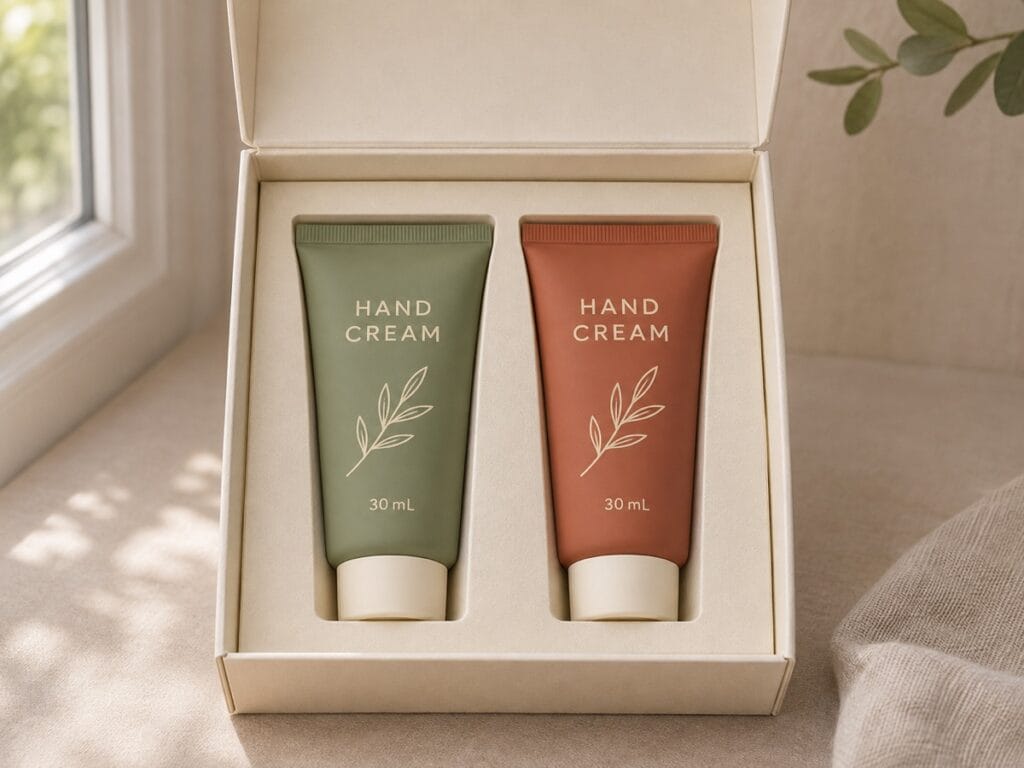
Picture a gift set that looks sharp in the artwork file. On the first assembled sample, the sage tube looks grey under the shop lights, the ivory leaf loses its finest lines, and the insert leaves a shiny rub mark near the cap. Each problem has a different cause. One production-style sample lets you check all three before you sign off.
If you’re buying printed 30 mL hand cream tubes for a gift set, this guide shows how to approve the tube body, print, and carton together. The example uses two soft-touch PE squeeze tubes, one sage and one terracotta, with molded shoulders, straight sealed tails, single-color ivory screen printing, and matching ivory screw caps. Use the workflow for your own design and have your supplier confirm the proposed combination before you commit.
Decide What the Gift Set Has to Do
Start With the Insert, the Fill, and the Opening Sequence
A gift set has two jobs. It needs to look orderly when the customer opens it, and the tubes need to lift out easily. Send the carton supplier a finished, filled sample of each tube. Ask them to check the shoulder and cap against the insert, then review how the pack looks with the tube rotated slightly to either side. If the artwork only reads when the tube is positioned perfectly, the insert needs to hold its orientation or the print needs a little more room.
Measure the Tube After Filling and Sealing
A 30 mL label describes the fill, while the finished length depends on the body diameter, closure, and sealing allowance. Give the box team the finished width and height, cap diameter, and likely tolerance for tube length. Let them see a sample at the expected limits if possible. A carton that fits an empty sample can pinch a fuller tube at the shoulders or catch a tail that was trimmed slightly longer.
Use a Shared Tube Design Where the Formulas Allow It
A shared diameter and cap simplify the layout of a two- or three-scent set and can reduce the number of parts you have to stock. Ask your filler to confirm that the same tube works for each formula. A dense balm might need a different outlet from a light hand cream even if the outer dimensions match. Keep each configuration traceable in your brief so a replacement order brings back the right version.
Give the two suppliers the same assembly drawing. Mark which end of the tube faces the lid, where a customer’s fingers should reach, and which areas of the print must remain visible. If a removable card sits over the tubes, check it with the lid closed. A card edge or folded tab can press against a tube during shipment even when it clears the pack on a table. Resolve those contact points before approving the final artwork position.
Specify Printing for Soft-Touch Squeeze Tubes for Hand Cream
Request Single-Color Screen Printing for Simple Artwork
A strong product name and a simple leaf graphic can work well as solid ink. Send vector artwork, the target ink color, and any details that must remain legible at actual size. Ask the printer for the minimum line width and clear spacing they can hold on this diameter. The proof should show the artwork on the curved tube body, with the cap and seal in place. Xinfly Packaging’s cosmetic tube printing options give you a starting point for discussing the available processes.
Choose Another Process When the Design Calls for It
If the artwork relies on a continuous gradient or intricate shading, share the original design and ask the supplier to recommend a workable process for the chosen tube construction. Get the recommendation in writing and ask to see a representative proof. Where a metallic accent is part of the brief, test it on the proposed coating and look for breaks at the edge of the graphic. Changing the artwork can change the setup cost, lead time, and minimum order, so compare quotes after the decoration is defined.
Quote Custom Printed Hand Cream Tubes by Artwork Version
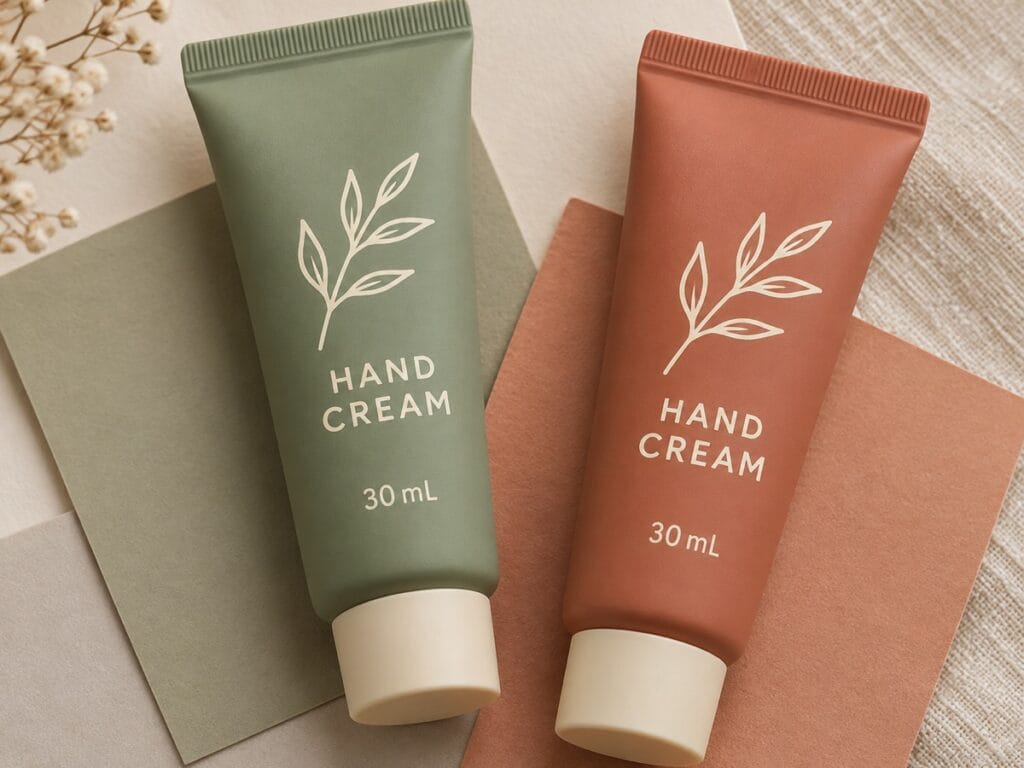
For a seasonal gift set, compare a common screen print across two tube colors with separate artwork for each scent. Specify the body color, ink color, finish and approved artwork revision per tube. If you want the same screw cap tube across both versions, check it against the actual filled samples and tray cutout. Ask whether a later refill order can keep the same cap and tube body if one scent sells out first.
Approve an Ink Proof on Every Body Color
The same ivory ink can appear different on sage and terracotta. Body color, ink opacity, and the surface finish all affect contrast. Review the actual substrate and finish under agreed lighting, then view the set under the light customers are likely to see. Compare the printed letters, body color, and cap color separately. If a color tolerance is part of the order, agree on the reference, the measurement method where appropriate, and how to handle small curved areas that are difficult to measure consistently.
| Decision | Give the supplier | Ask to see |
|---|---|---|
| Body and closure | Target fill, finished dimensions and cap color reference | Filled and sealed tube with the actual cap |
| Print design | Vector artwork, ink target, dieline and artwork version | Proof on each final tube color, with critical copy legible |
| Soft-touch finish | Physical finish reference and planned handling conditions | Decorated sample with the finish applied as proposed for production |
| Carton and insert | Insert drawing, packing orientation and carton supplier contact | Complete assembled gift set for handling and transport checks |
Ask to see the body color and print under the same agreed lighting at each approval. Keep the master color reference out of prolonged light exposure and label it with the approved revision. For a seasonal set, check the printed tube against the final carton stock as well. A small shift may be acceptable on the tube by itself and conspicuous next to a matching band on the box. Agree which components are meant to match and which are meant to contrast.
Leave Space for the Seal and Batch Code
Ask the tube maker for the production dieline and confirm the safe print area with the filler. Leave the area near the seal clear as required, and reserve space for a readable batch code. If the cap has a preferred front or a feature that faces the consumer, ask how the filler will orient it to the artwork. A visible guide mark or detectable mark may be part of the solution, depending on the line. Keep the approved artwork version with the approved tube drawing. See the tube design area guide for the dimensions to confirm.
Inspect the Pack as It Will Be Sold
Test Ink Adhesion and Scuffing Separately
Discuss an ink adhesion check with the supplier and agree on the tape, conditioning, test area, and pass criteria. Then check rubbing using the actual box insert and the planned assembly process. Good adhesion alone won’t tell you whether repeated rubbing polishes a soft-touch finish or transfers carton dust onto the tube. Try inserting and removing the pack a few times, then inspect the front graphic, shoulder, and closure under consistent light. If spilled cream can reach the tube in use, agree on a simple exposure check with the final formula as well.
Watch the Assembly Team Pack a Small Batch
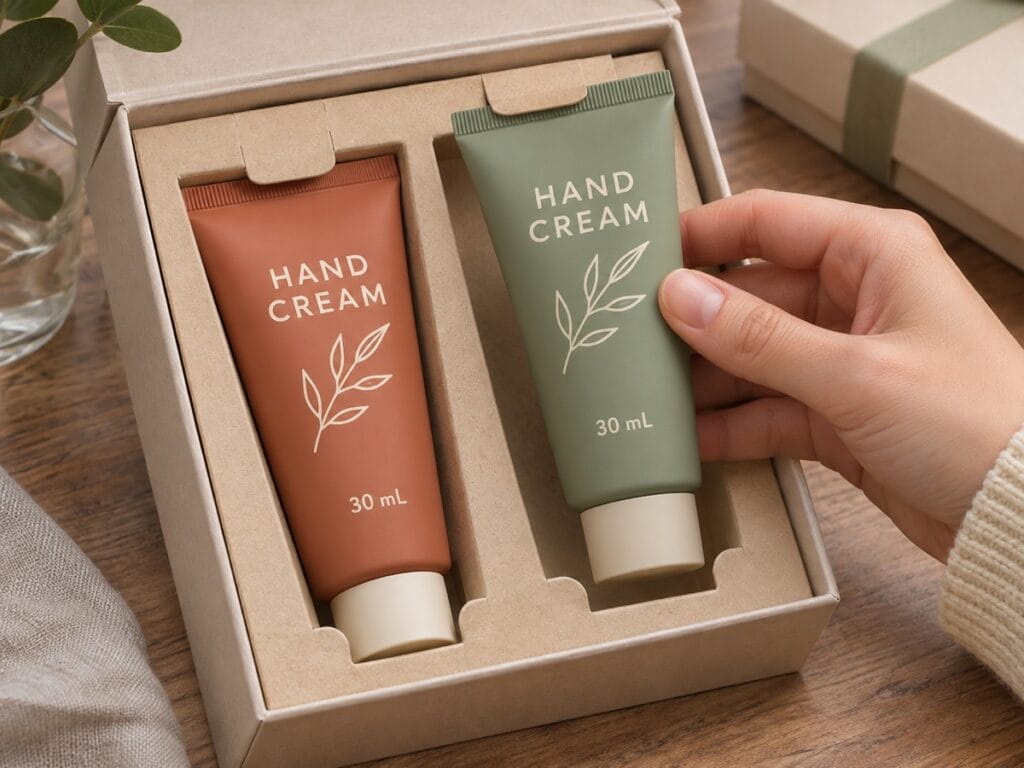
Ask the team to pack the gift set carton at their usual working pace. See if they have to turn each tube by hand, push down on the cap to seat it, or flatten the insert to close the lid. If they struggle, find out whether the issue is clearance, insert stiffness, or an unstable tube position. Review the same sets after handling or a shipment trial in the planned outer carton. An insert that survives a single careful demonstration can behave differently when people pack a full case.
| Check | Inspect | If it fails |
|---|---|---|
| Print legibility | Fine strokes, product name, contrast and orientation on both colors | Review ink opacity, stroke weight, or print placement |
| Ink and finish durability | Ink lift, finish polishing, ink transfer or carton dust at contact points | Identify whether the issue is adhesion, finish or insert friction |
| Insert fit | Tube rotation, clearance at the cap and tail, ease of removal | Adjust the cutout or retention tabs with a filled sample |
| Post-transit appearance | Tube movement, carton marks and damaged caps after the agreed trial | Recheck retention, dividers and outer carton protection |
Identify the Paper Grade Covered by the Report
If the set is going to the EU, list the retail carton, insert, and shipping case separately in your document request. SGS-CSTC’s Guangzhou branch reported a pass for the four-metal test on one submitted brown corrugated paper sample (report GZHL260804214501PK, August 21, 2026). The report lists 17 mg/kg total against its 100 mg/kg limit under Article 5(4) of Regulation (EU) 2025/40. Use the report to see how a shipping case material is identified. Ask for separate evidence matching your actual insert, print, and carton finish. Keep fit and rub testing in the approval plan, since the metal screen answers a different question.
Price the Set and Its Reorders
Compare Minimums for Empty Hand Cream Tubes Wholesale
When buying empty hand cream tubes wholesale, break the order down by body color, cap color, and artwork. The tube body may share a tool while each color requires its own setup. Ask for the minimum quantity and one-time charges for each version. If the gift set needs equal quantities of two scents, ask how overruns and replacements are handled so you can estimate the number of complete sets you can assemble.
Compare Quotes per Complete Set
Suppose you need 5,000 gift sets with one sage tube and one terracotta tube. If one color arrives with 4,900 usable pieces, you can assemble at most 4,900 complete sets even if you have surplus stock of the other color. Quote both versions, the insert and carton, filling and assembly, and any contingency stock together. Ask when each component will reach the assembly site so the slower item is visible in the launch plan.
Keep a Reference Set for the Next Run
Approve a signed tube proof for each color and keep a complete filled set with the correct insert and carton. Save the drawing revisions, decoration file, ink and body targets, and inspection results in one place. Give the tube supplier and carton supplier the current reference. If you replace the coating, insert board, or cap in a reorder, revisit the checks that change can affect. Explore Xinfly Packaging’s hand cream tubes and share your print and packing brief when requesting production-style samples.
Frequently Asked Questions
Can one ink color work on both sage and terracotta tubes?
It can. Ask to see the same ink on both final body colors. If one proof lacks contrast, discuss adjusting ink opacity, changing the artwork, or approving a slightly different ink for that variant.
Do I need a filled sample to approve the insert?
Yes. Fill and seal the tube at the target volume and fit the intended cap. That gives your carton supplier the finished shape, weight, and stiffness they need to evaluate retention and removal.
How do I tell if a shiny mark is ink damage or coating wear?
Compare the mark with the print boundary under good lighting. A shiny patch on an unprinted area points to the finish or contact with the insert. Look for ink lift or transfer on a separate sample and send the supplier photos showing the contact point.
Can I use the artwork proof from a larger hand cream tube?
Use it as a color and design reference. Request a new dieline and a proof on the 30 mL body. Curvature and the print area change, and small copy may need more spacing than it had on the larger tube.
What should I send for the first quote?
Send the target fill and formula type, finished tube dimensions if available, cap style, number of tube colors and artwork versions, desired finish, quantities per version, and the insert drawing. Ask the supplier to list what they need to make a production-style proof.
Conclusion
Approve printed 30 mL hand cream tubes as part of the assembled gift set. Check the artwork on both actual body colors, verify that the finish survives contact with the insert, and confirm that the filled tube lifts out cleanly. Share the approved tube, artwork, and carton specifications with Xinfly Packaging so purchasing and quality can use the same reference for the next run.