Quick Answer
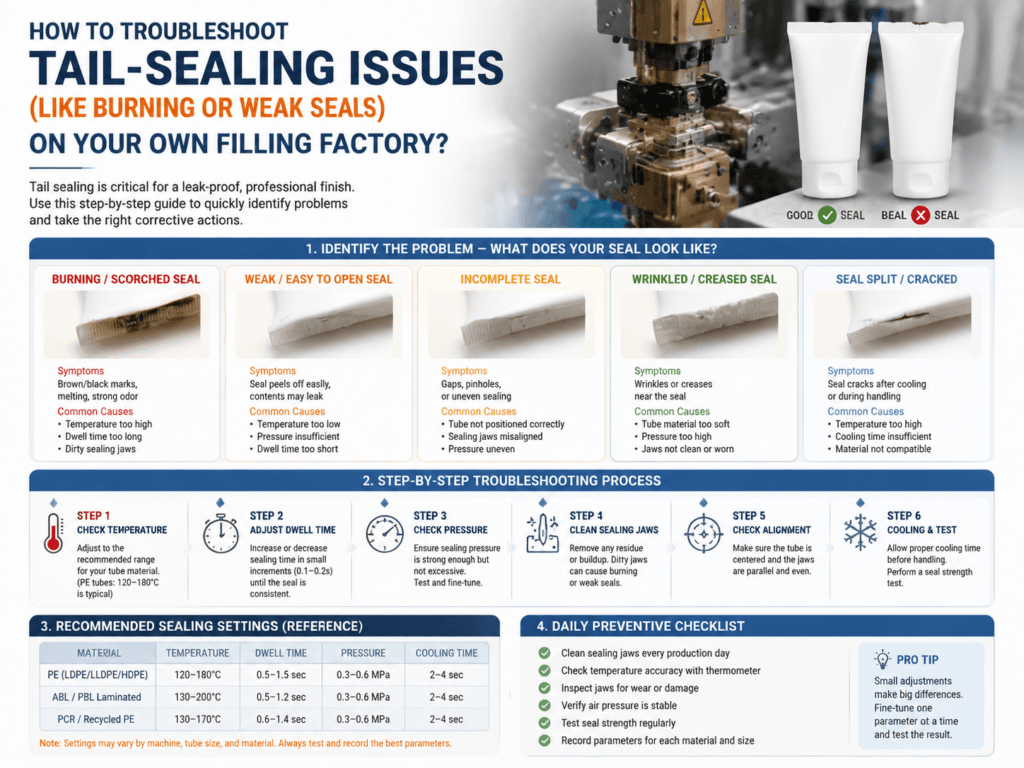
Tail-sealing problems on cosmetic tube filling lines, such as burnt seals, weak sealing strength or leakage, are usually caused by incorrect sealing temperature, pressure, sealing time, contamination at the tube tail or incompatibility between the tube material and filling machine parameters.
The solution is not simply increasing the sealing temperature. A professional troubleshooting process requires checking material structure, machine settings, product contamination and sealing conditions step by step.
During cosmetic tube filling production, tail sealing is the final step that closes the tube after filling. A stable seal protects against leakage, contamination and product quality issues during transportation and consumer use.
For PE tubes, ABL tubes, PBL tubes and EVOH barrier tubes, sealing parameters may vary because each structure has different melting behavior and heat response.
What Is Cosmetic Tube Tail Sealing?
Tail sealing is the process of permanently closing the open end of a filled cosmetic tube after the product has been dispensed into the tube body.
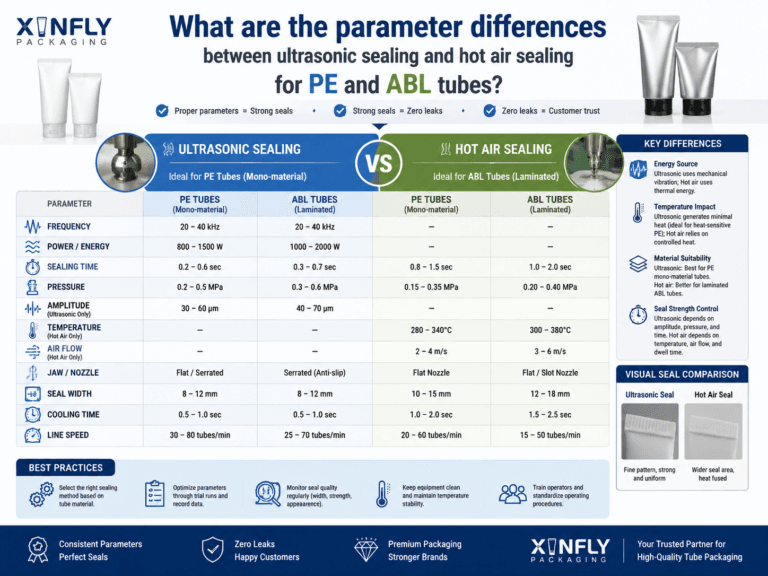
Most automatic filling machines use heat sealing technology, which melts the inner plastic layers and bonds them together under controlled temperature, pressure and time.
| Sealing Parameter | Function | Possible Problem If Incorrect |
|---|---|---|
| Temperature | Melts the tube layers to create bonding. |
Too high: burning or deformation. Too low: weak seal. |
| Pressure | Applies force to create proper bonding. |
Too low: incomplete seal. Too high: damaged tube tail. |
| Sealing Time | Controls heating duration. |
Too short: poor bonding. Too long: overheating. |
| Tube Position | Ensures correct sealing area. | Uneven seal or leakage. |
Common Tail-Sealing Problems in Cosmetic Tube Filling
Burnt Tube Tail
The sealed area becomes dark, melted, brittle or distorted because excessive heat damages the plastic layers.
Weak Seal Strength
The tail opens easily because the sealing temperature, pressure or time is insufficient.
Product Leakage
Formula leaks from the sealed area due to contamination or incomplete bonding.
Wrinkle Seal
The tail area appears uneven because the tube is not positioned correctly during sealing.
Seal Cracking
The sealed area breaks during transportation because of excessive stress or poor sealing conditions.
Appearance Damage
Printing or decoration near the tail area may become damaged by incorrect sealing settings.
Why Does a Cosmetic Tube Seal Become Burnt?
A burnt tube tail usually indicates excessive heat energy during the sealing process.
Typical causes include:
- Sealing temperature set too high.
- Heating time too long.
- Tube material requires lower sealing temperature.
- Heating nozzle or sealing blade is too close.
- Machine temperature sensor is inaccurate.
- Continuous production causes overheating.
Why Does a Tube Have a Weak Tail Seal?
A weak seal means the plastic layers did not achieve sufficient bonding strength.
| Possible Cause | Troubleshooting Method |
|---|---|
| Low sealing temperature | Increase temperature gradually and test sealing strength. |
| Insufficient sealing pressure | Check machine pressure settings and sealing fixture alignment. |
| Short sealing time | Increase heating duration carefully. |
| Product contamination | Check whether cream, oil or gel remains inside the sealing area. |
| Wrong sealing parameters for tube material | Adjust settings according to PE, ABL, PBL or EVOH structure. |
How Do Tube Materials Affect Tail-Sealing Parameters?
Different cosmetic tube structures have different melting behaviors. The correct sealing parameters depend on whether the tube is made from mono-layer PE, multi-layer PE, EVOH barrier structure, ABL or PBL laminate.
| Tube Structure | Sealing Characteristics | Common Adjustment Direction |
|---|---|---|
| Mono-layer PE Tube | Simple structure with good heat sealing performance. | Requires balanced temperature and pressure to avoid melting deformation. |
| 2-Layer PE Tube | Different inner and outer layers may require optimized heat transfer. | Adjust sealing temperature according to inner sealing layer behavior. |
| 5-Layer EVOH Barrier Tube | Barrier layer requires controlled heating to protect structure integrity. | Avoid excessive heat that may affect layer bonding. |
| ABL Tube | Aluminum barrier layer changes heat transfer characteristics. | Requires correct temperature profile and pressure control. |
| PBL Tube | Plastic barrier laminate provides excellent flexibility. | Optimize temperature to achieve consistent polymer bonding. |
How to Adjust Tail-Sealing Temperature Correctly?
One of the most common mistakes in tube filling factories is changing sealing temperature too aggressively. Temperature should be adjusted gradually while checking seal strength and appearance.
| Problem | Possible Adjustment | Expected Result |
|---|---|---|
| Burnt or darkened seal area | Reduce temperature or shorten heating time. | Prevent overheating and tube deformation. |
| Seal opens easily | Increase temperature slightly or improve sealing pressure. | Increase bonding strength. |
| Uneven sealing line | Check tube alignment and sealing fixture pressure. | Create uniform sealing contact. |
| Seal cracks after cooling | Check excessive heat or material stress. | Improve flexibility and durability. |
| Tube tail becomes too thin | Reduce sealing pressure or excessive melting. | Maintain proper wall thickness. |
Important: Never judge sealing quality only by appearance. A visually perfect seal may still fail leakage testing, while a slightly different appearance may still meet mechanical strength requirements.
Why Does Product Contamination Cause Weak Tube Seals?
One of the most common causes of sealing failure is cosmetic formula contamination inside the tube tail area.
Creams, oils, gels and emulsions can prevent the plastic layers from bonding correctly during heat sealing.
Cream Residue
Thick skincare creams remaining near the sealing area can create weak bonding points.
Oil Contamination
Oil-based formulas may reduce adhesion between sealing surfaces.
Overfilling
Insufficient headspace may push product into the sealing area.
Incorrect Filling Height
Tube filling level must match sealing equipment requirements.
Nozzle Position
Filling nozzle alignment affects whether product contacts the tail area.
Cleaning Procedure
Regular machine cleaning prevents repeated contamination issues.
How to Troubleshoot Tail-Sealing Problems Step by Step?
Factory Troubleshooting Checklist
- Step 1: Check whether the issue happens with all tubes or only one batch.
- Step 2: Confirm tube material structure and supplier specifications.
- Step 3: Inspect tube tail cleanliness before sealing.
- Step 4: Verify sealing temperature calibration.
- Step 5: Check sealing pressure and fixture alignment.
- Step 6: Adjust sealing time gradually.
- Step 7: Perform leakage and pull-strength testing.
- Step 8: Record the approved production parameters.
What Tests Should Filling Factories Perform After Tail Sealing?
| Test | Purpose |
|---|---|
| Leakage Test | Confirm the tube does not leak during storage and transportation. |
| Seal Strength Test | Verify the tail seal can withstand normal handling forces. |
| Appearance Inspection | Check sealing line quality and visual consistency. |
| Drop or Transport Simulation | Evaluate packaging performance during logistics. |
| Aging Test | Confirm long-term sealing reliability with the formula. |
Factory Engineer Recommendation
How to Reduce Tail-Sealing Problems Before Mass Production
- Conduct filling trials before commercial production.
- Confirm tube structure compatibility with the formula.
- Approve sealing parameters during pilot production.
- Keep production settings recorded for future batches.
- Train operators to identify early sealing defects.
- Use consistent tube suppliers to reduce material variation.
For cosmetic brands working with third-party fillers, communication between the tube manufacturer and filling factory is essential. Tube structure, sealing requirements and machine settings should be confirmed before large-scale production.
How to Prevent Cosmetic Tube Tail-Sealing Failures?
Preventing sealing problems is more effective than adjusting machine parameters after defects appear. A stable sealing process requires cooperation between the tube manufacturer, filling factory and quality team.
1. Validate Tube Compatibility
Confirm that the tube material structure matches the formula and filling process before mass production.
2. Run Filling Trials
Conduct pilot filling tests to determine suitable sealing temperature, pressure and time.
3. Control Filling Level
Maintain proper head space to prevent product contamination during tail sealing.
4. Maintain Equipment
Regularly check heaters, sensors, sealing blades and machine alignment.
5. Train Operators
Operators should understand common sealing defects and adjustment procedures.
6. Record Parameters
Keep approved sealing settings for repeat production batches.
How Should Cosmetic Brands Coordinate With Their Filling Factory (CMO)?
Many tube sealing problems happen because the tube supplier and filling factory do not communicate technical requirements before production.
| Information To Share | Why It Matters |
|---|---|
| Tube Material Structure | PE, EVOH, ABL and PBL tubes may require different sealing conditions. |
| Formula Characteristics | Oil-based, water-based and high-viscosity formulas behave differently during filling. |
| Filling Machine Model | Different machines have different sealing systems and adjustment ranges. |
| Target Production Speed | Higher speed may require optimized sealing parameters. |
| Quality Requirements | Leak testing and seal strength standards should be agreed before production. |
What Should a Filling Factory Check Before Increasing Sealing Temperature?
Increasing temperature is often the first reaction when a seal fails, but it may not solve the real problem.
- Check whether formula residue exists at the tube tail.
- Verify that the sealing blade contacts the tube evenly.
- Confirm the tube material structure.
- Check whether the heating system temperature is accurate.
- Verify sealing pressure and holding time.
- Confirm the tube supplier’s recommended sealing conditions.
Common Mistake: Excessive temperature may temporarily improve weak sealing but can create hidden problems such as brittle seals, deformation, color changes or reduced packaging strength.
Cosmetic Tube Tail-Sealing Troubleshooting Checklist
| Problem | Check First | Recommended Action |
|---|---|---|
| Burning at Tube Tail | Temperature and heating time. | Reduce heat energy and verify sealing contact. |
| Seal Opens After Cooling | Temperature, pressure and contamination. | Optimize parameters and improve tube cleanliness. |
| Leakage During Storage | Seal strength and material compatibility. | Perform leakage testing and adjust process. |
| Seal Looks Uneven | Tube position and machine alignment. | Adjust fixture and sealing pressure. |
| High Rejection Rate | Production consistency. | Record approved settings and train operators. |
Summary
Tail-sealing problems such as burning, weak seals, leakage and seal cracking are usually caused by a combination of sealing parameters, tube structure, formula characteristics and filling conditions.
The correct solution is a systematic troubleshooting process: confirm the tube material, inspect contamination, adjust temperature and pressure gradually, verify sealing strength and document the approved production settings.
For cosmetic brands using PE, EVOH, ABL or PBL tubes, early cooperation between the tube manufacturer and filling factory can significantly reduce production failures and product returns.
Related Questions
| Topic | Related Resource |
|---|---|
| Tube Material Selection | Single-layer PE vs 2-layer vs 5-layer Co-extruded Tubes: How to Choose? |
| Barrier Tube Selection | How to Choose Between ABL and PBL Tubes? |
| Oxygen Barrier Performance | OTR Difference Between PE Tubes and EVOH Tubes |
| Sample Approval | PPS vs Digital Layout Proof |
| Quality Standards | Cosmetic Tube QC Standards (AQL 2.5/4.0) |
Packaging Engineer Recommendation
Before launching mass production, brands should always complete a tube filling compatibility test using the actual formula, actual tube structure and actual filling equipment.
- Approve sealing parameters during pilot production.
- Keep sealing samples as production references.
- Test finished tubes after aging and transportation simulation.
- Share technical data between packaging supplier and CMO.
A reliable cosmetic tube solution is not only about producing the tube, but ensuring the tube performs correctly throughout filling, shipping and consumer use.
Need Technical Support for Cosmetic Tube Filling Problems?
Xinfly Packaging provides OEM cosmetic tubes with engineering support for tube selection, filling compatibility, sealing performance and mass production quality control.
Contact Packaging Engineer