Quick Answer
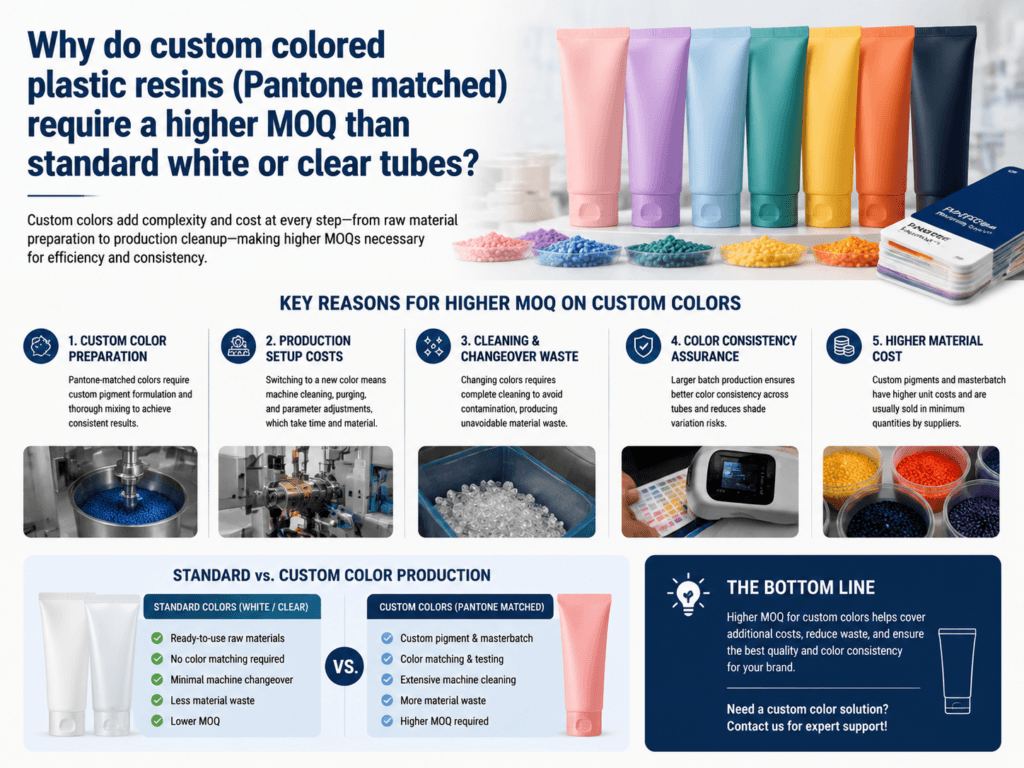
Custom colored plastic resins with Pantone matching usually require a higher MOQ because the factory must create a dedicated color formulation, purchase or prepare custom masterbatch, clean production equipment between colors and absorb color adjustment losses during setup.
Standard white or natural clear cosmetic tubes use commonly available resin systems and can be produced more efficiently, while custom colors require additional preparation and inventory commitment.
Many cosmetic brands ask why a factory can produce white, translucent or standard-colored tubes with a relatively low MOQ but requires a much higher quantity for a specific Pantone color.
The reason is not simply the cost of pigment. Custom color production changes the entire manufacturing process, from raw material preparation to extrusion setup, quality approval and inventory management.
Why Do Pantone Matched Cosmetic Tubes Need Higher MOQ?
When a brand requests a custom color tube, the manufacturer usually cannot use standard production materials. Instead, the factory must create a customized resin formulation by combining polyethylene resin with specific color masterbatch.
Unlike standard white tubes, which are produced regularly for many customers, a unique Pantone color is usually dedicated to one specific brand.
Custom Masterbatch
A special pigment concentration must be developed to achieve the customer’s required Pantone shade.
Color Matching
Multiple trials may be required to achieve acceptable color accuracy under factory lighting conditions.
Production Setup
Extrusion lines require additional adjustment when switching from standard resin to custom colors.
Material Inventory
Unused custom-colored resin cannot always be reused for other customers.
Color Consistency
Larger production quantities improve color stability between batches.
Waste Control
Color changeovers create additional startup material loss during production.
White, Clear and Custom Color Tube Cost Comparison
| Tube Color Type | Production Difficulty | MOQ Requirement | Reason |
|---|---|---|---|
| Standard White Tube | Low | Usually lowest MOQ | Common resin color with stable production demand. |
| Natural Clear Tube | Low | Usually lowest MOQ | No additional pigment system required. |
| Standard Black Tube | Medium | Medium MOQ | Common cosmetic color but requires pigment addition. |
| Custom Pantone Color Tube | High | Higher MOQ | Requires dedicated masterbatch, testing and production adjustment. |
| Special Metallic / Pearl Color | Very High | Higher MOQ | Special pigments require additional control and consistency testing. |
How Is a Custom Pantone Color Created for PE Cosmetic Tubes?
Pantone matching is not simply adding a color code into a machine. The factory must translate the target color into a practical plastic formulation.
Typical Color Development Process
- Brand provides Pantone reference or physical color sample.
- Color technician selects suitable pigment and masterbatch combination.
- Trial extrusion samples are produced.
- Color is evaluated under controlled lighting conditions.
- Adjustment is made if necessary.
- Approved color becomes the production reference standard.
Why Cannot Factories Produce Small Quantities of Every Pantone Color?
A cosmetic tube manufacturer may support hundreds of brands, but each brand may request a different shade of pink, green, blue or beige.
Maintaining small quantities of hundreds of custom color resins would create significant inventory risk because unused colored materials may not match future orders.
Example: A factory can easily reuse standard white PE resin for different customers. However, a custom “Brand A Rose Pink” resin may only be suitable for one customer’s product line.
Why Does Custom Color Resin Increase Production Costs?
A Pantone matched cosmetic tube requires more than simply adding pigment into plastic resin. The manufacturer must manage color development, material preparation, production adjustment and quality verification.
| Cost Factor | Impact on Custom Color Production |
|---|---|
| Custom Masterbatch Development | A special pigment formula may need to be created to achieve the required Pantone shade. |
| Minimum Masterbatch Purchase | Color suppliers usually require minimum quantities, creating additional inventory commitment. |
| Color Testing | Multiple trials may be required before the color meets the approved standard. |
| Production Adjustment | Extrusion parameters may need adjustment to achieve stable color output. |
| Material Waste | Startup tubes produced during color adjustment may not be used for final shipment. |
Why Does Color Changeover Create Additional MOQ Requirements?
Cosmetic tube factories normally produce different colors in scheduled batches. Changing from one resin color to another requires cleaning and preparation of production equipment.
During the color change process, the first production output may contain mixed colors or unstable shades. These tubes cannot always be shipped as final products.
Typical Color Change Process
- Remove previous color resin from extrusion equipment.
- Clean remaining pigment residue.
- Introduce new Pantone matched material.
- Adjust extrusion conditions.
- Inspect color consistency.
- Start approved mass production.
Why Are Small Quantity Pantone Orders More Difficult to Control?
Small production runs create several challenges for manufacturers:
- The custom masterbatch cost is spread across fewer tubes.
- Color adjustment waste becomes a larger percentage of production.
- Maintaining exact color consistency is more difficult.
- Unused custom resin may remain in inventory.
- Production scheduling becomes less efficient.
How Does Order Quantity Affect Pantone Color Tube Pricing?
| Order Quantity | MOQ Situation | Cost Effect |
|---|---|---|
| 1,000–5,000 pcs | Difficult for fully customized resin colors. | Higher unit cost because color setup costs are concentrated. |
| 10,000–30,000 pcs | More practical for custom colors. | Better balance between color customization and cost. |
| 50,000+ pcs | Suitable for regular production. | Improved material efficiency and lower unit cost. |
| 100,000+ pcs | Ideal for large brands. | Best color consistency and production economics. |
Why Are White and Clear Cosmetic Tubes Easier to Produce?
White and clear tubes are commonly requested across many cosmetic industries, which allows manufacturers to maintain stable production processes.
Standard Material Availability
White and natural PE resin systems are widely available and regularly stocked.
Lower Inventory Risk
Standard colors can often be used for multiple customers.
Faster Production Setup
Less adjustment time is required before mass production.
Stable Quality Control
Factories have more historical production data for standard colors.
Lower Waste
Less material is lost during production preparation.
Flexible Ordering
Lower MOQ options are usually available.
How Can Brands Reduce MOQ for Custom Colored Cosmetic Tubes?
Brands do not always need to abandon custom colors. Several strategies can reduce MOQ pressure.
- Use existing standard colors: Select factory-available colors close to the desired Pantone shade.
- Increase annual planning: Combine multiple production orders into one color batch.
- Use colored printing instead: Keep the tube white and achieve branding through surface decoration.
- Share the same tube structure: Use one tube size with different artworks where possible.
- Forecast future demand: Provide annual volume expectations to suppliers.
Can Printing Replace Custom Colored Plastic Resin?
In many cases, yes. Instead of producing a fully colored plastic tube, brands can use a standard white tube with high-quality printing to achieve a similar visual effect.
| Solution | Advantage | Limitation |
|---|---|---|
| Custom Colored Resin | Premium integrated appearance and full-body color effect. | Higher MOQ and color development requirements. |
| White Tube + Printing | Lower MOQ and more flexible artwork changes. | Color is limited to printed surface. |
| White Tube + Full Coverage Printing | Can simulate many custom colors. | Requires good printing control. |
Factory Engineer Recommendation
Choosing the Right Color Strategy
For startup and emerging cosmetic brands, a practical approach is:
- Use standard white or clear tubes for initial market testing.
- Validate product demand before investing in custom resin colors.
- Move to Pantone matched resin after annual volume increases.
- Combine multiple orders to achieve better MOQ efficiency.
- Approve physical color samples before mass production.
For established brands with stable demand, custom colored resin provides stronger shelf recognition and a more premium packaging experience.
Summary
Custom colored plastic resins with Pantone matching require a higher MOQ than standard white or clear cosmetic tubes because they involve additional material preparation, color development, production setup, inventory commitment and quality control requirements.
Standard white and clear tubes benefit from regular production demand, stable raw material availability and lower production risk. In contrast, a unique Pantone color is usually dedicated to one brand and cannot easily be reused for other customers.
For brands that need a premium customized appearance, Pantone matched resin can provide stronger shelf recognition and brand identity. However, for startups or smaller orders, using standard tubes with professional printing may provide a more cost-effective solution.
The best packaging strategy depends on annual volume, brand positioning, design requirements and long-term purchasing plans.
Related Questions
| Topic | Related Resource |
|---|---|
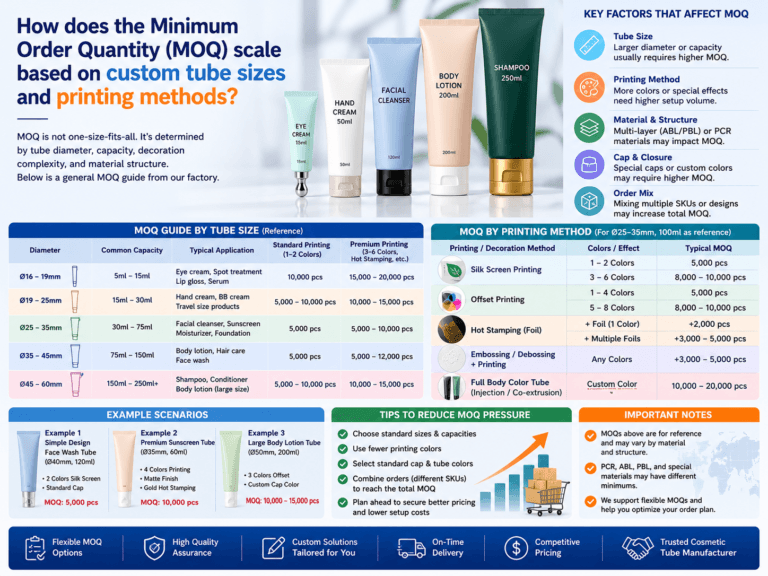
| MOQ and Tube Pricing | How does MOQ scale based on custom tube sizes and printing methods? |
| True Packaging Cost | How to calculate the true cost of custom cosmetic tubes? |
| Cosmetic Tube Materials | PE Cosmetic Tubes: LDPE, LLDPE and HDPE Material Guide |
| Printing Options | Cosmetic Tube Printing and Decoration Options |
| Artwork Preparation | What Artwork Files Are Required for Cosmetic Tube Printing? |
| Production Samples | PPS vs Digital Layout Proof: Cosmetic Tube Sample Approval Guide |
What Should Brands Prepare Before Requesting a Pantone Color Tube Quote?
To receive an accurate quotation and avoid unnecessary color adjustment costs, brands should provide complete technical information.
- Pantone color reference number or physical color sample.
- Tube material requirement (PE, PCR PE, EVOH, ABL or PBL).
- Tube size and capacity.
- Required quantity and annual forecast.
- Printing and decoration requirements.
- Expected delivery schedule.
- Target market and regulatory requirements.
Can Pantone Color Matching Guarantee 100% Identical Color?
Plastic color matching is highly accurate, but achieving absolutely identical color appearance under every condition is difficult because plastics, lighting environments and surface finishes can influence visual perception.
Professional cosmetic tube manufacturers normally establish a physical approved color standard before mass production.
Color Approval Best Practice
- Approve physical samples instead of relying only on digital screens.
- Review color under standardized lighting conditions.
- Confirm acceptable color tolerance before mass production.
- Keep approved samples as production reference standards.
- Inspect color consistency during production.
How Does Xinfly Packaging Help Brands Manage Custom Color MOQ?
For brands requiring custom colored PE cosmetic tubes, Xinfly Packaging supports the complete development process from color confirmation to mass production.
- Pantone color matching support.
- Custom PE resin color development.
- Production sample approval.
- Flexible solutions for different order volumes.
- Professional advice on choosing resin color vs printed decoration.
- Quality inspection during mass production.
Packaging Engineer Recommendation
For brands ordering below high-volume MOQ levels, we usually recommend evaluating three options:
- Option 1: Standard white or clear tube with premium printing.
- Option 2: Factory standard colors close to the brand requirement.
- Option 3: Fully customized Pantone resin color for larger annual volumes.
Choosing the correct approach helps balance visual impact, cost efficiency and inventory risk.
Need Custom Pantone Color Cosmetic Tubes?
Xinfly Packaging provides custom PE cosmetic tubes with Pantone matched colors, premium decoration, flexible material options and OEM manufacturing support.
Request Color Tube QuoteTalk To Packaging Expert