Quick Answer
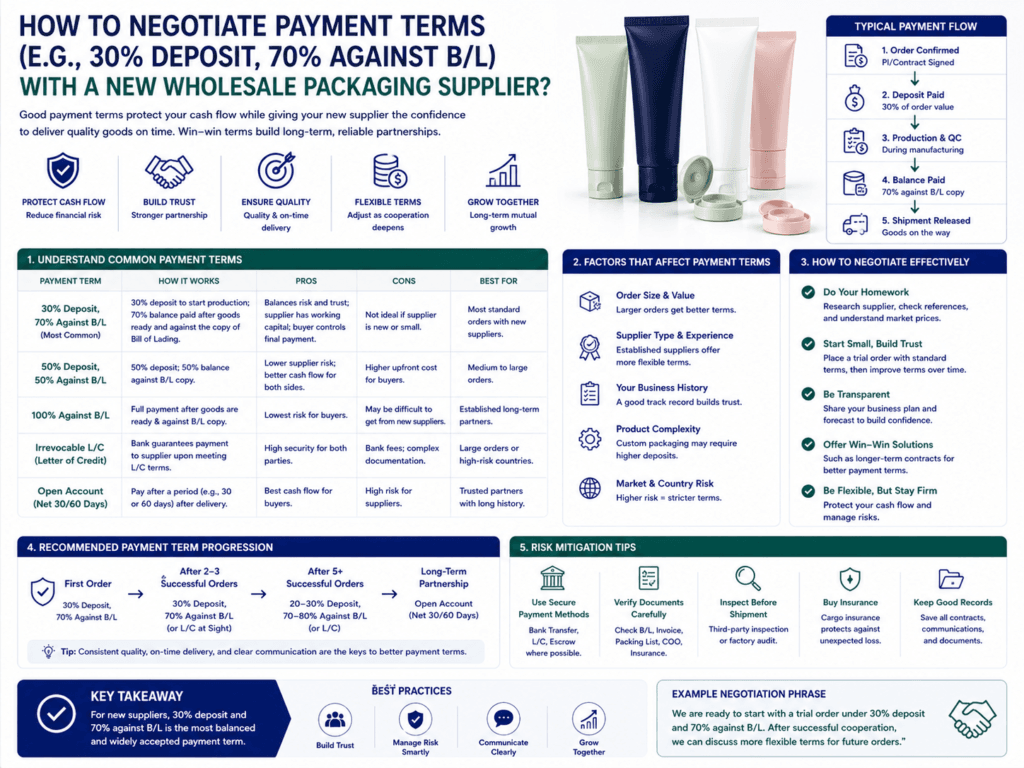
For a first order with a new wholesale cosmetic packaging supplier, the most common international payment term is 30% deposit before production and 70% balance against the Bill of Lading (B/L) copy after shipment.
This structure protects both sides: the supplier receives working capital to purchase raw materials and start production, while the buyer avoids paying 100% before receiving shipment evidence.
Negotiating payment terms with a new cosmetic tube manufacturer is one of the most important steps in international sourcing. Many buyers focus only on unit price but overlook payment risk, production control, quality approval and shipment security.
A professional negotiation should create a balance between supplier confidence and buyer protection. The final terms depend on order quantity, customization level, supplier relationship, production investment and transaction history.
Why Do Cosmetic Packaging Suppliers Request a Deposit?
Custom cosmetic tubes require the supplier to purchase materials, reserve production capacity, prepare printing plates, create tooling, produce custom colors and arrange factory labor before the buyer receives finished goods.
Unlike standard stock products, customized packaging cannot usually be resold easily if the buyer cancels the order.
Factory Engineer & Procurement Explanation
For customized PE tubes, ABL tubes, PBL tubes or PCR cosmetic tubes, the 30% deposit is normally used for:
- Purchasing PE resin, EVOH barrier materials or laminate materials.
- Preparing tube-head tooling, molds or customized components.
- Ordering customized caps and decoration materials.
- Scheduling extrusion, printing and assembly production.
- Covering initial labor and quality-control costs.
What Does “30% Deposit, 70% Against B/L” Mean?
| Payment Stage | Buyer Action | Supplier Action | Risk Control |
|---|---|---|---|
| 30% Deposit | Buyer pays initial deposit after confirming quotation, artwork, specifications and purchase order. | Supplier purchases materials and begins production preparation. | Production starts only after commercial agreement is confirmed. |
| Production & Inspection | Buyer reviews production samples, PPS or inspection results if required. | Supplier completes manufacturing and prepares shipment. | Quality approval before shipment reduces disputes. |
| 70% Against B/L Copy | Buyer pays remaining balance after receiving shipping documents. | Supplier releases Bill of Lading copy and export documents. | Buyer confirms shipment before final payment. |
Is 30% Deposit + 70% B/L Payment Safe for First-Time Buyers?
For established manufacturers with export experience, this payment structure is widely used in global B2B packaging transactions.
However, first-time buyers should still complete supplier verification before sending any deposit.
- Verify the supplier’s factory address and manufacturing capability.
- Request production samples before large orders.
- Confirm company registration and export history.
- Review certifications such as ISO, SGS, REACH or other compliance documents.
- Use a formal purchase contract with specifications and acceptance criteria.
What Payment Terms Can Buyers Negotiate With New Suppliers?
| Payment Method | Typical Situation | Buyer Risk | Supplier Risk |
|---|---|---|---|
| 100% Before Production | Small sample orders or highly customized tooling projects. | Higher risk because full payment happens before shipment. | Lowest supplier risk. |
| 30% Deposit + 70% B/L | Most common international manufacturing transaction. | Balanced risk. | Balanced risk. |
| 20% Deposit + 80% After Inspection | Large-volume buyers with negotiation power. | Lower buyer risk. | Higher supplier financial pressure. |
| Letter of Credit (L/C) | Large corporate buyers or high-value shipments. | Strong payment protection. | More banking procedures. |
| Open Account | Long-term strategic partnerships. | Lowest buyer payment risk. | Highest supplier risk. |
How Can Buyers Negotiate Better Payment Terms?
Payment terms are usually improved through trust-building rather than simply requesting lower deposits.
What Should Be Included Before Paying a Deposit?
- Final product specifications including tube size, material, capacity and closure.
- Approved artwork files and printing requirements.
- Sample approval or Pre-Production Sample (PPS) agreement.
- Production lead time and shipment date.
- Quality acceptance standards such as AQL requirements.
- Packaging specifications including carton quantity and pallet requirements.
- Payment schedule and bank information verification.
Common mistake: Do not negotiate payment terms only based on price. A supplier offering a very low unit price but requiring 100% advance payment may create a higher financial risk than a slightly higher-priced manufacturer offering balanced payment protection.
How Should Buyers Handle Tooling Costs?
Custom cosmetic tube projects may involve additional tooling costs for special shoulders, applicators, caps or unique shapes.
Tooling payment should be separated clearly from production payment.
| Cost Item | Recommended Payment Approach |
|---|---|
| Custom Mold or Tooling | Usually paid before tooling development because the supplier must invest immediately. |
| Tube Production | Commonly 30% deposit + 70% balance before shipment. |
| Sample Development | May be charged separately and credited back after mass production depending on supplier policy. |
Should Buyers Request Inspection Before Final Payment?
Yes. For large orders, third-party inspection or buyer inspection before shipment can provide additional confidence.
Inspection can verify:
- Tube dimensions and appearance.
- Printing quality and color accuracy.
- Cap assembly and leakage performance.
- Carton quantity and shipping marks.
- Overall production consistency.
Factory Recommendation for New Cosmetic Tube Buyers
Recommended First Order Structure
For a new customer ordering custom cosmetic tubes, a practical structure is:
- 30% deposit after purchase order confirmation.
- Pre-production sample approval before mass production.
- Production completion with internal quality inspection.
- Third-party inspection if order value requires it.
- 70% balance payment against B/L copy.
After several successful shipments, buyers may negotiate improved terms such as lower deposits, extended payment periods or credit arrangements.
Summary
The most common payment structure when purchasing customized cosmetic tubes internationally is 30% deposit and 70% against B/L. It provides a reasonable balance between supplier production requirements and buyer financial protection.
Successful payment negotiations depend on supplier verification, clear specifications, sample approval, quality standards and building a long-term business relationship.
For cosmetic packaging projects involving PE tubes, ABL tubes, PBL tubes, PCR tubes or custom closures, professional communication before payment is the best way to reduce sourcing risks.
Need a Reliable Cosmetic Tube Manufacturing Partner?
Xinfly Packaging helps global cosmetic brands manage OEM production, payment terms, quality control, samples and international shipment processes.
Request A Packaging Quote Contact Packaging Expert