
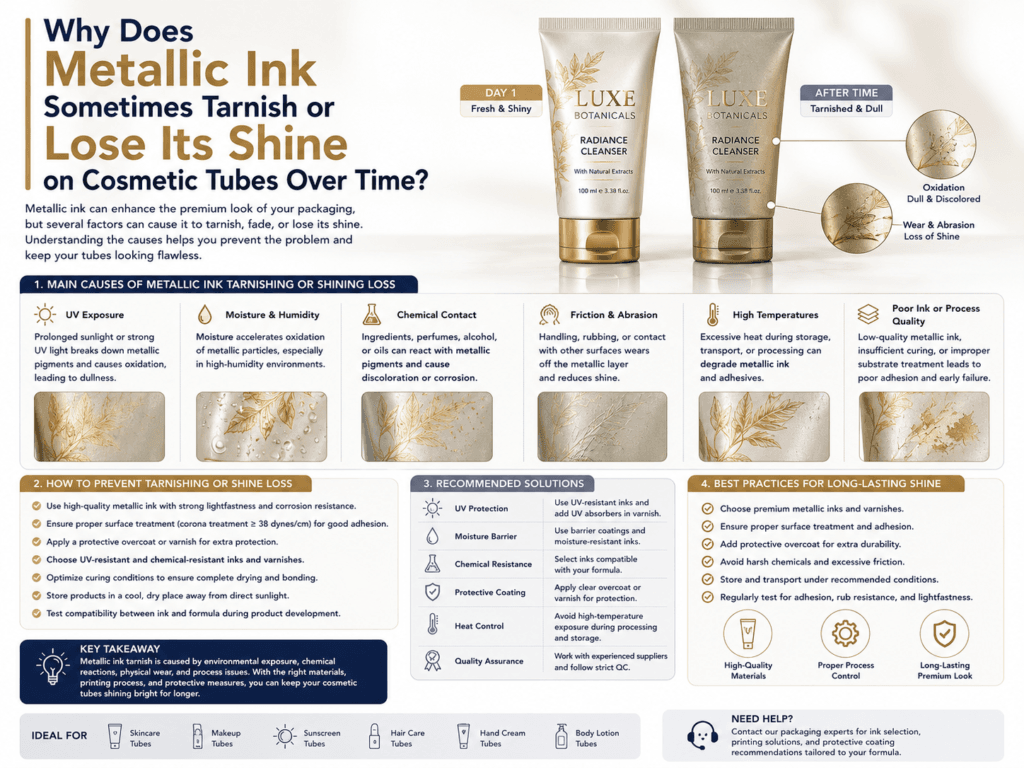
Metallic ink on cosmetic tubes can tarnish, look dull, or lose its shine over time because the metallic effect is highly sensitive to surface wear, chemical exposure, UV light, and weak protection of the printed layer. In most cases, the problem is not that the tube is made of real metal. It is that the metallic pigments or metallic ink layer gradually lose their clean reflective surface when exposed to friction, humidity, oils, solvents, sunlight, or incompatible overprint systems.
On cosmetic tubes, metallic decoration is expected to look bright, smooth, and premium. But unlike hot stamping foil, metallic ink is still a printed ink layer. If the pigment orientation is disturbed, the binder ages, or the print surface is scratched or chemically affected, the metallic effect may appear darker, flatter, or “tarnished” even when the artwork itself has not disappeared.
Main Reasons Metallic Ink Loses Shine Over Time
| Cause | What Happens | Visible Result |
|---|---|---|
| Surface abrasion | Rubbing during transport or handling damages the metallic layer | Ink looks dull, scratched, or less reflective |
| Weak protective coating | The metallic print is not properly shielded by a compatible varnish or topcoat | Shine fades faster during storage and shipment |
| UV exposure | Light slowly degrades the ink binder or surface clarity | Metallic effect becomes flatter or darker |
| Chemical contact | Fragrance oils, alcohol, lotion residue, or aggressive ingredients affect the print layer | Discoloration, haze, or local shine loss |
| Humidity and heat | Environmental exposure accelerates aging of the ink film | Metallic brilliance becomes weaker over time |
Why Metallic Ink Is More Sensitive Than Standard Ink
- Metallic brilliance depends on surface smoothness: If the surface becomes rougher, the light reflection becomes weaker.
- Pigment orientation matters: Metallic inks look brightest when the metallic particles stay aligned properly in the ink film.
- The ink layer needs protection: Without a compatible overprint varnish or durable topcoat, metallic inks can lose their premium look faster.
- Curved cosmetic tubes face real handling stress: Tubes rub against guides, cartons, and other tubes much more than flat packaging.
Common Failure Scenarios on Cosmetic Tubes
| Failure Scenario | Likely Cause |
|---|---|
| Metallic logo becomes dull after transport | Surface abrasion or insufficient protective coating |
| Metallic area turns darker after storage | Heat, humidity, or binder aging |
| Only some areas lose shine | Localized rubbing, contamination, or uneven coating |
| Metallic print looks hazy after filling | Chemical contact from product splash or line contamination |
| Premium shine fades faster than expected | Wrong metallic ink system or poor topcoat compatibility |
How Manufacturers Prevent Metallic Ink Tarnishing or Shine Loss
- Choose the right metallic ink system: The ink must match the tube substrate and the expected handling conditions.
- Use a compatible protective varnish or overprint coating: Metallic inks usually need protection to keep their visual brilliance longer.
- Control curing completely: A poorly cured metallic ink layer is more vulnerable to rubbing and chemical attack.
- Reduce transport friction: Better packing methods and separation between tubes can significantly reduce surface wear.
- Validate chemical resistance: For skincare, makeup, and fragrance-related products, testing against formula splash or residue is important.
- Test under heat, humidity, and light exposure: Premium metallic decoration should be checked for aging stability before approval.
Metallic Ink vs Hot Stamping Foil
| Decoration Type | Main Advantage | Main Risk Over Time |
|---|---|---|
| Metallic ink | Flexible for printed artwork and multi-element designs | Can lose luster if not well protected |
| Hot stamping foil | Usually brighter and more mirror-like metallic effect | May crack or flake if badly matched to deformation zones |
Best Practice for Premium Cosmetic Tubes
If a beauty brand wants long-lasting metallic brilliance, the safest approach is to treat metallic ink as a decorative system, not just a color choice. The substrate, surface treatment, ink chemistry, curing process, and protective coating all need to work together. In many premium projects, shine loss is not caused by the metallic pigment itself, but by the lack of enough protection or durability validation before production.
Summary
Metallic ink sometimes tarnishes or loses its shine on cosmetic tubes because the reflective ink layer is sensitive to abrasion, UV exposure, humidity, chemical contact, weak coating protection, and incomplete curing. When the surface is damaged or the binder ages, the metallic particles no longer reflect light as cleanly, so the print begins to look dull or darkened.
To reduce the risk, manufacturers should use the correct metallic ink system, apply a compatible protective coating, confirm full curing, and validate resistance to transport, storage, and formula exposure before mass production.
Learn more: Printing Options, Tube Decoration, Hot Stamping Tubes, Surface Finishing, Customize Cosmetic Tubes, Quality Assurance.
Need Longer-Lasting Metallic Decoration on Cosmetic Tubes?
Xinfly Packaging helps brands select the right metallic ink, protective coating, and surface-finishing system to keep cosmetic tube decoration brighter, cleaner, and more stable over time.