
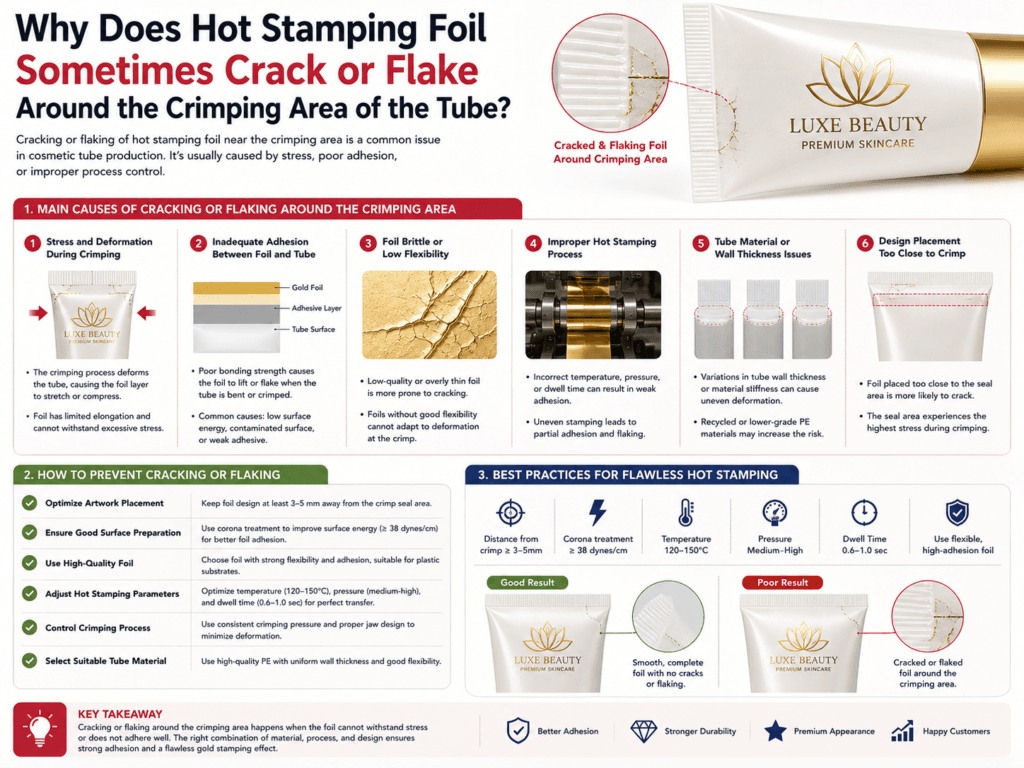
Hot stamping foil sometimes cracks or flakes around the crimping area because that part of the tube experiences the highest mechanical stress during sealing, folding, and repeated squeezing. Even if the foil looks perfect right after decoration, the crimping zone is later compressed and bent sharply during sealing, which can cause the metallic layer to fracture or detach if the foil system is too rigid or the adhesion is not strong enough.
In most cases, the problem is not caused by only one factor. It is usually the result of a combination of foil flexibility, substrate compatibility, stamping temperature, pressure, dwell time, crimping deformation, and surface preparation. On soft cosmetic tubes, the crimping area is one of the most demanding places for hot stamping durability.
Why the Crimping Area Is More Vulnerable
| Crimping Condition | Effect on Hot Stamping Foil |
|---|---|
| Strong folding and compression | Can fracture the metallic foil layer |
| Sharp deformation angle | Creates stress concentration at foil edges |
| Repeated tube handling | Weakly bonded foil may begin to flake after transport or use |
| Seal-area heat and pressure | May weaken foil adhesion if the system is not compatible |
Main Causes of Cracking or Flaking Around the Crimping Area
- Foil too brittle: Some metallic foils are not flexible enough to survive strong deformation in the sealed tail area.
- Poor foil-to-substrate match: A foil grade that works on one plastic may not bond well to another tube surface.
- Excessive stamping pressure: Too much pressure can weaken the transferred layer and make it easier to crack later.
- Incorrect temperature or dwell time: If transfer conditions are too weak, the foil adhesion will be poor; if too aggressive, the foil may become unstable or damaged.
- Decoration placed too close to the crimp line: Artwork inside the high-deformation zone is more likely to fail mechanically.
Common Failure Patterns
| Failure Pattern | Likely Cause |
|---|---|
| Fine cracks across the foil | Foil layer is too rigid for the crimping deformation |
| Foil flakes off in small chips | Weak adhesion or poor substrate compatibility |
| Gold line breaks after sealing | Artwork placed inside the folding zone |
| Foil looks fine at first, then peels later | Adhesion was marginal and failed under handling stress |
How Manufacturers Prevent the Problem
- Choose a more flexible foil grade designed for plastic cosmetic tubes and deformation-sensitive areas.
- Keep foil artwork away from the crimping zone whenever possible.
- Optimize temperature, pressure, and dwell time to achieve strong transfer without overstressing the foil.
- Test the exact tube surface and foil combination before mass production.
- Run sealing and post-crimp durability tests instead of checking only the flat pre-seal appearance.
Best Artwork Rule for Tube Tail Areas
If a brand wants gold foil decoration on a cosmetic tube, the safest practice is to keep the main foil logo or decorative element in the stable body area of the tube rather than the sealing tail. The crimping area should usually be treated as a high-risk mechanical zone, not a premium decoration zone.
Recommended Quality Control Checks
| QC Check | Purpose |
|---|---|
| Adhesion test after stamping | Confirms initial foil bond strength |
| Seal simulation / crimp test | Checks whether foil survives actual tube sealing |
| Bend or squeeze test | Evaluates deformation resistance after filling |
| Transport abrasion check | Verifies that foil does not begin flaking after packing and shipping |
Summary
Hot stamping foil cracks or flakes around the crimping area mainly because that zone undergoes strong folding, compression, and sealing stress. If the foil is too brittle, the adhesion is weak, or the decoration sits too close to the crimp line, the metallic layer can break or detach after sealing.
To avoid this problem, manufacturers should use flexible foil grades, optimize hot stamping conditions, keep foil artwork out of the high-deformation area, and validate performance with real post-crimp testing before mass production.
Learn more: Hot Stamping Tubes, Tube Decoration, Printing Options, Surface Finishing, Customize Cosmetic Tubes.
Need More Reliable Hot Stamping on Cosmetic Tubes?
Xinfly Packaging helps brands optimize foil selection, artwork placement, and stamping durability so metallic decoration stays cleaner and more stable after sealing and shipping.