Published: .
Two suppliers quote the same number of empty toothpaste tubes. One lists fewer cartons and a lower shipping volume, so its freight estimate looks attractive. Before choosing it, check the contents: are caps attached, are retail cartons included, and is the quoted quantity based on the same packing configuration? A smaller number is useful only when it describes the same shipment.
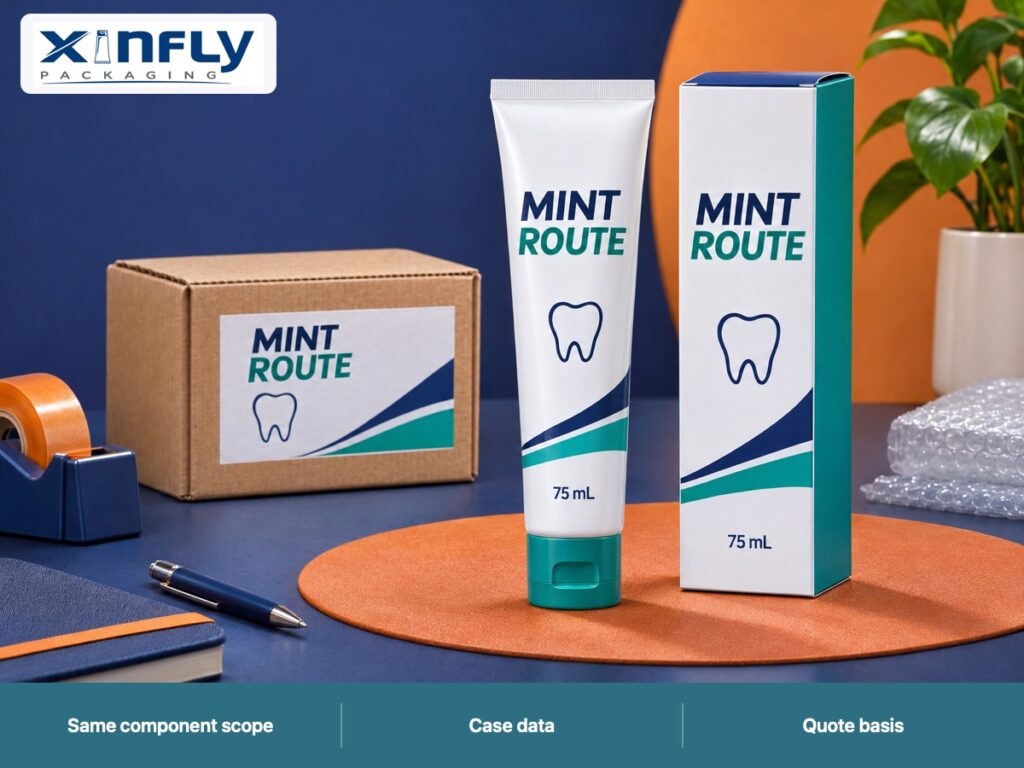
An empty toothpaste tube freight quote comparison puts those assumptions on one worksheet. The illustrated MINT ROUTE concept is a nominal 75 mL white PBL tube with molded shoulder, teal flip-top, straight sealed display tail and navy-and-teal offset artwork. Its retail carton and example case label carry matching tooth artwork. These are packaging illustrations, not a validated shipping arrangement. Actual empty tubes may be supplied with open tails for filling; request data for the delivered state. Start with the toothpaste tube packaging assembly and normalize the shipment data before comparing prices.
Define the Shipment Before Asking for Freight
Fix the Supplied Component State
List what the supplier will deliver: tube bodies, assembled caps, separate closures, protective materials and any retail cartons. Identify whether the tubes are open at the filling end and which dimensions apply in that state. A finished sealed sample can help discuss appearance, but it may not represent the empty component's packing geometry.
For empty toothpaste tubes wholesale orders, give every bidder the same component scope and quantity. If one supplier recommends a different cap or body size, ask for that alternative separately. Do not let an assembly substitution hide inside a freight estimate that is presented as a direct comparison.
Separate Retail Cartons From Shipping Cases
A printed folding carton is a product component; a corrugated shipping case is part of the transport pack. Record both when they are included. Ask whether the retail cartons are supplied flat, assembled around tubes or shipped separately. Those arrangements can produce different shipment data even when the finished consumer pack looks identical.
The MINT ROUTE illustrations include a matching retail carton to show the package design. They do not establish how many units fit into the displayed case. Never derive a commercial case quantity or shipping cube from a product image. Obtain the actual packing proposal and sample arrangement from the supplier.
Identify the Delivery Stage
Clarify whether the quoted shipment goes to a contract filler, a consolidator, a warehouse or another receiving point. The recipient may have its own receiving and handling requirements. Send those requirements to the supplier before the case count is finalized. A freight comparison should refer to a named route and delivery scope, not simply shipping to the United States or Europe.
| Field | Required description | Comparison question |
|---|---|---|
| Component scope | Bodies, caps, protection and retail cartons | Do both offers include the same items? |
| Delivered state | Open or finished tail; assembled or separate parts | Are the dimensions relevant to the shipment? |
| Case packing | Units per case and inner packing | Is the quantity based on the actual arrangement? |
| Shipment totals | Cases, external dimensions and gross weight | Can a forwarder price the same data basis? |
| Delivery scope | Named collection and receiving points | Are the quoted services comparable? |
Recalculate the Case Cube
Use External Packed Dimensions
Ask for the external dimensions of the packed and closed case, with units stated. Do not substitute the internal box size or a flat board dimension. The forwarder needs the measurements relevant to the shipment it will handle. If the values are preliminary, label them as estimates and identify what will confirm them.
For dimensions in centimeters, case volume in cubic meters is length multiplied by width multiplied by height, divided by 1,000,000. Multiply that result by the number of cases for a simple total case cube. Keep that calculation separate from any carrier's pricing or chargeable-weight method.
Compare a Controlled Arithmetic Example
The table below uses a 10,000-unit order and two hypothetical packing records. The dimensions and quantities are arithmetic examples only. They are not tested case capacities, recommended packing arrangements or Xinfly shipping specifications. Both rows assume the same explicitly defined component scope; a real comparison must confirm that scope before using the numbers.
| Example | Units per case and case count | External case dimensions | Calculated total case cube |
|---|---|---|---|
| A | 200 units; 50 cases | 48 × 36 × 28 cm | 2.4192 m³ |
| B | 250 units; 40 cases | 52 × 38 × 30 cm | 2.3712 m³ |
Example A uses 0.048384 m³ per case; example B uses 0.05928 m³. B has the larger individual case but a slightly lower total case cube because it uses fewer cases. The difference across the illustrative order is 0.0480 m³. This is a calculation result, not a freight saving: an actual charge can depend on other shipment and service factors.
Keep the Denominator Consistent
Normalize comparable totals to the same ordered quantity. Total case cube divided by supplied units gives a volume-per-unit comparison; multiplying by 1,000 gives a volume per thousand units. Use the same definition of supplied units in both offers. Separate caps, sample packs or retail cartons should not disappear from one denominator while remaining in the other shipment.
For a quantity that does not divide evenly into cases, ask how the partial case will be packed and measured. Do not round the case count down. Conversely, do not assume every partial case has the same dimensions and weight as a full one without the supplier's packing proposal.

Add Weight and Pallet Information
Ask for Gross Weight, Not Only Product Weight
The weight of a tube assembly does not include every part of the shipping pack. Request case gross weights and shipment totals for the actual configuration. Identify whether any separate components or accessory cartons are listed elsewhere. A forwarder cannot reliably reconcile an incomplete shipment merely from a nominal tube weight.
Keep measured and estimated values separate. If a quote is based on a prototype calculation, ask when a packed sample or production packing record will confirm it. Record the version of the packing specification associated with each number so later changes do not leave the freight worksheet referring to an obsolete arrangement.
Treat Palletization as Another Configuration
If pallets are required, ask for the loaded dimensions, pallet count and gross weights, including any stated stacking restrictions. Do not assume that adding the individual case volumes gives the final loaded shipment cube. A palletized configuration can contain gaps and height constraints that a simple case total does not describe.
Give the receiving warehouse's actual requirements to the supplier and forwarder. Request a packing or loading proposal appropriate to that route. The comparison should state whether the prices refer to loose cases or a specified palletized shipment. Changing between those arrangements is a change in scope, not just a different presentation of the same number.
Ask the Forwarder to State Its Pricing Basis
Have the forwarder explain the rate basis, minimums, measurement rules, included services and quote validity for the proposed shipment. Do not apply a generic dimensional-weight divisor to every service. Use the method stated for the actual quote and retain it with the shipment data. The supplier provides packing information; the transport provider confirms how it will price and handle that information.
Review Protection Before Chasing a Smaller Cube
Inspect the Proposed Inner Packing
Ask how the tube bodies, caps and open filling ends are arranged and protected. Review the actual proposed material and handling method with the filler and quality team. A tightly packed case is not automatically a better case if it introduces deformation, contact marks or a receiving problem. The protection decision belongs alongside the volume calculation.
Xinfly's guide to shipping-carton planning for empty cosmetic tubes provides a broader discussion route. This comparison worksheet has a narrower purpose: making the data and scope consistent enough to price the shipment. Any new packout still needs the project's relevant handling and distribution review.
Confirm the Tube Specification Has Not Changed
A supplier may reduce case cube by changing body dimensions, packing orientation or component state. Ask which change creates the new figure. For laminated toothpaste tubes, preserve the agreed structure, cap and drawing unless the brand and filler approve an alternative. An apparent freight improvement should not silently reopen filling or carton-fit assumptions.
If the proposal changes the tube printing or decoration process or the way decorated surfaces contact packing, include that in the sample review. Keep a representative packed set with the release record. It is easier to assess the trade-off while the actual proposed arrangement is available.
Keep Claims Proportional to the Evidence
A calculation can show a difference in recorded cube. A packing trial can support observations about a particular arrangement. Neither automatically proves a lower delivered cost or an acceptable result on every route. Ask the supplier and forwarder to identify what remains estimated and what has been checked before the buyer commits.
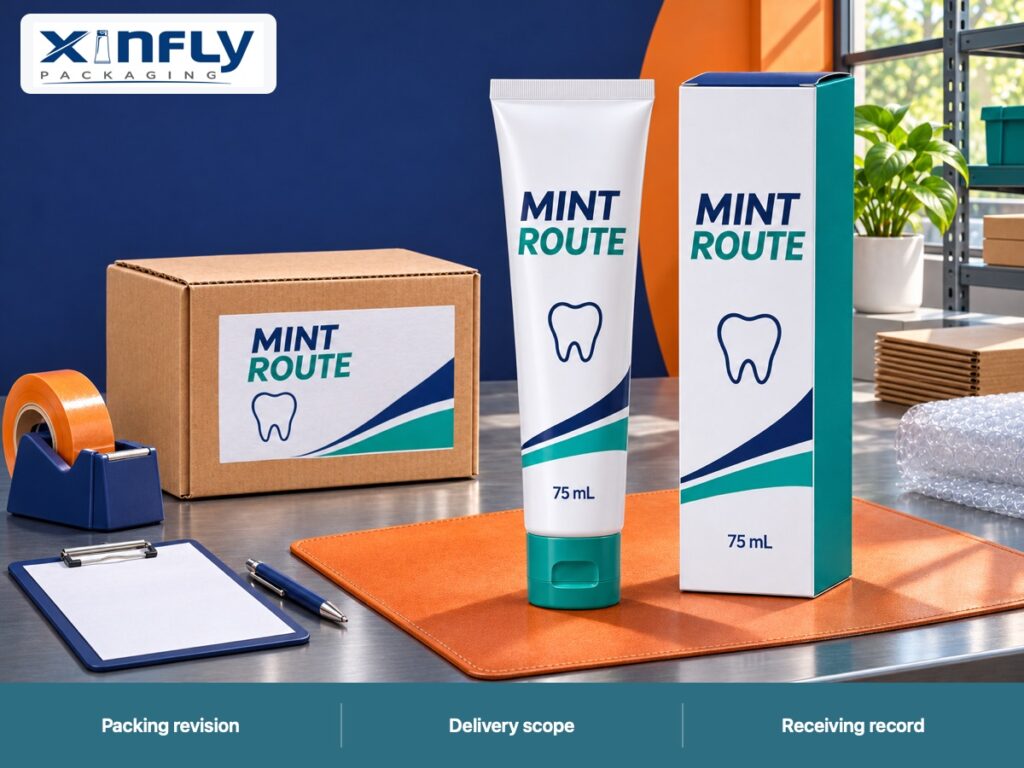
The illustrated receiving desk is a concept setting, not a factory dispatch record or customer shipment. Use actual packed-case photographs, dimensions and agreed methods in the commercial file. That distinction keeps attractive package artwork from being mistaken for logistics evidence.
Normalize the Commercial Quote
Compare Named Points and Included Services
Ask both offers to identify collection point, destination, transport scope, currency, validity and any separately billed items. If trade terms are used, record the agreed term and named place and have the parties clarify their responsibilities. Do not compare a limited transport estimate with a broader delivered-service offer as if the totals cover identical work.
Request the forwarder's written quote based on the same packing record sent to the supplier. If the package data change, ask for an updated price rather than carrying forward a convenient old estimate. This keeps the decision tied to the shipment that will actually be prepared.
Create One Accepted Packing Record
Put the final component scope, packing revision, units per case, case count, dimensions, weights and pallet details into a controlled record. Identify who confirms the actual data before dispatch. Connect the record to the purchase order and receiving requirements. A list of dimensions in an old email is difficult to audit when production has moved to a different carton.
Keep alternative proposals as comparison history, with the selected arrangement marked clearly. At delivery, the receiving team can compare the packing list and case identities with the accepted record rather than reconstruct the buyer's original calculation.
Ask Xinfly Packaging for Comparable Data
Send the intended toothpaste tube structure, dimensions, cap, quantity, decorated-item scope, retail-carton arrangement and receiving point. Ask for an identified packout proposal through the sample development process when the configuration is new. Send the packaging team your freight-data brief and request the assumptions behind each estimate. That gives your forwarder a usable basis for a like-for-like quotation.
Frequently Asked Questions
Does a larger case always mean more total shipping volume?
No. Compare case volume multiplied by case count for the same supplied quantity and scope. A larger case with more units can produce a different total, as the illustrative arithmetic shows.
Can I estimate case quantity from a catalogue photograph?
Use the photograph for design discussion only. Obtain the supplier's actual packing arrangement, dimensions and unit count before using it in a freight request.
Are retail cartons always included in a tube freight estimate?
Ask explicitly. They may be supplied flat, assembled or separately. Record their arrangement and make sure every bidder and forwarder uses the same component scope.
Can total case cube replace pallet dimensions?
Not when the shipment is quoted or handled as a specific palletized load. Request the actual loaded dimensions, count and weights relevant to that configuration.
What should trigger a new freight quote?
Review changes to quantity, packing, components, dimensions, weights, route or service scope. Have the transport provider confirm the updated quote against the revised shipment record.
Conclusion
An empty toothpaste tube freight quote comparison starts with matching contents and ends with one accepted packing record. Recalculate cube, keep weights and pallet data clear, protect the product and compare the same delivery scope. Xinfly Packaging can provide a useful packing proposal when the brief identifies the actual tube assembly and the receiving requirements behind the shipment.