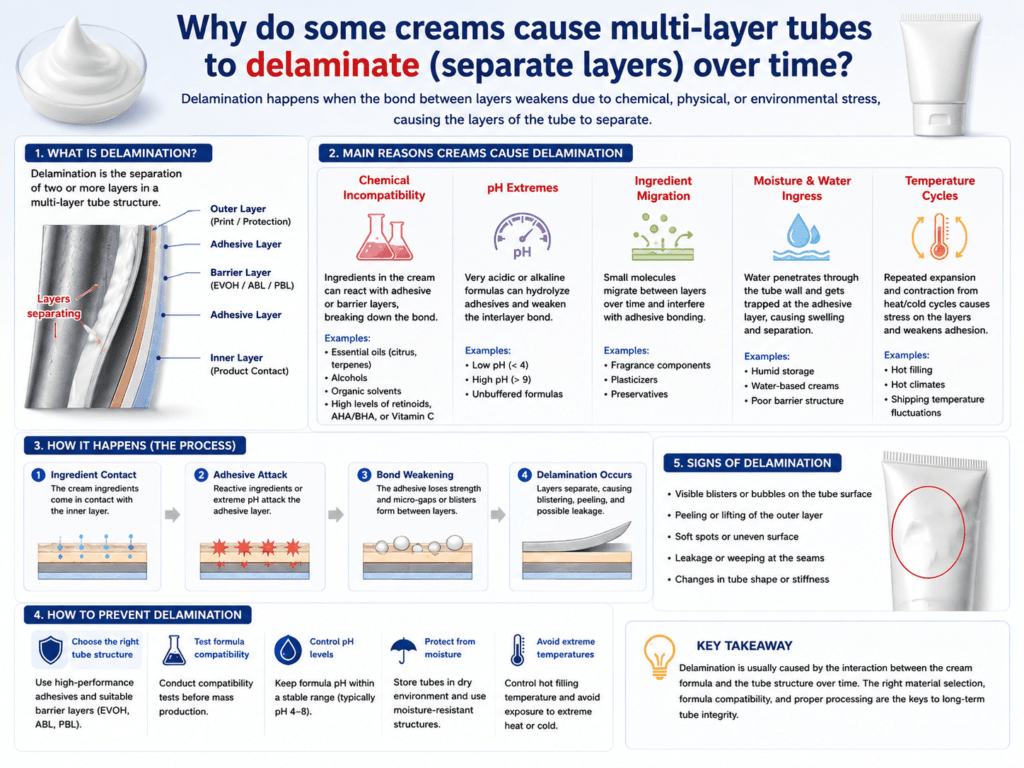
Some creams can cause multi-layer cosmetic tubes to delaminate over time when formula ingredients weaken the adhesion between layers, attack the tie resin, migrate into the tube wall, or create internal stress during storage. Delamination means the layers of a co-extruded or laminated tube begin to separate, creating bubbles, wrinkles, white patches, soft spots, or peeling inside the tube wall.
This issue is usually not caused by one single factor. It often comes from the combination of formula aggressiveness, inner-layer compatibility, barrier-layer structure, adhesive or tie-layer performance, filling temperature, storage condition, and mechanical stress during squeezing or transport.
What Is Tube Delamination?
Delamination happens when the bonded layers inside a multi-layer tube separate from each other. In cosmetic tubes, this may occur in 5-layer co-extruded tubes, EVOH barrier tubes, ABL tubes, PBL tubes, or other laminate structures if the layer bonding is weakened by formula contact, heat, pressure, or poor production control.
Important: Delamination may not appear immediately after filling. It can develop after weeks or months of storage, especially under heat, pressure, or formula-aging conditions.
Main Causes of Delamination in Multi-Layer Tubes
| Cause | What Happens | Visible Result |
|---|---|---|
| Formula incompatibility | Oils, solvents, actives, or fragrance components interact with the inner layer or tie layer | Bubbles, layer lifting, softening, peeling |
| Weak tie-layer adhesion | The adhesive layer between PE and barrier material does not bond strongly enough | Layer separation after storage or squeezing |
| Essential oil or fragrance migration | Small molecules migrate into the plastic wall and weaken interfaces | Wrinkles, swelling, odor loss, delamination |
| High oil phase or solvent-like emollients | Formula softens or swells the inner contact layer | Inner wall distortion or layer separation |
| Heat exposure | High temperature accelerates diffusion, softening, and internal stress | Faster delamination during aging or transport |
Formula Ingredients That Increase Delamination Risk
Creams with high oil content, strong fragrance, essential oils, chemical UV filters, solvent-like esters, exfoliating acids, retinol systems, or aggressive botanical extracts may create higher compatibility risk. These ingredients can migrate into plastic layers, soften the inner lining, or weaken the bonding between different layers.
| Formula Ingredient Type | Why It Is Risky | Packaging Concern |
|---|---|---|
| Essential oils | Small volatile molecules can migrate into plastic | Scalping, swelling, softening, delamination |
| Fragrance oils | Aroma compounds may interact with inner layers | Odor loss and layer-interface stress |
| Ester emollients | Some can behave like plastic-interacting solvents | Softening, swelling, weak adhesion |
| High oil phase | Long-term contact increases plastic absorption risk | Inner wall weakening and deformation |
| Active skincare ingredients | Some actives require special compatibility validation | Material stress, barrier-layer interaction, formula instability |
Why Tie Layers Matter
In a multi-layer tube, PE and barrier materials do not always naturally bond well to each other. A tie layer is used to connect different materials into one stable structure. If the tie resin is not compatible with the barrier material, processing temperature, layer ratio, or formula environment, the tube may separate over time.
- PE-to-EVOH bonding: Requires a suitable tie layer to keep the barrier layer stable.
- Layer ratio: Very thin or uneven tie layers may reduce long-term adhesion.
- Processing temperature: Poor extrusion conditions can weaken bonding strength.
- Formula contact: Aggressive creams may migrate into interfaces and reduce adhesion.
- Mechanical stress: Squeezing, bending, and transport can expose weak interlayer bonding.
Delamination Risk by Tube Structure
| Tube Structure | Delamination Risk | Key Control Point |
|---|---|---|
| Single-layer PE tube | No interlayer delamination, but may still soften or swell | Inner-layer formula compatibility |
| 2-layer PE tube | Low to moderate depending on layer bonding | Layer adhesion and material compatibility |
| 5-layer EVOH co-extruded tube | Project-dependent | PE/tie/EVOH bonding, layer ratio, formula compatibility |
| PBL laminated tube | Depends on laminate adhesive and plastic barrier structure | Inner layer, adhesive system, side seam, aging stability |
| ABL laminated tube | Can be affected by foil/adhesive interface and formula stress | Aluminum barrier adhesion, edge protection, formula compatibility |
How Delamination Appears in Real Products
- Small bubbles or blisters under the tube surface
- White cloudy patches inside the tube wall
- Wrinkled or uneven tube body after storage
- Peeling near the tail seal, shoulder, or side seam
- Soft spots where the wall feels weaker
- Layer separation visible at the cut edge or tail area
- Leakage or cracking after repeated squeezing
Storage Conditions That Make Delamination Worse
Heat, humidity, pressure, and time can accelerate layer separation. A tube may pass initial production inspection but fail after being stored in a hot warehouse, shipped by sea container, exposed to retail lighting, or compressed inside cartons.
| Storage / Handling Factor | Effect on Tube | Possible Result |
|---|---|---|
| High temperature | Accelerates migration and softening | Faster layer separation |
| Temperature cycling | Layers expand and contract differently | Interface stress and wrinkles |
| Carton compression | Applies pressure to already weakened areas | Blistering, creasing, delamination |
| Repeated squeezing | Bends the wall and stresses layer interfaces | Peeling or cracking after use |
| Long shelf life | Gives more time for ingredient migration | Delayed delamination after months |
How to Prevent Delamination
| Prevention Method | How It Helps |
|---|---|
| Choose a compatible inner layer | Reduces formula attack, swelling, and migration into the tube wall |
| Use the correct tie resin | Improves adhesion between PE, EVOH, and other barrier layers |
| Optimize layer thickness ratio | Improves structural balance and prevents weak interfaces |
| Control extrusion or lamination conditions | Ensures stable bonding during tube production |
| Run filled aging tests | Confirms whether the real cream causes layer separation over time |
| Control filling temperature and storage | Reduces heat-driven migration and stress |
Recommended Tests Before Mass Production
| Test | Purpose | What to Check |
|---|---|---|
| Filled compatibility test | Checks formula interaction with the tube structure | Softening, swelling, blistering, delamination, leakage |
| Accelerated aging test | Predicts long-term storage behavior | Layer separation, odor change, formula instability |
| High-temperature storage test | Checks heat-driven delamination risk | Bubbles, wrinkles, paneling, adhesive weakening |
| Cross-section inspection | Checks layer structure and bonding condition | Layer uniformity, tie layer continuity, visible separation |
| Peel or bond-strength test | Measures interlayer adhesion strength | Weak bonding between layers |
| Repeated squeeze test | Checks mechanical durability after formula contact | Layer lifting, cracking, stress whitening, leakage |
Common Misunderstandings
| Misunderstanding | Correct Explanation |
|---|---|
| “Delamination is always a factory defect.” | Not always. It may come from formula incompatibility, storage heat, overfilling, or aggressive ingredients. |
| “If the empty tube looks good, it will not delaminate.” | Empty-tube inspection cannot replace filled aging and compatibility testing. |
| “Thicker tube walls always prevent delamination.” | Thickness helps strength, but delamination mainly depends on interlayer adhesion and formula compatibility. |
| “All EVOH tubes behave the same.” | Layer ratio, tie resin, PE grade, processing conditions, and formula contact can all change performance. |
When to Change the Tube Structure
If a cream causes delamination in one structure, the solution may be to change the inner contact layer, adjust the tie resin, use a different barrier-layer ratio, switch from standard multi-layer PE to PBL or ABL, or redesign the formula-package system together. The correct solution depends on whether the failure starts from formula attack, weak interlayer adhesion, side seam stress, or heat-aging instability.
| Failure Situation | Recommended Direction |
|---|---|
| Inner layer softens or swells | Change inner contact material or improve formula compatibility |
| EVOH layer separates from PE | Review tie resin, extrusion temperature, and layer ratio |
| Delamination appears after heat aging | Improve heat stability and run higher-temperature storage tests |
| Failure occurs near tail seal | Check sealing temperature, headspace, filling pressure, and layer bonding |
| Failure occurs only after squeezing | Improve layer adhesion and mechanical flexibility |
Best Practical Recommendation
If a cream has high oil content, essential oils, fragrance, chemical filters, actives, or solvent-like emollients, do not select a multi-layer tube based only on barrier performance. The tube must also pass formula compatibility, interlayer adhesion, heat aging, and repeated squeeze testing.
For high-risk formulas, ask the tube supplier to review the full formula type, filling temperature, shelf-life target, storage conditions, and intended tube structure before finalizing the material. A small adjustment in inner layer, tie resin, wall structure, or barrier ratio can prevent major delamination issues later.
Summary
Some creams cause multi-layer tubes to delaminate because ingredients migrate into the tube wall, soften the inner layer, weaken tie-layer adhesion, or create stress between different materials. Heat, storage time, repeated squeezing, overfilling, and poor layer bonding can make the problem worse.
To prevent delamination, brands should choose compatible inner layers, use suitable tie resin, optimize layer ratios, control production conditions, and validate the real filled product with aging, heat storage, peel-strength, cross-section, and repeated squeeze tests before mass production.
Learn more: 5-Layer Plastic Tubes, Multi-Layer Cosmetic Tubes, What Is EVOH Barrier Material?, Essential Oil Scalping in Plastic Tubes, Chemical Sunscreen and LDPE Compatibility, Quality Assurance.
Need to Prevent Multi-Layer Tube Delamination?
Xinfly Packaging helps brands evaluate formula compatibility, inner-layer selection, EVOH barrier structure, tie-layer adhesion, filling temperature, aging performance, and squeeze durability to reduce delamination and leakage risk.