
To calculate the head space required in a cosmetic tube before tail sealing, the factory must leave enough empty volume between the filled product level and the tail sealing zone. This empty space allows the product to move slightly during tube handling, heat sealing, crimping, and cooling without being squeezed out of the tail.
In practical production, head space is not only a mathematical number. It must consider tube diameter, fill volume, product viscosity, filling accuracy, tail-seal width, formula expansion, filling temperature, air bubbles, and the movement of the tube during automatic sealing. Too little head space can cause product overflow, seal contamination, weak tail sealing, leakage, and messy production lines.
Quick Answer
For most cosmetic squeeze tubes, a practical head space is usually around 5% to 10% of the tube’s usable capacity, or enough vertical distance to keep the product safely below the tail-sealing area. Thick creams, hot-filled formulas, foaming products, or high-speed filling lines may require more head space.
| Tube / Formula Situation | Suggested Head Space Direction | Reason |
|---|---|---|
| Low-viscosity lotion | Moderate head space | Product can move easily during handling and sealing |
| Medium cream | Standard head space | Usually stable, but still needs tail-seal clearance |
| Thick paste or dense cream | Slightly more head space | High squeeze pressure may push product toward the seal area |
| Hot-filled formula | More head space required | Thermal expansion and cooling shrinkage can affect pressure |
| Foaming or air-sensitive formula | More head space required | Air bubbles or expansion may cause overflow |
Basic Head Space Calculation
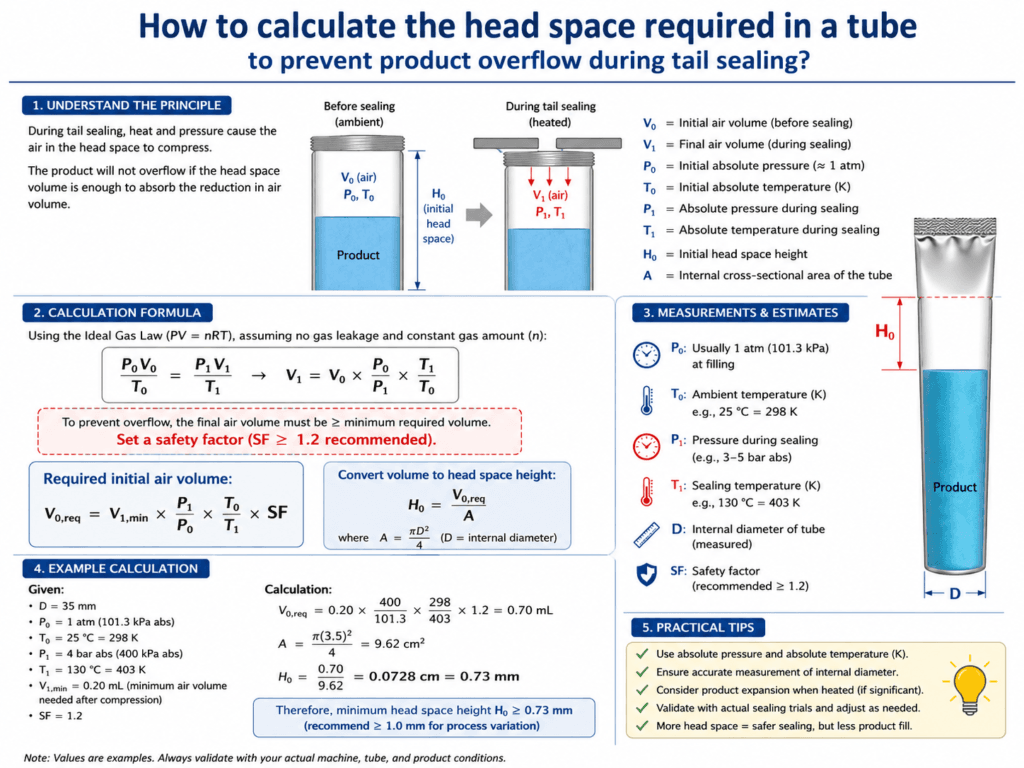
The simplest method is to compare the tube’s usable internal capacity with the actual filling volume. The remaining volume becomes the head space and sealing allowance.
Basic formula:
Head Space Volume = Usable Tube Capacity - Actual Fill Volume
Head Space Percentage:
Head Space % = Head Space Volume ÷ Usable Tube Capacity × 100%
For example, if a tube has a usable internal capacity of 110ml and the product fill volume is 100ml, the head space is 10ml. The head space percentage is about 9.1%, which may be suitable for many standard cream or lotion products after testing.
Example Calculation
| Item | Example Value | Explanation |
|---|---|---|
| Usable tube capacity | 110ml | Actual internal capacity before tail sealing allowance |
| Target fill volume | 100ml | Product volume required by the brand |
| Head space volume | 10ml | 110ml – 100ml |
| Head space percentage | About 9.1% | 10ml ÷ 110ml × 100% |
| Result | Usually reasonable starting point | Final value still needs filled sealing test |
Important: The tube must not be filled to its full theoretical capacity. The filling volume should leave enough space for tail sealing, product movement, formula expansion, and filling tolerance.
How to Convert Head Space Volume into Tube Length
Factories often need to convert the required empty volume into a practical empty height near the tail. For round tubes, a wider tube needs less vertical head space for the same empty volume, while a narrow tube needs more vertical space.
Practical direction:
Required Empty Height = Required Head Space Volume ÷ Internal Cross-Section Area
For round tubes, the internal cross-section area is based on the tube’s inner diameter.
This is why two tubes with the same fill volume may need different body lengths. A 35mm tube and a 40mm tube can both hold 100ml, but the head space height near the tail will not be the same.
Typical Head Space Considerations by Tube Diameter
| Tube Diameter | Head Space Behavior | Design Consideration |
|---|---|---|
| 19mm – 25mm | Small cross-section, so the same head space volume needs more height | Useful for samples, but filling accuracy is more sensitive |
| 30mm – 35mm | Balanced head space and tube length | Common for hand cream, sunscreen, and skincare tubes |
| 40mm | More internal area, shorter head space height for same volume | Good for 100ml–150ml lotion, cleanser, and sunscreen |
| 50mm+ | Large internal area, but higher filled weight and pressure | Need to check overflow, tail seal strength, and carton compression |
Factors That Increase Required Head Space
| Factor | Why It Requires More Head Space | Risk If Ignored |
|---|---|---|
| High filling temperature | Hot formula may expand and later shrink during cooling | Overflow, paneling, tail-seal stress |
| High filling speed | Product may splash or create air pockets | Seal contamination and weak sealing |
| Low viscosity formula | Product flows easily toward the tail during movement | Overflow during sealing |
| High viscosity formula | More pressure may be required during filling and sealing | Product forced into sealing zone |
| Air bubbles | Entrapped air may expand or move during sealing | Leaking, seal voids, product spitting |
| Filling tolerance | Actual fill volume may vary slightly between tubes | Some tubes may be overfilled even if average fill is correct |
Why Head Space Is Critical for Tail Sealing
During tail sealing, heat and pressure are applied to close the open end of the tube. If product reaches the sealing area, the tube cannot seal cleanly. Even a small amount of cream, oil, lotion, or gel in the sealing zone can reduce seal strength and create leakage risk.
- Clean sealing zone: The tail area must stay free from product contamination.
- Stable heat seal: Product residue can block proper PE-to-PE bonding.
- Reduced overflow: Enough head space prevents product from being squeezed out during crimping.
- Better appearance: Clean tail sealing improves retail presentation.
- Lower leakage risk: Correct head space supports stronger seal integrity.
Recommended Filled-Tube Testing
| Test | Purpose | What to Check |
|---|---|---|
| Trial filling test | Confirms whether the target fill volume leaves enough space | Product level, air bubbles, splash, overflow risk |
| Tail sealing test | Checks sealing performance under real conditions | Seal contamination, leakage, weak bonding, tail appearance |
| Weight variation test | Checks filling machine accuracy | Overfill risk and actual net content control |
| Hot-fill cooling test | Checks expansion and shrinkage behavior | Paneling, collapse, seal stress, overflow |
| Drop and compression test | Checks transport durability after sealing | Tail leakage, seal cracking, product movement |
How to Prevent Product Overflow During Tail Sealing
- Do not fill to full capacity: Always reserve enough head space and sealing allowance.
- Confirm the real usable capacity: Theoretical tube volume is not the same as safe filling volume.
- Control filling accuracy: Reduce overfilling by calibrating the filling machine.
- Remove or reduce air bubbles: Vacuum mixing or controlled filling can improve stability.
- Adjust filling speed: Slower filling may reduce splash for low-viscosity formulas.
- Control formula temperature: Avoid sealing while the product is too hot or unstable.
- Keep the sealing zone clean: Product contamination directly weakens tail sealing.
Common Mistakes to Avoid
| Mistake | Problem | Better Approach |
|---|---|---|
| Using theoretical tube capacity as fill volume | No space remains for sealing and product movement | Use safe fill capacity after head space allowance |
| Ignoring filling tolerance | Some tubes may be overfilled even if average weight is correct | Set target fill volume with safety margin |
| Testing with water only | Water does not behave like cream, gel, lotion, or paste | Test with real formula or closest production simulation |
| Not checking air bubbles | Air expansion can push product into the tail area | Control mixing, filling, and deaeration |
| Sealing immediately after hot filling | Thermal expansion may increase overflow and deformation risk | Control filling temperature and cooling process |
Best Practical Recommendation
Start by calculating the difference between usable tube capacity and target fill volume. For most cosmetic tubes, reserve around 5% to 10% head space as a practical starting point. For hot-filled, foaming, low-viscosity, high-viscosity, or high-speed filling projects, increase the safety margin and validate the result with real filled and sealed samples.
The final head space should be confirmed by checking the actual product level before tail sealing, seal cleanliness, leakage resistance, filled weight variation, cooling behavior, and transport durability.
Summary
Head space prevents product overflow during tail sealing by keeping the formula below the sealing zone and allowing room for product movement, air bubbles, filling tolerance, thermal expansion, and crimping pressure. The basic calculation is: usable tube capacity minus actual fill volume.
As a practical guideline, reserve about 5% to 10% head space for many cosmetic tubes, then adjust based on formula viscosity, filling temperature, tube diameter, filling speed, air bubbles, and tail-sealing process. The safest standard is always confirmed through real filling and sealing tests before mass production.
Learn more: Tube Capacity, Diameter, Length & Thickness, Match Cosmetic Tube Diameter and Fill Volume, 50g Sunscreen Tube Diameter and Length, Maximum Filling Temperature for PE Tubes, Quality Assurance, Sample Development.
Need Help Calculating Safe Tube Head Space?
Xinfly Packaging helps brands calculate tube capacity, fill volume, head space, tail-seal allowance, filling tolerance, and sealing safety margin to prevent overflow, leakage, and weak tail sealing during production.