Published: . Updated: .
An empty toothpaste tube can meet its drawing and still need work on the filling line. Paste may trail into the open tail, the tube may sit differently in the holder, or the finished trim may crowd the batch code. Approving only the empty component leaves these questions until the line is booked and everyone is waiting.
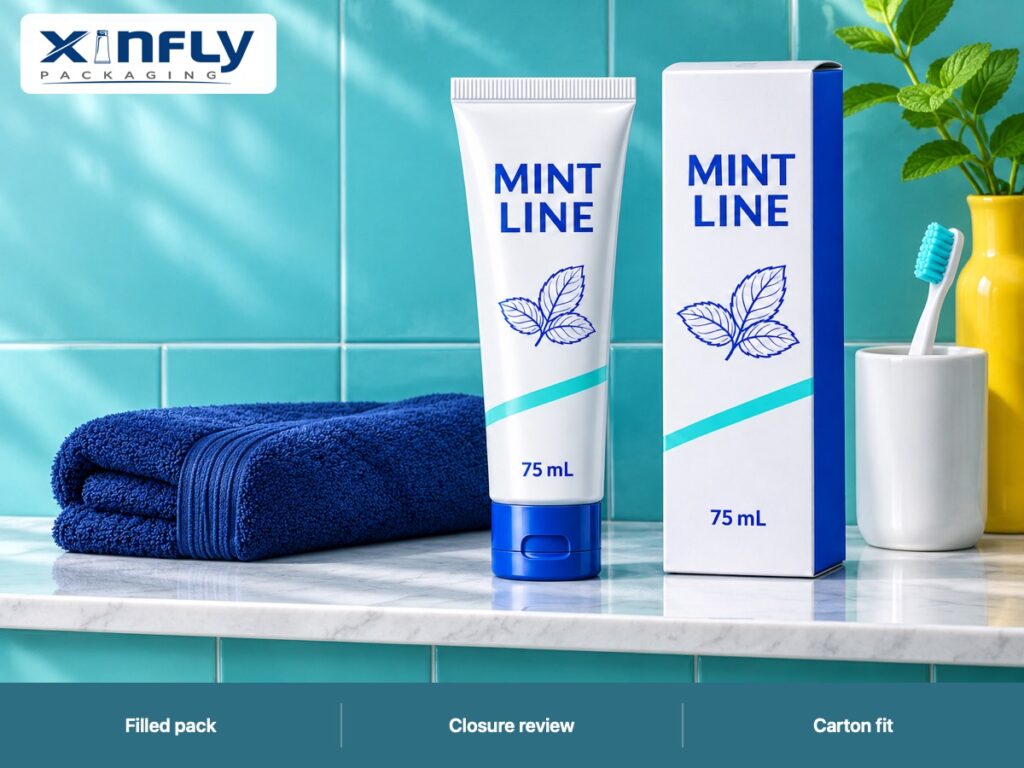
An ABL toothpaste tube filling trial should connect the tube supplier's drawing with the contract filler's actual equipment and paste. This guide uses an illustrated 75 mL MINT LINE pack: a white aluminum-barrier laminate body, molded shoulder, cobalt flip-top cap, straight sealed tail and cobalt-and-aqua offset artwork. Its printed carton follows the same design. The pack is a planning illustration, not a production SKU or evidence of a successful line trial. Begin with the toothpaste tube packaging specification and plan the trial before the bulk order.
Establish the Trial Configuration
Identify the Laminate Structure
ABL describes an aluminum-barrier laminate construction; it does not specify every layer, gauge or sealing requirement. Ask the supplier to identify the proposed web, inner sealing layer, body dimensions, shoulder and cap. Give that information to the filler. A photograph showing a white tube cannot establish that two constructions are interchangeable on the same machine.
For ABL tubes for toothpaste, request the drawing and material specification relevant to the quoted assembly. Confirm whether the trial tubes have the same construction as production. If a temporary web or shoulder is used, list the difference and decide which results can reasonably inform the production decision. Do not turn a feasibility sample into blanket approval for an untested structure.
Use the Intended Paste and Fill Conditions
Tell the filler which formula batch, nominal fill and operating conditions the trial should represent. A substitute cream can help an early machine setup, but it does not reproduce the behavior of the intended toothpaste. Record the paste condition at filling and whether any conditioning step was used. If more than one formula is planned, ask which differences require separate trials.
The illustrated 75 mL designation is a design reference. The actual fill specification must be set by the brand and filler using the intended product and market requirements. Do not substitute a volume-to-mass conversion based on an assumption about density. Put the agreed fill basis in the trial sheet.
Name the Supplier and Filler Responsibilities
The tube supplier should identify the supplied component and relevant processing guidance. The filler should identify the equipment, setup and operating observations. The brand should define the finished-pack acceptance decision with quality. Agree who records each item and who can approve changes. A supplier can advise on a tube without knowing every detail of a third-party line.
| Item | Tube supplier provides | Filler confirms |
|---|---|---|
| Tube assembly | Body, shoulder, cap and material revision | Holder fit and handling compatibility |
| Open-tail geometry | Drawing and usable filling opening | Nozzle access and fill positioning |
| Sealing interface | Relevant material guidance | Proposed sealing method and setup |
| Artwork and orientation | Print revision and reference mark location | Detection and finished-pack orientation |
| Finished pack | Proposed trim and pack dimensions | Actual sealed length and coding access |
Check Handling Before Introducing Product
Observe Loading and Tube Support
Run an appropriate dry setup with the filler before adding paste. Check how the tube enters the holder, where it is supported and whether the cap creates an unstable contact. Note any visible scuffing, ovalization or unwanted rotation. A tube that can be placed by hand is not necessarily ready for the intended feed and transfer sequence.
Ask the operator to identify adjustments made during the setup. If a holder or guide is changed, record its setting or part reference. This makes the later production transfer easier to repeat. Without that record, a successful trial can become a one-off achievement that depends on the original operator remembering the setup.
Confirm Orientation With the Printed Tube
Use the final artwork or a clearly identified representative print when orientation matters. Check the relationship among the front panel, cap opening, side seam, reference mark and tail. Do not assume the printed front is aligned simply because the cap faces forward in a static photograph. Observe the pack after the full handling and sealing sequence.
If the filler asks for a reference-mark adjustment, send the request to the tube printer with the affected dimensions marked. Confirm the tube printing and decoration process before changing the artwork. The revised print file and line setup should refer to the same drawing version.
Keep Paste Away From the Sealing Interface
Watch the End of the Fill Motion
Observe nozzle withdrawal and any paste stringing or smear near the open tail. Photograph the location before wiping it. Product on the intended sealing interface can complicate a seal review, but do not diagnose every weak result as contamination without evidence. Record what was actually seen and connect it with the identified sample.
Ask the filler to review nozzle geometry, fill motion and the available space above the product. Xinfly's guide to tube headspace before tail sealing can support that discussion. The specific clearance still belongs to the actual formula, fill quantity, tube geometry and machine setup. Avoid adopting a generic percentage as the release criterion.
Separate Setup Adjustments From Material Changes
If the tail area becomes contaminated, first document the baseline and the proposed adjustment. Changing fill quantity, nozzle motion and tube length at once makes the result difficult to interpret. Where practical, compare one controlled adjustment at a time and retain the affected samples. If more than one factor must change together, describe it as a new setup rather than attributing the result to one isolated cause.
A longer tube may offer more working space, but it also changes the finished pack and carton fit. Ask the brand to approve that trade-off before the supplier manufactures a revised body. A filling problem should not silently become an artwork and secondary-pack change.

Let the Filler Establish the Seal Setup
Ask the filler to select and document a suitable method for the proposed laminate and equipment, with the tube supplier's guidance. Record the settings used, the line speed or cycle condition, and any relevant observations. Do not publish or purchase against a universal temperature or dwell setting for all ABL tubes. The seal depends on the actual assembly and process.
Assess the Finished Seal Independently
Inspect the tail's appearance and dimensions, then use the agreed integrity checks on identified filled samples. A straight crimp is an appearance observation, not proof of strength or leak resistance. If a result is outside the project requirement, keep the sample and record where it failed. Ask whether the likely cause involves material, contamination, process or handling before choosing the next action.
Protect Coding and Final Trim Space
Reserve the Variable-Code Area
The filler needs a defined location for batch or date information if those fields are part of the project. Agree the data format, application stage and marking method with the brand. Put the reserved area on the controlled artwork and check it on the sealed tube. The LOT AREA rectangle in the illustration shows a layout discussion only; it is not a working production code.
Confirm whether trimming, embossing, sealing jaws or a later label can interfere with the marking. A neat code on an unsealed tube may disappear or become difficult to read after the remaining operations. Retain a finished sample with the actual agreed marking from the trial rather than approving the code station in isolation.
Measure the Final Pack for the Carton
Record the sealed and trimmed length after the process is settled. Put that tube into the proposed folded carton and check insertion, removal and contact with the flaps. If the tube supplier and carton supplier work from different revisions, the box can become the last surprise in an otherwise successful trial. Send the confirmed finished dimensions to both.
For empty toothpaste tubes wholesale orders, this information is commercially useful. A supplier quoting only nominal fill and body artwork may be missing the finished-length constraint that determines packout. Include the carton scope and actual filler requirements in the RFQ so the quote represents the assembly you intend to release.
| Observation | Evidence to keep | Next question |
|---|---|---|
| Tube rotates or sits poorly | Holder setup and orientation photos | Does support or feed geometry need adjustment? |
| Paste reaches open tail | Fill sequence and unwiped sample | Which motion or clearance should be reviewed? |
| Seal looks irregular | Material ID, settings and retained pack | Is the issue repeatable under the same setup? |
| Code is crowded or distorted | Final sealed and marked sample | Which operation affects the reserved area? |
| Carton fit changes | Finished tube dimensions and folded carton | Are all suppliers using the same revision? |
Review the Filled Package Beyond the Line
Set Storage and Handling Checks With Quality
A line trial establishes processing observations under recorded conditions. It does not by itself establish shelf life, formula compatibility or transport performance. Agree the additional filled-pack program with the brand's quality and formula teams. State the sample count, storage orientations, conditions, duration and acceptance basis before results are evaluated.
For laminated toothpaste tube packaging, inspect the cap and shoulder separately from the tail. Record product location if residue or leakage is suspected. This helps the team avoid blaming the sealing station for a closure issue, or changing a cap when the evidence points to the tail. Keep the investigation tied to the actual observed interface.
Retain a Representative Setup and Release Pack
Keep signed drawings, material references, artwork files, machine setup records and identified finished samples. Record which checks were performed and which remain outstanding. A repeat order should refer to this package of evidence, not simply to a previous invoice. If the laminate, shoulder, cap or formula changes, review which parts of the trial need repeating.
Write a Comparison-Ready RFQ
Price the Same Trial and Production Scope
Ask each toothpaste tube supplier to quote the same body construction, dimensions, cap, printing, carton and quantity. Identify the required trial samples and any special preparation. Request separate line items for tooling, setup, sampling and shipping where applicable. A low tube price is difficult to assess if the sample program or proposed laminate differs between bidders.
Clarify the milestones for drawing approval, sample delivery, filler trial, corrective action and production release. Ask which milestone starts the quoted production lead time. Do not assume a general website timeline applies to a new laminate and an unconfirmed filler setup.
Send Xinfly Packaging the Filler's Brief
Share the formula type, intended fill basis, machine information the filler can provide, target dimensions, cap preference, artwork, code location and carton scope. Ask Xinfly Packaging to identify the proposed structure and trial-sample revision through its sample development process. Send the packaging team your toothpaste project details and keep the filler in the approval loop. That gives the supplier a concrete processing question to solve.
Frequently Asked Questions
Does ABL identify one standard sealing setup?
No. Confirm the actual laminate and inner sealing layer, then have the filler document an appropriate method and settings for its equipment and the supplied assembly.
Can I trial the line with a substitute paste?
It can support an early setup if clearly labeled. Use the intended formula for the relevant filling and finished-pack decisions, and keep the two results separate.
Is a straight tail seal proof that the tube passed?
It is an appearance observation. Use the agreed integrity and handling checks on identified filled packs before deciding whether the seal meets project requirements.
Should the carton be approved before the line trial?
Develop it alongside the tube, then confirm fit against the actual sealed and trimmed length. A process adjustment can change the finished dimensions used for the box.
What should trigger another trial on a repeat order?
Review changes to laminate, shoulder, cap, body dimensions, formula and machine setup. Repeat the checks affected by the change rather than assuming the earlier approval covers every revision.
Conclusion
An effective ABL toothpaste tube filling trial turns an empty component into a documented finished-pack decision. Align the structure and drawing with the filler, observe handling and clean-tail conditions, review the seal and code after the complete process, and confirm carton fit. Xinfly Packaging can help define the proposed tube and sample route when the RFQ includes the actual formula, filler and release requirements.