Published: .
An aluminum cosmetic tube sample arrives with excellent external printing. Your team likes the cap and the metallic finish. Then someone asks which internal coating the proposed tube uses. The sample label says only “coated,” and the attached document does not identify the same tube reference. The appearance review has moved ahead of the material discussion.
An aluminum cosmetic tube inner coating sample brief connects the proposed contact surface, documents and sample states before approval. Begin with Xinfly Packaging’s aluminum cosmetic tubes, then ask which construction is proposed for your formula. This guide provides a supplier request sheet and an evidence-scope table. It does not identify a universally suitable coating or establish compatibility for a particular product.
Separate the Three Surfaces in the Conversation
Identify the Body, Interior and External Decoration
The aluminum body, any proposed interior coating and the external decoration need their own descriptions. A copper-colored exterior does not identify the interior contact surface. Keep those references separate in the inquiry so the supplier can explain the complete proposal instead of answering a material question with a photograph of the outside.
Use a marked drawing or component description where needed. Ask which areas the proposed interior treatment covers and whether any other relevant contact surfaces need identification. The responsible packaging and formula owners should decide what information is required for their assessment. Avoid assuming that the phrase “lined tube” describes every surface of the finished assembly.
Ask for the Proposed Coating Reference
Request an identifiable reference, revision or specification that the supplier can connect to the offered tube. Clarify what information is available and whether any details need an agreed confidential review route. If the supplier uses a general coating description at the quotation stage, record what still needs confirmation before a more specific approval is possible.
Do not infer that two proposals use the same coating because their colors or generic material names sound similar. Ask what identifies the actual proposed contact-surface construction. Purchasing can keep the question visible while the relevant technical teams assess the available information, rather than declaring equivalence from an incomplete commercial description.
Build a Formula-Specific Request
Provide Information the Responsible Teams Need
Identify the formula revision and intended product category. Ask the supplier and the team responsible for the formula which additional information is relevant to selecting and assessing the proposed construction. Share it through the project’s agreed information-handling process. A product name such as cream, balm or serum is useful context but does not define the entire formula.
Keep any early assumptions explicit. If the formula is still changing, state its development status and ask which later changes would reopen the assessment. A sample request based on one revision should not silently become a compatibility approval for a different formula that reaches production months later.
Include Filling and Final Closing Responsibilities
Tell the supplier how the proposed tube will be filled and finally closed, or identify the filling partner who will confirm those requirements. Ask which sample state the filler needs and which operations sit with each party. An attractive finished display sample may not show the open delivery state or the actual preparation needed for your qualification work.
Keep Nominal Fill Separate from the Contact-Surface Specification
The intended fill volume helps organize the inquiry, but it does not identify the inner coating, tube geometry or the full assembly. For aluminum tubes for cosmetics, request the drawing, closure and proposed interior reference together. A nominal 30 mL description should not become the only link between a document, a sample and a production order.
| Request field | Information to identify | Decision it supports |
|---|---|---|
| Tube construction | Body specification, drawing and revision | Defines the offered packaging assembly |
| Interior reference | Proposed coating or contact-surface specification | Makes the material proposal traceable |
| Coverage scope | Relevant surfaces included in the proposal | Clarifies what the description actually covers |
| Formula | Revision and information required by responsible reviewers | Connects selection to the intended product |
| Preparation route | Filling, closing and relevant sample responsibilities | Defines the state needed for review |
| Documents | Available records and the references they cover | Identifies evidence and information gaps |
| Sample purpose | Appearance, construction or formula-related review | Prevents one sample from receiving an undefined approval |
Match Each Document to the Question It Can Answer
Read Scope and Sample Identity Before the Conclusion
Ask which material, component or prepared sample a document concerns. Check the reference, date and scope against the actual proposal. A document for a coating material may support a different question from a report on a finished tube. Keep that distinction visible instead of collecting attachments as if their number establishes qualification.
If the document does not identify the offered construction clearly, request clarification. Record the missing link and the effect it has on the pending decision. Avoid treating a statement such as “document received” as the same status as “proposed assembly reviewed and accepted.” The release record should describe what the responsible reviewer actually concluded.
Keep Material Information Separate from Performance Evidence
A material description or safety data sheet is not automatically a formula-compatibility result for your filled pack. Likewise, evidence for one identified test does not establish every market, contact or performance claim someone may wish to make. Ask which evidence is relevant to the actual product, use conditions and intended market.
Do not shorten a limited document conclusion into a broad public claim. Where market review is required, give the responsible reviewer the complete proposal and applicable records. Record actual participation and decisions. If that review has not happened, leave its status pending rather than adding an assumed certification or approval to the sample description.
Choose Sample States That Resolve Different Questions
Identify What an Empty Tube Can Represent
An identified empty sample can help the team examine the component and the features it meaningfully presents. Ask the supplier to state how it relates to the proposed construction and whether relevant preparation differs from the intended production route. Keep appearance, dimensions and contact-surface questions distinct in its review record.
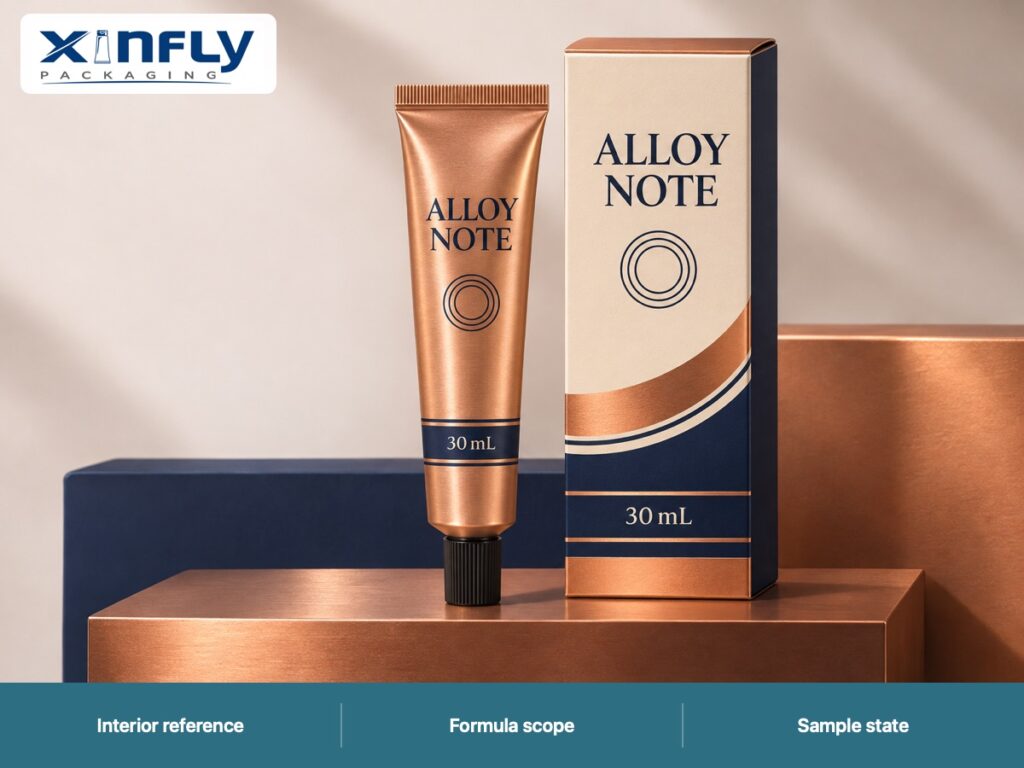
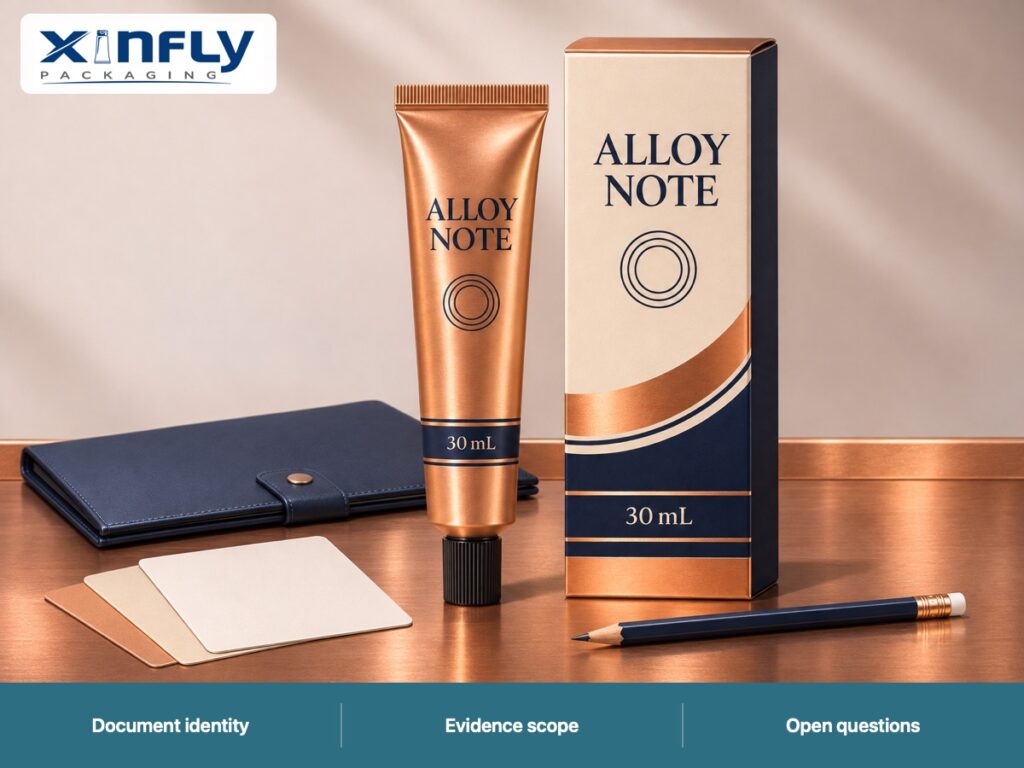
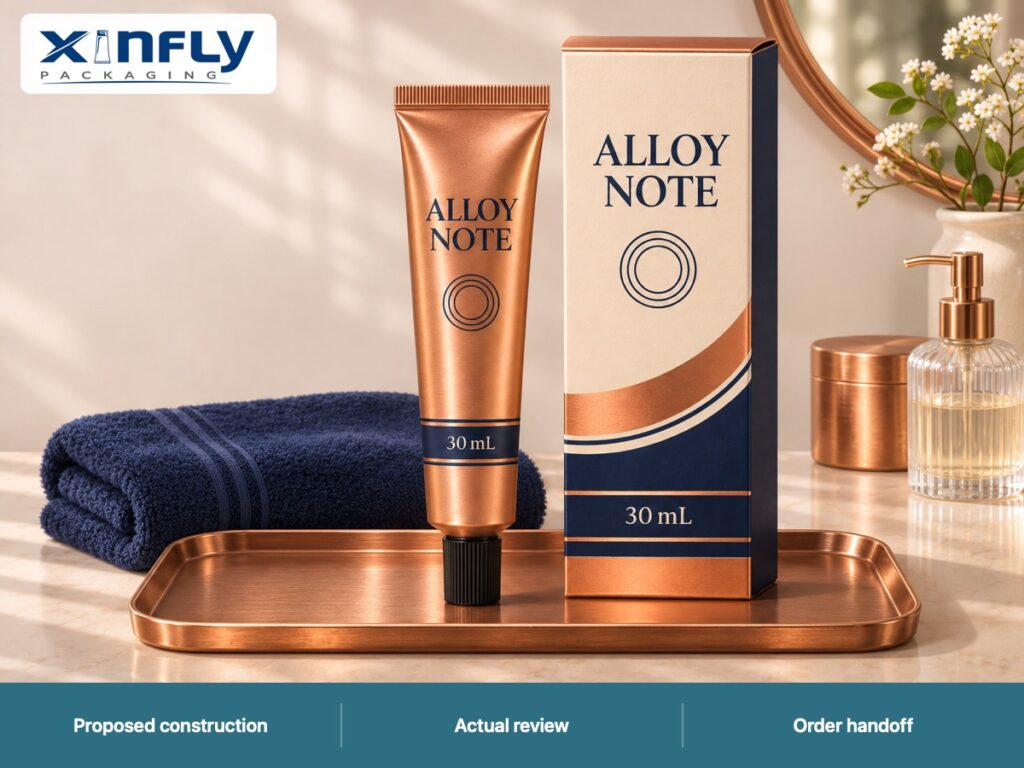
A photograph of the outside cannot establish internal coverage or compatibility. The ALLOY NOTE illustrations show a nominal 30 mL copper-colored aluminum body, a sloped shoulder, black ribbed screw cap and straight flattened closed display tail. Navy and cream offset-style artwork coordinates with the printed carton. No inner layer is depicted, and the pictures do not represent a coated SKU or a physical test.
Plan Actual-Formula Samples with the Review Owner
When the assessment requires filled samples, agree the formula revision, preparation, relevant conditions, observations and acceptance plan with the responsible teams. Identify who fills, closes, stores and reviews the samples. Do not borrow a universal duration or temperature from an unrelated product and present it as sufficient qualification for the proposed tube.
If another kind of specimen is offered, ask what it can represent and what it cannot. A material coupon or another development sample may be useful for a defined purpose. It should not silently replace an identified finished-pack review when the decision concerns the actual assembly and preparation route.
Keep Observations Separate from Diagnoses
Describe the Finding and Sample History
Record the location, appearance, sample identity and conditions relevant to an observation. If a team notices a change in the product or package, preserve the evidence and ask the responsible owner to investigate. A visual observation alone does not identify the chemical cause, establish safety or tell purchasing which component should be changed.
Keep comparison samples and controls identified according to the agreed plan. If a source value or condition is unknown, note the gap. A clear record makes it easier for the supplier and formula team to decide what additional information or samples would address the actual uncertainty.
| Evidence or sample | Useful question to discuss | Scope that still needs separate review |
|---|---|---|
| Material identification record | Which proposed interior reference is described? | Applicability to the complete offered assembly |
| Identified empty tube | Which component features does the sample represent? | Actual-formula behavior and intended preparation |
| Development specimen | Which limited material or construction question does it address? | Whether the finished-pack decision needs another sample state |
| Prepared actual-formula pack | What was observed under the agreed conditions? | Any requirements outside that plan’s documented scope |
| Specific report | Which identified sample and test does the conclusion concern? | Uncovered markets, constructions or claims |
| Final release record | Which proposal and use have actually been accepted? | Any changes or unresolved work excluded from the release |
Control Changes After the Initial Review
Identify Which Proposal the Approval Belongs To
Connect the accepted tube, interior reference, formula and relevant preparation route to the release. If the supplier proposes a changed coating reference or another relevant construction detail, compare it with that baseline before supply. Ask the responsible owners which evidence remains applicable and which checks need to be reopened.
Do not transfer approval solely because the external color, printed name or nominal capacity remains the same. The change record should identify the first affected order or lot and any conditions on the decision. A buyer placing a repeat order should be able to locate the correct references without reconstructing the project from old sample photographs.
Ask Xinfly Packaging for a Complete Sample Proposal
State the Unresolved Question in the Inquiry
For aluminum tube cosmetic packaging, send the intended product, nominal fill, proposed drawing or reference, closure, artwork, quantity and market. Identify whether you need construction information, material records or samples for a defined assessment. Xinfly Packaging’s sample development process is a starting point for agreeing what can be prepared and what each sample represents.
Ask the quotation to make sample preparation and document scope visible. Confirm availability, costs, quantities, timing and responsibility for any filling or review work on the actual proposal. A tube-only quotation should not be assumed to include every activity required for the product’s qualification.
Retain the Review and Purchasing Handoff Together
Keep the supplier response, identified documents, sample plan, findings and actual release decisions connected to the order. Use quality assurance information to discuss the project’s required inspection records, and OEM and ODM services for the broader development handoff. Those discussions should refer to the specific proposed construction rather than a generic material category.
When requesting help, send Xinfly Packaging your inner-coating sample brief with the question that remains unresolved. That gives the team a concrete basis for identifying missing information and the next useful sample stage. It also makes competing proposals easier to compare on the work and evidence actually included.
Frequently Asked Questions
Does an aluminum-colored exterior identify the inner coating?
No. Keep the body, external finish and proposed interior contact surface separately identified. Ask for the interior reference and its connection to the offered tube. An exterior photograph cannot supply that information.
Can a safety data sheet approve compatibility with my formula?
Treat each document according to its actual scope. Material information does not automatically establish compatibility of the proposed filled pack. Ask the responsible teams which records and samples are needed for that specific decision.
Should every formula use the same internal coating?
This guide does not prescribe a universal choice. Identify the actual product, proposed construction and intended conditions, then have the responsible teams assess the relevant information and samples. Keep unknown or provisional details visible.
Is an empty tube enough to approve the whole project?
An empty sample can support the features it represents. Formula-related behavior and other finished-pack requirements may need separately prepared samples and evidence. State the approval scope instead of using “sample accepted” as a blanket release.
What should reopen the coating review on a repeat order?
Ask the responsible owners to assess relevant changes to the interior reference, tube construction, formula or preparation route. Keep the affected order and revision traceable. Do not assume that unchanged external artwork preserves every earlier approval.
Conclusion
A useful inner-coating brief connects an identified construction, applicable documents and the right sample states. Keep exterior appearance separate from contact-surface evidence and preserve the actual review scope. That gives Xinfly Packaging and your buying team a clearer basis for deciding which aluminum cosmetic tube proposal can move toward release and which questions still need to be answered.