Published: .
To review EVOH tube barrier report specimen scope, begin with the object that the laboratory actually assessed. A material sheet, a piece cut from a tube wall and a complete packaging assembly answer different questions. A report can be relevant to the sourcing discussion while still leaving parts of the proposed pack outside its evidence. Buyers need that boundary before comparing results or requesting an approval.
This guide supplies a specimen-scope map and a report-completeness checklist. It does not present Xinfly test results, select a test method or assign a barrier threshold. The responsible laboratory and technical reviewer must establish the appropriate assessment for the actual material and assembly. Purchasing can help by keeping the report's specimen, units and conditions visible instead of reducing the evidence to one number.
Start with the proposed packaging reference
Identify the material and assembly being considered
For EVOH barrier tubes, request the actual proposed construction reference and relevant revision. Keep the body, shoulder and closure identifiers connected to the enquiry. A material-family name does not uniquely identify a supplied structure, and a tube photograph cannot establish the composition or thickness of its layers.
Ask the supplier which documentation connects the proposed item to the specimen in the report. If that relationship is not established, record the report as background material information pending an applicability review. Do not turn a familiar material name into an assumed SKU match. The reviewer should be able to trace the evidence to the item being considered.
State the purchasing question
Identify whether the request concerns a material comparison, a proposed tube construction or the performance of a complete packaging configuration. These questions may need different evidence. A useful brief tells the supplier what decision the buyer needs to make and asks the responsible technical team which assessment can support it.
Name the specimen before interpreting the result
Distinguish flat material from a packaging assembly
The public ASTM D3985-24 listing identifies an oxygen-transmission method for plastic film and sheeting. This is a limited reference to the public method title, not a review of the full procedure or a claim that a test has been performed. When a report references a method, ask the laboratory to identify the exact specimen and its preparation.
For purchasing purposes, a film result by itself does not document every component of a finished tube and closure. Keep the distinction explicit. The material evidence may remain useful within its stated scope, while the responsible reviewer decides what additional evidence is needed for the proposed assembly.
Record how a specimen was obtained
If a specimen was cut from a tube wall, ask where it came from and which material or production reference it represents. If the report concerns a prepared assembly, identify its included components and preparation. Do not infer those details from a broad report heading such as “cosmetic packaging.” Request the source information needed to interpret the actual result.
Map the specimen to the proposed pack
The following map is a coordination tool. It lists possible specimen descriptions a buyer may need to clarify, not a set of interchangeable test methods. The laboratory should define the appropriate specimen and method for the assessment question. Retain its actual description rather than rewriting it into a broader packaging claim.
| Reported specimen description | Scope to establish | Question before applying it to the proposed pack |
|---|---|---|
| Flat film or sheet | Identified material and preparation | Which proposed material reference does it represent? |
| Piece from a tube wall | Source tube, location and specimen preparation | What part of the supplied body is represented? |
| Prepared component assembly | Included components and preparation | Which interfaces or parts are inside the assessment scope? |
| Complete packaging configuration | Exact assembly and defined assessment conditions | Does it match the proposed tube, shoulder and closure? |
| Filled packaging specimen | Formula, assembly and preparation history | Which packaging or product question was actually assessed? |
| Unclear specimen description | Insufficient identification | What clarification is required before interpretation? |
Identify included and unrepresented parts
List the components represented by the evidence and those that still need an applicability decision. A report on material from the body should not be described as a separate assessment of the cap unless the actual record supports that statement. Likewise, a prepared assembly needs its own component list rather than an assumption that every proposed accessory was included.
Use this map to formulate a specific follow-up question: “Does this report represent the proposed body material only, or the identified complete assembly?” Keep the laboratory's or supplier's answer beside the report. That answer should clarify evidence scope without silently changing the original document.
Preserve the complete reported unit
Keep area and container bases distinct
Record the entire unit string from the report, including its quantity, time and any stated area or container basis. A value expressed on an area basis and one expressed per container should not be compared as though their numerical values had the same meaning. Ask the responsible reviewer whether a comparison or conversion is appropriate for the actual specimens and methods.
Do not invent a conversion using an estimated tube surface area. The reviewer needs to establish the assumptions and applicability of any calculation. A curved tube with an identified closure is not automatically represented by a guessed rectangle of material. Purchasing should preserve the reported unit and flag the missing basis instead of manufacturing a normalised result.
Keep the reported property correctly named
An oxygen-transmission record and a water-vapour-transmission record concern different reported properties. Preserve the property's name as well as its units. Do not use a result for one property as a substitute for evidence about another. If the sourcing brief needs several properties, identify each question and ask which evidence addresses it.
Retain the conditions that belong to the result
Ask the laboratory to identify the relevant temperature, humidity and other method conditions as actually reported. Keep the method designation and edition with those conditions. A result without enough context may still be a useful lead for clarification, but it should not be ranked against another offer as if the assessment basis were already established.
When comparing two reports, ask the technical reviewer which differences in specimen preparation, condition or method matter to the purchasing decision. Do not prescribe a universal test condition through a supplier questionnaire. The record should expose differences for review rather than hide them behind an apparently common material label.
Separate a method reference from an applicability decision
Two reports can cite the same method while representing different specimens or material references. The method name alone does not establish that they answer the same project question. Conversely, different report formats do not automatically make the evidence irrelevant. Ask the reviewer to assess the actual information and identify the remaining gap.
Build a reviewable report request
Use the second checklist to request missing fields without implying that the work has already been completed. Retain the original report and connect any clarification or revised issue to it. Do not replace a laboratory's result with a purchasing summary that omits the specimen boundary or conditions.
| Record field | Information to request | Review question |
|---|---|---|
| Report identity | Issuer, report identifier, issue date and revision | Which evidence is being discussed? |
| Proposed item connection | Supplier item and construction reference | Is the specimen-to-item relationship documented? |
| Specimen description | Material, component or assembly actually assessed | What object does the result represent? |
| Preparation and included parts | Actual preparation and component scope | Which parts remain outside the evidence? |
| Method reference | Designation, edition and relevant stated conditions | What assessment basis was used? |
| Property and units | Full reported property and unit string | Can the numerical meaning be understood? |
| Result and limitations | Actual observations, reported limitations and clarification | What does the source record support? |
| Applicability review | Responsible reviewer and project-specific disposition | What further information is needed before approval? |
Keep the application question separate from the material name
A request for barrier tubes for active skincare creams still needs the actual formula and packaging brief. Ask the responsible team which packaging and product assessments are required. A material report cannot by itself establish shelf life, ingredient stability or suitability for every formulation in an application category.
For an enquiry concerning EVOH barrier tubes for sunscreen, keep the packaging evidence separate from any SPF or formula claim. Identify the actual decision that the report is intended to support. Do not extend a transmission result into a sunscreen-performance statement that was not assessed by the cited record.
Compare alternatives through their actual evidence
If PE tube options or another construction are being considered, request evidence relevant to each proposed item rather than assigning a universal performance ranking from material names. Keep the same purchasing question visible across the comparison. Any conclusion should state the specimens and conditions to which it applies.
Request the next step as a defined activity
If the existing evidence does not answer the complete-assembly question, ask the responsible technical team to define the additional work or information needed. Do not label the current material report “failed” merely because it has a narrower purpose. Record the unresolved question and the person responsible for the next decision.
Through packaging sample development, identify the components and reference information needed for that discussion. Confirm which specimens can be supplied and what a proposed assessment would cover. Keep requested work distinct from completed trials and retain current commercial conditions for any separate activity.
Read the posters within their appearance scope
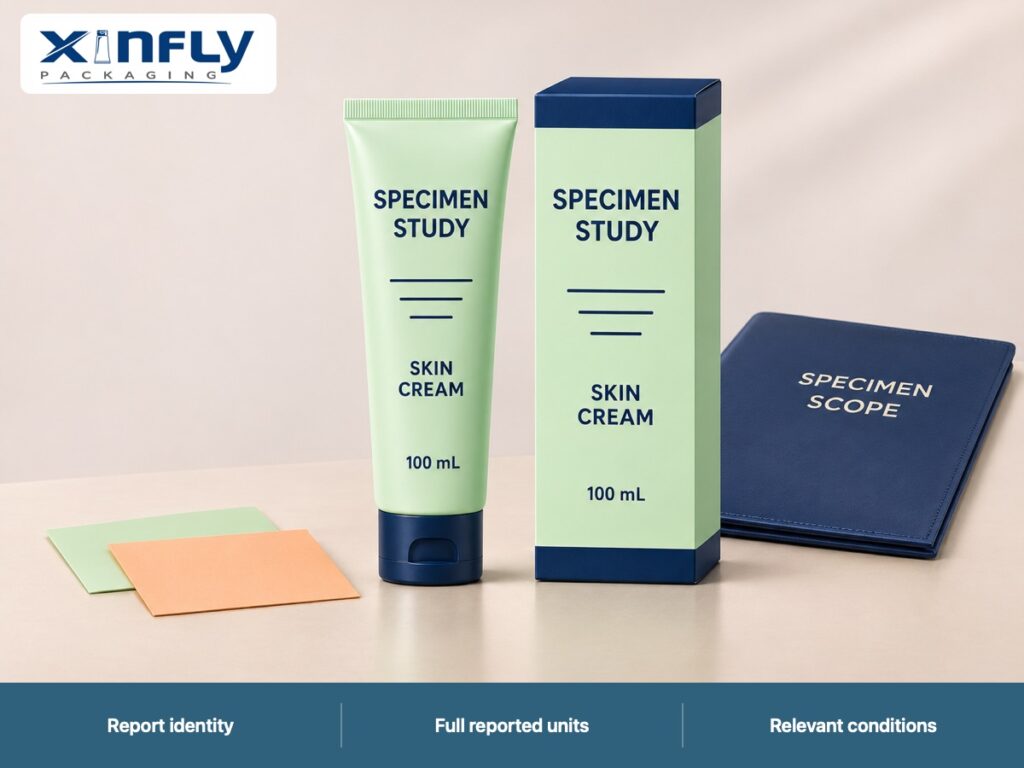
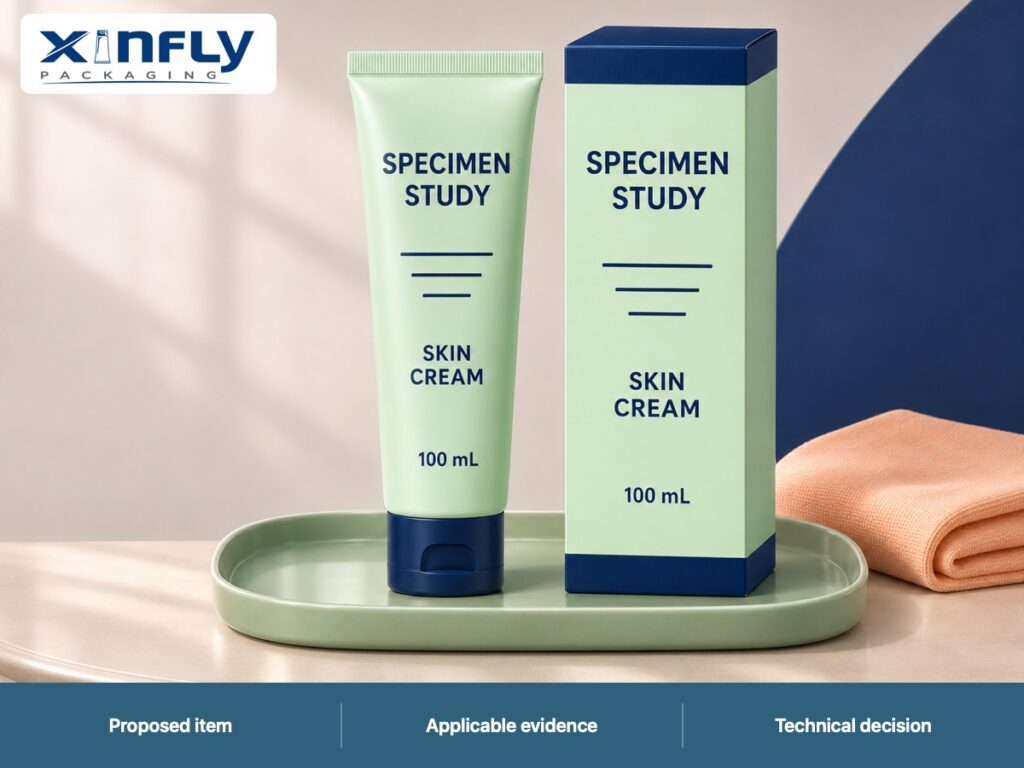
The SPECIMEN STUDY posters use a pale-jade PE-style tube, moulded shoulder, straight crimped tail, closed navy flip cap and navy single-colour screen-print-style text and lines. The printed carton repeats the same original design. The images show no verified EVOH layer structure, oxygen-transmission measurement or physical test specimen.
Use the quality assurance discussion to coordinate the actual report references and project questions with Xinfly Packaging. Send the proposed assembly identifier, the evidence you are reviewing and the specimen-scope gap that needs clarification. That request is more useful than asking for a broad barrier claim without identifying the packaging item.
Frequently Asked Questions
Does a film report certify a finished tube and closure?
Keep the report within its actual specimen and assessment scope. Ask which proposed material it represents and whether any complete-assembly evidence is available. A material result by itself does not document every component of a finished pack.
What if the report does not identify the specimen clearly?
Request clarification from the issuer or responsible supplier contact and retain it with the original. Keep applicability pending until the reviewer has the necessary information. Do not infer the specimen from the product photograph or material-family name.
Can area-based and per-container values be compared directly?
Preserve the full units and ask the technical reviewer to establish whether a comparison is appropriate. Do not normalise the values using a guessed tube area or assume that identical numbers represent equivalent assessments.
Does a lower oxygen-transmission figure prove longer shelf life?
Do not extend a packaging result into an unassessed product claim. Shelf life and formulation suitability require the relevant product and packaging evidence. Ask the responsible team to define the actual decision and the supporting assessment scope.
Which information should accompany an evidence enquiry?
Send the proposed material and assembly references, the original report, the intended application and specific unresolved questions. Identify the responsible technical reviewer and mark any additional work as requested rather than completed. Keep the evidence scope visible in the resulting decision record.
Conclusion
Identify the specimen before interpreting an EVOH tube barrier report. Connect it to the proposed item, preserve the property, units and conditions, and state which components the evidence represents. Share the scope map and completeness checklist with Xinfly Packaging to clarify the records needed for the next packaging selection or approval decision.