Published: .
A hotel amenity tube language version matrix connects each approved text block to a particular artwork file and order item. That connection matters when the same shampoo pack serves several properties or language groups. A visually similar carton can carry different wording, while two similar filenames can refer to different language combinations. Buyers need a record that identifies what was translated, who approved it and where it belongs before authorising print.
This guide provides a procurement worksheet for that decision. It does not supply translations or determine the labelling rules for a destination market. Your responsible product and labelling teams must establish those requirements. The objective is narrower: give the packaging supplier an unambiguous set of approved inputs, then check that the resulting tube and carton reproduce those inputs faithfully.
Start with the order item and its intended destination
For hotel shampoo tubes, create a separate matrix entry for every combination that needs different printed wording. Record the product identity, intended destination, hotel or programme identifier, language combination and component. A shampoo tube and its outer carton are separate components even when they share a design. Establish whether the carton is part of this order rather than assuming that a photograph defines the supply scope.
When reviewing hotel amenity tubes, describe the proposed format alongside this text scope. Tube capacity, cap choice and body dimensions help the artwork team identify the correct layout. They do not establish which languages or statements the market requires. Keep the packaging specification and the responsible team's labelling decision as linked records with different owners.
Give the source text a stable identity
Use text block IDs instead of page position alone
Assign an identifier to each source block, such as product name, description or use instructions where applicable. A position such as “the paragraph under the picture” becomes unreliable after a layout change. A block ID can remain stable while the approved wording and its revision change. Keep the complete source string in a controlled copy file, including punctuation and intentional line breaks if these carry meaning.
Include a source revision and approval reference. The packaging supplier should be able to distinguish final copy from a note suggesting possible wording. Avoid mixing editing comments into text that will be printed. A clear instruction is “use the approved string in block P02, revision C”; “please improve this wording” starts a separate copy decision that needs an owner.
Separate product identity from translated description
Hotel shampoo and conditioner tubes can share a graphic family while containing different product names and descriptions. Give each product its own row. Do not let a common background design turn one product's translation approval into approval for another. If a brand name remains unchanged while descriptive wording changes, record that instruction explicitly instead of expecting the designer to infer it.
Build the language version matrix before placing text
Use the following blank-field structure as a working tool. The block names are examples of how to organise information, not a list of legally required statements. Add or remove rows according to the requirements established by the responsible labelling team. Each entry should lead to a retrievable approved source rather than an informal conversation.
| Record field | Buyer entry | Evidence or owner to identify |
|---|---|---|
| Order item and component | Product code plus tube or carton | Current purchase specification |
| Source block ID | Product name or another controlled block | Complete approved source text and revision |
| Language and regional variant | Exact required version | Person responsible for the language decision |
| Approved target string | Full text, not an abbreviation | Actual translator or language reviewer approval |
| Placement reference | Artwork panel and block location | Current layout revision |
| Character or line instruction | Required characters and agreed treatment | Language reviewer and artwork owner |
| Print release reference | Final artwork identifier | Authorised release record |
Record language variants accurately
Use a description precise enough to distinguish the approved strings in your project. A language name alone may leave a regional wording question unresolved. Ask the responsible reviewer whether the supplied version is appropriate for the intended readers and destination. Do not choose a variant because it fits into the available space or because another hotel previously used it.
Keep the reviewer's actual name or accountable role and approval evidence in the project file. A blank approval field means the wording remains unresolved. Recording a role to be assigned is useful for planning, but it must not be presented as a completed review. The packaging supplier's successful placement of text does not replace linguistic approval.
Check the text after it enters the artwork
Review characters, punctuation and reading order
Compare the placed text with its approved source string. Check accented characters, punctuation, numerals and any direction or ordering requirements identified by the language reviewer. A font substitution may change a visible character even when the copy file was correct. Ask the reviewer to inspect the rendered artwork, not only the editable source text.
Do not approve wording from a tiny email thumbnail. Use the agreed proof format and a view that lets the reviewer inspect the relevant characters. If a reviewer cannot assess a script, assign that review to someone qualified to do it. An English packaging brief is useful for coordination but does not establish that every language version has been checked.
Resolve line wrapping without silently editing the copy
A narrow tube panel can force a different line break from the carton. Ask the artwork team to flag any proposed abbreviation, deletion or word change. The language reviewer should approve changes affecting the string or its interpretation. Keep a record of layout-only adjustments as well, so a later designer can understand which breaks were intentional.
The tube printing and design workflow provides a relevant starting point for discussing the actual decoration process and artwork preparation. Request a project-specific layout and proof requirement. Do not assume that a font size or a line spacing value suitable for one tube automatically applies to another capacity or print process.
Treat the tube and carton as a connected pair
Compare shared information across both components using the matrix. The approved product identity and language combination should map to the intended order item. Different panel sizes can justify different layouts; they do not justify accidental wording differences. Identify which blocks are shared and which are intentionally component-specific before checking the proofs.
For 30ml squeeze tubes for hotel amenities, buyers may consider a small pack where copy space is limited. Treat that phrase as an application brief, then confirm the actual capacity and usable artwork area with the supplier. Do not remove text to make a compact layout attractive before the responsible team has decided what the final pack must carry.
Use an exception field for intentional differences
If the carton has an additional block that is absent from the tube, record the reason and approval owner. An exception field prevents a reviewer from repeatedly treating an intentional difference as an error. It also exposes unapproved differences: if no authorised explanation exists, the discrepancy needs a decision before print release.
Review a proof as a text-and-layout record
Request the proof type appropriate to the question. A digital layout proof can show the placement and rendering of approved strings. A physical sample can help reviewers inspect how the chosen arrangement appears on a curved pack. Neither automatically demonstrates language accuracy, compliance or production performance. State the purpose of each proof in the request.
Through packaging sample development, ask what can be supplied for the particular design and what remains to be checked on later materials. Record the actual process, component and artwork revision represented by a sample. Keep a sample's limitations beside the approval rather than relying on a general “sample approved” message.
Use a release check that can stop an unresolved version
The second tool links each release question to a concrete record. Agree who can release the artwork and how unresolved fields are escalated. “Supplier to confirm” is a pending action, not a completed check. If a change arrives after release, identify the affected component and order item before discussing whether the existing release remains valid.
| Question | Compare these records | Disposition when unresolved |
|---|---|---|
| Is the correct language set present? | Order item, destination decision and matrix | Hold the affected version for an owner decision |
| Does each block use approved wording? | Rendered artwork against approved strings | Return the identified block for correction |
| Are characters and breaks acceptable? | Proof and actual language review | Obtain the missing review or amendment |
| Do tube and carton match the intended pair? | Both component revisions and exception log | Resolve the specific mismatch |
| Can the supplier identify the released files? | Release reference and file identifiers | Issue a clear component-level release |
| Did a later edit affect this version? | Change record and current approvals | Recheck the affected blocks before release |
Keep quantities connected to language versions
Once the versions are defined, map the requested quantities to their artwork identifiers. Keep the unit clear: tubes, cartons or complete sets as actually quoted. A total for a hotel programme does not tell the supplier how many pieces use each language design. Ask the supplier to quote any version-related setup or quantity conditions explicitly; do not infer them from a previous order.
When discussing an OEM or ODM packaging brief, attach the matrix with the component specifications. Request confirmation that the supplier has received the intended versions. Record any unresolved copy, proof or order-scope fields before agreeing the next step. This makes the quotation easier to compare without inventing a universal minimum order quantity or delivery promise.
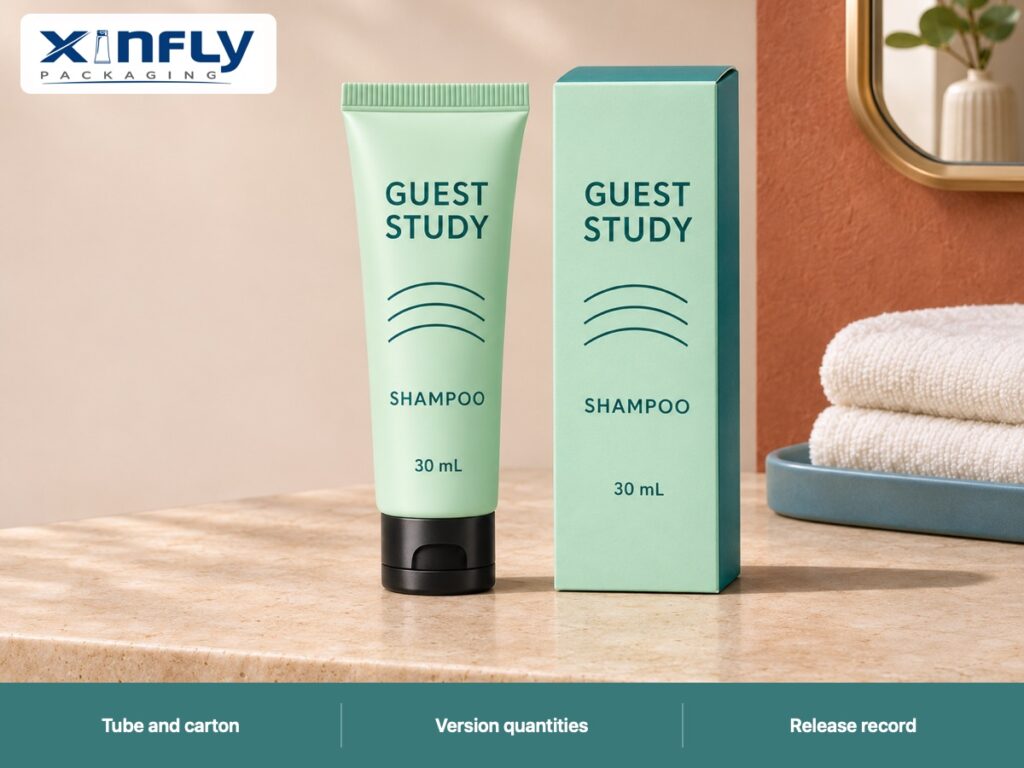
Keep the illustration separate from the released label
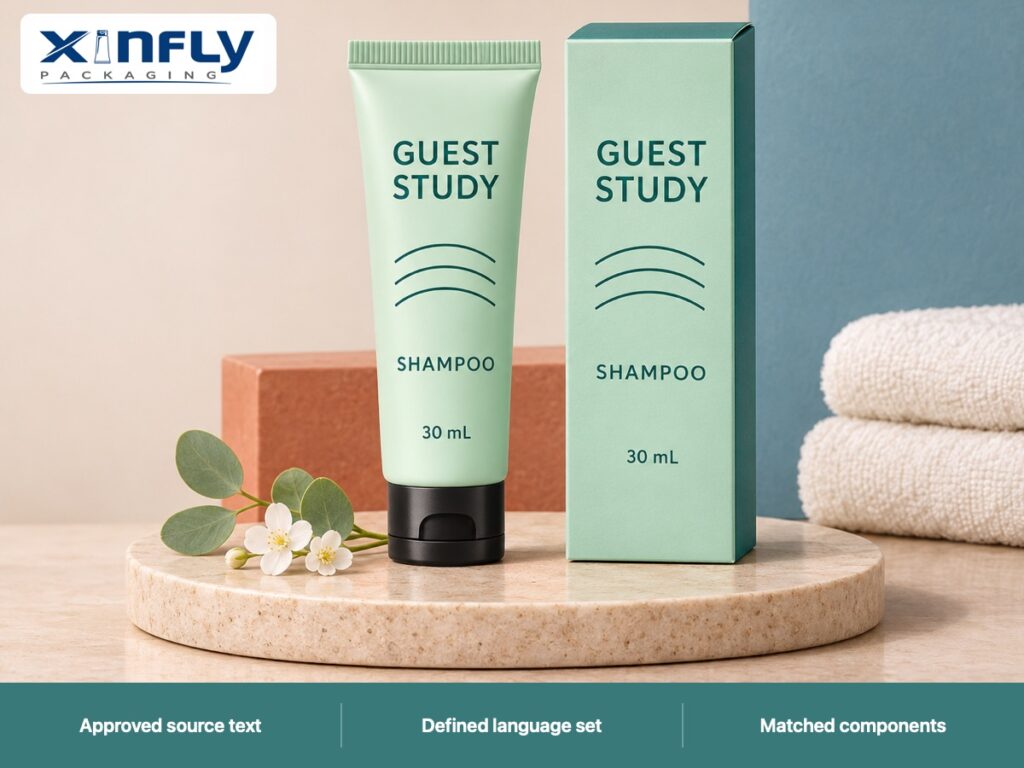
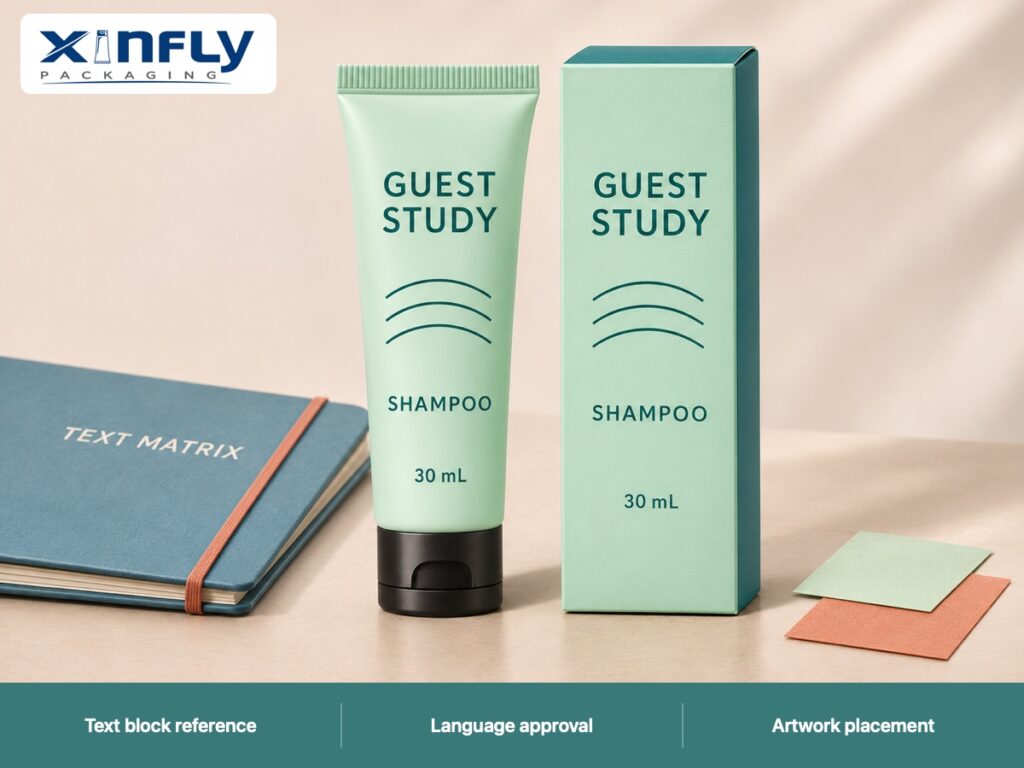
The GUEST STUDY posters show a mint PE-style tube, moulded shoulder, straight crimped tail, closed black flip cap and single-colour dark teal screen-print-style artwork. Its carton repeats the same original design. The English wording illustrates a coherent packaging concept; it is not a translated label, a customer project or an approved labelling file for any market.
The posters cannot establish that small text is readable on a production tube. Use the actual artwork area, agreed proof and responsible review for that decision. Their procurement purpose is to show why the tube and carton need a connected identity while the underlying text matrix controls the content supplied for each version.
Frequently Asked Questions
Can one translation approval cover every hotel product?
Only where the actual approved scope says so. Keep shampoo, conditioner and other product identities separately mapped. Shared wording can be referenced consistently, but a common graphic style does not prove that all product-specific strings have been reviewed.
Should the packaging supplier choose the required languages?
The buyer should identify the responsible product and labelling decision owner. Ask the supplier about layout constraints and production inputs. Record the owner's approved language requirements rather than treating available artwork space as the rule for selecting languages.
What happens when translated text is too long?
Flag the affected block and review the layout options. Any wording change or abbreviation needs the responsible language approval. Keep the resulting string and artwork revision connected so the change is traceable when the files return for release.
Is a digital proof sufficient for approval?
Define what it is being used to approve. It can support a text placement check, while other questions may require an actual component sample or specialist review. Record the proof's scope rather than using one approval message for every packaging question.
Which files should accompany a request for quotation?
Send the order-item specification, language version matrix, approved copy references and current component artwork where available. Clearly mark pending fields. Ask the supplier to identify missing information and version-related quotation conditions before comparing offers.
Conclusion
Start a hotel amenity language project by mapping approved text to a defined product, component and artwork revision. Review the rendered strings, document intentional tube-and-carton differences and keep quantities tied to the released versions. Share this matrix with Xinfly Packaging when requesting a quotation or proof plan, and identify the language approvals that still require your responsible team's decision.