Published: .
Two cosmetic tube quotations both say “50% recycled.” Your brief asks for post-consumer recycled material. Have both suppliers answered it? Not necessarily. A total recycled-content figure can combine different material origins. Before comparing the offers, you need to know what each percentage describes and which evidence supports that description.
A PCR tube post-consumer recycled content review separates the origin category from the percentage and the component being measured. This guide provides original quote-comparison and evidence-request tools. It does not certify any supplier, prescribe a recycled-content target or report the composition of the illustrated tube. The actual proposal needs documentation and review for its intended market and claims.
Clarify What Your Brief Means by PCR
Spell Out Post-Consumer in the Request
For PCR cosmetic tubes, write “post-consumer recycled” in the RFQ rather than relying on an unexplained abbreviation. Identify whether the requirement concerns the tube body, a particular layer, the closure or another defined scope. Ask the supplier to return the same fields in its offer. A clear request makes a broad “recycled material” response easier to recognise as incomplete.
Keep Material Origin Separate from Polymer Type
A polymer description and a recycled-origin description answer different questions. Ask for both in the proposed material specification. A familiar polymer name does not establish whether the material is post-consumer, pre-consumer or virgin. Likewise, a stated recycled origin does not complete the technical description of the material or establish its suitability for the proposed formula and construction.
Understand the Relevant U.S. Claim Distinction
Read the Official Guidance Within Its Scope
For U.S. environmental marketing claims, 16 CFR 260.13 on recycled content distinguishes material diverted during manufacturing from material recovered after consumer use. It allows claims to distinguish those origins and calls for substantiation when they do. It also addresses qualification of partial-content claims. This is U.S. guidance context, not a certificate for a cosmetic tube or a conclusion about another market.
Ask About Manufacturing Scrap Rather Than Assuming
The same section discusses ordinary manufacturing spills and scraps that are normally reused within the original process and would not otherwise enter the waste stream. Do not automatically label every internally reused material stream as qualifying recycled content. Ask the supplier to describe the origin and basis of its classification, then have the responsible claims reviewer assess the evidence applicable to the actual proposal.
Compare Quotes on a Shared Component Basis
Keep the Denominator the Same
Before comparing percentages, establish that they refer to the same defined component or material basis. A body-only figure cannot be compared directly with an entire-pack figure. Nor should a resin-feed description quietly become a finished-pack statement. The worksheet below deliberately fixes one fictional material basis so the origin distinction can be examined without changing the denominator at the same time.
Use a Fictional Same-Basis Example
Assume two illustrative blends each contain 100 grams of material and that the listed origin categories have been established for this exercise. Proposal A has 20 grams post-consumer, 30 grams qualifying pre-consumer and 50 grams virgin material. Proposal B has 50 grams post-consumer and 50 grams virgin material. Both have 50 grams total recycled material, but their post-consumer contributions differ.
| Field | Proposal A | Proposal B |
|---|---|---|
| Post-consumer material | 20 g, equal to 20% of the stated basis | 50 g, equal to 50% of the stated basis |
| Qualifying pre-consumer material | 30 g, equal to 30% of the stated basis | 0 g in this illustration |
| Virgin material | 50 g | 50 g |
| Total recycled material | 50 g, equal to 50% of the stated basis | 50 g, equal to 50% of the stated basis |
| Question answered by 50% recycled alone | Combined recycled contribution | Combined recycled contribution |
| Question still requiring the origin breakdown | How much is post-consumer? | How much is post-consumer? |
These numbers are not available Xinfly formulations, commercial specifications or environmental claims for a finished package. They show why equal total recycled percentages do not identify equal post-consumer percentages. Ask the supplier to establish the actual categories, quantities and scope. The arithmetic depends on those inputs being valid and mutually exclusive; the worksheet does not verify their origin.
Request Evidence That Connects to the Proposed Material
Identify the Supplier’s Actual Reference
Ask for the material identity, supplying party and document reference used for the proposal. Record dates, versions and the component or construction covered. A general brochure about recycling does not identify the material intended for your order. If a declaration describes a particular grade or source, ask how that reference connects to the material and component in the quotation.
Clarify the Information Behind Each Figure
Ask how the supplier establishes the post-consumer and other recycled contributions, what records support them and which scope the figures cover. Record whether the statement is a proposed target, a declared specification or information tied to supplied material. Those statuses should remain distinguishable. Do not describe an unconfirmed target as a verified composition simply because it appears in a quote table.
Resolve an Unspecified Recycled Category
If an offer states total recycled content without an origin breakdown, ask for the missing breakdown needed by your brief. Preserve “not provided” as a missing field. It is not the same as zero post-consumer content, and it is not permission to assume all the recycled material is post-consumer. Compare the supplier’s clarified response before making the purchasing or artwork decision.
If a fictional brief requested at least 40 grams post-consumer material on the worksheet’s same 100-gram basis, Proposal A’s stated 20 grams would be below that numerical request and Proposal B’s 50 grams would be above it. That comparison addresses one stated input only. It does not approve either material’s documentation, technical suitability or proposed public wording, which remain separate review questions.
Keep the Body, Closure and Carton Distinguishable
Map the Claimed Attribute to a Named Item
For custom PCR cosmetic tubes, identify which component carries the proposed recycled-content attribute. Ask separately about the shoulder and closure where relevant to your requirement. The name of the product family cannot settle that scope. Your evidence map should let a reviewer trace the proposed statement to the actual item without guessing which parts were included.
Review Secondary Packaging on Its Own Information
A printed cosmetic carton has its own material and claim information. Do not transfer a carton’s recycled-content statement to the tube or a tube-body statement to the carton. If a public statement describes the combined package, the responsible reviewer needs an appropriate basis covering that stated scope. Keep component-level documents available even when the brand presents a coordinated packaging set.
Distinguish Content Evidence from Packaging Performance
Request Relevant Physical Samples
Use sample development to discuss the proposed material and construction. Ask which specimen represents the quote and which differences remain. A tube’s colour, texture or visible specks cannot verify its recycled origin or percentage. Appearance samples and origin documents can support different parts of the project file, so preserve their roles separately.
Let the Technical Team Define the Evaluation
Recycled-origin information does not by itself establish formula compatibility, dispensing behaviour, print durability or closure performance. Your technical team should define the relevant evaluation for the actual assembly and formula. If the supplier changes the proposed material, ask what information and assessment need updating. Avoid carrying a general “recycled” approval across materially different constructions without review.
Prepare an Evidence Request the Supplier Can Answer
| Request field | Supplier response to seek | Buyer follow-up |
|---|---|---|
| Named component | Body, layer, shoulder, closure or stated assembly scope | Confirm that it matches the brief |
| Material identity | Proposed material reference and relevant specification | Connect it to the quotation line |
| Post-consumer contribution | Figure and basis, with supporting information | Distinguish confirmed information from a target |
| Other recycled contribution | Category, figure and classification basis | Avoid treating unspecified material as PCR |
| Total recycled contribution | Figure using the same stated basis | Check that the categories reconcile |
| Document scope | Issuer, reference, date and covered item | Resolve unrelated or incomplete references |
| Proposed public wording | Exact claim and described component | Obtain the responsible claims review before printing |
Keep Confidentiality and Traceability Practical
Some information may need an appropriate confidential exchange between the relevant parties. Identify what the technical or claims reviewer needs and ask how it can be provided. Purchasing should retain enough references to connect the response to the order. A confidential detail can remain controlled without replacing the entire evidence trail with an unsupported marketing phrase.

Review Artwork After the Material Statement Is Clear
Use Wording That Matches the Evidence
Have the responsible reviewer check the exact proposed claim, percentage and component description against the supporting information. A statement approved for one component should not expand during layout into a claim about the complete set. Keep the artwork revision linked to that review, and revisit the wording when the proposed material or scope changes.
Assess Symbols and Broader Messages Separately
The FTC’s Green Guides summary cautions against broad, unqualified environmental-benefit claims and emphasises specific qualifications and substantiation. Use that U.S. context when reviewing broad wording, rather than treating recycled content as proof of an overall environmental benefit. A proposed symbol or slogan needs its own review of the message it communicates and the evidence available.
Keep the Illustration Outside the Evidence File
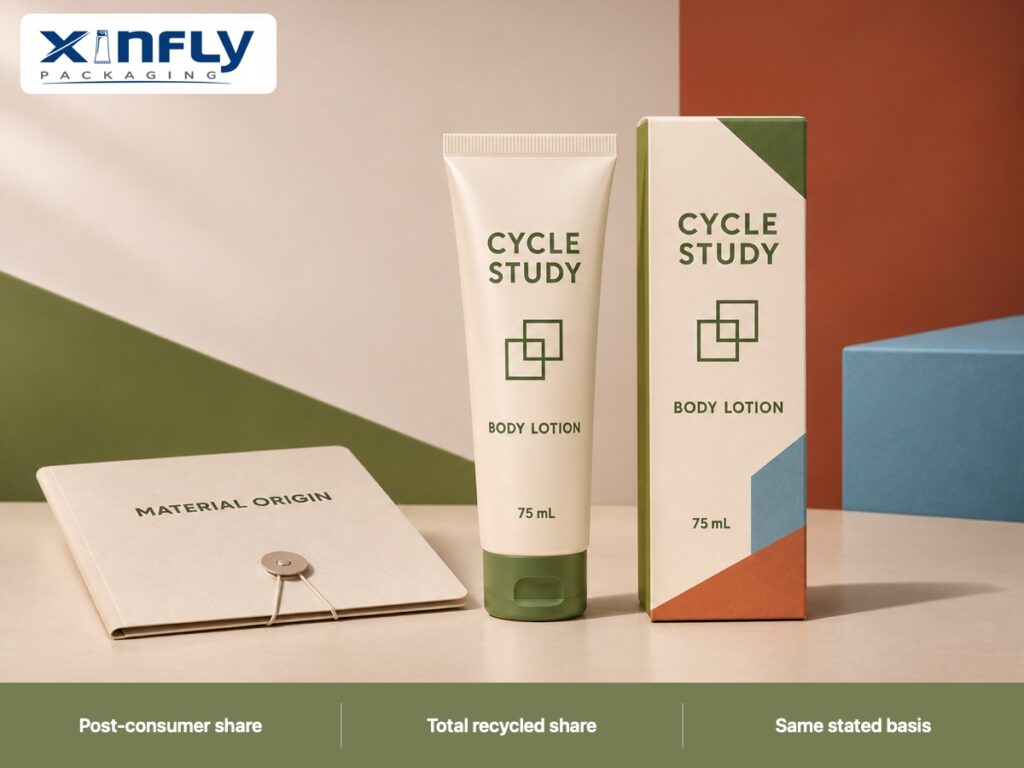
The fictional CYCLE STUDY body lotion design uses a warm ivory PE-style body, moulded shoulder, straight crimped display tail and olive round flip cap. Olive single-colour screen-print-style wording and interlocking squares coordinate with the printed carton. No content percentage or recycling emblem appears on the pack. These illustrations do not establish material origin, a resin grade or the composition of any supplied product.
For a PCR cosmetic packaging enquiry, send the desired component scope, target attribute, formula type, quantity, decoration and destination market. Ask Xinfly Packaging to identify the actual proposed material and the information available to support it. Keep project-specific price, sample availability, timing and technical requirements subject to the actual offer and review rather than infer them from the illustration.
Frequently Asked Questions
Does 50% Recycled Mean 50% Post-Consumer Recycled?
Not necessarily. Ask which origin categories make up the recycled figure and which component or material basis it uses. Compare the post-consumer contribution with your brief after the supplier provides the relevant breakdown and supporting information.
Should Missing Post-Consumer Information Be Entered as Zero?
No. Record it as not provided or awaiting clarification. Zero is an actual stated value, while missing information leaves the question unresolved. Ask the supplier for the response needed to evaluate the proposal.
Can the Tube’s Appearance Verify Its PCR Percentage?
No visual feature in these illustrations verifies a recycled-content percentage. Request identifiable supplier information tied to the proposed material and component. Review appearance using suitable specimens while keeping origin substantiation in the relevant document record.
Does a Recycled Tube Body Establish a Recycled Closure?
Do not extend the body statement automatically. Identify the closure separately and request information for the scope your project requires. Also distinguish the carton and any other components included in the proposed public wording.
Does This Guide Set the Right PCR Target for My Product?
It does not prescribe a target. Define your purchasing and claims requirements, ask what material and construction are proposed, and have the responsible technical and claims reviewers assess the evidence and suitability for the actual project.
Conclusion
Compare material origins, percentages and component scopes as separate fields before approving a PCR tube proposal. A total recycled figure is useful only when its meaning is clear. Xinfly Packaging can review a focused material enquiry and discuss the proposed construction, sample options and supporting information so purchasing and artwork decisions follow the same documented proposal.