Published: .
A lip gloss tube cap can look perfectly matched from the outside while leaving an unanswered question inside: where does the applicator sit when the cap is fully seated? Buying by cap height or a product photograph alone will not answer it. You need the assembled component references and the dimensions that describe the actual space around the tip.
A lip gloss tube cap applicator clearance review connects the cap, applicator and neck in one defined configuration. This guide helps buyers request the right drawing information and representative samples before approving that combination. It does not prescribe a clearance, guarantee tip protection or replace the supplier’s technical assessment. The goal is a clear comparison of what is known and what still needs checking.
Start with the Complete Applicator Assembly
Identify the Parts Behind the Product Name
For 10ml lip gloss squeeze tubes, record the body, neck, applicator and cap references separately when the construction uses separate parts. A nominal capacity does not identify that combination. Ask the supplier which components its proposed item includes and which drawings or sample references describe them. Keep the relevant revisions attached to the quotation.
Some designs integrate features that another design supplies as separate components. Let the supplier describe the actual construction. Do not assume that a similar-looking cap uses the same internal shape or seating arrangement. The purchasing record should identify the proposed assembly, rather than turn a category description such as “slanted tip” into a complete component specification.
Record the Intended Closed State
Ask the supplier to define the assembled condition used in its drawing and fit discussion. Which surfaces establish the seated cap position? What is the applicable assembly instruction? Which components are installed for the review? These questions establish the reference state. They do not authorise a buyer to choose assembly torque or change the closure’s intended engagement.
Separate External Height from Internal Space
An Outer Dimension Does Not Describe the Cavity
A cap’s external height can help describe overall pack dimensions. It does not by itself define the usable internal cavity around an applicator. Ask for the relevant internal profile and reference surfaces, through an appropriate drawing, section or supplier explanation. If detailed geometry is confidential, request enough agreed information to answer the fit question without inventing missing dimensions.
Find the Applicator’s Relevant Envelope
Ask the supplier which points on the installed applicator govern its relationship with the cap. The outermost point may depend on the selected tip shape and assembly. Record the envelope in the directions relevant to the review, together with the reference surface. Avoid comparing a bare loose component dimension with a dimension from an assembled drawing unless the supplier establishes their connection.
| Reference | Information to request | Question it should answer |
|---|---|---|
| Installed applicator | Component identity and assembled envelope | Which tip configuration is under review? |
| Neck or shoulder | Relevant mating and reference surfaces | Where do the assembly dimensions originate? |
| Seated cap | Defined assembled position | Which cap condition does the drawing represent? |
| Internal cap profile | Applicable cavity and internal features | What space surrounds the installed tip? |
| External cap size | Clearly labelled outer dimensions | What does the complete pack occupy externally? |
| Variation basis | Supplier’s relevant dimensional information | Which changes must the technical reviewer consider? |
| Review specimen | Complete component references and condition | Does the sample represent the proposed combination? |
Keep dimensions, units and reference points together. A number without its origin can be more confusing than an openly missing field. The supplier’s technical reviewer should determine which dimensions are relevant and how they relate. Purchasing can then preserve that explanation in the approval record instead of carrying a simplified sketch into the order as though it were the supplier’s design.
Compare Dimensions Only When Their References Match
Ask Whether the Two Heights Share a Datum
Suppose someone subtracts the visible tip height from the cap’s total outer height and calls the result clearance. That calculation can omit the cap wall, internal features and seating arrangement. Before subtracting dimensions, ask the supplier whether both describe the relevant geometry from the same reference in the same assembled condition. The arithmetic must follow the geometry, not substitute for it.
Use an Illustrative Difference Carefully
In a purely fictional drawing exercise, an identified internal boundary is 12 mm from an agreed reference and the relevant installed-tip point is 10 mm from that same reference. Their stated axial difference is 2 mm. That is only a one-direction calculation under those assumptions. It is not a recommended gap, a tolerance, a protective-performance result or a specification for a Xinfly product.
Include the Other Relevant Directions
Even a properly referenced axial difference does not describe every relationship between the components. Ask the technical reviewer whether the cap’s internal profile, the applicator shape or another feature requires additional assessment. A drawing can show the intended relationship; a representative assembly and the appropriate project checks help review the selected physical combination.
Review Contact Against the Intended Design
Do Not Assume Every Contact Point Is a Fault
A closure may include intended engagement or other functional contact. Ask the supplier to identify which relationships are intentional for the proposed assembly. Do not classify every observed contact as a defect, and do not assume an unexplained contact is acceptable. The relevant drawing and the responsible technical reviewer should establish the basis for that decision.
Use the applicator options page to identify the specific tip under discussion. Its appearance can help distinguish options, but a catalogue image cannot confirm the internal fit with an arbitrary cap. Keep the cap reference connected to the chosen applicator when requesting drawings and samples. Similar product names do not establish an approved pairing.
Keep the Formula State Explicit
An empty assembly can answer component-identity and some fit questions. A filled specimen may be needed for a different review involving product around the tip or closure. Ask the project team what condition is appropriate for each question. Record the formula reference and specimen state when relevant, without treating an empty-pack check as proof of performance with the finished formula.
Plan a Representative Physical Review
Request the Proposed Components Together
Through sample development, request a complete assembly that represents the quoted combination. Ask the supplier to label the sample’s role and limitations. A decorated appearance mock-up may use different components from a production-intent fit sample. That can be useful if it is clearly identified, but it should not quietly become the reference for a different technical decision.
Record Observations at the Appropriate Stage
Have the responsible parties agree the relevant inspection or evaluation conditions. Record the specimen references, assembly state, observation and reviewer. This guide does not set a sample quantity, opening cycle count, tightening value or pass limit. Those conditions need a project-specific basis. Keep a limited observation separate from a broader statement that the cap protects every applicator under all handling conditions.
Keep Appearance References in Their Proper Role
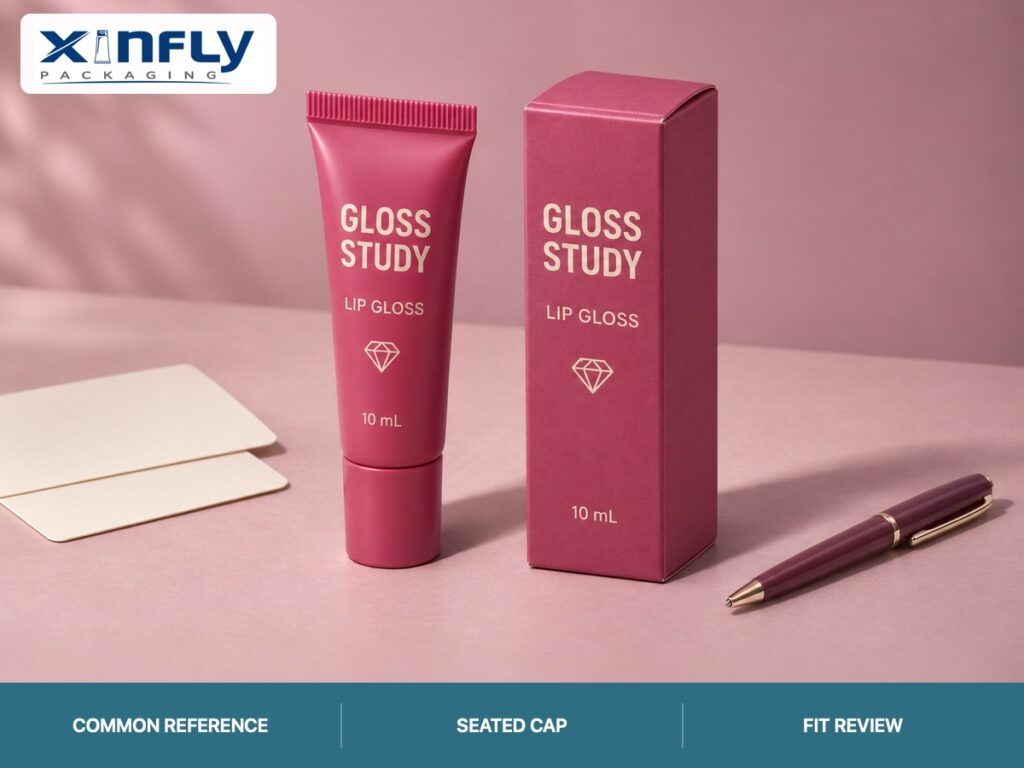
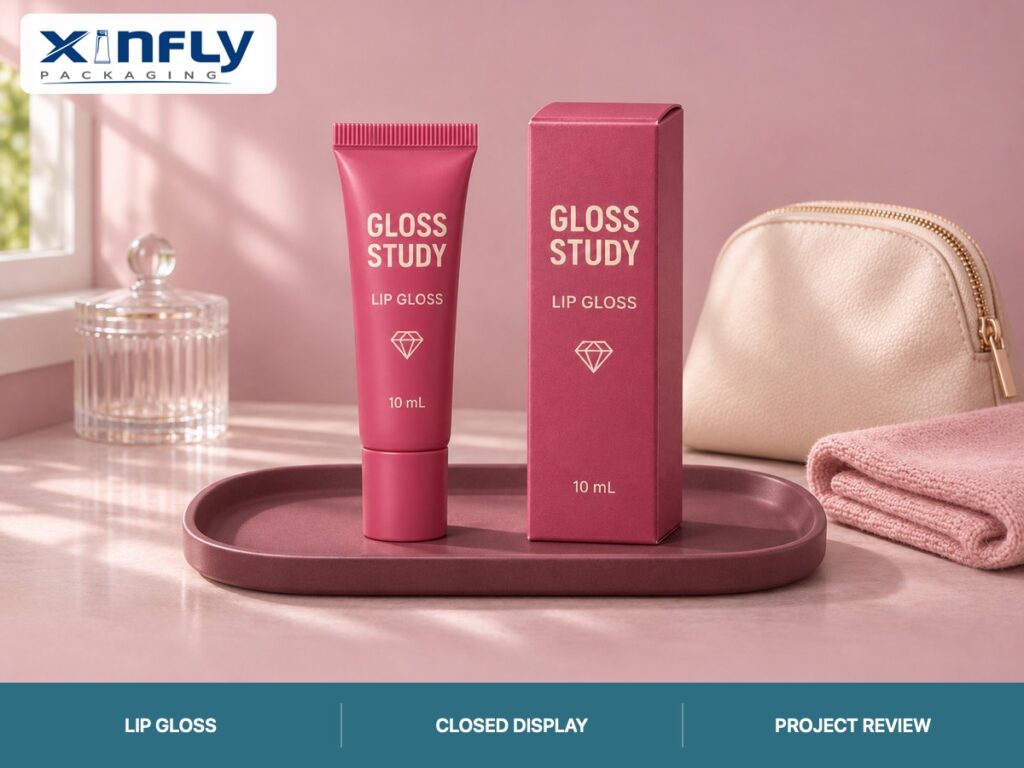
The illustrations use a fictional GLOSS STUDY design: a raspberry PE-style squeeze tube with a moulded shoulder, straight crimped display tail and matching cylindrical screw cap. Cream single-colour screen-print-style wording and a diamond coordinate with the printed carton. The cap remains closed in the illustrations. The images do not reveal the internal cavity, demonstrate a measured gap or establish a protective test result.
For custom lip gloss tubes, use the artwork reference to discuss appearance and the component reference to discuss fit. Both belong to the same project, but they answer different questions. If a cap’s colour changes without a structural change, ask what review is relevant. If its component identity changes, have the technical reviewer assess the affected fit decisions rather than relying on visual similarity.
Resolve Questions Before Releasing the Combination
| Question | Evidence to connect | Status to record |
|---|---|---|
| Do the components match the offer? | Quotation and component references | Confirmed or clarification required |
| Are dimensions compared from the same reference? | Supplier drawing and explanation | Technical relationship established or unresolved |
| Does the sample represent the intended assembly? | Sample identity and supply-state description | Representative scope and limitations |
| Is an observed contact intended? | Design explanation and review observation | Authorised interpretation or further review |
| Was the relevant formula state considered? | Specimen condition and agreed evaluation | Applicable scope of the result |
| Has a component changed? | Old and new references | Reassessment required or justified carry-over |
| Who accepts the configuration? | Named responsible reviewer and decision record | Approval for the stated scope or pending action |
An unresolved field is a sourcing question, not an automatic rejection. Ask the supplier to explain the gap and propose the appropriate next step. The quality assurance discussion should connect applicable requirements with the review and acceptance authority. Do not manufacture a technical sign-off by treating an unanswered email as agreement.
Send a Fit-Focused Supplier Request
A concise request can read: “Please identify the proposed lip gloss tube, installed applicator and cap references. Describe the seated cap condition and provide the relevant internal-profile and applicator-envelope information for assessing their relationship. Please state which dimensions share a reference and which representative sample is appropriate for review.” Attach the selected option and the intended application so the supplier can answer a concrete question.
Add intended capacity, decoration, quantity and destination for the commercial discussion. Specify which information is needed for appearance review and which concerns component fit. If the project is still choosing among lip gloss squeeze tubes, keep each candidate combination identified separately. A cap accepted with one applicator should not automatically be treated as accepted with every other option in the catalogue.
Frequently Asked Questions
Does a taller cap always provide more applicator clearance?
External height alone does not establish the usable internal profile or seated position. Ask for the dimensions and assembly reference relevant to the selected combination. A supplier’s technical explanation and an appropriate physical review are more useful than comparing visible cap heights in photographs.
Can I calculate a gap from two catalogue dimensions?
Only if the supplier establishes that the dimensions describe the relevant points from a compatible reference and condition. A simple difference may otherwise compare unlike quantities. Keep any calculation limited to its stated direction and assumptions; it does not by itself approve the assembly.
Should the cap never touch any part of the applicator assembly?
Ask the supplier which contacts are intended by the design. The appropriate relationship depends on the selected construction. Record unexpected observations against that explanation and have the responsible reviewer decide their significance, rather than adopting a universal no-contact rule.
Is an empty sample enough for final approval?
It depends on the question and the agreed evaluation. An empty assembly can support certain component checks, while other questions require a different specimen condition. Document the actual scope reviewed and any remaining formula or handling evaluation needed for the project.
What should I send Xinfly Packaging first?
Send the intended size, selected applicator option, proposed cap reference, artwork and quantity. Explain whether the unresolved question concerns internal fit, overall dimensions or a filled-pack review. Ask Xinfly Packaging to confirm the proposed combination and the information needed before sampling.
Conclusion: Review the Space Around the Actual Tip
A useful cap-clearance brief connects the installed applicator, cap cavity, seating reference and representative assembly. It keeps outer dimensions, drawing calculations and physical observations within their proper scope. Contact Xinfly Packaging with your selected lip gloss configuration to discuss a quotation and sample review based on the components you actually intend to buy.