Published: .
A hotel amenity order often contains several packs that share almost everything: logo, tube size, cap, typeface and carton. Only a product name or a few lines of copy may differ. That makes the range look coordinated. It also makes a wrong file, old proof or mixed component harder to notice when the order moves between purchasing, printing and filling.
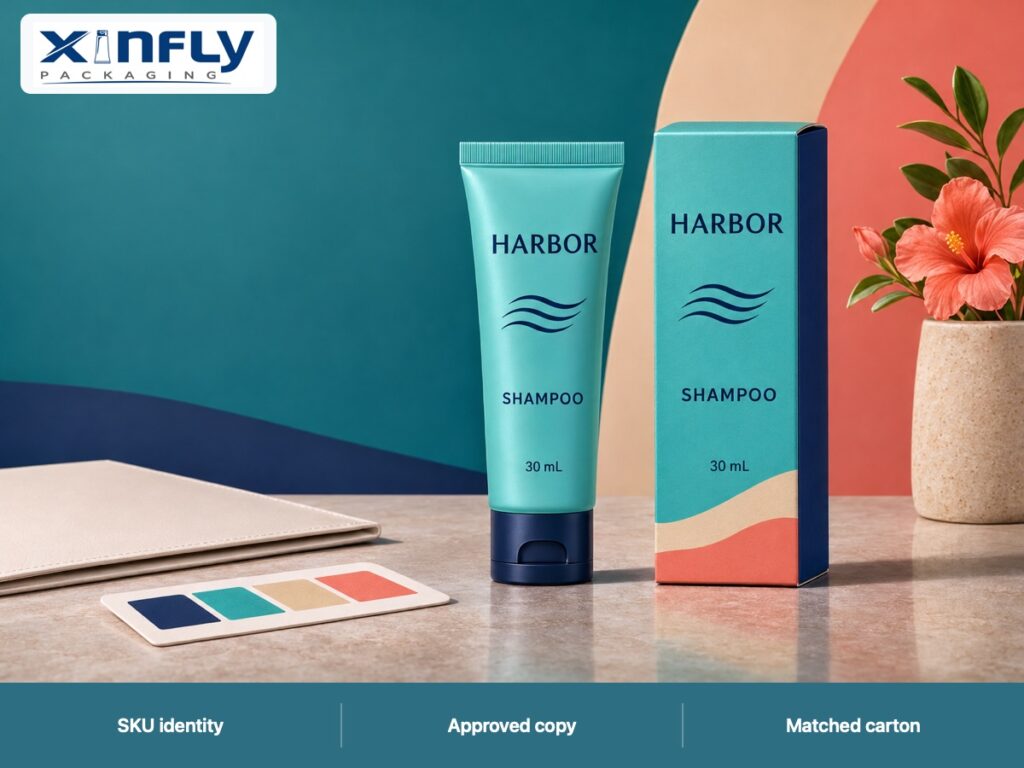
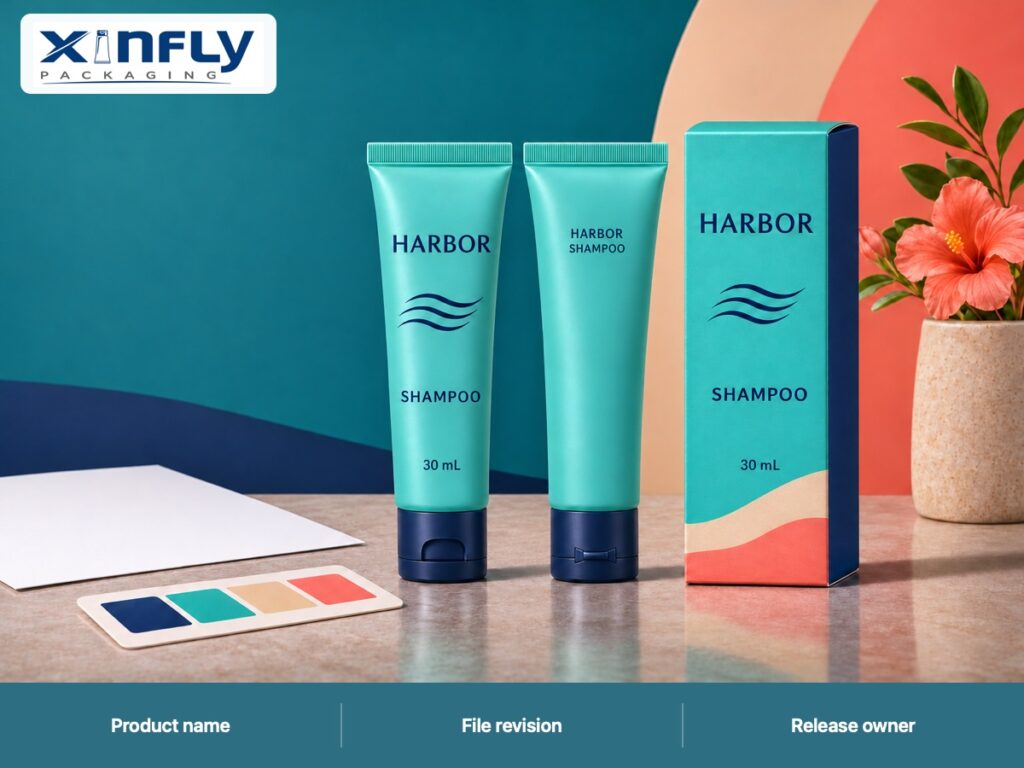
Hotel amenity tube artwork version control gives each product a clear identity throughout that handoff. The illustrated HARBOR SHAMPOO concept uses a 30 mL teal extruded PE tube, molded shoulder, straight heat-sealed tail, navy flip-top and navy one-color screen print. Its designed carton repeats the same product name and wave motif. It is an illustrative pack, not a hotel customer account, stock SKU or complete market-ready label. Start with the hotel amenities tubes specification, then establish the file and approval record for every item in the range.
Give Every Product One Controlled Identity
Separate the Range Name From the SKU
A range name can appear on shampoo, conditioner and body wash. It is not enough to identify the artwork. Assign each proposed item a distinct internal product or packaging reference and connect it to the formula, nominal fill, market and pack format. Use that reference in quotations, proofs, purchase orders and component labels.
For hotel shampoo and conditioner tubes, make the product name an explicit field in the approval record. Do not assume a different background color is sufficient to distinguish the two. Color can support quick recognition, while the written identity and component record provide a stronger basis for purchasing and inspection.
Freeze the Copy Source Before Layout
Keep one controlled source for product name, directions, ingredient text and any other required wording. Have the brand's responsible person supply and approve it. The designer should not have to choose between an email, a messaging attachment and an older carton PDF. If the copy changes, identify what changed and which SKU and market it affects.
This guide does not prescribe the label requirements for every destination. Ask the responsible brand or market reviewer to confirm the required content for the actual product. A coordinated hotel design does not make the same wording appropriate for every formula or country. Keep that review separate from a printer's confirmation that the text fits.
Name the Final Decision Owner
Many people can comment on a proof; one agreed owner should communicate the release decision. Record who approves product copy, brand appearance, technical print layout and final purchasing release. Your organization may combine some roles. What matters is that the supplier receives a clear decision tied to one revision rather than several partial approvals.
| Field | Example of what to record | Why purchasing needs it |
|---|---|---|
| Pack identity | Internal reference and product name | Prevents range name from replacing SKU identity |
| Formula connection | Product or formula reference | Links the printed component to the intended fill |
| Market and copy | Approved language set and source revision | Identifies which wording belongs on this item |
| Tube specification | Capacity, body, shoulder, cap and print | Defines the physical pack being quoted |
| Artwork status | File revision, approver and release date | Distinguishes working files from production files |
Control Tube and Carton Files Together
Keep Related Files Connected Without Making Them Identical
A tube and its carton may repeat the same product identity but have different layouts and available space. Give each file its own reference, then link both to the same packaging SKU and release record. A revised carton file should not silently imply that the tube file also changed. Show which components are affected by each request.
The HARBOR illustration deliberately repeats SHAMPOO on both components. In a real order, check that the tube, carton and packing list use the intended product description. A visually matched carton carrying the wrong product name is still a wrong component, even when every color looks right.
Identify Dimensions and Printable Areas
Ask the supplier to confirm the body drawing, printable area and seal restrictions before the designer finishes small text. For 30ml squeeze tubes for hotel amenities, the available panel can be limited. Reducing an entire layout to fit can make important text difficult to read. Return an overcrowded proof to the copy and layout owners with a clear question about space and priorities.
Discuss the tube printing method on the selected body material. A one-color screen-printed PE tube and a differently decorated sample may require different file preparation. Keep the production process in the proof record so a later change to decoration triggers the relevant review.
Use Names That Reveal the Version
Agree a file naming convention that includes the SKU, component, market and revision. Keep a separate status field or folder for the approved production file. A file called final-final-new does not tell a receiving supplier whether an earlier version remains valid. The exact naming convention can be simple; consistency matters more than complexity.
When sending a revision, state which file it replaces and whether any quantity has already entered production. Ask the supplier to acknowledge the replacement. Do not assume that uploading a new attachment deletes the earlier file from every printer, assembler and filler involved in the order.
Review Proofs for Different Kinds of Error
Read Copy Without Judging Color
Run one pass for product identity and text. Compare the proof against the approved copy source, including spelling, units, punctuation and language version. Read small text at the intended size as well as in an enlarged view. A beautiful render can distract reviewers from a product-name error that would be obvious on a plain text sheet.
Ask reviewers to identify the source and proof revision used. A comment saying copy looks good is difficult to interpret if it refers to an untracked screenshot. Keep the marked proof with the release decision. If an agency is involved, make sure the brand and supplier receive the same approved file.
Inspect Appearance on the Actual Substrate
Use a representative decorated sample to assess print placement, color and legibility on the curved tube. Keep the cap and body colors consistent with the proposed pack. Inspect the folded carton separately, then place both together under the same light. A flat digital proof supports layout decisions, but it does not establish the appearance of printed PE and paperboard together.
If a sample uses temporary materials or a substitute cap, identify those differences. Decide which approvals remain open. Avoid treating a physical sample as final merely because it carries the correct brand name. The material, printing and component references still need to match the order.
Separate Copy Approval From Formula Approval
A correct printed tube does not prove that the intended product was filled into it. The filler needs the approved packaging identity and formula connection, with its own handling and release controls. Purchasing should ask how those records meet, rather than assuming that a similar color or scent is an adequate check. Do not create an informal consumer test to replace the filler's quality system.
Make Changeovers Visible in the Handoff
Ask How Components Are Identified at Receiving
Request packaging labels and delivery documents that identify the component reference, product name and relevant revision. Agree the information the filler needs to distinguish cartons of similar empty tubes. Keep those outer labels connected to the contents. A correctly labeled shipping carton is useful evidence, while a sample from inside still needs to be compared with the approved reference.
For hotel shampoo tubes, the cap color may be shared with other items in the range. Do not rely on the cap alone when selecting components for a filling run. Ask the filler to describe its line-clearance and component-verification approach for the actual order. This is a request to understand the process, not a claim that one simple checklist eliminates all mix-up risk.
Record What Happens When a Revision Arrives Mid-Order
A hotel may change a logo, a language line or a property name after part of an order is produced. Stop and establish the status of the affected quantity before releasing a new file. Ask which components are printed, assembled, shipped or already at the filler. Decide the disposition with the responsible commercial and quality teams.
Record the approved treatment of earlier stock and how revised stock will be identified. If both versions are intentionally accepted for different destinations, make that distinction visible in the purchase and shipment records. A verbal statement that both are fine can become confusing when another warehouse handles the delivery later.
Keep Sampling Decisions Specific
Agree the inspection and sample-retention plan with the supplier and quality team. Identify which products and revisions must be represented. Do not take one attractive tube from the range and use it as proof that every SKU carries the right wording. A range-level design review and an item-level identity check answer different questions.
| Gate | Evidence to retain | Question before moving on |
|---|---|---|
| Copy release | Approved source text and product reference | Does this wording belong to this formula and market? |
| Technical layout | Dieline, print process and marked restrictions | Can the chosen pack carry the approved design? |
| Physical proof | Identified tube and folded carton | Does the real appearance match the accepted concept? |
| Production file | Revision and replacement acknowledgment | Is every supplier using the released version? |
| Filler handoff | Component labels and formula connection | Can similar items be distinguished at the next stage? |

Close the Loop With the Hotel Buyer
Review the Guest-Facing Range in Context
Present the actual range to the hotel's responsible buyer in the intended tray or display arrangement. Confirm that product names remain easy to distinguish at normal viewing distance. This is a presentation review, not a substitute for copy or market review. Keep any request to change the typography or color connected to the same revision process used earlier.
The HARBOR bathroom image illustrates one setting. It does not claim a real hotel installation or a tested guest response. In a project, the hotel should review its own pack and use context. A design that looks clear on a studio desk may need a different presentation in a small bathroom or a dimly lit amenity station.
Preserve the Release Package for Reorders
Retain the approved artwork, assembly drawing, physical reference and change history for each SKU. A repeat order should identify the versions to be reused rather than simply saying same as last time. Confirm whether the market, hotel property, formula or language set has changed before sending an old production file back to print.
Ask which changes require a new physical sample and which can be reviewed through a controlled proof. Keep the decision with the responsible people. That approach reduces avoidable rework while maintaining a clear record of what was actually approved.
Send Xinfly Packaging an Organized Brief
Provide the amenity range, individual product references, nominal fills, tube and cap preferences, carton scope, markets, language sets and approved copy sources. Ask Xinfly Packaging to identify the proposed printing and sample stages through its sample development process. Send the packaging team your hotel range brief with a list of which fields are final and which need a proposal.
Request a quotation that separates product quantities, artwork versions, decoration, cartons and any additional sampling work. Suppliers can compare the same scope more effectively when the range is described as identified components rather than a single hotel set. Clear files make the commercial discussion clearer too.
Frequently Asked Questions
Can one approval cover all items in a hotel amenity range?
It can cover agreed shared design elements, but review each SKU's identity, wording and component reference separately. Shared branding does not make the product copy interchangeable.
Is cap color enough to distinguish shampoo and conditioner?
Use it as a visual aid rather than the only identity control. Keep product names, component references and filler handoff records clear, especially when several products share the same cap.
Should the carton and tube use one artwork file?
They can share a controlled copy source, but each component needs a suitable layout and version reference. Link the files to the same SKU without assuming every change affects both.
What if the hotel requests a change after printing starts?
Establish the status and quantity of affected stock, then obtain a documented disposition and replacement-file decision. Identify how earlier and revised components will be handled.
What should be saved for a repeat order?
Retain the released files, copy source, assembly specification, physical samples and change history for each item. Confirm the intended versions when the reorder is placed.
Conclusion
Hotel amenity tube artwork version control connects a coordinated range with the individual products being purchased and filled. Give every SKU a clear identity, control tube and carton revisions, review real printed samples and make the handoff to the filler explicit. Xinfly Packaging can propose the pack and sampling route when the brief identifies the range, markets, copy sources and release owners.