Published: . Updated: .
A leave-in conditioner can feel economical when the package releases the amount a user expects. It can feel wasteful when a light squeeze delivers a large ribbon that is difficult to stop. For a buyer, that difference is a packaging question as well as a formula question. The outlet, body stiffness, fill level and user's hand all belong in the comparison.
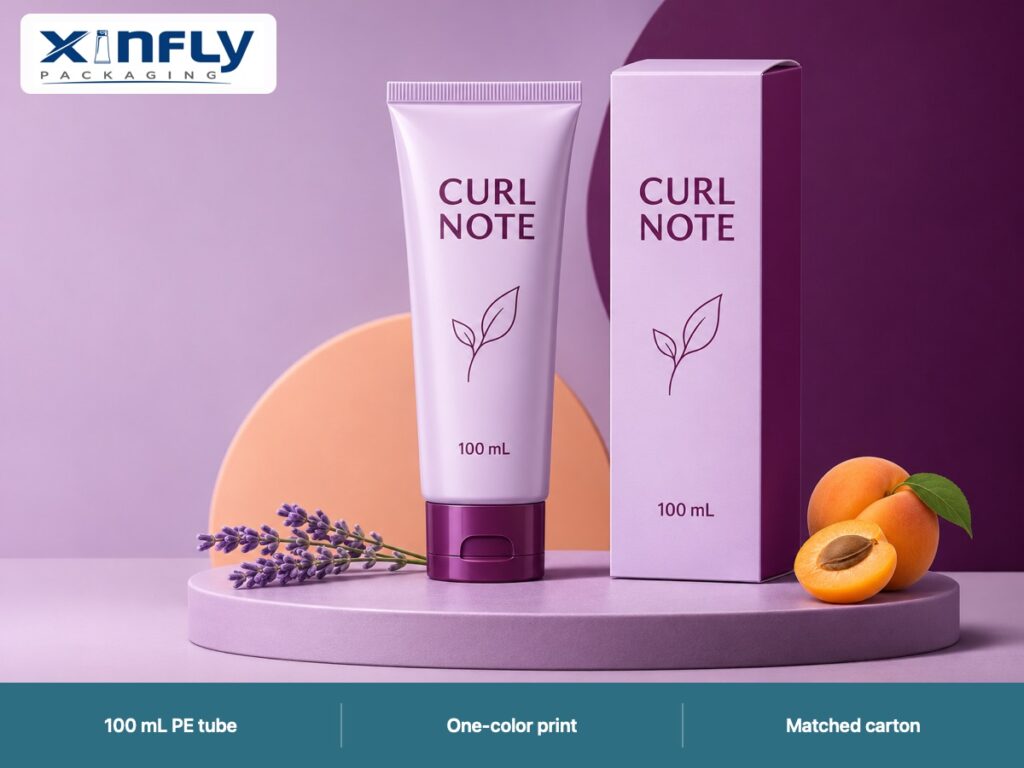
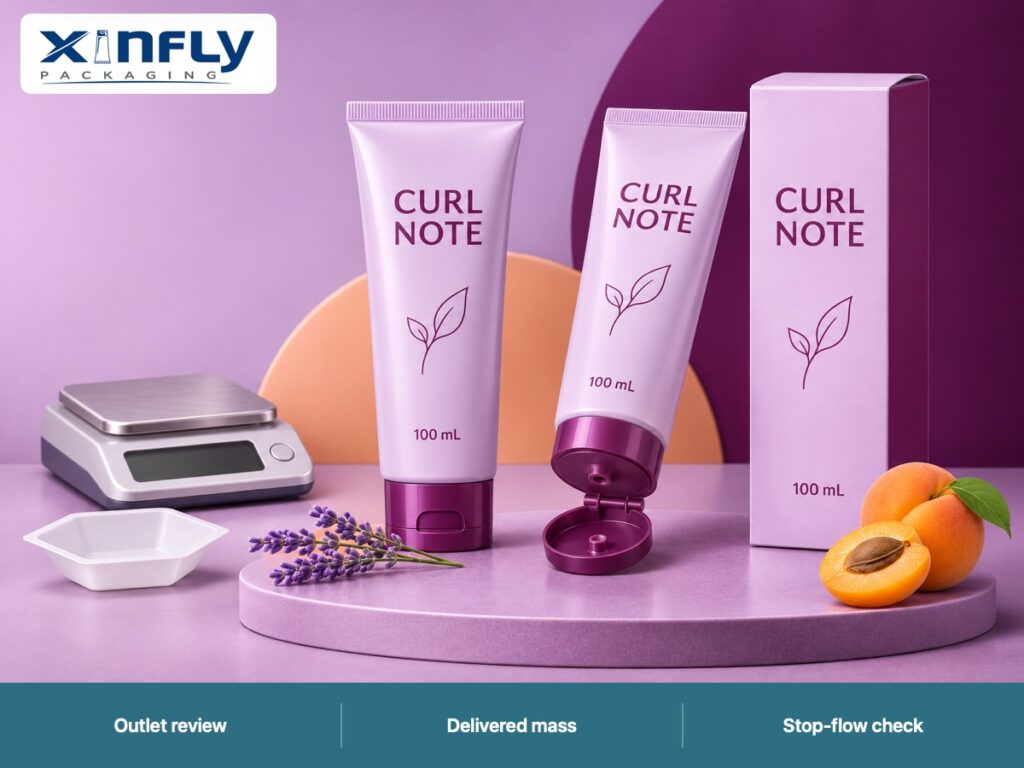
This leave-in conditioner tube dose comparison helps a brand choose between complete sample assemblies without pretending that an ordinary squeeze tube is a metered dispenser. The illustrated CURL NOTE concept uses a 100 mL lavender extruded PE body, molded shoulder, straight heat-sealed tail, plum hinged cap and one-color plum screen print. Its folding carton repeats the name and leaf motif. The images show a design idea, not an existing SKU or measured dispensing result. Review the hair conditioner squeeze tubes range, then build a sample trial around the actual leave-in formula and use routine.
Define the Amount the User Is Trying to Dispense
Start With the Brand's Application Brief
Ask the formula and product teams what a typical application should look like for the intended user. Hair length, texture and application routine can vary. The packaging team should not invent a universal dose or a hair-performance claim. Instead, obtain a practical target or range from the product owner and use it to evaluate handling. A tube can be compared against that brief even when the brief does not promise a precise amount per squeeze.
Describe whether the conditioner is dispensed into a palm, onto fingertips or through another application method. Record whether the user normally holds the tube cap down. A sample trial should reproduce the expected motion rather than a convenient laboratory orientation that nobody uses at home.
Separate Package Output From Formula Performance
The mass released from the tube is one observation. How well the formula spreads through hair is another. Keep the records separate so a packaging change is not credited with a formula benefit. Product evaluation can inform the target amount, while the package trial examines how easily users approach it, stop flow and close the cap.
Use a Target Without Calling the Tube Metered
An ordinary hinged-cap squeeze tube allows users to vary force and duration. Its output should not be marketed as a fixed dose merely because one operator produces similar portions during a trial. If the brand requires a defined amount per actuation, discuss an appropriate dispensing system and its verification separately. For this guide, the decision concerns controllability and observed variation under a recorded routine.
| Factor | What to record | Why it matters to the decision |
|---|---|---|
| Formula | Batch, revision and condition at test | Keeps product behavior comparable |
| Assembly | Body, shoulder, outlet and cap references | Identifies the complete pack being reviewed |
| Fill state | Starting fill and storage orientation | Avoids mixing full and partly used samples |
| Handling | Grip, orientation and squeeze instruction | Makes user observations interpretable |
| Measurement | Balance method and collection procedure | Separates delivered mass from visual estimates |
Ask for Comparable Sample Assemblies
Keep the Body Constant When Comparing Outlets
Ask the supplier to provide proposed outlet options with identified dimensions and cap drawings. Where practical, compare them on the same tube body construction and fill. Otherwise the buyer may attribute a difference to the outlet when the softer body or different fill state contributed. If the parts cannot be matched, describe each sample as a complete alternative assembly.
Do not select an outlet only from the nominal capacity. A 100 mL tube for a thin leave-in fluid and one for a thicker cream may need different evaluation. Tell the supplier the actual formula type and what users find difficult: starting the flow, preventing overshoot, stopping the ribbon or keeping the outlet clean. That gives the proposal a useful purpose.
Confirm Cap and Shoulder Details
A flip-top includes more than the visible lid. Identify the outlet, closing contact, hinge and relationship to the molded shoulder. Ask whether any sample uses a temporary cap that will change before production. The caps and closures options can help frame the choice, but the approved drawing and physical assembly determine what will actually be ordered.
Check the thumb recess and cap opening with the intended grip. If users squeeze the body while struggling with the lid, they may release product before they have positioned their hand. That is a handling observation worth recording separately from the outlet's flow behavior. A larger opening does not resolve every difficulty associated with dispensing.
Inspect the Tail and Print as Part of the Pack
The tube should have a representative sealed tail and the intended body finish. A smooth printed surface and a textured sample can encourage different grips. Confirm the tube printing method and artwork revision before treating a decorated sample as the final reference. Keep the cap color and body construction aligned across comparison samples wherever possible.
Measure Delivered Product With a Clear Method
Establish the Collection Procedure
Use a suitable balance and collection vessel, with the quality team defining the method and resolution appropriate to the expected amount. Record the empty vessel mass or tare it according to the agreed procedure. Dispense using the stated motion, then record the collected mass. Keep any product left on the outlet distinct from what reached the vessel.
A simple record can include sample ID, fill state, operator, squeeze instruction, delivered mass and stop-flow observation. If product misses the vessel, mark the result rather than quietly correcting it into an apparently normal reading. The purpose is a defensible comparison, not an attractive spreadsheet.
Choose One Type of Comparison at a Time
A controlled operator trial can compare assemblies under a repeatable instruction. A user trial can show how people naturally handle them. Both are useful, but the conclusions differ. In the first, keep the grip, orientation and squeeze instruction as consistent as practical. In the second, allow realistic variation and record what users actually do.
Avoid presenting the two as one dataset. A trained operator may quickly learn how to obtain a target amount, while a first-time user may overshoot. If the brand cares about the first application, retain that observation before training the participant. Do not replace it with a later, more practiced attempt.
Record Squeeze and Stop Behavior Together
A delivered amount alone can hide an awkward interaction. Note whether the stream starts suddenly, whether a ribbon continues after pressure stops, and whether the user needs a second squeeze. Photograph the outlet before cleaning if residue remains. These observations can help explain the numbers without asserting a cause that has not been checked.
If stringing or delayed flow appears, discuss the formula condition, outlet and handling with the supplier and product team. Change one factor at a time where practical. A new cap, softer body and warmer formula introduced together do not isolate the reason for an improvement.
Include the Package's Working Life
Compare Full and Partly Used Tubes
A consumer does not use every application from a newly filled tube. Agree representative fill states and prepare identified samples for each. Record how the partly used state was reached. Repeated dispensing can leave the body in a different shape from removing product through an artificial preparation method. That distinction can matter when interpreting the result.
The aim here is dispensing control at defined stages, not a residual-product claim. Keep near-empty evacuation questions in a separate study if they are relevant. A pack can be easy to empty yet difficult to control at the first squeeze, or manageable when full and awkward later. The purchase decision should acknowledge both observations.
Use Relevant Storage and Hand Conditions
Define the storage orientation and formula condition before testing. If the product is commonly handled with damp hands after washing hair, include that scenario on a separately identified group. Keep a dry-hand baseline. Do not introduce water or cream residue to every sample and then treat the observations as an as-delivered inspection.
For squeeze tubes for leave-in conditioner, it is sensible to discuss the expected bathroom, vanity or travel setting with the product team. The CURL NOTE vanity scene illustrates a use context only. It does not establish a temperature range, transport claim or long-term compatibility result.
Check Closing After Dispensing
Once product has been dispensed, ask the user to close the cap normally. Observe whether product around the outlet affects the motion or transfers to the lid. Inspect the cap-down pack after the agreed storage interval. A well-controlled portion does not automatically establish closure integrity, so retain those decisions separately in the release record.
| Decision | Evidence to compare | Supplier follow-up |
|---|---|---|
| Amount control | Delivered masses and first-use observations | Which complete assembly best fits the brief? |
| Flow stopping | Ribbon, dribble or stringing observations | Which factor should be isolated next? |
| Grip and opening | Dry and relevant damp-hand handling | Does the cap or surface need review? |
| Working-life behavior | Identified full and partly used samples | Does the preferred option remain manageable? |
| Closing and packout | Cap observations and folded-carton fit | Are all parts ready for the next trial stage? |

Turn Results Into a Purchase Specification
Compare the Pattern, Not Only the Average
A group of readings can have a reasonable average and still contain awkward extremes. Review the range and the individual observations with the quality team. Ask whether one operator, fill state or grip explains the difference. Decide in advance how much variation matters to the product brief. Do not announce a universal pass threshold for all conditioners.
Keep any comparison panel in proportion to its size. A small internal exercise can help select a prototype; it is not automatically a representative consumer study. Document the number and type of participants and the limited purpose. That gives a later project team a clearer basis for deciding whether additional work is needed.
Lock the Accepted Assembly and Changes
Record the body construction, dimensions, shoulder, cap, outlet and artwork versions used in the preferred sample. Identify which acceptance decisions are complete and which require filled-pack compatibility, transport or further user work. If the supplier proposes a substitute cap or body material, review the affected checks before ordering.
Keep a signed physical sample and the observation sheet with the purchase specification. For custom conditioner tube packaging, this is more useful than asking for the same feel as last time. It tells purchasing which parts and behaviors the team actually accepted, and it gives the supplier a clear reference for a repeat order.
Request an Evidence-Based Proposal From Xinfly Packaging
Share the formula type, intended application routine, target fill, desired tube dimensions, cap preference, carton scope and the output problem you want to resolve. Ask for identified alternatives through Xinfly Packaging's sample development process. Send the packaging team your conditioner project brief with the trial conditions and any observations. Request itemized pricing for each complete assembly rather than comparing isolated cap prices.
Frequently Asked Questions
Does a smaller outlet always give a smaller dose?
It can change dispensing behavior, but the result also depends on formula, body, squeeze and fill state. Compare the proposed assemblies with the actual product rather than relying on outlet size alone.
Can I claim a fixed dose from a standard squeeze tube?
Do not infer that from a small trial. A standard squeeze tube is user-controlled. A defined-dose claim requires an appropriate dispensing system and evidence for the claimed performance.
Should I compare samples when they are full?
Include a controlled full-pack comparison, then add agreed partly used states if relevant. Keep the preparation and starting conditions documented for each group.
Is visual portion size enough for approval?
It can support a handling observation. If delivered amount affects the decision, use an agreed mass-measurement procedure and keep product left on the outlet separate from collected product.
What changes require the preferred sample to be revisited?
Review changes to formula, body stiffness, outlet, cap, dimensions and use instructions. Repeat the relevant checks on the revised assembly and retain its own sample identification.
Conclusion
A leave-in conditioner tube dose comparison should show how a complete pack behaves under a defined routine. Align formula and fill state, measure delivered product carefully, observe flow stopping and closing, and review variation across the package's use. Xinfly Packaging can propose sample assemblies when the brief explains the actual product and the handling decision your team needs to make.