Published: . Updated: .
A buyer asks for sugarcane PE tubes. The designer adds a leaf, a green panel and a percentage. Then purchasing discovers that the supplier's document describes a resin, while the artwork appears to describe the entire assembled package. The packaging may still be a sensible choice, but the claim has moved further than the evidence.
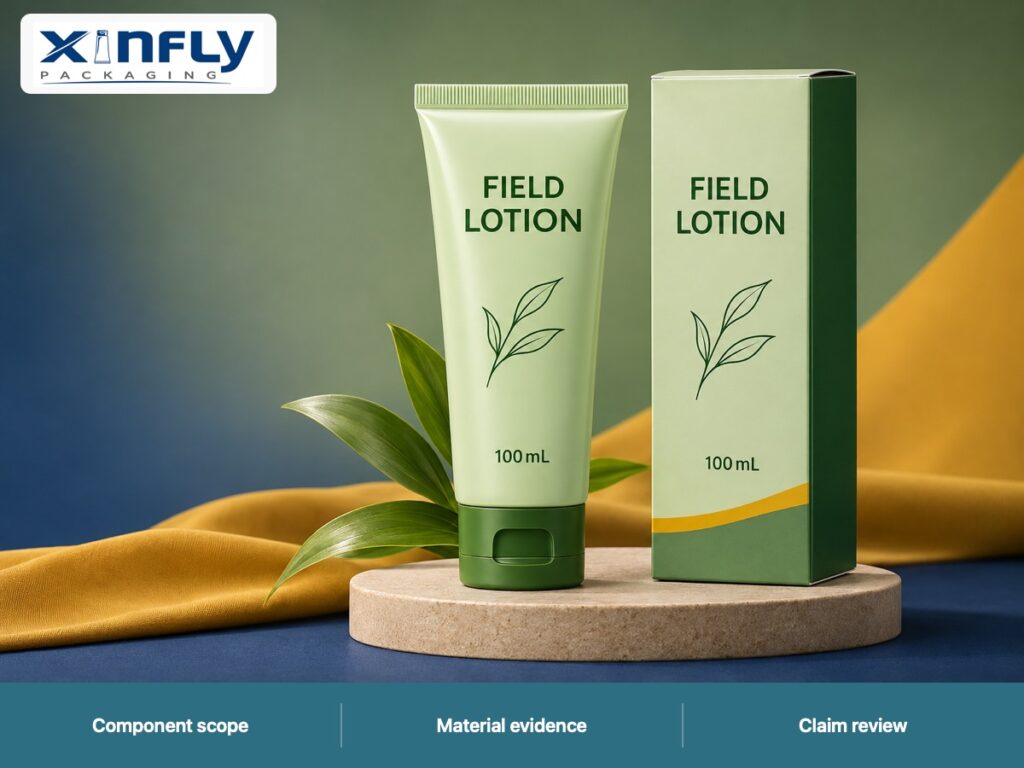
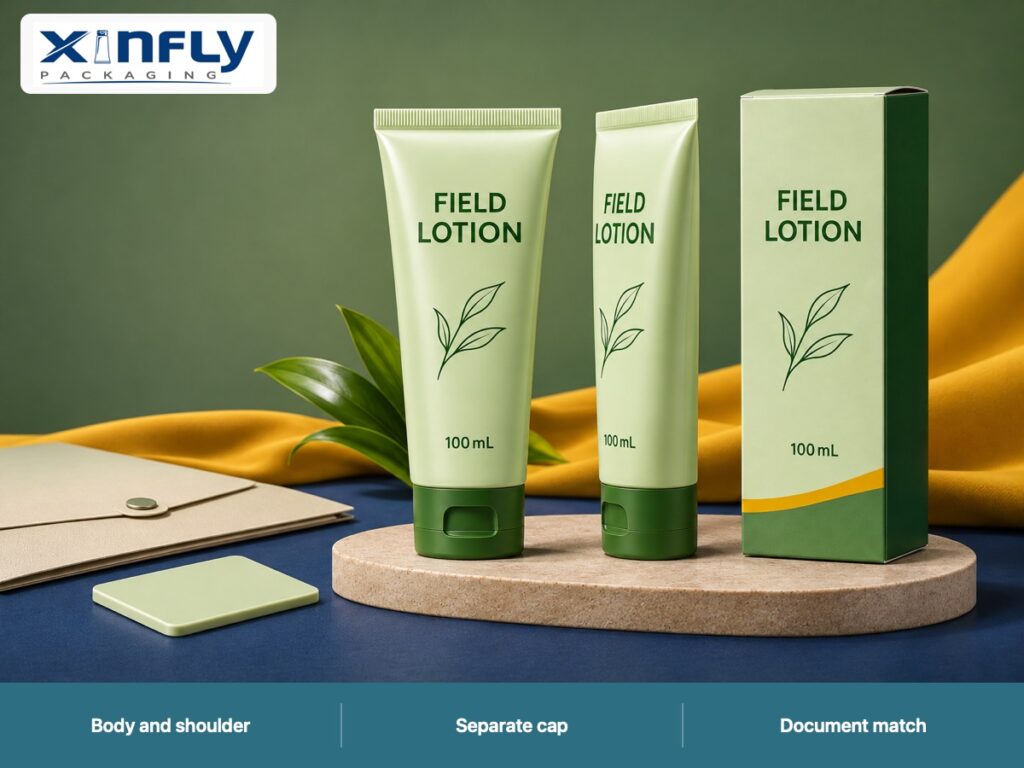
This sugarcane PE tube claim evidence check helps a brand connect the material brief, component records and final artwork before placing an order. The illustrated FIELD LOTION concept is a 100 mL sage tube with a molded shoulder, straight heat-sealed tail, forest-green flip-top and one-color screen print. Its printed carton repeats the name and leaf motif. No environmental claim is printed on the concept. Appearance cannot establish its feedstock or biobased content, and it is not a stocked or certified SKU. Use Xinfly's sugarcane tube packaging page to begin the sourcing discussion, then request evidence for the proposed assembly.
Write the Claim You Actually Want to Make
Separate Material Selection From Public Wording
A purchasing description can identify a candidate resin while the public label needs a narrower statement supported by the finished project. Write the proposed sentence before approving the artwork. Ask what a customer would reasonably think it covers: the body, the body and shoulder, the complete tube including the cap, or the tube and carton together. That scope determines which documents you need.
Do not let a supplier's short quotation label become the final consumer claim automatically. A line saying sugarcane PE tube may summarize the supplier's proposed body material without identifying the cap or other components. Ask the supplier to expand the description into an assembly specification, and ask the brand's responsible reviewer to assess the proposed wording for the destination market.
Keep the Different Attributes Separate
Biobased content, recycled content, recyclability, biodegradability and compostability describe different attributes. Treat each as a separate question with its own evidence and scope. Selecting a renewable-feedstock PE candidate does not, by itself, supply the documents needed for every other statement. If a marketing brief asks for several attributes, create separate lines in the evidence record instead of grouping them under a general green-packaging label.
The sustainable packaging materials overview can help organize those material options. The procurement task is to identify which attributes the quoted structure actually supports. Keep an unconfirmed statement off the signed artwork until the project reviewer has the relevant evidence.
Name the Component in the Draft Wording
A body-level statement is easier to evaluate when it says body. If the cap is outside the claim scope, make that boundary clear in the proposed wording and evidence record. The final language still needs review for the target market and context. Precise component descriptions give that review a better starting point than an unqualified statement about the whole package.
| Component | Information to request | Claim-scope question |
|---|---|---|
| Tube body | Resin identification, structure and relevant content evidence | Does the document identify this body construction? |
| Shoulder | Material and assembly reference | Is it included in or excluded from the proposed statement? |
| Cap | Resin, color and supplier reference | Does the body evidence cover this separate component? |
| Decoration | Ink, coating and artwork revision | Is the finished decorated part represented? |
| Carton | Board, printing and separate sourcing records | Is the tube statement being incorrectly extended to the box? |
Read the Measurement Basis Before Using a Percentage
Ask What the Percentage Measures
A percentage is incomplete without its basis. Is it a measured biobased-carbon result, a supplier's resin-blend proportion, or another documented calculation? Which specimen and component does it describe? Ask for the test method or calculation, sample identity, date and reporting basis. Do not combine unlike percentages from different documents into a single package figure.
The USDA BioPreferred program explains how biobased content is measured using a ratio involving recent biological organic carbon and total organic carbon under ASTM D6866. That basis is different from simply weighing the whole assembled package. Ask a qualified reviewer to interpret the actual report rather than relabeling a carbon-based result as a whole-pack mass percentage.
Distinguish Content Evidence From Origin Records
A test result, resin supplier declaration and shipment record have different jobs. A report can describe the specimen tested. A declaration can identify the proposed grade and stated feedstock route. Commercial records can help connect the ordered material to the supplier and manufacturing lot. Ask how those records relate to each other for your project.
For sugarcane PE tubes for skincare packaging, the word sugarcane adds an origin question. Ask what documentation supports that specific sourcing description and which part of the package it covers. A general biobased result should not be treated as the complete supplier-origin record. Keep the document chain readable enough that a new buyer can follow it without relying on the original salesperson's explanation.
Identify What Has Not Been Established
An incomplete record does not always mean the material is unsuitable. It means the claim decision remains open. Mark the missing component, version or report rather than filling the gap with an assumption. If the supplier can offer only a resin-level document initially, record that limitation and agree which finished-part evidence the brand needs before artwork release.
Match Documents to the Proposed Tube
Use a Controlled Assembly Specification
Identify body structure, layer arrangement where applicable, resin grades, shoulder, cap, colors, print process and finish. Ask which components contain the proposed sugarcane-derived material. If different layers use different materials, have the supplier describe that construction clearly. A product-family brochure is useful background but weaker evidence than a document tied to the quoted assembly.
The FIELD LOTION design has a sage body and forest cap for visual clarity. Neither the green color nor the leaf drawing proves a material attribute. A smooth PE appearance is also not a test for feedstock origin. Keep the artwork reference and material evidence as separate records that are connected by the same assembly revision.
Check Dates, Names and Sample References
Read the document's product name, supplier, date, revision and sample description. Ask the supplier to explain any mismatch between the report specimen and the proposed part. A result for a natural-color resin may not represent a decorated, pigmented assembled tube. The extent of any additional evidence should be determined for the actual claim and project.
Retain the source document and a short internal summary of what it supports. Avoid a summary that removes the limitations and leaves only a favorable conclusion. If a document is replaced, keep the old version as history and identify which version supports the current artwork.
Treat Certification Labels as a Separate Approval
If a supplier proposes a certification mark or program label, ask for evidence covering the exact product and the right to use that mark in the planned context. Do not copy a label from a resin brochure, another brand's tube or a supplier's presentation into a new artwork file. The reviewer should confirm both the scope and the artwork conditions before release.
This guide does not assert that the illustrated tube has a particular certification or content result. Xinfly's material offering is a reason to request project documents, not proof that every configuration can carry the same label. The quotation should state what evidence is available for the selected structure and what remains to be obtained.
Keep Supplier Evidence and Brand Approval Distinct
A supplier supplies technical and sourcing information; the brand decides the statement it will publish with appropriate review. Ask the supplier to confirm facts and scope in writing. Ask the brand's reviewer to approve the final wording and context. Keep both decisions in the record so a later artwork change is not mistaken for a supplier-authorized claim.
Use an Artwork Release Log
Connect Every Claim to a Document
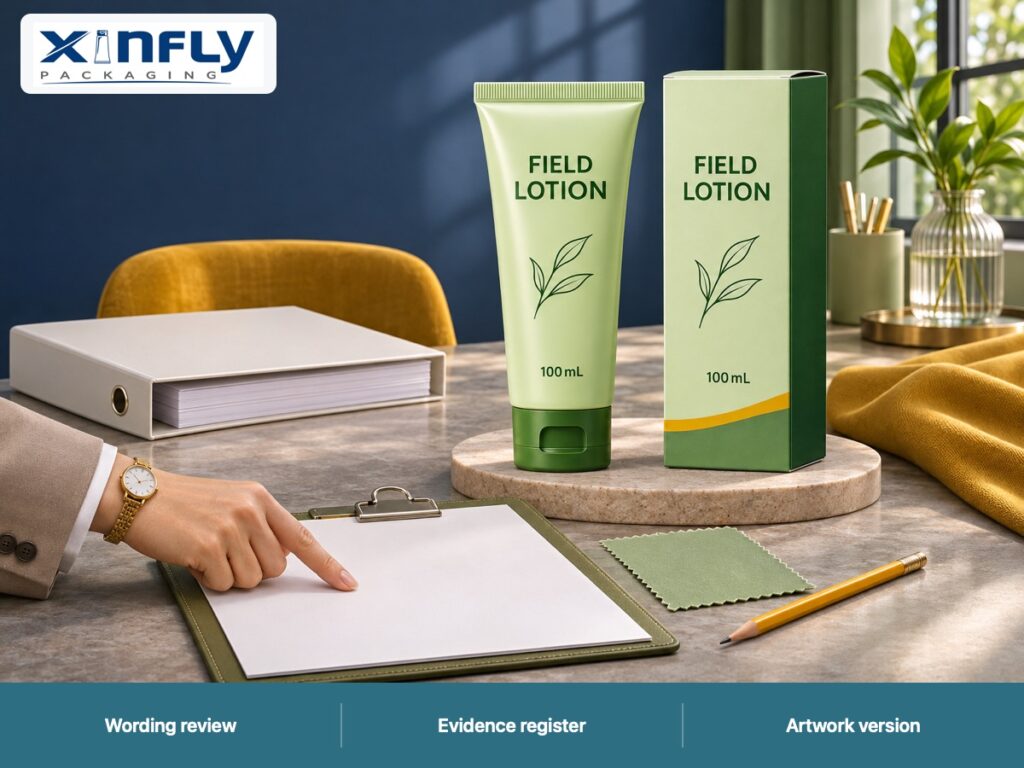
Create a claim register with the exact sentence, component scope, source document, reviewer and artwork version. Include icons and short side-panel text, not just the main headline. A small leaf accompanied by a broad statement can communicate a larger claim than the purchasing brief intended. Review the complete visual context with the responsible brand team.
For sugarcane cosmetic packaging, compare the tube and carton together. A carton may contain information about the tube, but the layout should not make that information appear to describe the board itself. Record which packaging component each sentence refers to and where the wording appears in the design.
Hold Unconfirmed Statements Without Holding Every Design Decision
The team can develop the name, color, dimensions and decorative print while a material claim is being reviewed. Mark the claim area as open in the controlled proof. Release only the version the reviewer has actually approved. Do not send a production file with an unresolved percentage and assume someone will remove it before printing.
If evidence arrives late, update the artwork through the same version process as any other change. Recheck the available print area and text size. A rushed claim addition can create an artwork problem even when the underlying statement is supportable.
| Field | What to enter | Question before printing |
|---|---|---|
| Exact statement | Complete wording and visual context | What will the customer think it covers? |
| Component scope | Body, shoulder, cap or assembled pack | Does the source cover that scope? |
| Evidence | Document ID, date, sample and method | Is it relevant to the ordered configuration? |
| Review | Actual reviewer and decision date | Is the wording approved for this use? |
| Artwork | File revision and tube/carton location | Is this the signed production version? |
Keep Material Performance in Its Own Sample Program
Test the Actual Formula and Filler
Material-origin evidence does not establish formula compatibility, dispensing, sealing or transport behavior. Develop those checks for the proposed assembly and actual formula. Tell the supplier and filler which body construction, cap and decoration will be used. A material change can affect which parts of the sample program need repeating, even when the front artwork remains unchanged.
Use Xinfly's sample development process to define identified parts for the relevant trials. Keep physical sample results separate from sourcing declarations and claim review. Each record answers a different procurement question, and together they make the release decision easier to audit.
Approve Printing on the Selected Material
Confirm the tube printing process and review the intended ink and finish on a representative body. Check the printed carton beside the tube under the same light. The color match and physical print review are practical buying tasks; they do not establish the environmental attribute. Retain the approved decorated sample with the material and artwork revisions used.
Ask Xinfly Packaging for a Scope-Based Quotation
Send the product application, formula type, nominal fill, dimensions, body construction preference, cap, decoration, carton scope, quantity and destination market. Include the exact claim you are considering and the evidence your reviewer needs. Ask the Xinfly Packaging team to review the material brief and separate available documents, additional work and physical sample costs in its response.
Compare suppliers against the same component scope and evidence request. A quotation with a clear body-level proposal may be more useful than a broad sustainability promise with no part references. The purchase decision should connect the material supplied, the package tested and the wording approved.
Frequently Asked Questions
Does a green tube prove it contains sugarcane-derived PE?
No. Color and decoration are design choices. Request material identification and sourcing evidence for the proposed component and keep the records tied to the ordered revision.
Can a body document cover the cap automatically?
Do not assume that. The cap is a separate component with its own material and source. Ask which parts the document and proposed claim explicitly include.
Is a biobased-carbon percentage the same as package mass content?
The reporting bases can differ. Read the method, specimen and denominator in the actual evidence and have the responsible reviewer confirm how the result may be described.
Can the carton repeat the tube's material statement?
It can be considered as information about the tube, but the wording and layout need a clear component reference and review. Do not let a tube statement appear to describe the carton board.
What should happen if a resin or cap supplier changes?
Update the assembly record and review the affected sourcing evidence, physical tests and artwork claims. Decide what needs repeating before relying on the earlier release.
Conclusion
A sugarcane PE tube claim evidence check connects the exact public statement with the actual ordered components. Define the scope, understand the reporting basis, match documents to the assembly and keep claim approval separate from physical testing. Xinfly Packaging can discuss the proposed structure and available evidence when the RFQ explains the package, destination market and wording your brand wants to support.