

Laminate Tubes for Eye Gel
Custom laminate tubes for eye gel in ABL and PBL structures for cooling eye gels, hydrating eye gels, under-eye treatments and lightweight eye-care formulas.
Xinfly Packaging manufactures compact eye gel tubes with precision nozzles, selected metal cooling tips, custom diameters, printing and premium finishes for skincare brands and OEM / ODM projects.
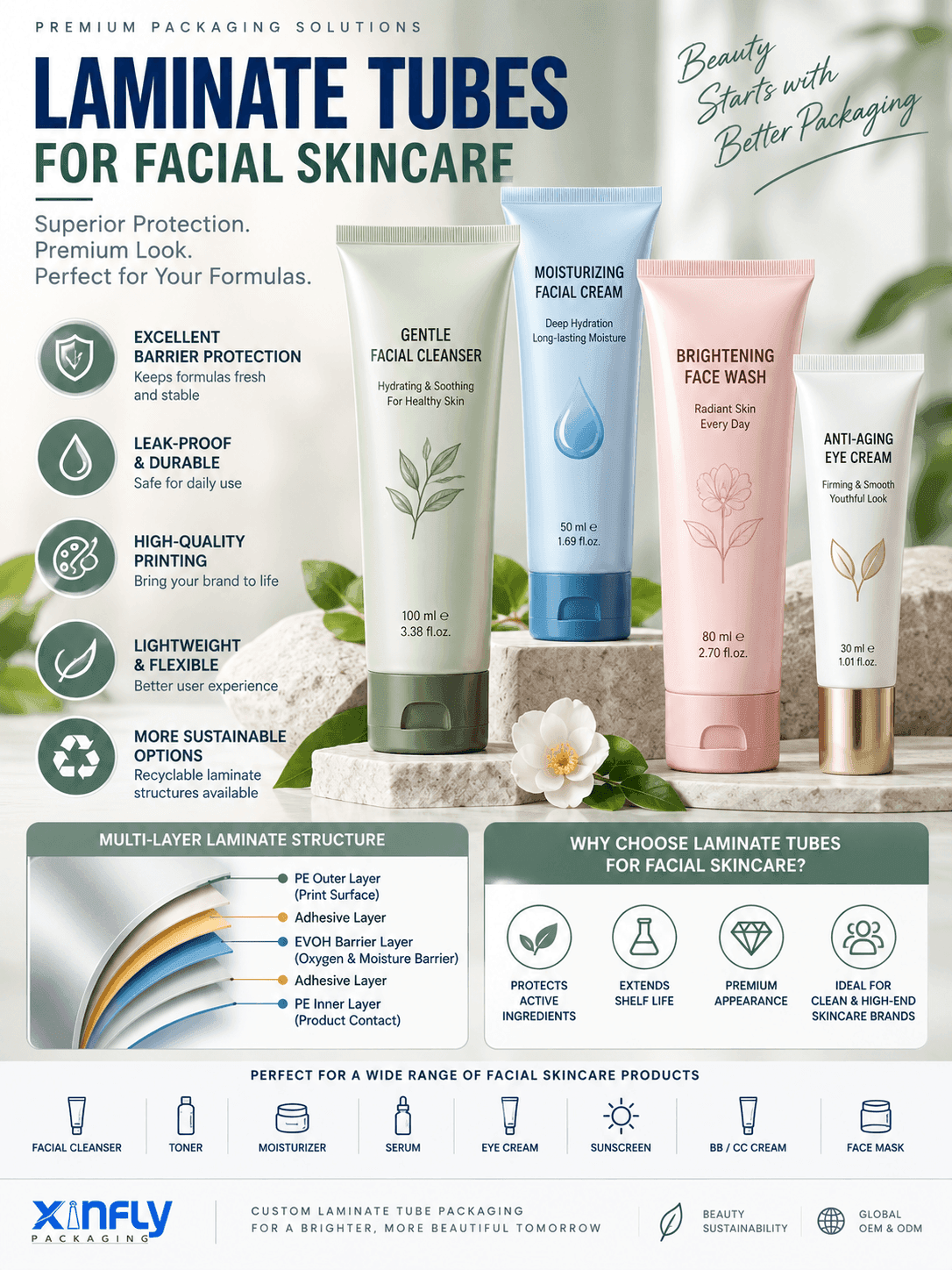
Why Use Laminate Tubes for Eye Gel?
Eye gels are commonly positioned around lightweight texture, controlled application and a fresh consumer experience. A well-designed laminate tube can combine formula protection, precision dispensing, portability and premium skincare branding.
Controlled Dose
Precision dispensing helps manage the small amount normally used around the eye area.
Cooling Experience
Selected metal-tip concepts can complement cooling and refreshing eye-gel positioning.
Compact Packaging
Small tube formats are portable and suitable for daily skincare routines.
Barrier Choice
ABL and PBL offer different structures for formula-specific requirements.
Eye Gel Products Suitable for Laminate Tube Packaging
Different eye-gel products can require different barrier, dispensing and applicator directions. Packaging should be matched to the actual formula rather than selected from the product name alone.
Cooling Eye Gel
Designed around a fresh application experience with controlled dispensing.
Hydrating Eye Gel
Compact packaging for lightweight daily moisturizing eye care.
Under-Eye Gel
Precision packaging for targeted under-eye application.
De-Puffing Eye Gel
Selected cooling-tip concepts can support refreshing product positioning.
Caffeine Eye Gel
Material selection should be based on the complete formula and stability requirements.
Hyaluronic Eye Gel
Compact tubes for hydrating and lightweight eye-care products.
Peptide Eye Gel
Premium packaging direction for targeted eye-area skincare.
Brightening Eye Gel
Custom printing and finishes for premium brightening ranges.
Men's Eye Gel
Minimalist tube designs for men's skincare and grooming lines.
After-Sun Eye Gel
Selected refreshing eye-area care and travel skincare concepts.
Travel Eye Gel
Compact sizes for travel kits, samples and skincare sets.
Private Label Eye Gel
Custom tubes for OEM, private-label and multi-SKU programs.
Eye Gel Tubes vs Eye Cream Tubes
Eye gel and eye cream can use similar tube formats, but their dispensing behavior can be very different. This is why the two packaging projects should not automatically use the same outlet or applicator.
| Packaging Factor | Eye Gel | Eye Cream | Engineering Focus |
|---|---|---|---|
| Texture | Often lighter | Often richer | Actual viscosity matters most |
| Dispensing | Higher risk of over-dispensing for low-viscosity formulas | May require more squeeze force | Match outlet to formula |
| Applicator | Cooling tip / precision nozzle | Precision nozzle / standard outlet | Consumer application method |
| User Experience | Fresh / cooling / lightweight | Rich / nourishing / treatment | Package should support positioning |
| Capacity | 10–30 ml direction | 10–30 ml direction | Consumption and product positioning |
ABL vs PBL for Eye Gel Tubes
Choose the laminate structure according to the complete formula, required barrier, desired appearance and commercial packaging strategy—not simply because the product is called an eye gel.
ABL Eye Gel Tubes
ABL uses an aluminum foil barrier layer and can support white or metallic silver eye-care packaging directions.
- White / silver
- Total thickness: 220 / 250 / 275 μm
- Total thickness: 310 / 350 / 360 / 390 μm
- Aluminum foil: 12 / 20 μm
- High light-barrier direction
- Custom printing and closures
PBL Eye Gel Tubes
PBL uses EVOH as the functional barrier layer and can support white or transparent visual directions.
- White / transparent
- Total thickness: 310 / 330 / 350 μm
- Total thickness: 370 / 390 / 400 μm
- EVOH: 8 / 15 μm
- Transparent visual direction available
- Custom printing and closures
Transparent PBL can look attractive for gel products—but appearance is not the first decision.
A transparent tube can visually reinforce the clear or gel-like character of selected eye products. However, if the formula requires stronger light protection or other specific barrier performance, material selection should take priority over the transparent visual concept.
Eye Gel Tube Sizes: 10 ml to 30 ml
| Capacity | Diameter Direction | Application | Positioning |
|---|---|---|---|
| 5–10 ml | Φ19 / project dependent | Sample / targeted gel | Trial / mini |
| 10 ml | Φ19 / Φ22 | Eye gel / under-eye treatment | Compact precision |
| 15 ml | Φ19 / Φ22 / Φ25 | Cooling / hydrating eye gel | Classic eye-care format |
| 20 ml | Φ22 / Φ25 | Daily eye gel | Extended-use format |
| 25 ml | Φ25 / Φ30 | Eye treatment gel | Larger treatment format |
| 30 ml | Φ25 / Φ30 | Multi-use eye / facial treatment | Higher-volume format |
Choose the Right Applicator for Eye Gel
For eye gel packaging, dispensing performance can be as important as the laminate material. Low-to-medium viscosity products require careful outlet selection to prevent excessive product flow.
Precision Nozzle
Supports controlled dispensing for targeted under-eye application.
Long Nozzle
Suitable for selected treatment-style and precision skincare concepts.
Metal Cooling Tip
Combines product dispensing with a cool-touch application surface.
Massage Applicator
Selected applicator designs can support a differentiated application experience.
Small Orifice
Useful for controlling lighter gels that could otherwise dispense too quickly.
Screw Cap
Simple closure direction for compact eye gel squeeze tubes.
Airless Pump Tube
Alternative dispensing direction for selected premium eye-care projects.
Custom Applicator
Project-specific systems can be reviewed for formula and branding requirements.
Metal Cooling Tip Tubes for Eye Gel
A metal cooling applicator can create a distinctive sensory experience for cooling, refreshing and de-puffing eye-gel positioning while allowing the package itself to participate in product application.
Cool-Touch Feel
Metal contact provides a naturally cool surface at initial application.
Targeted Application
The applicator can guide product toward the under-eye area.
Premium Appearance
Metallic applicators can support prestige skincare positioning.
Integrated Experience
Dispensing and application can be combined in one packaging concept.
A cooling tip should be selected for function—not just appearance.
Before production, evaluate gel viscosity, flow path, dispensing pressure, applicator contact surface, closure fit, leakage risk and consumer application method. A premium-looking applicator is only successful when the gel also dispenses cleanly.
Match Eye Gel Viscosity to the Outlet
| Formula Direction | Viscosity | Dispensing Direction | Main Risk |
|---|---|---|---|
| Fluid Gel | Low | Small / precision outlet | Over-dispensing or dripping |
| Light Eye Gel | Low–medium | Precision nozzle | Uncontrolled flow |
| Cooling Gel | Medium | Cooling tip / nozzle | Applicator flow resistance |
| Rich Gel | Medium–high | Appropriate larger flow path | High squeeze force |
| Gel-Cream | Formula dependent | Nozzle / standard outlet | Incorrect assumptions from product name |
Transparent PBL Tubes for Clear Eye Gel
For selected formulas, transparent PBL can create a visual connection between the gel texture and the packaging design. This can be especially useful for clear, blue-tinted or fresh-looking cosmetic gel concepts.
Show the Gel Character
Transparent areas can allow the product appearance to become part of the packaging design.
White Underprint
Selected artwork areas can use white underprint to improve graphic contrast.
Transparent Windows
Artwork can combine printed areas with selected clear visual zones.
Custom Printed Eye Gel Tubes
Eye gel packaging can combine clinical, refreshing or prestige visual directions through custom colors, printing, metallic details and surface finishes.
Offset Printing
Multi-color graphics for branded eye-care packaging.
Silk Screen
Selected text and logos for premium graphic effects.
Hot Stamping
Metallic accents for prestige eye-gel packaging.
Pantone Colors
Custom colors for tubes, graphics and coordinated closures.
Matte Finish
Modern low-gloss direction for clinical and premium skincare.
Glossy Finish
Clean bright surface for fresh gel-oriented product concepts.
Soft-Touch
Selected projects can use a premium tactile finish.
Multi-SKU Artwork
Coordinate eye gel, eye cream and other eye-care products.
Eye Gel Tube Filling Considerations
Empty eye gel tubes can be supplied open at the tail for downstream filling and final sealing. Small diameters require careful coordination with filling-line tooling.
Tube Diameter
Confirm compact tube dimensions with filling equipment.
Finished Length
Allow room for fill volume and final tail sealing.
Eye Mark
Confirm artwork orientation requirements before production.
Seal Area
Protect critical artwork from the heat-sealing zone.
10 Common Eye Gel Tube Packaging Problems
Gel Drips After Dispensing
A fluid eye gel uses an outlet that is too large.
Control the Flow Path
Match the outlet to actual viscosity and target dose.
Too Much Gel Comes Out
The dispensing system is not designed for small-dose use.
Use Precision Dispensing
Evaluate a smaller outlet, nozzle or suitable applicator.
Cooling Tip Restricts Flow
The gel is too viscous for the applicator flow path.
Test Formula & Tip Together
Validate squeeze force and dispensing before production.
Applicator Leaks
Formula, outlet and closure are not validated as a system.
Test the Filled Package
Evaluate leakage in intended storage and transport conditions.
Transparent Tube Chosen Only for Appearance
Formula protection requirements are overlooked.
Prioritize Formula Requirements
Confirm whether transparent packaging is appropriate.
Tube Is Too Stiff
The structure makes precise dispensing difficult.
Balance Barrier & Squeeze Feel
Avoid over-specifying the tube without a functional reason.
Artwork Is Too Crowded
Too much information is placed on a 10–20 ml tube.
Simplify the Front Panel
Prioritize brand, product name and key communication.
Tube Does Not Fit Filling Line
Diameter is finalized before equipment confirmation.
Confirm Filling Parameters
Review holder, tube length and sealing requirements early.
Hot Foil Enters Tail Seal
Decoration is positioned too close to the sealing area.
Reserve a Safe Tail Zone
Design artwork using final finished tube dimensions.
Repeat Orders Vary
Material, color or applicator specifications change.
Lock Approved References
Maintain approved material, dimensions, color and decoration data.
How to Choose Laminate Tubes for Eye Gel
Why Choose Xinfly for Eye Gel Tube Packaging?
Xinfly Packaging supports eye-care packaging projects from laminate selection and compact tube dimensions to precision dispensing, decoration and commercial production.
B2B Experience
Cosmetic and personal-care tube packaging manufacturing experience.
Production Capacity
Scalable production for launches, repeat orders and multi-SKU programs.
Annual Capacity
Commercial manufacturing capacity for international customers.
Barrier Options
Different laminate structures for eye-care packaging requirements.
Applicator Options
Nozzle, cooling-tip and selected custom dispensing directions.
Engineering Support
Support for size, material, outlet, printing and filling considerations.
Explore Related Laminate Tube Solutions
Laminate Tubes for Eye Gel FAQ
1. What are laminate tubes for eye gel?
2. What size tube is suitable for eye gel?
3. What diameters are available for eye gel tubes?
4. Is PBL suitable for eye gel?
5. Is ABL suitable for eye gel?
6. Can eye gel use a transparent tube?
7. Can eye gel tubes use a metal cooling tip?
8. What is the advantage of a cooling tip?
9. Can low-viscosity eye gel leak from the tube?
10. What outlet size should I use for eye gel?
11. Can eye gel use a long nozzle?
12. Can eye gel use an airless pump tube?
13. Can eye gel tubes be custom printed?
14. Can transparent PBL tubes use white printing?
15. Can eye gel tubes have a matte or soft-touch finish?
16. Are eye gel tubes supplied empty?
17. Should the actual eye gel formula be tested with the package?
18. What is the MOQ for custom eye gel tubes?
19. How long does eye gel tube production take?
20. What information is needed for an eye gel tube quotation?
Need Custom Laminate Tubes for Eye Gel?
Send Xinfly Packaging your eye-gel formula type, fill volume, viscosity, quantity, preferred ABL or PBL structure and applicator direction. We can help review the tube diameter, barrier material, precision outlet, cooling-tip options, printing and filling requirements before sampling.