

Empty PBL Tubes with EVOH Barrier for Cosmetic Packaging
Empty PBL tubes combine a flexible plastic laminate tube construction with an EVOH functional barrier layer in selected structures. They are designed for cosmetic, skincare, sunscreen, oral-care and personal-care brands seeking a laminate tube with strong gas-barrier potential, custom printing and white or transparent appearance options.
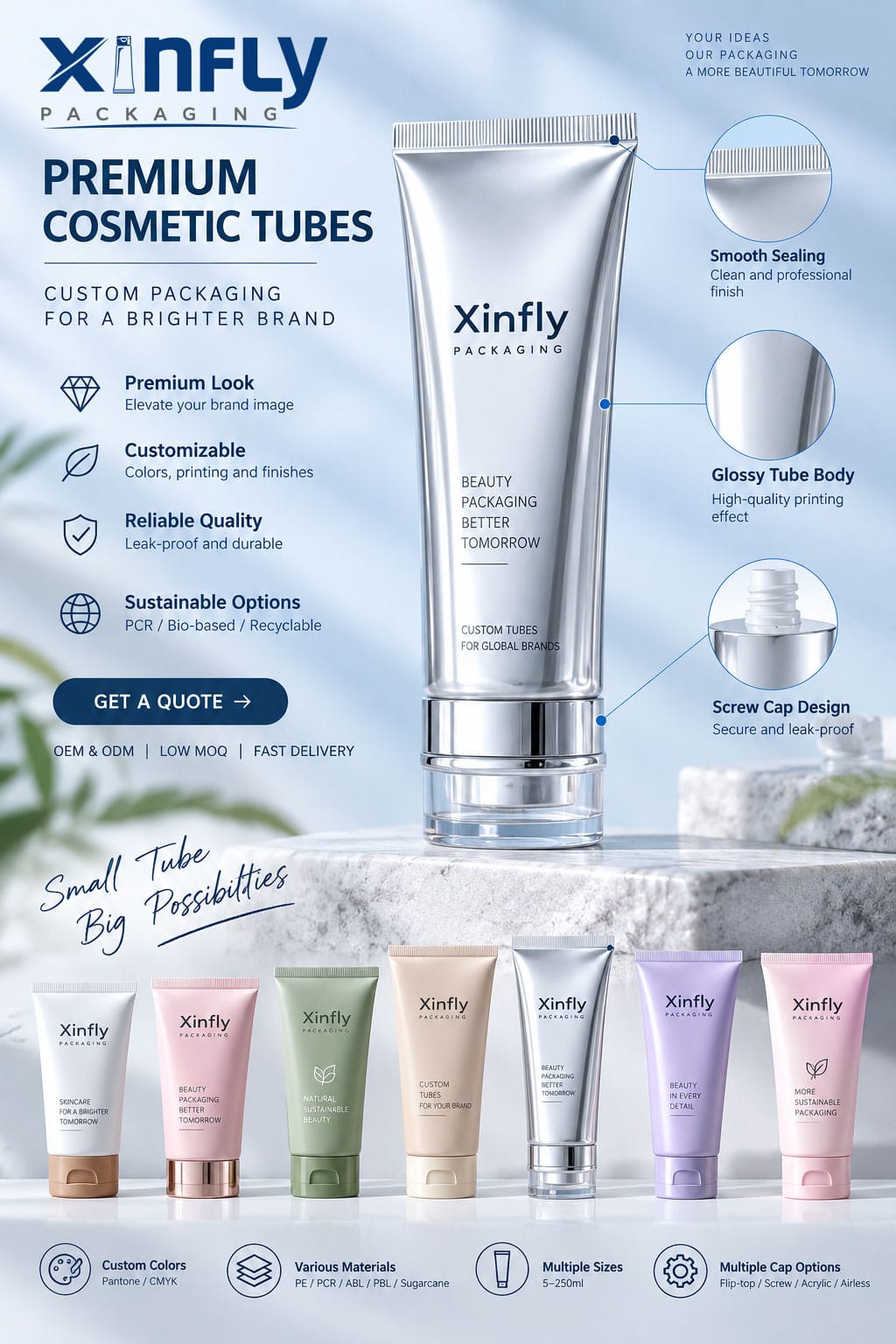
Xinfly Packaging manufactures custom Plastic Barrier Laminate tubes with multiple laminate thicknesses, EVOH options, tube diameters, capacities, closures and printing configurations. Empty tubes can be supplied according to the customer's downstream filling and tail-sealing process.
What Are Empty PBL Tubes?
PBL stands for Plastic Barrier Laminate. An empty PBL tube is a finished laminated squeeze tube supplied without the customer's formula inside. Selected PBL constructions incorporate EVOH as a functional barrier layer, providing strong gas-barrier potential while retaining a plastic laminate tube structure.
EVOH is used in selected PBL structures to improve gas-barrier performance compared with a conventional non-barrier plastic tube construction.
PBL provides a laminate packaging option without using an aluminum foil barrier layer.
Different PBL constructions can support clean white packaging or transparent visual directions depending on the selected material.
Tube diameter, length, shoulder, closure, orifice, printing and decoration can be customized before filling.
How an EVOH Barrier PBL Tube Is Built
A typical PBL structure combines polymer films, bonding layers and an EVOH functional barrier layer into a laminate web that can be printed and converted into the finished tube body.
PBL Thickness & EVOH Barrier Options
Different PBL specifications allow the finished tube to be engineered around barrier requirements, tube diameter, capacity, stiffness, squeeze behavior and visual design.
Why Use EVOH in Empty PBL Tubes?
EVOH is used as a functional barrier material in multilayer packaging because of its strong gas-barrier properties. In PBL tube packaging, it can provide additional formula protection while preserving a plastic laminate construction.
Gas Barrier
The EVOH layer can substantially improve gas-barrier performance compared with a basic non-barrier plastic tube structure.
Formula Protection
For selected formulations, reducing gas transmission through the tube wall can support the package's overall protection strategy.
Plastic Laminate Design
PBL achieves functional barrier performance without using the aluminum foil barrier found in ABL.
Transparent Possibilities
Selected PBL constructions can support transparent packaging designs that are not possible with opaque aluminum foil ABL.
Flexible Tube Feel
The complete laminate can be engineered to provide a balance between tube body stiffness, flexibility and squeeze recovery.
Printing Flexibility
PBL supports high-quality printed artwork for skincare, cosmetics, oral care and personal-care packaging.
White PBL Tubes vs Transparent PBL Tubes
One of PBL's useful design advantages is the ability to choose between an opaque white appearance and selected transparent packaging directions.
White PBL Tubes
White PBL provides a clean, neutral base for cosmetic branding while incorporating an EVOH functional barrier in selected constructions.
- Clean cosmetic appearance
- Strong base for multi-color artwork
- Suitable for skincare and sunscreen
- Supports matte or glossy design directions
- Useful for clinical and minimalist branding
Transparent PBL Tubes
Transparent PBL allows the product or internal package appearance to become part of the visual design while retaining an EVOH barrier in selected structures.
- Product visibility possibilities
- Modern cosmetic appearance
- Suitable for gels and selected clear products
- Can combine transparent and printed areas
- Physical proof recommended for transparency expectations
What Products Can Use Empty PBL Tubes?
PBL is used across skincare, cosmetics, sun care, oral care and personal care. The final laminate structure should be selected and tested against the actual formulation.
Face Cream Tubes
White PBL tubes for moisturizers, anti-aging creams, facial treatments and everyday skincare products.
Sunscreen Tubes
PBL structures can be evaluated for facial sunscreen, body sunscreen and other SPF packaging projects.
Facial Cleanser Tubes
Custom PBL tubes for face wash, cleansing creams, exfoliating formulas and specialty cleansers.
BB & CC Cream Tubes
Printed PBL tubes for BB cream, CC cream, foundation, primer and complexion products.
Vitamin C Tubes
EVOH barrier PBL can be evaluated for selected active skincare formulas where gas-barrier performance is an important requirement.
Retinol Tubes
PBL can be considered for selected retinol packaging, although light protection and complete package requirements must also be evaluated.
Toothpaste Tubes
PBL provides an alternative laminate construction for household, travel and specialty oral-care tube packaging.
Hand Cream Tubes
White or custom printed PBL tubes for moisturizing, repair and premium hand-care products.
Transparent Gel Tubes
Transparent PBL can create a distinctive package for selected gels and clear cosmetic formulations where product visibility is desired.
Empty PBL Tube Sizes & Capacities
| Diameter | Typical Size Direction | Common PBL Applications | Closure Direction |
|---|---|---|---|
| Φ19 mm | Small-volume formats | Eye cream, spot treatment, samples | Screw / nozzle |
| Φ22 mm | Small cosmetic formats | Eye care, specialty treatment | Screw / nozzle |
| Φ25 mm | Small–medium formats | Face cream, BB cream, gel | Screw |
| Φ30 mm | Approx. 30–60 ml direction | BB/CC cream, skincare, hand cream | Screw / flip top |
| Φ35 mm | Approx. 40–100 ml direction | Sunscreen, skincare, toothpaste | Screw / flip top |
| Φ40 mm | Approx. 60–150 ml direction | Face wash, sunscreen, cleanser | Flip top / stand-up |
| Φ45–50 mm | Larger formats | Body care, cleanser, hair care | Flip top / stand-up |
Custom Closures for Empty PBL Tubes
The closure, tube head and dispensing opening should be selected as one system according to the formula, consumer use and filling requirements.
Screw Caps
Suitable for skincare, makeup, treatment creams and oral care.
Flip-Top Caps
Convenient for sunscreen, cleanser and frequent-use products.
Stand-Up Caps
Useful for inverted storage, shelf presentation and larger tubes.
Nozzle Closures
Designed for controlled or targeted dispensing of selected formulas.
Airless Pump Heads
Can be evaluated for selected premium cosmetic tube projects.
Acrylic Closures
Decorative closure direction for premium skincare packaging.
Custom Cap Colors
Closure colors can be coordinated with the tube artwork and brand identity.
Custom Orifice
Typical projects may use approximately 1.5 / 3 / 5 mm openings depending on formula viscosity.
Printing & Decoration for Empty PBL Tubes
PBL laminate can support rich cosmetic artwork, brand colors and decorative finishes. Artwork engineering should consider the final tube shape, seam, shoulder and material appearance.
Offset Printing
Suitable for multi-color graphics, branding and large-volume cosmetic tube production.
Silk Screen
Useful for strong logos, solid graphics and selected premium design elements.
Hot Stamping
Adds metallic decorative accents to white or custom printed PBL tube designs.
Matte / Glossy
Surface appearance can be coordinated with the selected laminate and artwork.
PBL Tubes Engineered for Your Filling Process
Empty PBL tubes are commonly delivered with the tube head and closure assembled while the tail remains open. The customer or contract filler fills the formula through the open tail before sealing and trimming.
Open-Tail Tubes
Finished empty PBL tubes can be supplied for downstream filling through the tube tail.
Tail-Sealing Compatibility
The selected laminate and tube dimensions should be coordinated with the intended sealing equipment and process.
Eye Mark & Orientation
Registration marks can support artwork orientation and tail-seal positioning during downstream production.
Empty PBL Tubes vs Empty ABL Tubes
The key difference is the functional barrier technology: PBL uses EVOH in selected structures, while ABL incorporates aluminum foil.
| Factor | Empty PBL Tubes | Empty ABL Tubes |
|---|---|---|
| Barrier Layer | EVOH in selected structures | Aluminum foil |
| Construction Direction | Plastic barrier laminate | Aluminum barrier laminate |
| Color | White / transparent | White / silver |
| Transparency | Possible in selected structures | Not transparent due to foil |
| Gas Barrier | Strong with suitable EVOH structure | High barrier potential |
| Light Barrier | Depends on complete construction and pigmentation | Strong opaque light barrier |
| Typical Design Driver | Plastic laminate + EVOH + appearance flexibility | Aluminum foil barrier + opaque/metallic structure |
| Selection Method | Evaluate formula, barrier requirement, transparency, tube feel, artwork, filling process and compatibility. | |
10 Common Problems When Buying Empty PBL Tubes
PBL sourcing requires more than choosing “EVOH.” The complete material, tube dimensions, appearance, closure, artwork and filling conditions must work together.
PBL Is Specified Without a Barrier Target
The buyer requests EVOH because it sounds more protective, but the actual formula requirement has not been defined.
Start with the Formula
Review formula sensitivity and package requirements before defining the PBL structure.
8 μm or 15 μm EVOH?
The buyer assumes the thicker EVOH option must automatically be better.
Evaluate Complete Barrier Performance
Select EVOH together with total laminate construction, formula requirements and finished package behavior.
Wrong Total Laminate Thickness
The tube becomes too stiff or does not provide the desired squeeze feel.
Match Thickness to Tube Geometry
Evaluate diameter, length, capacity and desired body feel before selecting 310–400 μm PBL.
Transparency Is Different Than Expected
The buyer expects perfectly clear packaging without approving the actual laminate.
Approve the Actual Transparent Material
Review physical laminate and converted tube samples before locking the visual specification.
Transparent Artwork Loses Impact
Brand colors appear different because there is no opaque white base underneath.
Engineer White Underprint
Separate transparent windows from opaque printed areas and use white underprint where required.
Wrong Orifice for Formula Viscosity
The package dispenses too quickly or requires excessive squeezing.
Match Dispensing Geometry
Evaluate viscosity, consumer use and target dose before confirming the opening.
Closure Does Not Seal Correctly
The cap appearance is approved without fully validating the tube head interface.
Test the Complete Closure System
Validate thread, sealing surface, cap assembly and dispensing together.
Tube Does Not Fit Filling Equipment
Tail allowance, overall length or orientation was not confirmed before production.
Review Filling-Line Data
Coordinate the finished tube specification with the filler before mass production.
EVOH Is Assumed to Guarantee Compatibility
Barrier performance is confused with chemical compatibility.
Run Formula Compatibility Tests
Evaluate the actual product against the inner contact layer, complete tube and closure.
Repeat Orders Do Not Match
Material, transparency, color or dimensions vary because approved specifications were not locked.
Maintain an Approved Master Standard
Retain approved laminate, artwork, tube dimensions, color references and finished tube samples for repeat production.
How Xinfly Develops an Empty PBL Tube
Our engineering workflow connects EVOH barrier selection with finished tube design, artwork, closure and downstream filling requirements.
Formula Review
Understand the formula, viscosity, sensitivity and intended use.
Barrier Definition
Determine the required package protection and whether PBL is appropriate.
PBL Selection
Evaluate total thickness, EVOH option and white or transparent material.
Tube Engineering
Confirm diameter, capacity, length, shoulder and orifice.
Artwork & Closure
Coordinate printing, transparent areas, cap design and dispensing.
Filling Validation
Review the finished empty tube against filling and tail-sealing requirements.
From PBL Laminate to Finished Empty Tube
Quality Checks for Empty PBL Tubes
Material Specification
Confirm the agreed PBL structure, total thickness and EVOH option.
Tube Dimensions
Check diameter, length, head and other critical dimensions.
Transparency
For transparent projects, compare visual appearance with the approved reference.
Printing
Check artwork position, registration and approved colors.
Closure Fit
Inspect cap assembly, thread engagement and sealing interface.
Tube Body
Inspect laminate conversion, seam and overall tube appearance.
Orientation
Confirm eye mark and artwork position for filling-line use.
Reference Standard
Compare mass production with the approved specification and physical sample.
Why Source Empty PBL Tubes from Xinfly Packaging?
Xinfly combines laminate material knowledge with finished tube manufacturing, printing, closure matching and filling-line engineering support.
15+ Years Experience
Long-term B2B manufacturing experience in cosmetic and personal-care tube packaging.
60M+ Annual Capacity
Scalable production capability for international brands, distributors and contract manufacturers.
10,000+ m² Workshop
Integrated manufacturing environment for custom cosmetic tube production.
Current PBL Options
310–400 μm total thickness with 8 or 15 μm EVOH options.
White & Transparent
Support for different package appearance and artwork directions.
Engineering Support
Assistance with material, tube size, closure, dispensing and filling requirements.
Empty PBL Tubes RFQ Checklist
Provide the following information so the tube can be quoted and engineered around the actual packaging project.
Send Your PBL Tube Requirements
If you already have a reference tube, drawing, formula information or filling-machine specification, send it together with your inquiry.
Explore More Laminate Tube Solutions
Printed Laminated Web
Custom printed laminate web for cosmetic tube conversion.
Printed Laminated Web →Empty PBL Tubes FAQ
Common technical and sourcing questions about PBL and EVOH barrier cosmetic tube packaging.
1. What is an empty PBL tube?
2. What does PBL mean?
3. What is EVOH in PBL tubes?
4. What EVOH thicknesses are available?
5. What PBL total thicknesses are available?
6. Are PBL tubes available in transparent material?
7. What sizes of empty PBL tubes are available?
8. Can PBL tubes be used for skincare?
9. Can PBL tubes be used for sunscreen?
10. Can PBL tubes be used for toothpaste?
11. What is the difference between PBL and ABL?
12. Is PBL better than ABL?
13. Is 15 μm EVOH always better than 8 μm EVOH?
14. Is 400 μm PBL always better than 310 μm?
15. Can transparent PBL tubes be custom printed?
16. What caps can be used with PBL tubes?
17. Should I test my formula with PBL?
18. How are empty PBL tubes filled?
19. What is the MOQ for custom empty PBL tubes?
20. What information is required for a PBL tube quotation?
Looking for Custom Empty PBL Tubes?
Send Xinfly Packaging your formula, fill volume, tube diameter, white or transparent PBL preference, barrier requirement, closure, artwork, filling method and quantity. Our packaging engineers can help evaluate the EVOH structure and finished tube specification for your project.