

Empty ABL Tubes for Cosmetic & Personal Care Packaging
Empty ABL tubes combine the convenience and squeezability of a laminated tube with an aluminum foil barrier layer engineered for packaging applications where protection from light, oxygen and moisture is an important consideration. Xinfly Packaging manufactures custom empty Aluminum Barrier Laminate tubes for sunscreen, toothpaste, skincare, pharmaceutical-style personal care, creams, gels and other formulations.
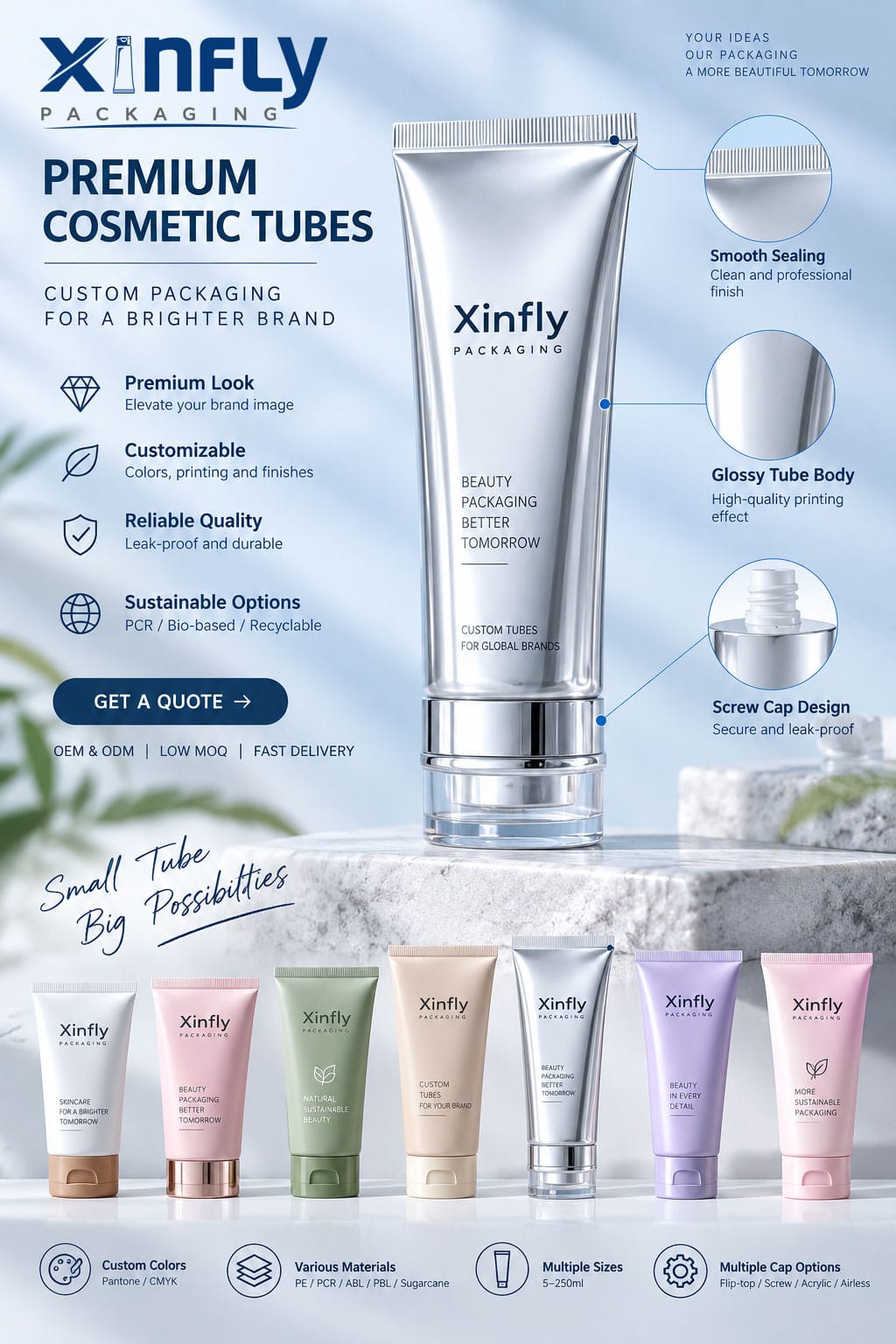
What Are Empty ABL Tubes?
Empty ABL tubes are laminated squeeze tubes supplied without product inside. ABL stands for Aluminum Barrier Laminate. The laminate incorporates a thin aluminum foil layer between polymer layers to create a flexible tube structure with high barrier potential while retaining the familiar appearance and dispensing convenience of a squeeze tube.
The aluminum layer provides a strong barrier against light and helps reduce transmission of oxygen and moisture through the tube wall.
ABL provides barrier functionality in a lightweight squeeze-tube package suitable for many cosmetic and personal-care applications.
Choose white, silver or other customized visual directions together with brand printing and decorative finishing.
Empty tubes can be engineered around the customer's filling, orientation and tail-sealing requirements.
How an Aluminum Barrier Laminate Tube Is Built
A typical ABL construction combines polymer films, bonding layers and aluminum foil into one laminated web, which is subsequently converted into the tube body.
ABL Thickness & Aluminum Foil Options
Xinfly Packaging can evaluate different ABL material thicknesses and foil options according to the finished tube design, required body feel, barrier objective and conversion requirements.
Why Brands Choose Empty ABL Tubes
ABL tubes are particularly useful when the packaging brief combines barrier requirements with the convenience, printability and lightweight characteristics of a squeeze-tube format.
Light Protection
The aluminum foil layer creates an opaque barrier that can be valuable for formulations where exposure to light is an important packaging consideration.
Oxygen Barrier
ABL provides high oxygen-barrier potential, making it a candidate for selected formulas that require stronger protection than standard PE tube structures.
Moisture Barrier
The aluminum layer also contributes to moisture-barrier performance when incorporated into a properly designed complete laminate.
Product Aroma Protection
For selected formulas, the complete laminate structure can help reduce package interaction with external environmental conditions.
Premium Metallic Direction
Silver ABL can be used as part of the visual design, allowing metallic areas to interact with printing and decoration.
Efficient Squeeze Packaging
ABL combines barrier functionality with a collapsible tube format that is familiar to consumers and convenient for dispensing.
White ABL Tubes vs Silver ABL Tubes
Both can use an aluminum barrier laminate structure, but their visual design strategies can be very different.
White ABL Tubes
White ABL provides a clean base for skincare, pharmaceutical-style, sunscreen, toothpaste and personal-care branding.
- Clean white packaging appearance
- Suitable for multi-color artwork
- Easy integration with brand color systems
- Common for clinical and skincare positioning
- Suitable for matte or glossy design directions
Silver ABL Tubes
Silver ABL allows the metallic appearance of the laminate to become part of the finished packaging design.
- Metallic visual effect
- Premium cosmetic positioning
- Can combine opaque and exposed silver areas
- Suitable for men's care and specialty products
- Physical printed proof recommended
What Products Can Be Packed in Empty ABL Tubes?
ABL is used across oral care, skincare, sun care, beauty and personal care. The final material should still be validated against the actual formulation rather than selected from the application name alone.
Empty ABL Sunscreen Tubes
A high-barrier tube option for SPF, mineral sunscreen, zinc oxide sunscreen and selected sun-care formulations.
Empty ABL Toothpaste Tubes
One of the established applications for aluminum barrier laminate packaging, available for household, travel and specialty toothpaste products.
Retinol Cream Tubes
ABL can be evaluated for light- and oxygen-sensitive active skincare where strong package protection is desired.
Vitamin C Cream Tubes
High-barrier packaging can be considered for selected vitamin C formulations, subject to compatibility and stability testing.
Face Cream Tubes
Custom ABL tubes for moisturizers, anti-aging creams, treatment creams and premium facial skincare.
BB & CC Cream Tubes
Printed ABL packaging for BB cream, CC cream, foundation and selected complexion formulations.
Acne & Spot Treatment Tubes
Small ABL tubes can be evaluated for targeted creams and treatment products requiring controlled dispensing.
Hand Cream Tubes
White or silver ABL can create distinctive hand-care packaging for premium, protective and intensive formulas.
Hair Removal Cream Tubes
ABL may be evaluated for selected specialty formulations where barrier and package compatibility requirements need additional attention.
Empty ABL Tube Size & Application Guide
| Diameter | Typical Size Direction | Common Applications | Closure Direction |
|---|---|---|---|
| Φ19 mm | Small-volume tubes | Eye care, spot treatment, samples | Screw / nozzle |
| Φ22 mm | Small treatment formats | Eye cream, treatment cream | Screw / nozzle |
| Φ25 mm | Small–medium formats | BB cream, face cream, treatment | Screw |
| Φ30 mm | Approx. 30–60 ml direction | BB/CC cream, sunscreen, hand cream | Screw / flip top |
| Φ35 mm | Approx. 40–100 ml direction | Sunscreen, toothpaste, skincare | Screw / flip top / stand-up |
| Φ40 mm | Approx. 60–150 ml direction | Sunscreen, cleanser, toothpaste | Flip top / stand-up |
| Φ45–50 mm | Larger tube formats | Body care, hair care, larger toothpaste | Flip top / stand-up |
Closure Options for Empty ABL Tubes
The closure is part of the package system. Thread fit, sealing surface, orifice and formula viscosity should be considered together.
Versatile option for creams, toothpaste and treatment products.
Convenient for sunscreen, cleanser and frequent-use products.
Supports inverted storage and strong shelf presentation.
Targeted dispensing for spot treatments and specialty creams.
Can be evaluated for selected premium skincare tube projects.
Decorative option for premium beauty and skincare packaging.
Pantone-matched closure colors for coordinated brand presentation.
Typical projects may use 1.5 / 3 / 5 mm openings depending on formula viscosity.
Printing & Decoration for Empty ABL Tubes
The laminate surface provides extensive branding possibilities. Printing should be engineered together with tube forming, seam position and final package appearance rather than approved only as flat artwork.
Offset Printing
Suitable for multi-color graphics, brand blocks and high-volume cosmetic tube production.
Silk Screen Printing
Useful for strong logos, solid graphics and selected premium decorative elements.
Hot Stamping
Metallic foil accents can create additional visual contrast on white or printed ABL tubes.
Matte / Glossy Finish
Surface appearance can be selected according to the laminate, artwork and desired brand positioning.
Empty ABL Tubes Must Match Your Filling Line
For most cosmetic tube projects, the empty tube is supplied with the head and closure assembled while the tail remains open for filling. After filling, the customer or contract filler seals and trims the tube tail.
Open-Tail Supply
The tube can be delivered ready for downstream filling through the open tail, according to the agreed production specification.
Tail-Sealing Parameters
Material construction, tube dimensions and the customer's sealing equipment should be considered when establishing sealing conditions.
Eye Mark & Orientation
Registration marks can support filling-line orientation where front/back alignment or tail-seal positioning is required.
Empty ABL Tubes vs Empty PBL Tubes
Both are laminated squeeze-tube technologies, but the functional barrier layer and package design direction are different.
| Factor | Empty ABL Tubes | Empty PBL Tubes |
|---|---|---|
| Barrier Technology | Aluminum foil | EVOH in selected structures |
| Light Barrier | Strong opaque light barrier | Depends on complete structure and color |
| Gas Barrier | High barrier potential | Strong gas barrier potential with suitable EVOH structure |
| Appearance | White / silver | White / transparent |
| Transparency | No | Possible with selected PBL construction |
| Typical Decision Driver | Strong foil barrier and opaque structure | Plastic barrier laminate and appearance flexibility |
| Final Decision | Select according to formula, barrier requirement, tube appearance, filling process and compatibility testing. | |
10 Common Problems When Buying Empty ABL Tubes
A successful ABL tube project depends on much more than selecting a capacity and sending artwork. The material, tube geometry, closure, printing, formula and filling process must work as one package.
Choosing ABL Without Reviewing the Formula
The buyer requests ABL because another brand uses it, without confirming the actual barrier requirement.
Start with Formula Requirements
Review formula sensitivity, product characteristics and expected storage conditions before selecting the laminate construction.
Unsure About 12 or 20 μm Foil
A thicker foil may appear safer, but the correct choice depends on the complete package requirement.
Evaluate the Complete Laminate
Consider barrier objectives, tube construction, diameter, squeeze behavior and conversion rather than choosing foil thickness in isolation.
Wrong Tube Diameter
Capacity is confirmed but the tube becomes too long, too short or visually unbalanced.
Engineer Diameter + Length Together
Match filling volume with diameter, length, shoulder geometry and required package proportions.
Wrong Orifice Size
The dispensing opening does not match the viscosity of the formula.
Match Orifice to Product Flow
Evaluate viscosity and dispensing expectations before choosing approximately 1.5, 3, 5 mm or another suitable opening.
Closure Leakage
The cap looks correct but the thread, sealing surface or assembly is not properly matched.
Validate Tube Head + Closure Together
Check thread engagement, sealing interface, orifice and assembled package performance before mass production.
Printed Colors Look Different on Silver ABL
The metallic substrate changes the visual appearance of inks and Pantone colors.
Use White Underprint + Physical Proof
Engineer opaque and metallic areas separately and approve important colors on the actual finished material.
Tail Seal Cracks or Looks Poor
The tube may experience excessive stress around the sealing and trimming area.
Coordinate Material + Sealing Parameters
Evaluate the laminate, tail allowance, filling-line settings and decoration near the sealing zone.
Tube Does Not Fit the Filling Machine
Tube length, orientation or tail allowance was not confirmed with the contract filler.
Review Filling-Line Specifications First
Confirm machine limitations and sealing requirements before finalizing tube dimensions.
Formula Compatibility Is Assumed
The buyer assumes high barrier automatically means the package is compatible with the formula.
Run Compatibility Testing
Test the actual formula with the complete tube, inner contact layer, closure and intended storage conditions.
Repeat Orders Have Color or Material Drift
Approved specifications are not clearly documented for future production.
Lock the Approved Production Standard
Retain material specification, approved artwork, color references, tube dimensions and critical quality requirements.
How Xinfly Develops an Empty ABL Tube
Instead of treating the tube as an isolated container, our engineering workflow considers material, formula, decoration, closure and downstream filling together.
Formula Review
Understand product type, viscosity, sensitivity and expected storage conditions.
Barrier Definition
Determine whether an aluminum barrier structure fits the packaging objective.
ABL Selection
Evaluate total laminate thickness, foil option and appearance direction.
Tube Engineering
Confirm diameter, capacity, length, shoulder, head and dispensing opening.
Closure & Artwork
Match closure geometry while engineering printing, color and seam position.
Filling Validation
Review the finished empty tube against the intended filling and tail-sealing process.
From ABL Laminate to Finished Empty Tube
What Should Be Checked Before Shipping Empty ABL Tubes?
Quality control should focus on the finished packaging requirements rather than checking appearance alone.
Dimensions
Check tube diameter, length, head geometry and other critical dimensional requirements.
Printing & Color
Review artwork position, registration, visual appearance and approved color references.
Closure Fit
Check assembly, thread engagement, opening and sealing interface.
Tube Appearance
Inspect tube body, seam, shoulder and decoration for unacceptable defects.
Orientation
Verify eye mark and artwork orientation where filling-line registration is required.
Packaging Protection
Pack finished tubes to reduce contamination, deformation and transport damage.
Sample Comparison
Compare production against the approved reference sample and specification.
Filled-Package Testing
For new formulas, customer-side compatibility and storage testing remain important.
Why Buy Empty ABL Tubes from Xinfly Packaging?
Xinfly combines laminate knowledge with finished tube manufacturing, printing, closure matching and filling-line engineering support.
15+ Years B2B Experience
Experience supporting international cosmetic, skincare, personal-care and packaging buyers.
60 Million+ Annual Capacity
Scalable manufacturing capability for both developing brands and larger repeat-order programs.
10,000+ m² Clean Workshop
Integrated production environment for cosmetic tube manufacturing and quality management.
ABL Material Options
Multiple total thicknesses, 12/20 μm foil options and white/silver appearance directions.
Printing & Decoration
Offset, silk screen, hot stamping and additional customization for branded packaging.
Engineering Support
Support from material selection through tube dimensions, closure, orifice and filling requirements.
Empty ABL Tubes RFQ Checklist
The more information supplied at the beginning, the easier it is to recommend the correct tube instead of quoting only a generic package.
Send These Specifications
If you already have a reference tube, drawing or filling-machine specification, include it with your inquiry.
Explore the Laminated Tube Packaging Cluster
Empty Laminated Tubes
Compare empty ABL and PBL tube packaging for different cosmetic applications.
Empty Laminated Tubes →Aluminum Barrier Laminate Web
Learn more about ABL material, foil options and laminate web engineering.
ABL Web →Silver Laminate Web
Explore metallic silver ABL material for cosmetic and squeeze tubes.
Silver ABL Web →Laminate Material
Compare ABL, PBL, MPET and other laminate material technologies.
Laminate Material →Printed Laminated Web
Explore custom printed laminate web for finished tube conversion.
Printed Laminated Web →Contact Xinfly
Send your tube specifications for material and packaging engineering support.
Request a Quote →Empty ABL Tubes FAQ
Technical and purchasing questions frequently asked by cosmetic brands, contract manufacturers, packaging distributors and filling companies.
1. What is an empty ABL tube?
2. What does ABL mean in tube packaging?
3. Why is aluminum foil used in ABL tubes?
4. What aluminum foil thicknesses are available?
5. What total ABL thicknesses are available?
6. What sizes of empty ABL tubes can Xinfly manufacture?
7. Are ABL tubes suitable for sunscreen?
8. Are ABL tubes suitable for toothpaste?
9. Can ABL tubes be used for retinol or vitamin C products?
10. What is the difference between white and silver ABL tubes?
11. Can empty ABL tubes be custom printed?
12. What caps can be used with ABL tubes?
13. Can the orifice size be customized?
14. How are empty ABL tubes filled?
15. Is ABL always better than PBL?
16. Does a thicker ABL tube always provide better packaging?
17. Should the formula be tested with the ABL tube?
18. What is the MOQ for custom empty ABL tubes?
19. How long does custom ABL tube production take?
20. What information should I send for an ABL tube quotation?
Need Custom Empty ABL Tubes?
Send Xinfly Packaging your formula, fill volume, tube diameter, preferred ABL structure, closure, orifice, artwork, filling method and order quantity. Our packaging engineers can help evaluate the aluminum barrier laminate, tube dimensions and filling-ready specification for your project.