

How to Choose Empty Laminated Tubes
Choosing an empty laminated tube requires more than selecting a capacity and sending artwork to a supplier.
For a commercial cosmetic packaging project, buyers should evaluate the formula, barrier requirements, ABL or PBL structure, capacity, diameter, laminate thickness, closure, outlet, printing, filling line and filled-package testing before mass production.
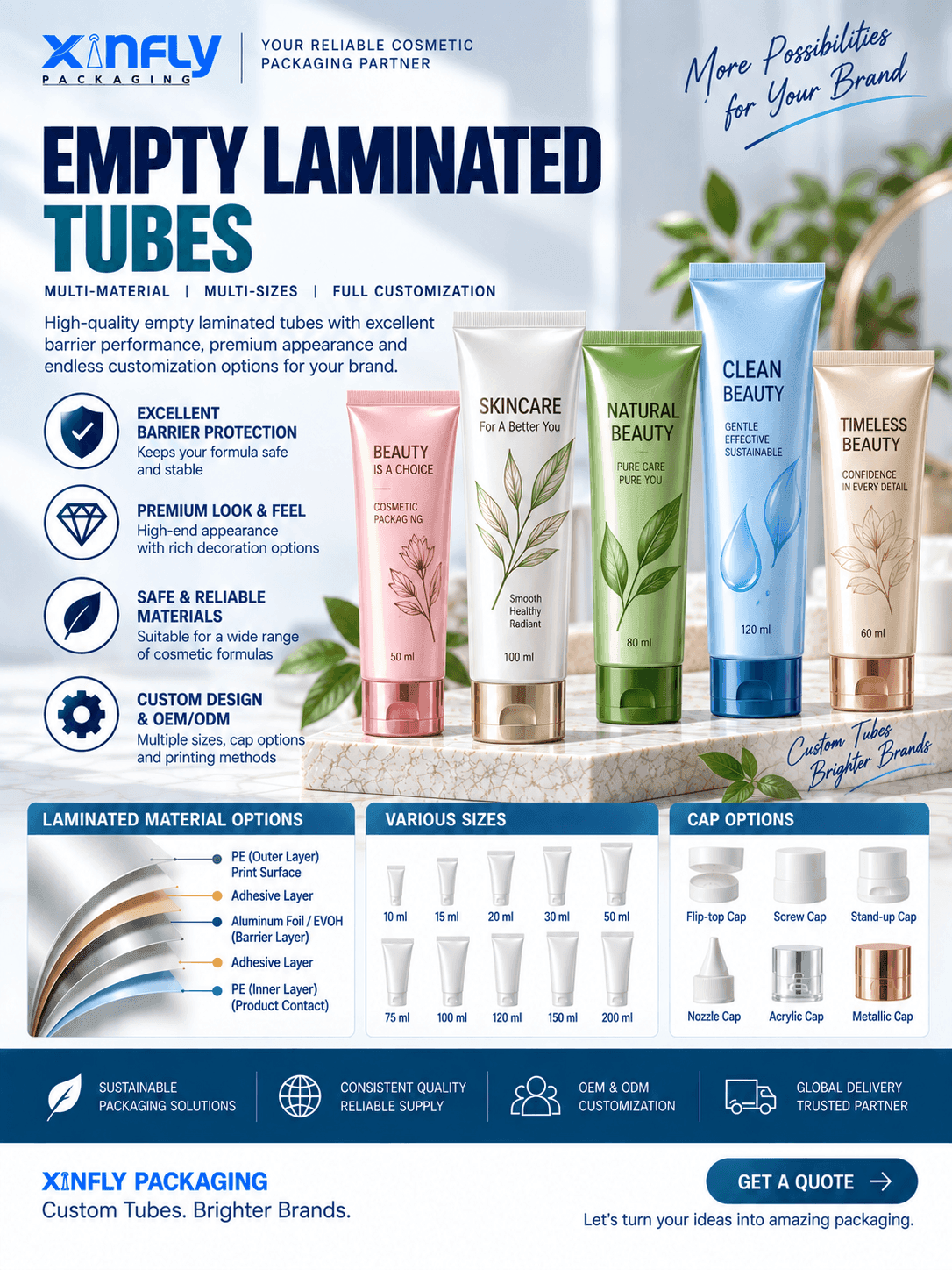
What Should You Consider Before Choosing a Laminated Tube?
The best tube is not necessarily the thickest tube, the most expensive material or the package used by another brand. The correct specification is the one that works with your formula, dispensing requirements, brand design, filling process and commercial supply plan.
Understand the Formula
Start with viscosity, sensitivity, ingredients and intended product use.
Define Barrier Needs
Determine whether light, oxygen, moisture or aroma protection is important.
Choose ABL or PBL
Select the laminate direction according to performance and visual requirements.
Select Capacity
Confirm the nominal fill volume and commercial product positioning.
Choose Diameter
Balance tube length, shelf appearance and filling-line requirements.
Choose Dispensing
Match closure and outlet to viscosity, dose and consumer use.
Develop Decoration
Coordinate artwork with laminate, tube geometry and tail sealing.
Test Before Production
Validate the complete filled package before commercial launch.
Start with the Formula — Not the Tube
Before asking “Which laminated tube should I buy?”, first define what will be filled inside the tube. The formula influences barrier requirements, dispensing, compatibility and tube feel.
Viscosity
A light gel and a dense cream may require different outlet sizes and dispensing systems.
Light Sensitivity
Light-sensitive products may require a packaging direction that reduces light exposure.
Oxygen Sensitivity
Products sensitive to oxygen should be evaluated against the complete barrier structure.
Compatibility
The formula should be evaluated against the complete tube, shoulder, outlet and closure system.
Do not choose packaging from the ingredient name alone.
“Vitamin C,” “retinol,” “sunscreen,” “cleanser” or “hand cream” can describe many different formulations. Two products in the same category may have different solvent systems, viscosity, sensitivity and dispensing requirements. Use the actual formula and filled-package testing when confirming the final tube.
Define the Barrier Requirement
Barrier performance should be considered according to the actual product requirement rather than assuming that every cosmetic formula needs the highest possible barrier.
Light
Consider whether the formula is sensitive to light during storage and consumer use.
Oxygen
Consider whether exposure to oxygen could affect product stability or performance.
Moisture
Evaluate moisture transmission requirements as part of the complete packaging system.
Aroma / Odor
For selected formulas, aroma retention and interaction with packaging may be relevant.
Choose ABL or PBL Empty Laminated Tubes
ABL and PBL are both used for laminated squeeze tubes, but their barrier layers and visual possibilities are different. There is no universal winner for every formula.
| Selection Factor | ABL | PBL | Buyer Guidance |
|---|---|---|---|
| Barrier Layer | Aluminum foil | EVOH | Choose according to formula and required protection |
| Appearance | White / silver | White / transparent | Consider the desired final brand appearance |
| Light Protection | Strong direction from aluminum layer | Depends on complete structure and design | Important for selected light-sensitive formulas |
| Transparency | No | Possible | PBL may suit projects requiring product visibility |
| Metallic Direction | Possible with silver ABL | Not the same aluminum-foil visual direction | Useful when metallic appearance is part of the design |
| Tube Feel | Structure dependent | Structure dependent | Do not judge feel only by ABL/PBL label |
| Printing | Custom decoration | Custom decoration | Artwork should be designed for the selected laminate |
| Final Selection | Project dependent | Project dependent | Validate with formula and production requirements |
Current ABL Options
Xinfly Packaging ABL material directions include:
- Color: white / silver
- Total thickness: 220 μm
- Total thickness: 250 μm
- Total thickness: 275 μm
- Total thickness: 310 μm
- Total thickness: 350 μm
- Total thickness: 360 μm
- Total thickness: 390 μm
- Aluminum foil: 12 μm / 20 μm
Current PBL Options
Xinfly Packaging PBL material directions include:
- Color: white / transparent
- Total thickness: 310 μm
- Total thickness: 330 μm
- Total thickness: 350 μm
- Total thickness: 370 μm
- Total thickness: 390 μm
- Total thickness: 400 μm
- EVOH: 8 μm / 15 μm
Choose the Correct Tube Capacity
Capacity should reflect the intended use cycle, product category, retail positioning and target market—not simply the largest volume that fits the budget.
| Capacity | Typical Positioning | Example Applications | Selection Direction |
|---|---|---|---|
| 10–20 ml | Compact / targeted | Eye care, treatment, sample | Precision dispensing |
| 30 ml | Compact retail | BB cream, face cream, treatment | Portable and cosmetic |
| 40 ml | Daily facial care | Sunscreen, BB/CC, moisturizer | Balanced beauty format |
| 50 ml | Full-size skincare | Face cream, sunscreen, hand cream | Standard retail direction |
| 75 ml | Medium daily-use | Skincare, hand care, treatment | More volume without large format |
| 100–120 ml | Higher-use skincare | Cleanser, face wash, sunscreen | Daily-use format |
| 150 ml | Personal care | Body lotion, cleanser, hair treatment | Mid-large format |
| 200 ml+ | High-consumption care | Body care, hair care, family-use products | Large-format packaging |
Capacity Is Not Enough — Choose the Diameter
Two tubes can contain the same nominal volume but look completely different because of diameter and length. Diameter also affects filling-line compatibility, artwork area and squeeze feel.
| Diameter Direction | Visual Character | Application Direction | Engineering Consideration |
|---|---|---|---|
| Φ19 / Φ22 | Slim / compact | Eye care, targeted treatment | Small package and precision use |
| Φ25 | Slim cosmetic | 30 ml beauty products | Longer appearance at same volume |
| Φ30 | Balanced / premium | 30–50 ml skincare and cosmetics | Good compromise between width and length |
| Φ35 | Wider retail format | 40–75 ml skincare | More artwork area |
| Φ40 | Substantial | 50–120 ml products | Useful for cream and cleanser formats |
| Φ45 | Large | 100–150 ml personal care | Higher product volume |
| Φ50 | Wide / large format | 150–200 ml personal care | Body and hair-care direction |
Choose capacity and diameter together.
For example, a 50 ml tube can be designed as a slimmer, longer package or a wider, shorter package. The decision changes the visual proportions, decoration area, filling-line setup and consumer handling. Confirm the intended look before approving the final tube length.
How Should You Choose Laminate Thickness?
Thickness influences the physical character of the tube, but it should not be treated as a simple “higher is better” number.
Tube Feel
Different structures can change stiffness, flexibility and perceived package substance.
Squeeze Behavior
The finished tube should dispense the formula without feeling unnecessarily difficult to squeeze.
Package Size
A structure suitable for a compact tube may not create the same experience on a large-format tube.
Barrier Requirement
Total thickness should not be used as a substitute for understanding the functional barrier layer.
Processing
Tube conversion, heading and downstream sealing should be considered when confirming the structure.
Cost
Avoid unnecessary over-specification when a more appropriate structure meets the project requirement.
Choose the Closure & Outlet for the Formula
A premium tube body cannot compensate for a poorly selected dispensing system. The closure, outlet and formula viscosity should be considered together.
Screw Cap
Flexible choice for skincare, cosmetics, treatment creams and smaller tubes.
Flip-Top Cap
Convenient for frequent-use cleanser, sunscreen and personal-care products.
Stand-Up Cap
Useful for selected larger or inverted daily-use packaging formats.
Nozzle
Useful when the formula requires more controlled or targeted dispensing.
| Formula Direction | Outlet Direction | Closure Direction | What to Validate |
|---|---|---|---|
| Light Cream / Gel | Smaller–medium | Screw / flip-top | Dose and leakage |
| Face Cream | Medium | Screw / premium closure | Control and user experience |
| Sunscreen | Medium | Screw / flip-top | Flow, cap-down storage and leakage |
| Facial Cleanser | Medium–larger | Flip-top / stand-up | Wet-hand use and evacuation |
| Dense Treatment | Larger orifice may be required | Project dependent | Squeeze force and dispensing |
Choose Printing & Surface Finish
Artwork should be developed for a three-dimensional tube, not only for a flat design file. Tube forming, shoulder position, eye mark and final tail sealing can all affect the visible artwork.
Offset Printing
Useful for multi-color graphics and commercial cosmetic packaging.
Silk Screen
Useful for selected text, logos and premium graphic elements.
Hot Stamping
Adds metallic details and premium visual accents.
Pantone Colors
Useful when the brand requires controlled color targets.
Glossy
Bright surface direction with strong retail presentation.
Matte
Lower-gloss direction often used for modern skincare branding.
Soft-Touch
Selected projects can use a tactile premium finish.
Multi-SKU Design
Coordinate common branding with different variants and artwork.
Match the Empty Tube to Your Filling Line
Empty laminated tubes are commonly supplied open at the tail. The filler inserts the formula and completes the final tail seal, so tube specifications should be checked against the filling equipment before mass production.
Diameter
Confirm the tube diameter against holders and filling-line tooling.
Finished Length
Check the usable length and required tail-sealing allowance.
Eye Mark
Confirm eye-mark requirements for orientation and final sealing.
Tail Seal
Confirm the sealing method and required printable/sealing area.
Send filling-line information before the purchase order.
If your contract filler or factory already has filling equipment, provide available information about tube diameter, holder size, eye-mark requirements and sealing method during development. Discovering an equipment mismatch after printed tubes arrive can be significantly more expensive than validating it early.
Test the Complete Filled Package
Packaging selection should not stop when an empty sample looks good. The final commercial package contains the formula, tube, shoulder, outlet, closure, decoration and tail seal as one system.
Evaluate the intended formula with the complete packaging system.
Evaluate closure, outlet and final filled-package sealing.
Confirm squeeze force, flow and consumer dosage.
Include cap-down storage where relevant to the intended product.
Evaluate final sealing with the actual laminate and filler.
Check printing and finish after handling and filling operations.
Evaluate packing and finished-product shipping requirements.
Use the brand's appropriate stability and compatibility validation process.
Which Empty Laminated Tube Should I Choose?
Use this table as a starting point for discussion—not as a replacement for formula compatibility and filled-package testing.
| Application | Capacity Direction | Material Starting Point | Closure Direction | Key Question |
|---|---|---|---|---|
| Eye Cream | 10–30 ml | ABL / PBL project dependent | Screw / nozzle / specialty | How precise must dispensing be? |
| BB / CC Cream | 30–50 ml | ABL / PBL | Screw / premium closure | Barrier, shade range and dosage? |
| Face Cream | 30–100 ml | ABL / PBL | Screw / flip-top | Formula sensitivity and viscosity? |
| Sunscreen | 30–200 ml | ABL / PBL | Screw / flip-top / stand-up | Formula, barrier and cap-down use? |
| Facial Cleanser | 50–200 ml | PBL / ABL project dependent | Flip-top / stand-up | Viscosity and frequent wet-hand use? |
| Hand Cream | 30–100 ml | ABL / PBL | Screw / flip-top | Portability or daily-use positioning? |
| Toothpaste | 10–250 g direction | ABL / PBL | Screw / stand-up | Flavor, viscosity and evacuation? |
| Hair Treatment | 75–200 ml | ABL / PBL | Flip-top / stand-up | How thick is the formula? |
| Body Lotion | 100–200 ml | Project dependent | Flip-top / stand-up | Flow rate and large-format squeeze feel? |
| Hair Removal Cream | 100–200 ml | Compatibility-driven | Flip-top / screw | Has the actual formula been tested? |
10 Common Mistakes When Choosing Empty Laminated Tubes
Choosing by Price Only
The cheapest quotation is selected before specifications are technically compared.
Compare Like-for-Like Specifications
Compare laminate, thickness, closure, printing, MOQ and testing requirements before comparing price.
Copying Another Brand
A competitor's tube is assumed to work with a different formula.
Design Around Your Formula
Use your own product, filling process and commercial requirements as the selection basis.
Always Choosing the Thickest Laminate
More thickness is assumed to mean better packaging.
Specify What the Product Needs
Balance barrier, tube feel, processing and cost instead of automatically maximizing thickness.
Choosing Capacity Without Diameter
Only the nominal fill volume is specified.
Confirm Package Proportions
Choose diameter and tube length together to achieve the intended appearance.
Ignoring Formula Viscosity
The outlet is chosen before the actual flow behavior is considered.
Match Outlet to Dispensing
Use viscosity and target dosage when selecting the outlet and closure.
Designing Artwork Too Late
Critical graphics conflict with seams, eye marks or tail sealing.
Design for Tube Conversion
Coordinate artwork with the actual finished tube geometry before final approval.
Ignoring Filling Equipment
The empty tube is ordered before machine compatibility is checked.
Involve the Filler Early
Confirm diameter, length, eye mark and sealing requirements before mass production.
Testing Only Empty Tubes
The tube looks good empty, so the project moves directly to production.
Evaluate the Filled Package
Test the formula, closure, tube and final tail seal as one packaging system.
Ignoring SKU Quantity
Total order quantity is quoted without splitting individual artworks.
Plan Quantity per SKU
Provide both total volume and quantity per design when requesting an accurate quotation.
No Repeat-Order Specification
Critical details are not documented after the first production.
Lock the Approved Specification
Maintain approved material, dimensions, closure, artwork and finish for future orders.
12 Questions to Answer Before Ordering
If you can answer most of these questions, your supplier can usually evaluate the project much more efficiently.
Product type and relevant formulation characteristics.
Nominal amount to be filled into each tube.
Light gel, cream, paste or high-viscosity treatment.
Light, oxygen, moisture or other protection direction.
Material preference or ask for an engineering review.
Confirm proportions and filling-line compatibility.
Screw, flip-top, stand-up, nozzle or another option.
Match dispensing to viscosity and dosage.
Number of colors, Pantone references and decoration.
Glossy, matte or selected soft-touch direction.
Total quantity and quantity per artwork/SKU.
Share filling and sealing information when available.
Empty Laminated Tube Sourcing Resources
How to Choose Empty Laminated Tubes FAQ
1. How do I choose an empty laminated tube?
2. Should I choose ABL or PBL?
3. Is ABL better than PBL?
4. When should I consider ABL tubes?
5. When should I consider PBL tubes?
6. Is a thicker laminated tube always better?
7. How do I choose tube capacity?
8. How do I choose tube diameter?
9. How do I choose the tube outlet size?
10. Should I use a screw cap or flip-top cap?
11. What is a stand-up cap used for?
12. Can laminated tubes use matte or soft-touch finishes?
13. What printing can be used on laminated tubes?
14. Why does the filling machine matter?
15. Are empty laminated tubes supplied open at the tail?
16. Should I test the formula in the tube?
17. What should I check when testing the filled package?
18. What MOQ should I expect?
19. What information should I send before requesting a quote?
20. Can Xinfly Packaging help select the tube specification?
Not Sure Which Empty Laminated Tube to Choose?
Send Xinfly Packaging your formula type, filling volume, viscosity, target quantity, preferred appearance and filling requirements. We can help review the ABL/PBL direction, tube diameter, closure, outlet and decoration before you move to sampling and commercial production.