

Empty Laminated Toothpaste Tubes for Oral Care Packaging
Empty laminated toothpaste tubes are widely used for fluoride toothpaste, whitening toothpaste, sensitive teeth formulas, herbal toothpaste, charcoal toothpaste, kids toothpaste, travel toothpaste and professional oral-care products.
Xinfly Packaging manufactures custom ABL and PBL empty toothpaste tubes for oral-care brands, toothpaste manufacturers, contract fillers, private-label companies, hotels and packaging distributors. We support tube development from laminate selection and tube sizing to closure matching, printing and filling-line compatibility.
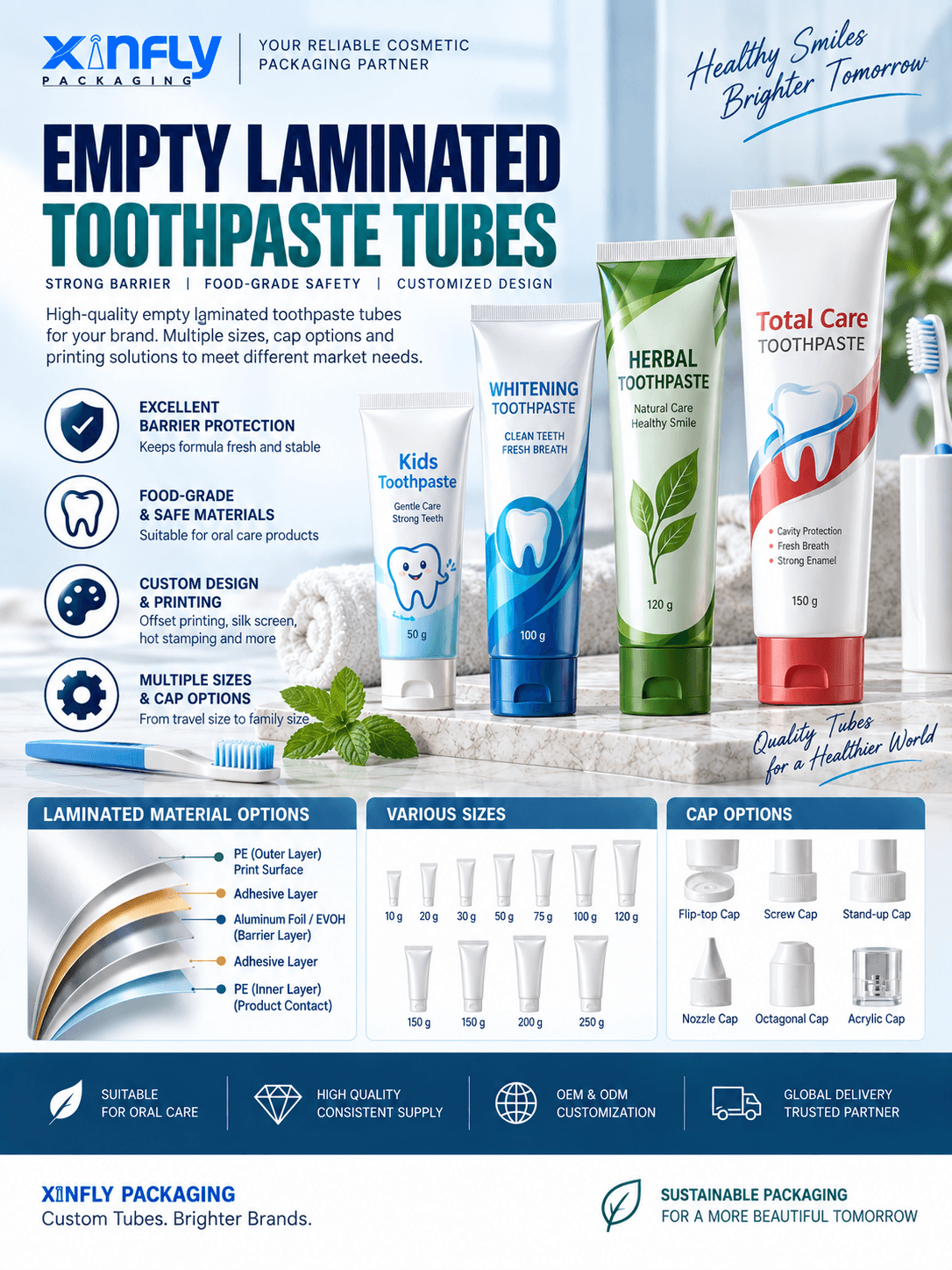
Why Are Laminated Tubes Widely Used for Toothpaste?
Toothpaste packaging must do more than hold the formula. The tube has to support barrier protection, flavor retention, high-viscosity dispensing, repeated squeezing, reliable cap performance, strong tail sealing and high-quality retail decoration.
Barrier Protection
ABL and PBL provide barrier options for oral-care formulas that require protection from the external environment.
Flavor Retention
Barrier selection is especially important for mint, herbal and other flavored toothpaste systems where aroma retention matters.
Controlled Dispensing
Tube body stiffness, shoulder, outlet and cap can be matched to toothpaste viscosity and consumer dispensing behavior.
Retail Printing
Laminate provides a smooth surface for detailed oral-care graphics, color blocks, product claims, instructions and branding.
Choose the Right Laminate Structure for Toothpaste
ABL and PBL use different barrier technologies. The correct material should be selected according to formula protection, appearance, dispensing, manufacturing and commercial requirements.
ABL Toothpaste Tubes
Aluminum Barrier Laminate incorporates an aluminum foil layer into the laminate structure. It provides an opaque packaging direction and can be evaluated for toothpaste formulas requiring strong barrier performance.
- Aluminum foil barrier layer
- White or silver appearance
- Opaque tube construction
- 12 / 20 μm foil options
- 220–390 μm current total thickness options
- Suitable for many retail toothpaste projects
PBL Toothpaste Tubes
Plastic Barrier Laminate can incorporate EVOH as a functional barrier layer while retaining a plastic laminate construction. PBL can support modern oral-care appearance and different squeeze and rebound characteristics.
- EVOH functional barrier
- White or transparent options
- 8 / 15 μm EVOH options
- 310–400 μm current total thickness options
- Premium oral-care appearance
- Flexible artwork possibilities
| Factor | ABL Toothpaste Tube | PBL Toothpaste Tube |
|---|---|---|
| Barrier Technology | Aluminum foil | EVOH in selected structures |
| Appearance | White / silver | White / transparent |
| Opacity | Opaque | Depends on structure and design |
| Tube Feel | More characteristic laminate feel | Plastic laminate feel |
| Typical Selection Focus | Barrier + opacity | Barrier + appearance + rebound |
| Final Decision | Should be based on the actual toothpaste formula, barrier target, shelf-life requirement, tube feel, closure, filling line and package testing. | |
Empty Laminated Tubes for Different Oral Care Formulas
Different toothpaste categories have different packaging priorities. Formula viscosity, flavor, active ingredients, target user and retail channel can all affect tube selection.
Fluoride Toothpaste Tubes
Custom laminate tubes for anti-cavity, enamel-care and everyday fluoride toothpaste.
Whitening Toothpaste Tubes
Premium laminated packaging for whitening, brightening and stain-removal toothpaste formulas.
Sensitive Toothpaste Tubes
Custom tubes for sensitive-teeth, gum-care and enamel-support oral-care ranges.
Herbal Toothpaste Tubes
Laminate packaging for herbal, botanical and naturally positioned toothpaste.
Charcoal Toothpaste Tubes
Custom printed tubes for charcoal, black toothpaste and specialty oral-care products.
Kids Toothpaste Tubes
Colorful custom packaging for children's toothpaste and flavored oral-care products.
Hotel Toothpaste Tubes
Small-capacity empty tubes for hotels, resorts, airlines and dental amenity kits.
Travel Toothpaste Tubes
Compact laminate tubes for travel sets, samples, promotional kits and portable dental care.
Family Toothpaste Tubes
Larger laminated tubes designed for daily household and high-frequency use.
Oral Care Gel Tubes
Precision packaging for oral gels, gum-care gels and specialty dental formulations.
Dental Clinic Toothpaste Tubes
Custom packaging for dental practices, professional oral-care products and sample programs.
OEM Toothpaste Tubes
Custom laminate packaging for private-label and contract-manufactured toothpaste programs.
Choose the Right Empty Toothpaste Tube Size
Capacity should be engineered from the actual fill weight, formula density, tube diameter, tube length and required sealing area.
| Size Direction | Common Diameter Direction | Typical Application | Packaging Focus |
|---|---|---|---|
| 10–15 g | Φ19–22 mm | Hotel / sample | Compact dimensions |
| 20–30 g | Φ22–25 mm | Hotel / travel | Small cap + filling accuracy |
| 30–50 g | Φ25–30 mm | Travel / kids | Portable dispensing |
| 50–75 g | Φ30–35 mm | Compact retail toothpaste | Cap + artwork balance |
| 75–100 g | Φ35–40 mm | Standard retail oral care | Daily dispensing |
| 100–150 g | Φ35–45 mm | Family / retail toothpaste | Stand-up cap + squeeze feel |
| 150–250 g | Φ40–50 mm | Large family format | Large closure + stability |
Toothpaste Formula Should Drive Tube Selection
Toothpaste formulations may contain abrasives, humectants, fluoride systems, flavor oils, herbal extracts, whitening ingredients, pigments and other components. These differences can affect packaging requirements.
Flavor System
Mint and other flavor systems make barrier selection an important part of toothpaste package development.
Moisture Balance
The package should support the required moisture-control strategy throughout the intended shelf life.
High Viscosity
Toothpaste viscosity influences tube squeeze force, outlet geometry and consumer dispensing.
Formula Compatibility
The actual formula should be evaluated with the tube inner layer, shoulder and closure system.
Caps & Dispensing Systems for Toothpaste Tubes
A toothpaste cap is a functional component, not simply decoration. Thread fit, outlet diameter, standing stability, sealing and consumer convenience should be evaluated together.
Screw Cap
Traditional and reliable closure for travel, hotel and retail toothpaste.
Flip-Top Cap
Convenient one-handed dispensing for daily family oral-care products.
Stand-Up Cap
Popular for retail toothpaste because the tube can be stored vertically.
Custom Color Cap
Match cap color to toothpaste variant, brand identity or product family.
Precision Outlet
Useful for selected oral gels and specialty dental-care formulas.
Wide Outlet
Can be evaluated for higher-viscosity toothpaste and faster dispensing.
Shoulder Matching
Shoulder geometry must match the cap and tube diameter correctly.
Leakage Review
Cap thread, outlet and sealing surfaces should be checked before mass production.
Empty Toothpaste Tubes Must Match the Filling Line
A tube can look perfect and still create production problems if its dimensions, tail area or eye mark do not match the customer's filling and sealing equipment.
Open Tail Supply
Empty tubes are typically supplied with the tail open for downstream toothpaste filling.
Tail Seal Area
Enough clean sealing area must be reserved for the customer's filling and sealing process.
Eye Mark Position
Printed eye marks should be positioned according to filling-line orientation requirements.
Tube Length Control
Finished tube length influences filling, tail sealing and final retail dimensions.
Retail-Ready Printing for Oral Care Brands
Toothpaste packaging often carries a large amount of information. Artwork engineering should balance brand visibility with product information, barcode, usage instructions and required market text.
Offset Printing
Suitable for multi-color oral-care graphics and scalable tube production.
Silk Screen
Adds strong spot-color logos and selected premium graphic details.
Hot Stamping
Metallic decoration for premium, whitening and specialty toothpaste.
Matte / Glossy
Surface finish can be coordinated with dental, natural or premium positioning.
8 Common Problems When Buying Empty Laminated Toothpaste Tubes
Flavor Weakens During Storage
The tube structure was selected without considering the toothpaste flavor system and required barrier.
Define the Barrier Requirement
Review the formula and shelf-life target before choosing ABL or PBL.
ABL or PBL?
The buyer chooses material from price or appearance without defining performance.
Compare the Complete Package
Evaluate barrier, appearance, tube feel, printing, filling and formula compatibility.
Toothpaste Is Difficult to Dispense
The tube stiffness or outlet size does not match the formula viscosity.
Match Tube to Rheology
Evaluate squeeze force, outlet diameter and closure using the actual toothpaste.
Tail Seal Fails After Filling
Tube length, sealing zone or filling conditions were not confirmed early enough.
Review Filling & Sealing Parameters
Confirm dimensions, tail allowance and equipment requirements before mass production.
Cap Leakage
Cap and shoulder are selected without sufficient thread and sealing evaluation.
Validate Closure Matching
Check thread engagement, outlet, sealing surface and cap fit as one system.
Tube Does Not Fit Filling Equipment
Only the nominal toothpaste capacity was provided to the tube supplier.
Confirm Finished Dimensions
Lock diameter, length, shoulder, eye mark and tail requirements.
Artwork Distorts After Conversion
The artwork looks correct flat but changes around the seam and curved tube.
Approve a Finished Tube Sample
Check artwork, barcode, eye mark and critical colors on the converted tube.
Repeat Orders Are Inconsistent
Critical material, color and closure specifications were not fully locked.
Lock the Approved Specification
Use approved samples and documented specifications as repeat-order references.
How We Develop an Empty Laminated Toothpaste Tube
Our engineering workflow starts with the toothpaste formula and filling requirements—not just the artwork.
Formula Review
Understand toothpaste type, flavor system, viscosity and packaging requirements.
Barrier Definition
Identify the required barrier direction and evaluate ABL or PBL.
Tube Dimensions
Define fill weight, diameter, length and tail-sealing allowance.
Closure Engineering
Match screw, flip-top or stand-up closure to shoulder and outlet.
Artwork Engineering
Check graphics, barcode, eye mark, seam and printing requirements.
Filling Validation
Review finished tube specifications against filling and sealing requirements.
From Laminated Web to Empty Toothpaste Tube
What Should Be Checked Before Empty Toothpaste Tubes Ship?
Tube Dimensions
Diameter, length and critical dimensions should match the approved specification.
Cap Fit
Thread engagement, opening and closure fit should be checked for consistency.
Printing
Artwork position, color, barcode, eye mark and decoration should be reviewed.
Tail Area
The open tail should remain suitable for downstream filling and sealing.
Why Source Laminated Toothpaste Tubes from Xinfly?
15+ Years Experience
Long-term B2B experience in cosmetic, personal-care and oral-care tube manufacturing.
200,000 Tubes / Day
Production capacity for growing brands, private-label programs and bulk orders.
60M+ Annual Capacity
Scalable supply for international oral-care packaging programs.
ABL & PBL
Multiple laminate directions for different toothpaste packaging requirements.
Custom Printing
Printing and decorative options for retail, dental, hotel and private-label brands.
Engineering Support
Support for material, dimensions, closure, outlet and filling compatibility.
What We Need to Quote Your Empty Toothpaste Tubes
Send Your Toothpaste Packaging Specifications
Existing filled tubes, empty tube samples, technical drawings or filling-machine information can help accelerate specification matching.
Explore More Toothpaste Tube Solutions
Empty Toothpaste Tubes
Explore PE, ABL, PBL and other empty toothpaste tube options.
Empty Toothpaste Tubes →Toothpaste Packaging Guide
Learn about toothpaste materials, sizes, caps and sourcing.
Read Packaging Guide →Fluoride Toothpaste Tubes
Dedicated packaging solutions for fluoride oral-care formulas.
Fluoride Tubes →Empty Laminated Toothpaste Tubes FAQ
1. What are empty laminated toothpaste tubes?
2. Why are laminated tubes used for toothpaste?
3. What is an ABL toothpaste tube?
4. What is a PBL toothpaste tube?
5. Which is better for toothpaste, ABL or PBL?
6. Are laminated tubes suitable for fluoride toothpaste?
7. Can laminated tubes be used for whitening toothpaste?
8. Can you manufacture hotel toothpaste tubes?
9. What toothpaste tube sizes are available?
10. What tube diameters are available?
11. What caps can be used for toothpaste tubes?
12. Can toothpaste tubes stand upright?
13. Can the toothpaste tube be custom printed?
14. Can you supply the tube with an open tail?
15. Why is the tail-sealing area important?
16. Should toothpaste and tube compatibility be tested?
17. What is the typical MOQ?
18. What information is needed for a quotation?
Develop the Right Laminated Tube for Your Toothpaste
Send Xinfly Packaging your toothpaste formula type, net fill weight, tube dimensions, ABL or PBL preference, cap, outlet, artwork, filling method and quantity. Our team can help evaluate the empty tube configuration before sampling and mass production.