

About This Ranking
This Top 10 list is compiled from publicly available information found on the internet, manufacturer websites and online cosmetic packaging resources.
The article is intended as an editorial sourcing guide for beauty brands, skincare companies, private-label companies and packaging buyers evaluating biodegradable, bio-based and other sustainability-oriented cosmetic tube suppliers in China.
Manufacturers were reviewed using publicly presented information relating to sustainable tube materials, biodegradable or bioplastic products, wheat straw materials, PCR, renewable feedstocks, recyclability, customization, OEM / ODM support and market presence.
This is not an official industry ranking and does not represent audited market share, independent certification or third-party endorsement. Sustainability claims should be independently verified with the supplier and relevant test documentation before procurement.
Version 2026.08 · Last Reviewed: August 24, 2026What Is a Biodegradable Cosmetic Tube?
A biodegradable cosmetic tube is a packaging structure containing materials designed to be broken down by biological processes under defined environmental conditions.
However, the word “biodegradable” should not be used as a generic synonym for sustainable packaging. A tube made from sugarcane PE can be bio-based but not necessarily biodegradable. A PCR tube contains recycled plastic but is not automatically biodegradable. A mono-material PE tube may be recyclable but not compostable.
Sustainability Terms Must Be Separated
Buyers should ask exactly what environmental claim the material supports: biodegradable, compostable, bio-based, recycled-content, recyclable or reduced-plastic.
These claims describe different packaging characteristics and should not be used interchangeably.
Biodegradable vs Compostable vs Bio-Based vs PCR vs Recyclable
One of the most important steps in sustainable cosmetic packaging procurement is understanding the terminology used in supplier quotations and marketing documents.
| Term | What It Means | What It Does NOT Automatically Mean |
|---|---|---|
| Biodegradable | Material can biologically break down under defined conditions. | It does not automatically mean home compostable. |
| Compostable | Material is designed to break down under specified composting conditions. | It may require industrial composting rather than home composting. |
| Bio-Based | Part or all of the feedstock comes from renewable biological sources. | Bio-based plastic is not necessarily biodegradable. |
| PCR | Plastic incorporates post-consumer recycled resin. | PCR is not automatically biodegradable or compostable. |
| Recyclable | Packaging is designed for an applicable recycling stream. | Actual recycling depends on local collection and processing infrastructure. |
| Mono-Material | Packaging primarily uses one polymer family to simplify material recovery. | Mono-material does not automatically guarantee recycling in every market. |
Related comparisons: Biodegradable Tubes vs Recyclable Tubes , Bio-Based Plastic Tubes vs PCR Tubes and Sugarcane Tubes vs Bioplastic Tubes .
Sustainable Cosmetic Tube Material Options
“Biodegradable cosmetic tube” searches often include several sustainable packaging technologies. Buyers should distinguish materials by actual environmental claim and technical performance.
Wheat straw can be blended with polymer materials to reduce the amount of conventional plastic and create a distinctive natural appearance.
Explore Wheat Straw Tubes →Sugarcane PE uses renewable feedstock while maintaining functionality similar to conventional PE.
Explore Sugarcane Tubes →Bioplastic is a broad category and may refer to bio-based, biodegradable or both, depending on the specific resin.
Explore Bioplastic Tubes →PCR tubes reduce virgin plastic use by incorporating post-consumer recycled resin.
Explore PCR Tubes →Mono-material designs can simplify the material structure and support recyclability-focused packaging strategies.
Explore Sustainable Materials →Lightweighting and optimized wall structures can reduce total material consumption without necessarily changing the polymer family.
Sustainable Packaging Solutions →Important Procurement Rule
Never approve a sustainability claim based only on a supplier's marketing phrase such as “eco,” “green” or “biodegradable.” Request the exact resin name, material composition, test standard and supporting documentation.
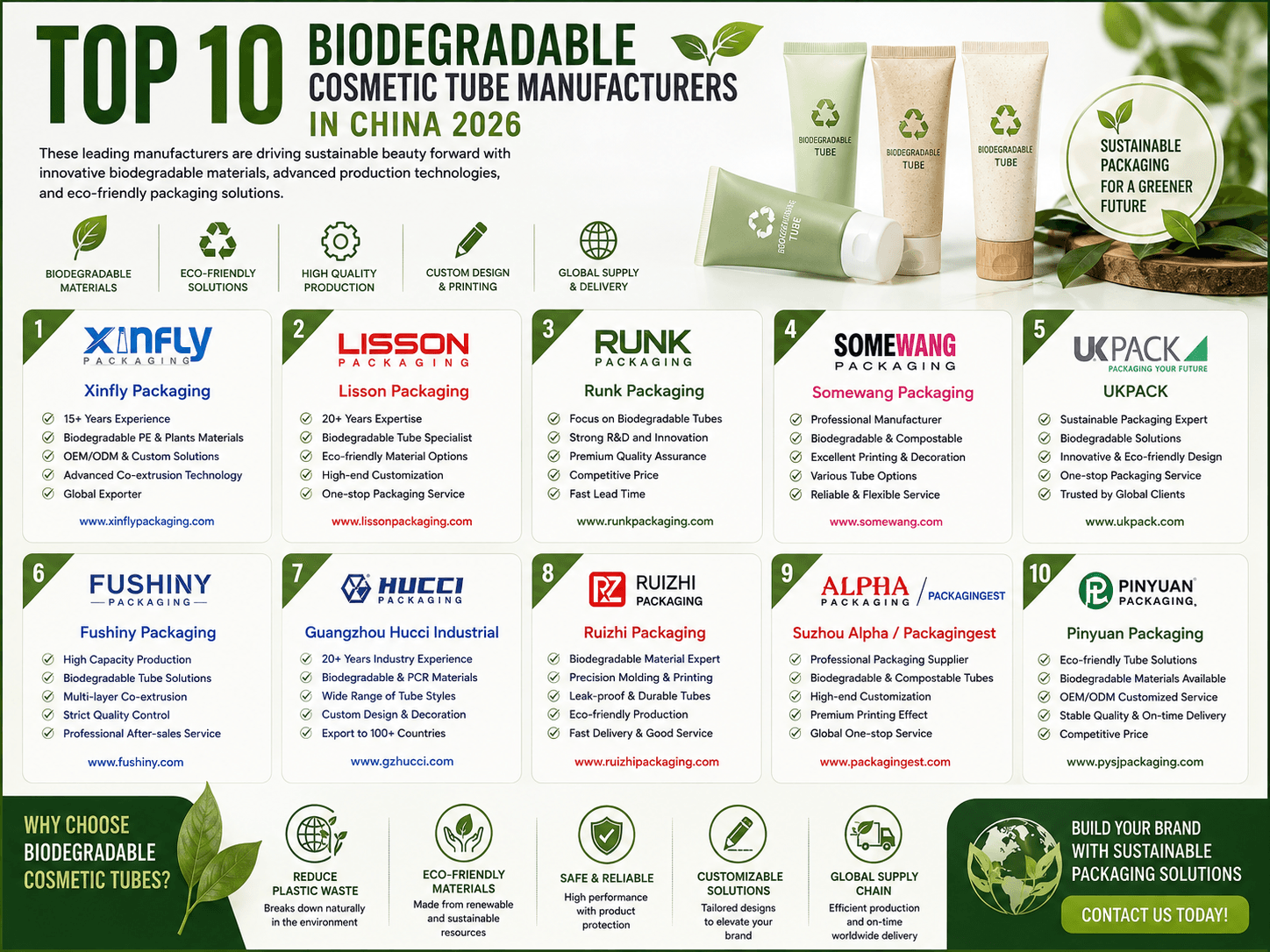
Top 10 Biodegradable Cosmetic Tube Manufacturers in China 2026
The companies below represent different sourcing options for biodegradable, bio-based, recycled and sustainability-oriented cosmetic tube packaging in China.
Because sustainability terminology varies by supplier, buyers should independently verify the exact environmental claim and certification associated with each material.
Xinfly Packaging
Xinfly Packaging develops sustainable cosmetic tube solutions for skincare, personal care and beauty brands, including PCR PE, sugarcane PE, wheat straw composite, mono-material and other reduced-virgin-plastic options.
Projects can be evaluated according to formula compatibility, sustainability objectives, recycled or renewable content, decoration requirements and filling performance.
- PCR PE tubes
- Sugarcane PE tubes
- Wheat straw composite tubes
- Mono-material PE structures
- Reduced-plastic packaging
- Skincare cream
- Facial cleanser
- Hand cream
- Body lotion
- Sunscreen
- Personal care
- Offset printing
- Silk screen printing
- Hot stamping
- Matte finish
- Soft-touch finish
- Custom Pantone colors
- OEM / ODM projects
- Material comparison
- Sample development
- Formula compatibility review
- Quality inspection
Lisson Packaging
Lisson Packaging offers cosmetic tube and beauty packaging development for skincare and personal-care applications, including sustainability-oriented packaging options.
- Custom cosmetic tubes
- Sustainable material options
- Beauty packaging development
- OEM / ODM support
- Beauty brands
- Private-label projects
- Multi-SKU programs
- Sustainability-focused launches
Runk Packaging
Runk Packaging provides multiple cosmetic tube structures, including conventional and sustainability-oriented options for skincare and personal-care applications.
- PE tubes
- PCR options
- Sugarcane options
- Multi-layer structures
- Laminate tube options
- Skincare
- Personal care
- Eco-positioned products
- Custom printed tubes
Somewang Packaging
Somewang Packaging supplies customized beauty and personal-care packaging and can be considered by brands looking for sustainable cosmetic tube options together with bottles, jars and other packaging formats.
Its broader packaging scope can be useful for brands developing coordinated eco-positioned product lines.
- Custom cosmetic packaging
- Cosmetic tube options
- Custom colors and finishes
- OEM / ODM support
- Multi-category sourcing
- Skincare brands
- Private-label projects
- Eco-positioned beauty collections
- Coordinated packaging programs
UKPACK
UKPACK provides skincare and beauty packaging solutions, including sustainability-oriented materials and customized cosmetic packaging programs.
Buyers should verify the exact material and environmental claim for each tube project rather than relying on broad sustainability terminology.
- Custom cosmetic tubes
- PCR packaging options
- Custom colors
- Surface finishing
- OEM / ODM support
- Skincare
- Body care
- Private-label products
- Sustainable beauty programs
Fushiny Packaging
Fushiny Packaging produces cosmetic tube packaging across plastic, multi-layer and laminate structures. It may be considered by buyers comparing conventional and sustainability-oriented tube packaging options.
- PE squeeze tubes
- 2-layer PE
- 5-layer EVOH
- ABL
- PBL
- Offset printing
- Silk screen
- Hot stamping
- Matte finish
- Glossy finish
Guangzhou Hucci Industrial
Guangzhou Hucci Industrial offers cosmetic tube packaging across several structures, including PE, laminate, eco-oriented and aluminum tube categories.
This broad material range can be useful for procurement teams comparing conventional and lower-impact packaging options.
- PE tubes
- ABL tubes
- PBL tubes
- Eco-friendly tube options
- Aluminum tubes
- Material composition
- Environmental claim
- Supporting test report
- Manufacturing scope
- MOQ by material
Ruizhi Packaging
Ruizhi Packaging provides soft cosmetic tube options across conventional and sustainability-oriented materials, including PCR and sugarcane-based directions.
- PE
- PCR
- Sugarcane
- ABL
- PBL
- Aluminum
- Skincare
- Personal care
- Eco-positioned products
- Custom applicator tubes
Suzhou Alpha Packaging / Packagingest
Suzhou Alpha Packaging, also marketed online through Packagingest, provides soft cosmetic tubes across PE, PCR, sugarcane, laminate and sustainability-oriented material categories.
- PE tubes
- PCR tubes
- Sugarcane tubes
- ABL tubes
- PBL tubes
- Sustainability-oriented options
- Multi-layer structures
- Offset printing
- Screen printing
- Hot stamping
- Cap assembly
Pinyuan Packaging
Pinyuan Packaging can be considered by buyers looking for customized cosmetic tubes and sustainability-oriented packaging development.
Because public material details can vary by product, buyers should verify exact composition and environmental claims for each SKU before procurement.
- Custom cosmetic tubes
- Material options
- Printing capability
- Closure options
- OEM support
- Material composition
- Factory production scope
- Sustainability documentation
- MOQ
- QC standards
Top 10 Sustainable Cosmetic Tube Manufacturer Comparison
The comparison below is intended as a sourcing framework. Sustainability-related capabilities should be verified directly with each manufacturer before commercial use.
| Manufacturer | Main Sustainable Direction | Relevant Materials | Buyer Should Verify |
|---|---|---|---|
| Xinfly Packaging | Multi-option sustainable tubes | PCR / Sugarcane / Wheat Straw / Mono PE | Claim and material documentation by project |
| Lisson Packaging | Sustainable beauty packaging | Verify exact sustainable structure by RFQ | Resin type + claim basis |
| Runk Packaging | Recycled + bio-based directions | PCR / Sugarcane / PE | Exact environmental claim |
| Somewang Packaging | Eco-positioned beauty packaging | Verify by project | Material composition |
| UKPACK | PCR and sustainable packaging | PCR / plastic packaging options | Recycled percentage + documentation |
| Fushiny Packaging | Tube material optimization | PE / EVOH / ABL / PBL | Barrier vs recyclability tradeoff |
| Guangzhou Hucci Industrial | Eco-oriented tube categories | PE / laminate / eco options | Exact resin and test reports |
| Ruizhi Packaging | PCR + sugarcane | PCR / Sugarcane / PE | Bio-based vs biodegradable claim |
| Suzhou Alpha / Packagingest | Recycled + bio-based soft tubes | PCR / Sugarcane / PE / laminate | Specific biodegradability evidence |
| Pinyuan Packaging | Custom sustainable projects | Verify by RFQ | Exact material + compliance data |
What Sustainability Claims Should Cosmetic Tube Buyers Verify?
Sustainability claims should be linked to a defined material, test method and end-of-life condition. A supplier statement alone is not enough for a serious brand claim.
Ask under what environmental conditions degradation occurs and what test method supports the claim.
Confirm whether the material is industrially compostable, home compostable or neither.
Ask what percentage of the material is derived from renewable biological feedstock.
Confirm recycled-content percentage and request chain-of-custody documentation where required.
Confirm polymer family, closure compatibility and the relevant recycling stream.
Ask whether the claim is supported by a life-cycle assessment or credible material carbon data.
EN 13432, ASTM D6400 and Compostability: What Buyers Should Know
Standards are important because “biodegradable” by itself does not tell buyers how quickly or under what conditions a material breaks down.
| Standard / Claim | General Purpose | Buyer Question |
|---|---|---|
| EN 13432 | European framework commonly associated with packaging recoverable through composting and biodegradation. | Does the actual tube material or finished package have documentation linked to this standard? |
| ASTM D6400 | Common U.S. specification related to plastics designed for aerobic composting in municipal or industrial facilities. | Is the tested material the same resin and structure used in my production tube? |
| Industrial Compostable | Designed to break down under controlled industrial composting conditions. | Is suitable infrastructure available in my target market? |
| Home Compostable | Intended to break down under lower-temperature home composting conditions. | Is there independent certification for this exact claim? |
| Biodegradable | Broad term describing biological breakdown. | Under what conditions, timeframe and test method? |
A Resin Certificate Is Not Always a Finished-Package Certificate
A cosmetic tube contains more than the tube wall. Printing inks, coatings, adhesive layers, shoulder material, caps and other components may affect whether a finished package qualifies for a particular environmental claim.
Formula Compatibility of Biodegradable and Bio-Based Cosmetic Tubes
Sustainability should never replace formula protection. A cosmetic package must remain stable throughout the intended shelf life.
| Formula Type | Main Risk | What To Test |
|---|---|---|
| Basic Moisturizer | Softening / odor interaction | Filled aging + squeeze test |
| Essential-Oil Formula | Migration / scalping | Weight, odor and material interaction |
| Vitamin C Cream | Oxidation | Color + active stability + oxygen barrier |
| Retinol Cream | Light and oxygen sensitivity | Barrier + opacity + stability |
| Sunscreen | Formula/package interaction | Accelerated compatibility testing |
| High-Alcohol Formula | Material attack or migration | Stress, swelling and weight-loss testing |
| High-Viscosity Cream | Difficult dispensing | Squeeze force + orifice test |
For sensitive actives, see Sustainable Tubes for Retinol & Vitamin C Packaging .
Can Bioplastic and Sustainable Tubes Run on High-Speed Filling Lines?
Sustainable materials may have different stiffness, thermal behavior and seal response compared with standard virgin PE. That can affect automated tube feeding, filling and tail sealing.
Tubes that are too soft may deform during automatic feeding or indexing.
Some alternative materials may require tighter sealing temperature control.
Seal parameters should be validated for the exact sustainable material structure.
Diameter and wall tolerances can affect high-speed machine positioning.
Technical reference: Bio-Plastic Tube Mechanical Strength & High-Speed Filling Limits .
Low-Temperature Shipping Is Another Important Risk
Some biodegradable or bio-composite materials may become more brittle at low temperatures. International buyers should evaluate winter transport and warehouse conditions, especially for products shipped through cold regions.
Recommended Test
Condition filled tubes at the expected low-temperature range, then perform squeeze, drop, cap and tail-seal testing after temperature recovery.
Read: Why Biodegradable Tubes Crack During Low-Temperature Shipping .
How to Choose a Reliable Biodegradable Cosmetic Tube Manufacturer in China
Sustainable packaging procurement requires more verification than conventional tube sourcing because environmental terms can describe very different materials and end-of-life pathways.
A reliable supplier should be able to explain the exact resin, sustainable claim, expected mechanical behavior, formula compatibility and supporting documentation for the proposed tube structure.
Ask for resin type, composition and percentage rather than accepting generic terms such as “eco” or “green.”
Clarify whether the project requires biodegradable, compostable, bio-based, PCR, recyclable or mono-material packaging.
Ask for the test standard, report scope and whether the document applies to the actual resin or finished package.
Sustainability should never compromise product stability, barrier performance or shelf life.
Alternative materials can have different stiffness and heat-sealing windows from virgin PE.
Natural fillers and alternative resin surfaces can influence printing, coating and hot-stamping performance.
PCR and natural-fiber composites may show more color, texture or particle variation than virgin materials.
Confirm whether the claimed recycling or composting pathway actually exists in the target market.
Common Procurement Pain Points for Sustainable Cosmetic Tubes
| Buyer Pain Point | Possible Cause | What To Request |
|---|---|---|
| Supplier says “biodegradable” but gives no standard | Marketing terminology without defined test basis | Test report + exact resin name |
| Tube becomes brittle | Alternative material or natural filler reduces toughness | Low-temperature and drop testing |
| Tube color varies by batch | PCR or natural-fiber variation | Approved color tolerance |
| Printing adhesion is unstable | Surface energy or texture variation | Corona + tape peel testing |
| Tube fails high-speed filling | Stiffness or thermal behavior differs from PE | Machine trial before production |
| Formula shelf life decreases | Barrier performance insufficient | Filled compatibility + stability test |
| Finished package is not actually compostable | Cap, inks or other components do not meet claim | Finished-pack assessment |
| Eco material costs more than expected | Special resin, MOQ or decoration complexity | Total landed-cost comparison |
How to Avoid Greenwashing in Cosmetic Tube Packaging
Sustainability claims should be specific, measurable and supported. Beauty brands should avoid broad environmental language that cannot be connected to an actual material characteristic or test method.
Claim: “100% Eco-Friendly”
This phrase is too broad to be technically meaningful. Ask what specific environmental advantage is being claimed.
Better wording:- Contains 50% post-consumer recycled PE.
- Made using bio-based sugarcane PE.
- Designed as a mono-material PE tube.
- Tested against a defined compostability standard.
Claim: “Biodegradable in Nature”
This should trigger additional questions about conditions, timeframe and test method.
Ask the supplier:- What exact test standard was used?
- What environmental conditions are required?
- How long does degradation take?
- Does the result apply to the finished tube?
Claim: “Compostable”
Industrial compostability and home compostability are not the same.
Verify:- Industrial or home composting?
- Material-only or complete package?
- Third-party certification?
- Infrastructure in target market?
Stronger Sustainability Claims Are More Specific
“Contains 30% certified PCR PE” is generally more useful to a buyer than “green plastic.” Clear claims improve procurement, compliance review and consumer communication.
Printing Adhesion on Wheat Straw, PCR and Bio-Based Cosmetic Tubes
Sustainable materials can behave differently during decoration. Natural fibers, recycled resin contamination and surface-energy variation can affect ink wetting and adhesion.
| Material | Possible Decoration Issue | Recommended Control |
|---|---|---|
| Wheat Straw Composite | Texture may reduce uniform ink contact | Corona treatment + tape peel test |
| PCR PE | Surface energy and color may vary | Batch control + ink validation |
| Sugarcane PE | Generally similar to PE, but process still needs validation | Normal PE decoration trials |
| Bioplastic | Ink / coating compatibility may differ | Material-specific adhesion test |
Related technical guide: Does Wheat Straw Tube Texture Affect Silk Screen Printing Adhesion? .
Does Sustainable Tube Material Affect Cosmetic Shelf Life?
It can. Shelf life depends on the interaction between formula sensitivity and package barrier performance.
A sustainable material is not automatically suitable for every cosmetic product. Formulas containing oxidation-sensitive actives, fragrance, oils or volatile ingredients may require stronger barrier properties.
Check OTR and consider barrier structures if needed.
Evaluate fragrance loss and migration.
Evaluate oxygen and light protection before selecting a sustainable structure.
Test polymer interaction and scalping risk.
Useful guide: Shelf Life of Cosmetics in Sugarcane-Based Bio-Plastic Tubes .
Why Choose Xinfly Packaging for Sustainable Cosmetic Tubes?
Xinfly Packaging supports beauty brands in comparing sustainability options according to the actual environmental objective, formula requirement and packaging performance target.
PCR, sugarcane PE, wheat straw and mono-material options can be compared for different projects.
Explore Sustainable Materials →Evaluate recycled-content percentage together with appearance, flexibility and formula compatibility.
PCR Cosmetic Tubes →Sugarcane PE and wheat-straw composite directions can support renewable or reduced-virgin-plastic packaging strategies.
Sugarcane Tubes →Sustainability can be evaluated together with barrier, filling and dispensing performance.
How To Choose Sustainable Cosmetic Tubes →Recommended Sustainable Tube Development Workflow
Sustainability Goal → Formula Review → Material → Environmental Claim Verification → Capacity → Tube Structure → Closure → Decoration → Sample → Compatibility Test → Filling Trial → QC → Mass Production
Sustainable / Biodegradable Cosmetic Tube RFQ Checklist
- Environmental goal: biodegradable, compostable, bio-based, PCR, recyclable, mono-material or reduced-plastic.
- Required standard: specify any compostability or material certification requirement.
- Product application: skincare, cleanser, hand cream, sunscreen, etc.
- Formula characteristics: viscosity, oils, fragrance, alcohol and active ingredients.
- Fill volume: required ml or gram quantity.
- Material preference: PCR, sugarcane PE, wheat straw, bioplastic, mono-material PE or supplier recommendation.
- Required recycled / bio-based percentage: if applicable.
- Tube diameter: preferred size or supplier recommendation.
- Closure: screw, flip-top, nozzle or other closure.
- Decoration: offset, silk screen, hot stamping, matte, glossy or soft touch.
- Artwork: AI / PDF artwork and Pantone references.
- Quantity: units per SKU.
- Filling equipment: machine type and sealing method.
- Target market: destination country or region.
- Required documentation: test reports, recycled-content certificates or other supporting evidence.
- Launch date: sampling and mass-production deadline.
Looking for a More Sustainable Cosmetic Tube?
Send Xinfly your formula, capacity, sustainability goal, preferred material, decoration and order quantity. We can help compare PCR, sugarcane PE, wheat straw, mono-material and other sustainable tube options before sampling.
Frequently Asked Questions About Biodegradable Cosmetic Tubes
1. Are all bio-based cosmetic tubes biodegradable?
No. Bio-based refers to the source of the feedstock. A bio-based material such as sugarcane PE can behave like conventional PE and is not automatically biodegradable.
2. What is the difference between biodegradable and compostable?
Biodegradable is a broad term describing biological breakdown, while compostable materials are expected to meet defined composting conditions and performance requirements.
3. Is PCR plastic biodegradable?
Not necessarily. PCR describes post-consumer recycled content, not biodegradability.
4. Are wheat straw cosmetic tubes biodegradable?
It depends on the complete composite formulation. Wheat straw can be blended with polymer resin, so the finished tube should not automatically be called biodegradable.
5. Is sugarcane PE biodegradable?
Standard sugarcane PE is generally a bio-based polyethylene and should not automatically be described as biodegradable.
6. What documents should I request for a biodegradable tube?
Ask for the exact resin specification, relevant test report, certification scope and confirmation that the tested material matches the production structure.
7. Can biodegradable cosmetic tubes run on automatic filling machines?
Some can, but mechanical strength, dimensional stability and sealing parameters should be validated on the actual line.
8. Can sustainable tubes protect Vitamin C and retinol?
Possibly, but barrier performance must be matched to the formula. Active skincare should undergo stability and compatibility testing.
9. Can sustainable tubes support custom printing?
Yes, but ink adhesion and surface treatment should be tested, especially for PCR, natural-fiber composites and alternative resins.
10. How do I choose a biodegradable cosmetic tube manufacturer in China?
Compare material transparency, test documentation, formula compatibility, manufacturing capability, filling performance, decoration, MOQ, QC and export support.
Factors considered include publicly presented sustainable tube capabilities, biodegradable or bioplastic options, PCR, bio-based materials, recyclability, customization, OEM / ODM support and market presence.
The order shown above is not an official industry ranking, audited market-share ranking or independent third-party endorsement.
Sustainability Disclosure: Terms including biodegradable, compostable, bio-based, recyclable and PCR describe different material characteristics. Buyers should independently verify the exact material, claim scope and supporting documentation for each project.
Publisher Disclosure: Xinfly Packaging is both the publisher of this guide and one of the suppliers included in the list. Readers should therefore use this page as a sourcing reference and independently verify all suppliers before procurement.
Edition: 2026 | Version: 2026.08 | Last Updated: August 24, 2026