
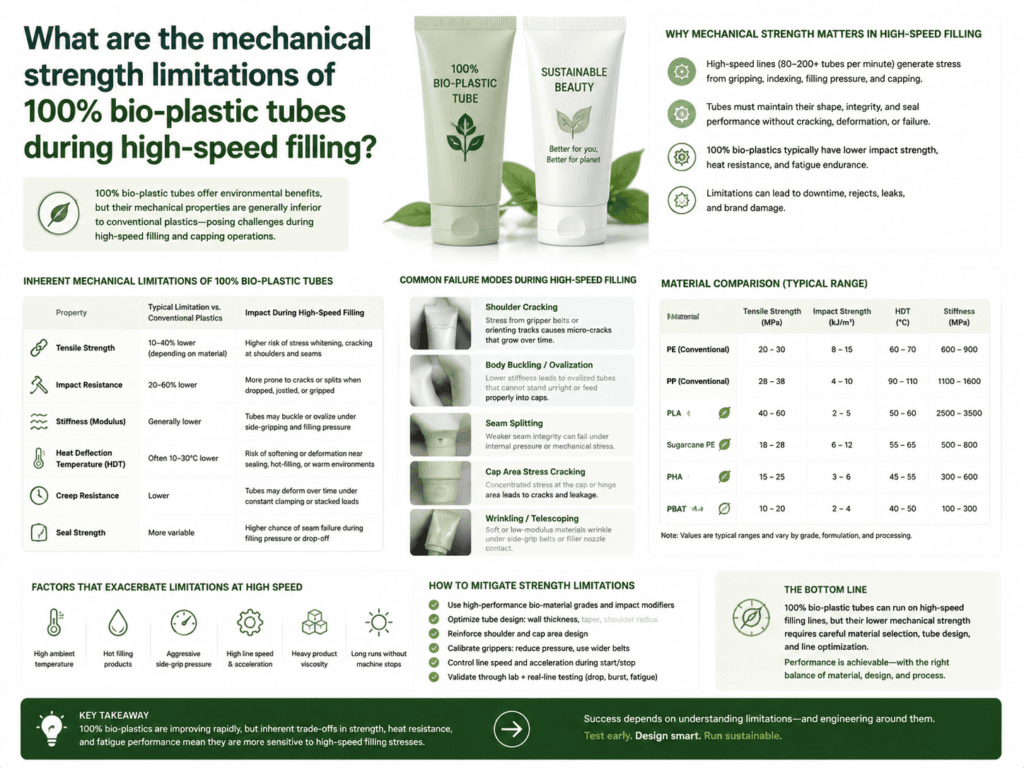
100% bio-plastic cosmetic tubes can face mechanical strength limitations during high-speed filling, especially when compared with conventional PE or multi-layer laminated tubes. These limitations are mainly related to material stiffness, heat resistance, and dimensional stability under rapid mechanical stress.
High-speed filling lines typically operate under strong compression, rapid tube handling, and high-pressure product dispensing, which can expose weaknesses in pure bio-based polymers.
Key Mechanical Strength Limitations
| Limitation | Impact During High-Speed Filling |
|---|---|
| Lower stiffness | Tube body may deform under fast clamping or squeezing pressure |
| Heat sensitivity | Softening can occur during hot filling or friction heat on filling lines |
| Reduced compression resistance | Higher risk of oval deformation or collapse during transport on conveyor systems |
| Seal weakness risk | Shoulder and crimping area may be less stable under high-speed sealing pressure |
Why 100% Bio-Plastic Tubes Are More Challenging
- Polymer chain structure: Bio-based resins (PLA, PHA blends, bio-PE variants) may have lower mechanical resilience than virgin PE.
- Processing window: Narrower temperature tolerance increases deformation risk during filling.
- Wall uniformity sensitivity: Small variations in extrusion can affect collapse resistance.
- Higher friction on filling lines: Can lead to instability at high speeds.
Performance Comparison in High-Speed Filling
| Tube Type | High-Speed Filling Performance | Stability Level |
|---|---|---|
| Virgin PE tubes | Excellent structural stability | High |
| PCR PE tubes | Good (depends on blend ratio) | Medium–High |
| 100% bio-plastic tubes | More deformation risk under pressure | Medium–Low |
| Laminate / ABL tubes | Very stable, high barrier + strength | Very High |
How Manufacturers Improve Strength
- Material blending: Mixing bio-plastic with PE improves rigidity and filling stability
- Wall thickness optimization: Slightly increased thickness enhances compression resistance
- Structural reinforcement: Strengthened shoulder and sealing zones reduce failure risk
- Cooling control: Improved extrusion cooling stabilizes tube geometry
- Filling line adjustment: Lower clamp pressure or optimized speed settings
Best Use Scenarios for 100% Bio-Plastic Tubes
- Low to medium-speed filling lines
- Smaller tube sizes (travel-size or sample packaging)
- Light viscosity products (gel, lotion, mild cream)
- Eco-focused brands prioritizing sustainability over industrial speed
Summary
100% bio-plastic cosmetic tubes may have mechanical strength limitations during high-speed filling due to lower stiffness, narrower thermal stability, and reduced compression resistance compared to traditional PE or laminated tubes.
However, with proper material engineering, wall optimization, and filling line adjustments, these limitations can be significantly reduced, making bio-plastic tubes suitable for many commercial applications.
Learn more: Bioplastic Tubes, Sustainable Packaging, Multi-layer Tubes.
Need High-Performance Sustainable Tubes?
Xinfly Packaging helps brands balance sustainability and production efficiency with engineered bio-based, PCR, and hybrid cosmetic tube solutions.