Quick Answer
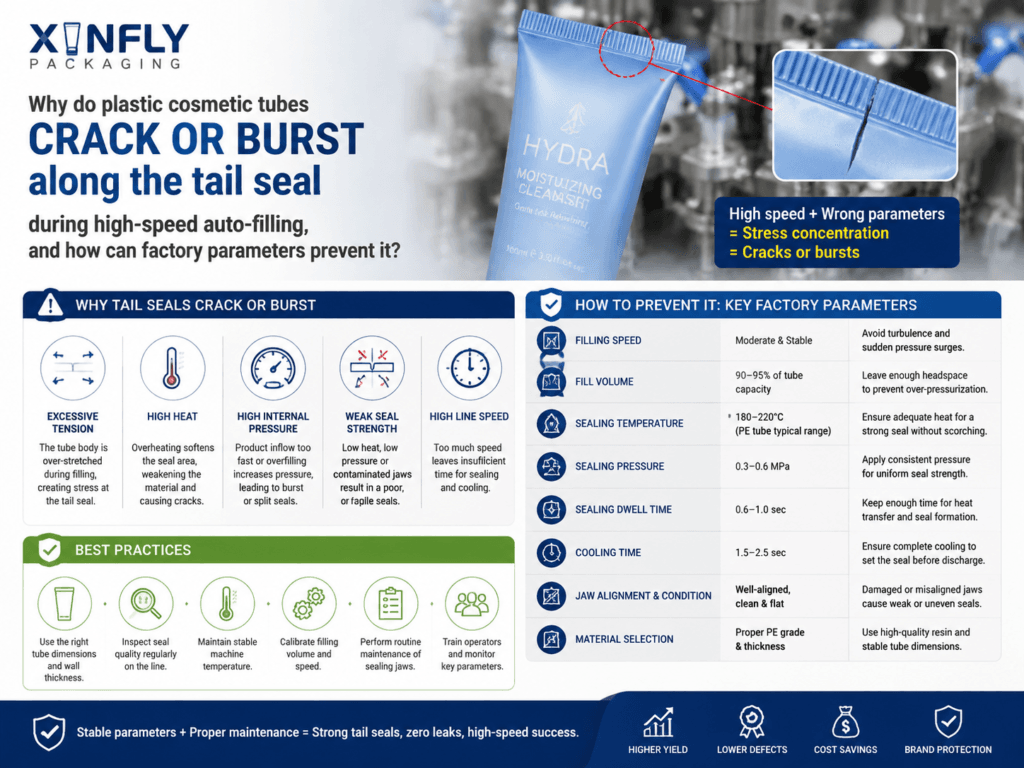
Plastic cosmetic tubes may crack or burst along the tail seal during high-speed auto-filling when sealing stress exceeds the tube material strength. The most common causes include excessive sealing temperature, incorrect sealing pressure, insufficient cooling time, formula contamination, improper headspace and unsuitable machine parameters.
Preventing tail seal failure requires optimizing the complete filling process, including tube structure, filling speed, sealing temperature, pressure, time and quality testing.
In modern cosmetic production, automatic filling lines can process thousands of tubes per hour. While high-speed automation improves efficiency, incorrect machine parameters can create mechanical stress at the weakest point of the package: the tail seal area.
When the sealed tail cannot withstand internal pressure, transportation stress or formula expansion, cracks may appear along the seal line or the tube may burst during production or storage.
Why Do Cosmetic Tubes Crack Along the Tail Seal?
The tail seal is a heat-bonded area where the inner layers of the tube are melted and joined together. This area must balance sealing strength, flexibility and appearance.
Cracking usually occurs when the sealing process creates excessive stress or when the sealed area becomes weaker than the tube body.
| Root Cause | How It Creates Cracks | Typical Symptom |
|---|---|---|
| Excessive Sealing Temperature | Overheating damages polymer structure and makes the seal brittle. | Burn marks, brittle tail, cracking after cooling. |
| High Sealing Pressure | Excessive compression creates stress concentration. | Split line along the tail seal. |
| Incorrect Cooling | Hot seals are exposed to stress before stabilizing. | Seal opens or cracks during handling. |
| Formula Contamination | Oil or cream prevents proper bonding. | Weak seal followed by leakage. |
| Insufficient Headspace | Product expansion creates internal pressure. | Tube deformation or bursting. |
Crack vs Burst: What Is the Difference?
Tail Seal Crack
A partial opening or fracture along the sealed area caused by weak bonding or excessive stress.
Tail Seal Burst
A sudden failure where internal pressure forces the sealed area to separate rapidly.
Micro Leakage
Small invisible defects that may cause leakage during storage or transportation.
What Factors Increase Tail Seal Failure During High-Speed Filling?
| Factor | Impact During Production |
|---|---|
| Higher Filling Speed | Reduces available time for stable positioning and sealing. |
| Thinner Tube Wall | Less material strength around the seal area. |
| High Viscosity Formula | Greater pressure during filling and sealing. |
| Hot Filling Temperature | Can soften the tube and increase deformation risk. |
| Incorrect Tube Size | Creates mismatch with filling machine parameters. |
How Does Tube Material Affect Tail Seal Strength?
Material Structure Considerations
- Mono-layer PE: Requires balanced sealing temperature to maintain flexibility.
- Multi-layer PE: Needs correct bonding conditions between layers.
- EVOH Barrier Tube: Requires controlled heat to protect barrier performance.
- ABL/PBL Tube: Needs sealing parameters suitable for laminate structure.
Common Warning Signs Before Tail Seal Failure
- Seal area becomes unusually hard or brittle.
- Dark color or burn marks appear after sealing.
- Small cracks appear during manual squeeze testing.
- Leakage occurs after transportation simulation.
- Seal strength varies between production batches.
How Can Factory Parameters Prevent Tail Seal Cracking During High-Speed Filling?
Preventing tail seal cracks requires controlling the interaction between the tube material, filling machine settings and production speed.
The goal is to create a seal that is strong enough to prevent leakage but flexible enough to withstand squeezing, transportation and temperature changes.
| Factory Parameter | Effect on Tail Seal | Risk If Incorrect |
|---|---|---|
| Sealing Temperature | Controls melting and bonding of inner tube layers. |
Too high: brittle seal and burning. Too low: weak bonding. |
| Sealing Pressure | Creates contact between melted surfaces. |
Too high: stress concentration and cracking. Too low: incomplete seal. |
| Sealing Time | Determines heat transfer duration. |
Too long: overheating. Too short: insufficient bonding. |
| Cooling Time | Allows seal area to stabilize before handling. | Hot seal may deform or split. |
| Filling Speed | Controls mechanical stress during production. | Excessive speed increases failure risk. |
How Does Sealing Temperature Cause Tube Bursting Problems?
Sealing temperature is one of the most critical parameters in automatic tube filling production.
If the temperature is too high, the polymer structure at the tail area can become over-melted and lose mechanical strength. After cooling, the seal may become brittle and crack when squeezed.
Temperature Too High
Burn marks, deformation, brittle sealing area and reduced flexibility.
Temperature Too Low
Incomplete bonding, weak seal strength and leakage risk.
Correct Balance
Strong bonding with sufficient flexibility after cooling.
How Does Sealing Pressure Affect Tail Seal Strength?
Sealing pressure must provide enough force to join the tube layers without damaging the sealed area.
Typical Pressure Problems
- Excessive pressure: Compresses the melted plastic excessively and creates weak stress points.
- Insufficient pressure: Leaves incomplete bonding between sealing surfaces.
- Uneven pressure: Creates inconsistent seal strength across production batches.
Why Is Headspace Important for Preventing Tube Burst?
Headspace is the empty space between the filled product surface and the tube sealing area.
Incorrect headspace design can create excessive internal pressure during sealing, transportation or temperature changes.
| Headspace Problem | Possible Result |
|---|---|
| Insufficient Headspace | Product may be pushed into the sealing area and weaken bonding. |
| Formula Expansion During Heat | Internal pressure increases and stresses the tail seal. |
| High Viscosity Product | Air pockets and pressure variation may occur during filling. |
| Incorrect Filling Volume | Creates inconsistent seal performance. |
How Does Formula Viscosity Influence Tail Seal Failure?
Cosmetic formulas with different viscosities create different filling pressures and sealing challenges.
Low Viscosity Products
Lotions and liquid formulas may flow into the sealing area if filling control is insufficient.
Medium Viscosity Creams
Most skincare products require balanced filling speed and headspace.
High Viscosity Gels
Require optimized nozzle design and filling pressure control.
What Should a Factory Check When Tubes Burst During Auto-Filling?
High-Speed Filling Troubleshooting Sequence
- Step 1: Check whether failures occur immediately after sealing or later during storage.
- Step 2: Inspect the crack location to identify whether the problem is sealing-related.
- Step 3: Review sealing temperature, pressure and time records.
- Step 4: Confirm tube material structure and production batch.
- Step 5: Check filling volume and headspace.
- Step 6: Inspect formula contamination at the sealing area.
- Step 7: Perform squeeze and leakage tests.
How Do Different Tube Structures Respond to High-Speed Filling?
| Tube Structure | High-Speed Filling Consideration |
|---|---|
| LDPE / LLDPE Tube | Excellent flexibility but requires correct sealing balance. |
| HDPE Tube | Higher rigidity requires careful stress control. |
| EVOH Multi-layer Tube | Requires controlled sealing conditions to protect barrier layers. |
| ABL Tube | Metal barrier layer affects heat transfer behavior. |
| PBL Tube | Needs proper temperature control for laminate bonding. |
Factory Engineer Recommendation
Optimize Parameters Before Increasing Production Speed
When moving from manual filling or low-speed production to high-speed automatic filling, factories should not simply increase machine speed. The sealing process must be revalidated.
- Conduct pilot production tests.
- Confirm sealing parameters with actual formula.
- Test finished tubes after cooling.
- Perform transportation simulation.
- Record approved parameters for future batches.
How Can Factories Prevent Cosmetic Tube Tail Seal Bursting?
Preventing tube burst failures requires controlling the complete production process from tube selection to final quality inspection.
Validate Tube Structure
Select suitable PE, EVOH, ABL or PBL structures according to formula requirements and filling conditions.
Optimize Machine Parameters
Adjust temperature, pressure, sealing time and cooling conditions before mass production.
Control Filling Volume
Maintain correct fill level and headspace to reduce internal pressure.
Prevent Contamination
Keep the sealing area clean and prevent cream or oil residue.
Perform Trial Runs
Verify sealing performance using actual formulas and production equipment.
Monitor Production Data
Record approved parameters and track quality performance.
How Should Tube Manufacturers and Filling Factories Work Together?
Many tail seal failures happen because the tube supplier and filling factory evaluate packaging separately instead of as one complete system.
| Information Exchange | Purpose |
|---|---|
| Tube Material Structure | Allows the filling factory to select correct sealing parameters. |
| Formula Characteristics | Helps determine filling pressure, nozzle design and contamination risk. |
| Filling Machine Model | Ensures compatibility with sealing equipment. |
| Production Speed | Allows optimization for high-speed manufacturing. |
| Quality Requirements | Defines leakage, seal strength and appearance standards. |
What Quality Tests Verify Tail Seal Reliability?
| Test Method | Purpose |
|---|---|
| Seal Strength Test | Measures whether the tail seal can withstand mechanical stress. |
| Leakage Test | Confirms the tube remains sealed during storage and transportation. |
| Squeeze Test | Checks whether normal consumer pressure causes seal failure. |
| Drop Test | Evaluates resistance to handling and logistics impact. |
| Aging Test | Checks long-term compatibility between formula and packaging. |
| Transportation Simulation | Evaluates performance under vibration, pressure and temperature changes. |
What Are the Most Common Mistakes During High-Speed Tube Filling?
- Increasing production speed without revalidating sealing parameters.
- Using the same sealing settings for different tube materials.
- Ignoring formula viscosity changes.
- Reducing tube wall thickness without testing strength.
- Skipping pilot production trials.
- Adjusting temperature without checking pressure and time.
- Failing to monitor seal quality during mass production.
Factory Engineer Recommendation
Recommended Production Validation Process
- Confirm tube specification and material structure.
- Test filling compatibility with the actual formula.
- Optimize sealing temperature, pressure and time.
- Check finished tubes after cooling.
- Perform leakage and mechanical testing.
- Approve production parameters before full-scale manufacturing.
High-speed filling efficiency should always be balanced with packaging reliability. A small adjustment in machine parameters can prevent thousands of defective tubes during commercial production.
Summary
Plastic cosmetic tubes may crack or burst along the tail seal during high-speed auto-filling when the sealing area cannot withstand production stress.
The main causes include incorrect sealing temperature, excessive pressure, insufficient cooling, formula contamination, improper headspace and unsuitable filling parameters.
Preventing failure requires cooperation between the tube manufacturer and filling factory, including material selection, machine parameter optimization, pilot testing and quality verification.
A reliable cosmetic tube supplier should provide not only packaging products but also technical support to ensure successful filling, sealing and transportation performance.
Related Questions
| Topic | Related Resource |
|---|---|
| Tail Sealing Troubleshooting | How to Troubleshoot Tail-Sealing Issues in Cosmetic Tube Filling? |
| Tube Leakage Problems | 10 Reasons Cosmetic Tubes Leak During Filling and Shipping |
| Tube Material Selection | Single Layer PE vs Multi-layer Cosmetic Tubes |
| Barrier Tube Selection | EVOH vs ABL Tubes: Barrier Packaging Comparison |
| Quality Control | Cosmetic Tube QC Standards AQL 2.5/4.0 |
| Sample Approval | PPS vs Digital Layout Proof |
Packaging Engineer Recommendation
Before launching large-scale production, brands should complete a filling compatibility test using:
- The final cosmetic formula.
- The selected tube structure.
- The actual filling machine.
- The approved sealing parameters.
- The expected transportation conditions.
This approach reduces production failures and ensures packaging performance from factory filling to consumer use.
Need Technical Support For Cosmetic Tube Filling Problems?
Xinfly Packaging provides OEM cosmetic tubes with engineering support for material selection, filling compatibility, sealing performance and mass production quality control.
Contact Packaging Engineer